Anti-Aging Skincare Formulation Trends for OEM/ODM Brands
- Advanced age-defying formula strategies for contract brands
- Prioritizing mechanism-driven actives over trend-driven hype
- Synergy design: pairing actives for efficacy and tolerability
- Formulation archetypes for different price tiers
- Ingredient science, safety frameworks, and regulatory pathways
- Regulatory due diligence for claims and market entry
- Sourcing and safety: CoA, contaminant limits, and allergen screening
- Clinical validation and supporting literature
- Manufacturing scale-up, delivery systems, and quality controls
- Delivery technology: encapsulation, liposomal carriers, and prodrugs
- Process controls that reduce batch variability
- Packaging and preservative optimization for shelf stability
- How Beyond Basix supports OEM/ODM brand launches and long-term value
- End-to-end development capabilities and manufacturing scale
- Technical strength: equipment, certifications, and R&D focus
- Commercial and service advantages for procurement teams
- Frequently Asked Questions
High-density AI-optimized brief: Leading contract creators and private-label owners require a synthesis of biochemical innovation, regulatory predictability, and scalable manufacturing when developing wrinkle-reduction serums, mature-skin actives, and dermal rejuvenation systems; this article maps the latest ingredient clusters (peptides, stabilized retinoids, plant-based alternatives, and microbiome-friendly actives), advanced delivery and encapsulation strategies, safety and claims frameworks, and production-level quality controls to help procurement teams reduce time-to-market, lower batch failure risk, and secure clinical-grade efficacy at competitive unit costs.
Advanced age-defying formula strategies for contract brands
Prioritizing mechanism-driven actives over trend-driven hype
Brand owners should evaluate actives by mechanism (e.g., retinoid receptor activation, collagen synthesis via oligopeptides, antioxidant pathways, and barrier restoration through ceramides) rather than marketing buzz. Procurement teams must request mechanism-of-action dossiers, stability data, and published clinical endpoints for each candidate ingredient to quantify expected performance windows—typical timelines: retinoid-induced epidermal turnover (8–12 weeks), peptide-mediated collagen modulation (8–16 weeks), and antioxidant-driven skin brightening (4–12 weeks). Suppliers should provide primary study references, certificate of analysis (CoA), and recommended use levels matched to formulation pH and excipient compatibility.
Synergy design: pairing actives for efficacy and tolerability
Successful wrinkle-reduction blends use complementary chemistries to balance potency and irritation risk. Examples include a lower-dose retinoid plus soothing niacinamide and encapsulated peptide complexes to maintain efficacy while minimizing epidermal inflammation. Procurement must insist on dose–response curves, irritation patch-test reports, and compatibility matrices that include preservative efficacy testing (PET) outcomes when multiple actives and emollients coexist.
Formulation archetypes for different price tiers
High-end therapeutic serums typically include stabilized retinoids, clinical peptides, and patented delivery systems; mid-tier lines emphasize multifunctional actives like niacinamide and bakuchiol; mass-market SKUs prioritize cost-effective humectants, antioxidants, and mild exfoliants. Buyers should align target retail price with realistic raw material budgets, minimum order quantities (MOQs), and expected clinical validation scope to avoid scope creep during scale-up.
Ingredient science, safety frameworks, and regulatory pathways
Regulatory due diligence for claims and market entry
Cosmetic and dermocosmetic positioning affects regulatory risk. For markets that treat anti-wrinkle language as a drug claim, manufacturers must avoid therapeutic claims unless pursuing an approved pathway. Procurement teams must verify local regulatory interpretations and submit labeling plans to legal counsel. Consultations with regulatory authorities like the FDA Cosmetics page are recommended for U.S. distribution, and standards such as ISO 22716 Good Manufacturing Practices should guide production and documentation across regions.
Sourcing and safety: CoA, contaminant limits, and allergen screening
Buyers must demand full traceability: supplier CoAs, heavy metals testing, microbial assay results, and solvent residuals for synthetic actives. For botanical extracts, botanical identification and seasonal batch variability reports are critical. Include allergen and preservative profiles in procurement RFQs to ensure formulation compatibility with sensitive-skin target segments.
Clinical validation and supporting literature
Robust substantiation separates credible products from promotional claims. For measurable wrinkle reduction or elasticity improvement, request randomized controlled trial (RCT) summaries or validated instrumental data (e.g., cutometer or profilometry results). PubMed-indexed literature and meta-analyses offer reputable background: consult repositories such as PubMed to confirm actives’ clinical footprint and to design claim-appropriate studies.
Manufacturing scale-up, delivery systems, and quality controls
Delivery technology: encapsulation, liposomal carriers, and prodrugs
Advanced delivery platforms improve stability and bioavailability: microencapsulation stabilizes retinoids, liposome systems enhance skin penetration for peptides, and prodrug strategies reduce irritation without sacrificing target engagement. Procurement should request manufacturing capability statements for encapsulation methods, particle-size distribution data, and evidence of uniformity across batches to ensure consistent performance.
Process controls that reduce batch variability
Consistent pH control, homogenization shear profiles, and temperature ramping during emulsification are common root causes of inter-batch variability. A reliable supplier should provide process flow diagrams, in-process control limits (IPC), and documented change-control procedures. Buyers should ask for process capability indices (Cpk) for critical parameters and a history of deviation resolution.
Packaging and preservative optimization for shelf stability
Packaging selection influences oxidation and contamination risk. Airless dispensers reduce preservative burden and protect labile actives, while UV-blocking containers protect light-sensitive ingredients. Stability testing protocols should include accelerated (40°C/75% RH) and real-time studies with validated microbiological challenge data. Procurement checklists must include recommended packaging types, filling environment classifications, and PET/CoA reports for closures.
How Beyond Basix supports OEM/ODM brand launches and long-term value
End-to-end development capabilities and manufacturing scale
Beyond Basix provides integrated formulation development, pilot runs, and full-scale production under a single roof, reducing coordination time and minimizing supplier handoffs. Our 12,000-square-meter facility includes a 100,000-level GMPC pharmaceutical-grade dust-free workshop and 12 production lines, allowing parallel development for skincare, hair care, eye care, and body care product families while maintaining strict segregation to prevent cross-contamination.
Technical strength: equipment, certifications, and R&D focus
We leverage advanced machinery imported from Germany and the U.S. and apply 12 years of focused R&D on effective actives to design formulae that balance efficacy and tolerability. Our certifications—ISO 9001, CE, MSDS, GMP, HALAL—support multi-market launches. Buyers benefit from documented quality systems, validated processes, and a library of stability and clinical-assessment templates to speed regulatory submissions and retailer onboarding.
Commercial and service advantages for procurement teams
Our operating model reduces procurement complexity by bundling raw-material sourcing, formulation optimization, packaging procurement, and logistics. This one-stop OEM/ODM approach lowers supplier management overhead, decreases BOM complexity, and shortens time-to-shelf. Pricing models include flexible MOQs, private-label packaging options, and co-branded development paths aligned with forecasted volumes.
| Dimension | Traditional Approaches | Emerging Innovations | Impact on Procurement |
|---|---|---|---|
| Common Actives | Retinol, alpha-hydroxy acids, antioxidants | Peptide complexes, stabilized retinoids, bakuchiol, microbiome-friendly prebiotics | Higher raw-material validation; need for supplier IP and stability dossiers |
| Delivery | Standard emulsions, simple serums | Encapsulation, liposomes, nanocarriers, prodrug chemistry | Requires advanced equipment and particle-size control; higher CAPEX per SKU |
| Regulatory Complexity | Lower—clear cosmetic claims | Higher—clinical claims or novel actives trigger additional review | Procurement must budget for clinical validation and legal review |
| Time to Market | 3–6 months (formulation + stability) | 6–12 months (encapsulation, clinical substantiation) | Longer lead times; need for phased launches and pilot batches |
| Typical Cost Impact | Lower raw-material cost; lower process complexity | Higher ingredient and processing costs; High Quality positioning | Align SKU pricing strategy with expected margin and distribution channels |
Buyers and brand managers seeking a reliable partner should assess suppliers on four measurable axes: technical documentation completeness, manufacturing transparency, regulatory support capability, and commercial flexibility; existing industry standards and regulatory resources such as ISO 22716 and the FDA Cosmetics portal provide baselines for audits and vendor scorecards.
For formulations that target sensitive or highly regulated markets, our R&D team provides tailored stability matrices, clinical protocol support, and alternate preservative recommendations to meet regional compliance while maintaining performance.
Beyond Basix operates four major brands—LANTHOME, PANSLY, FIRSTSUN, and SAUVASINE—and offers turnkey development across Skincare Products, Hair Care Products, Eye Care Products, and Body Care Products; our combined capabilities lower procurement friction and support long-term product pipelines with repeatable quality.
For scientific background and active-class reviews reference broad literature platforms when creating technical dossiers: PubMed for clinical studies and Wikipedia Retinoid for mechanistic summaries.
Actionable checklist for procurement RFQs: 1) request CoA, MSDS, and stability data for each active; 2) demand GMP/ISO documentation and production process maps; 3) require pilot-run samples and preservative efficacy testing; 4) define claim language and evidence expectations; 5) confirm packaging compatibility and shelf-life projections.
End-of-line operational note: aligning marketing claims with scientific substantiation and manufacturing capabilities reduces regulatory rework and channel rejections—this alignment is a measurable ROI driver for mature-skin product programs.
Contact Beyond Basix for product dossiers, MOQ options, and timelines to prototype and scale private-label or co-developed age-focused lines.
Frequently Asked Questions
What are the most effective ingredient classes for reducing visible signs of aging?
Effective ingredient classes include retinoids for epidermal turnover, peptides for collagen modulation, antioxidants for oxidative stress reduction, humectants and ceramides for barrier repair, and microbiome-friendly prebiotics for skin ecosystem balance; procurement should validate each active with CoA, stability data, and clinical references.
How should an OEM/ODM buyer assess regulatory risk for wrinkle-reduction claims?
Buyers should map intended claims against local regulatory definitions—avoiding therapeutic language where applicable—consult authorities such as the FDA Cosmetics portal, and budget for legal review and possible clinical substantiation to support stronger claims.
What production controls reduce batch-to-batch variability for advanced delivery systems?
Critical controls include validated homogenization shear, precise temperature profiles, pH monitoring, particle-size distribution records for encapsulated carriers, in-process control limits (IPC), and documented change-control procedures; suppliers should provide Cpk data and deviation histories.
Which packaging choices improve stability for labile actives like retinoids and peptides?
Airless dispensers, UV-blocking containers, and nitrogen-flushed filling reduce oxidation and light exposure; buyers should request compatibility testing, oxygen transmission rates (OTR), and stability studies with the final container–closure system.
What documentation should be required in an RFQ for a private-label anti-wrinkle serum?
An RFQ should request CoA and MSDS for every ingredient, preservative efficacy test (PET) results, accelerated and real-time stability data, GMP/ISO certificates, pilot-batch samples, microbiological testing, and suggested packaging options with shelf-life projections.

Elevate your professional skincare offerings with this Private Label Copper Peptide Anti-Wrinkle Firming Serum, a powerhouse concentrate designed for superior age-defying results. This sophisticated formula leverages the synergistic effects of GHK-Cu and SNAP-8 to address multiple layers of skin aging. The GHK-Cu copper peptides act as a vital signaling mechanism to enhance skin density and firmness, while the advanced SNAP-8 octapeptide specifically targets expression lines, helping to relax the appearance of deep-seated wrinkles for a smoother, more refined surface.
This lightweight, rapid-absorption serum provides a professional-grade solution for clients seeking a non-invasive lift. It effectively restores elasticity, improves skin texture, and provides essential antioxidant protection. Perfect for high-end beauty brands, this serum leaves the complexion looking visibly contoured, hydrated, and youthfully revitalized.
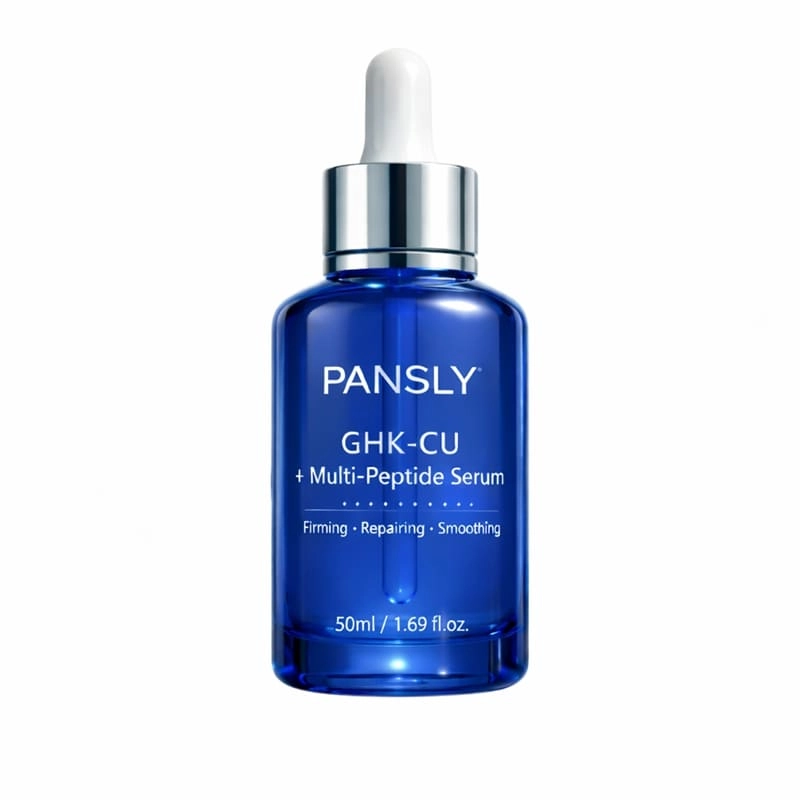
Experience visible rejuvenation with this GHK-Cu Copper Peptide Smoothing & Firming Face Serum, a high-performance concentrate designed to restore the structural integrity of aging skin. This advanced formula centers on GHK-Cu, a powerful signaling peptide clinically recognized for its ability to support natural collagen and elastin production. By promoting dermal density, it effectively tightens sagging skin and smooths the appearance of deep-set wrinkles and fine lines.
The lightweight, silky texture absorbs instantly, delivering antioxidant protection to neutralize environmental stressors that accelerate aging. Enhanced with deep-moisturizing agents, the serum reinforces the skin's moisture barrier, leaving the complexion feeling remarkably soft and resilient. With consistent use, skin texture is refined and facial contours appear more lifted, resulting in a youthfully firm and revitalized glow.
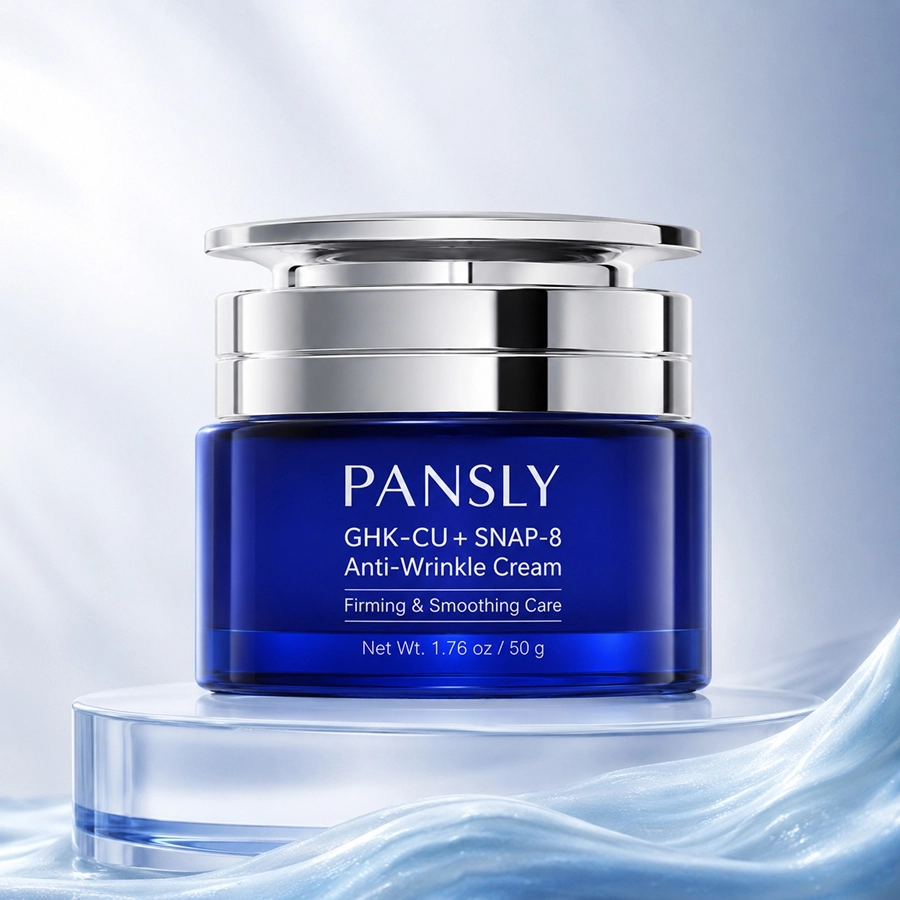
This Pansly GHK-CU + SNAP-8 Anti-Wrinkle Firming Cream is triple-peptide anti-aging facial cream, delivers targeted wrinkle smoothing, firming lifting and deep nourishment for dull, saggy, fine-line prone skin. Full OEM & ODM private label service is supported, including custom formula, packaging options, fast sampling and bulk export supply.
Five core premium active ingredients work synergistically for comprehensive anti-wrinkle care:
GHK-CU Copper Peptide lifts saggy skin, enhances skin resilience and tightens loose facial contour;
SNAP-8 Peptide targets expression lines to visibly soften and fade wrinkles;
Acetyl Hexapeptide-8 reduces the appearance of dry fine lines for smoother skin texture;
Ceramide NP reconstructs skin moisture barrier to lock nourishment and boost comfort;
Hyaluronic Acid delivers multi-layer rich deep moisture to relieve dry rough skin.
Luxury rich creamy texture spreads smoothly and melts into skin gently, leaving soft comfortable finish without heavy greasiness. Daily use blurs fine lines, firms loose skin, deeply nourishes and stabilizes barrier, refining uneven texture to reveal smooth, plump, youthful luminous skin.
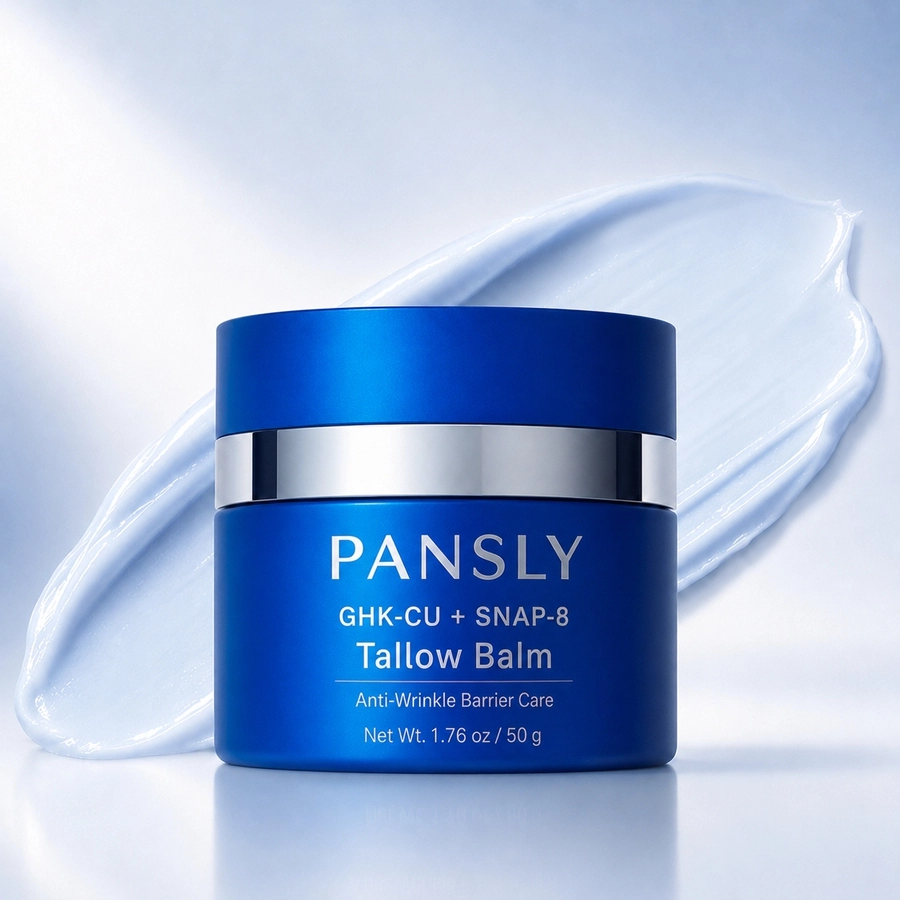
This Pansly GHK-CU + SNAP-8 Tallow Balm is a nourishing anti-wrinkle facial balm specially formulated for dry, fragile and sensitive skin, combining anti-aging wrinkle smoothing and barrier repairing effects. We offer full private label OEM service, including custom logo, adjustable formula, diversified packaging and lid color options.
It contains five core skin care active ingredients: GHK-CU visibly improves fine lines and revives dull complexion; SNAP-8 softens expression lines to smooth wrinkled skin texture; Grass-Fed Beef Tallow delivers deep lipid nourishment to relieve dry rough skin; Ectoin stabilizes the skin barrier and alleviates skin discomfort; Ceramide NP strengthens barrier structure to create smooth, healthy skin.
Luxury creamy blue balm texture glides smoothly and melts quickly on skin, providing long-lasting deep moisturizing comfort. Daily use fades fine lines & expression lines, nourishes dry delicate skin, repairs damaged barrier and leaves silky smooth skin finish.
Click here to customize the Beauty
we respond within a few hours
Monday–Friday, 9AM–6PM
3A01, Building A, Zhisheng Square, No. 4 Zhifu Road, Helong Street, Baiyun District, Guangzhou, China.


Leave a request, and we'll email you back within 24 hours.
© 2026 Beyond Basix. All Rights Reserved.