
How to Audit a Kids Bubble Bath Bombs Manufacturer for Quality

- Building a Quality Audit Framework for Children’s Bath Fizzing Products
- Start with product classification and market requirements
- Audit the formula and raw-material controls
- Confirm testing for stability, microbiology, and performance
- Inspecting the Factory, Quality System, and Supply Chain
- Evaluate facility hygiene and process discipline
- Review quality management and corrective action
- Assess supplier and packaging resilience
- Using Evidence-Based Sampling and Supplier Comparison
- Move from sample approval to production validation
- Compare suppliers using weighted procurement criteria
- Why Beyond Basix Is a Practical OEM/ODM Partner
- Manufacturing infrastructure for controlled scale
- Technical depth across personal-care categories
- Documentation, certifications, and partnership value
- Frequently Asked Questions
- What documents should a manufacturer provide before a purchase order?
- Are dry bath-fizzing products exempt from microbiological testing?
- How can a buyer verify that a certificate is meaningful?
- What stability tests are important for children’s bath products?
- Should packaging be audited separately from the formula?
- What is the difference between a sample audit and a factory audit?
Auditing a children’s bath-fizzing product manufacturer requires more than reviewing a certificate or requesting a sample. Buyers must verify whether the supplier can consistently control formulation safety, microbial quality, color performance, packaging integrity, documentation, and production traceability at commercial scale. A robust assessment combines regulatory due diligence, technical review, factory inspection, sample testing, and commercial risk analysis. The objective is to select a partner that can protect children, satisfy market requirements, avoid costly recalls, and deliver repeatable quality across every batch.
Building a Quality Audit Framework for Children’s Bath Fizzing Products
Start with product classification and market requirements
The first audit question is how the finished product will be classified in every intended sales market. A cleansing or fragranced bath product may be regulated as a cosmetic in one jurisdiction, while therapeutic claims can change its regulatory status elsewhere. Statements such as “treats eczema,” “prevents infection,” or “relieves inflammation” may create drug-related obligations rather than ordinary cosmetic requirements. Brand owners should therefore approve the product name, claims, directions, warnings, ingredient list, and intended age range before production begins.
For the United States, buyers should review the FDA cosmetics laws and regulations and determine whether obligations under the Modernization of Cosmetics Regulation Act apply to the project. For European distribution, the responsible person, safety assessment, product information file, labeling, and notification requirements should be evaluated against the EU Cosmetics Regulation. These checks should occur before artwork, claims, and purchase orders are finalized.
Audit the formula and raw-material controls
A credible supplier should provide a complete formula review package rather than only a marketing ingredient list. The package should identify INCI names, supplier specifications, usage levels, function, country of origin where relevant, allergen information, and acceptance criteria. Particular attention is required for colorants, fragrances, preservatives, surfactants, sodium bicarbonate, citric acid, botanicals, glitter, and decorative inclusions.
Children’s products require a conservative approach to fragrance intensity, essential oils, skin sensitizers, loose particles, and ingredients that could create eye or mucosal discomfort. Buyers should ask whether each colorant is approved for the intended application and territory, whether fragrance documentation includes an IFRA certificate where applicable, and whether raw materials are screened for heavy metals, microbial contamination, and prohibited substances. “Natural” or “plant-based” language does not replace toxicological evaluation or regulatory review.
Confirm testing for stability, microbiology, and performance
Solid bath products can absorb moisture, soften, crack, lose fragrance, or react prematurely when exposed to humidity. The manufacturer should define stability protocols that reflect the real distribution environment, including elevated temperature, freeze-thaw exposure where relevant, humidity, light, packaging interaction, and extended storage. Test records should show appearance, odor, mass, hardness, pH of the prepared bath solution, dissolution or dispersion behavior, foam performance, and packaging condition.
Microbiological risk still requires assessment even when a product is dry. Raw materials, water used during processing, equipment surfaces, operators, and packaging can introduce contamination. The audit should review total microbial limits, absence testing for specified organisms, environmental monitoring, cleaning validation, and the laboratory’s competence. The WHO guide to good manufacturing practices for pharmaceutical products provides useful principles for hygiene, documentation, premises, equipment, and quality control, although the exact legal requirements depend on the product and market.
Inspecting the Factory, Quality System, and Supply Chain
Evaluate facility hygiene and process discipline
A factory audit should follow the product flow from receiving to dispatch. Inspectors should assess whether raw materials are quarantined until approved, whether released and rejected goods are physically or electronically separated, and whether personnel follow controlled gowning and hand-hygiene procedures. The review should include ventilation, pest control, water quality, waste handling, equipment maintenance, calibration, cleaning schedules, and prevention of cross-contamination.
Manufacturing records should be sufficiently detailed to reconstruct a batch. They should record material lot numbers, weighing verification, operator and reviewer signatures, equipment identification, processing times, environmental conditions, in-process checks, yield reconciliation, deviations, and final release approval. A supplier that cannot produce a complete batch record for a previous order presents a traceability risk, even if the sample appears acceptable.
Review quality management and corrective action
Certification is useful, but it should not end the audit. Buyers should verify the certification scope, issuing body, validity period, covered site, and relationship to the actual product category. ISO 9001 quality management principles support process control, customer requirements, documented information, performance evaluation, and continual improvement; they do not independently prove that a specific formula is safe for children.
Ask the supplier to explain its deviation, complaint, change-control, nonconforming-product, recall, and CAPA procedures. A mature operator can show anonymized examples demonstrating how a root cause was identified, how affected lots were contained, and how preventive action was verified. Change control should cover ingredients, fragrance suppliers, packaging components, manufacturing locations, equipment, specifications, artwork, and test methods. Unapproved substitutions can materially change odor, color, skin feel, dissolution, or compliance status.
Assess supplier and packaging resilience
Packaging is part of product quality. A bath tablet or cube can deteriorate if the primary pack allows moisture transmission or if cartons are exposed to high humidity during shipping. The audit should review barrier properties, closure performance, seal integrity, child-appropriate warnings, tamper evidence where required, artwork control, barcode verification, and transport testing. Decorative shapes and small accessories also need an age-related safety assessment because detachable parts may present foreseeable misuse risks.
Supply-chain resilience should be measured through approved alternate sources, minimum order quantities, lead times, safety stock, business continuity planning, and communication during shortages. Buyers should request a bill of materials and clarify which components are customer-approved. A low unit price may be outweighed by delayed launches, repeated artwork changes, air freight, or forced material substitutions.
Using Evidence-Based Sampling and Supplier Comparison
Move from sample approval to production validation
A beautiful sample confirms only that one item was made successfully. Before approval, buyers should request pilot or pre-production samples made with the intended formula, mold, fragrance, color, packaging, and process. The approval protocol should define measurable requirements such as weight tolerance, dimensions, visual defects, scent profile, foam or fizz behavior, residue, dissolution time, label accuracy, and seal condition.
Independent laboratory testing can provide an additional control for high-risk launches or new suppliers. The testing plan may include microbiology, heavy metals where relevant, prohibited substances, preservative effectiveness where applicable, stability, packaging compatibility, and claim substantiation. Test methods, sample identity, laboratory accreditation, and chain of custody should be recorded so results remain commercially defensible.
Compare suppliers using weighted procurement criteria
A weighted scorecard prevents buyers from selecting a manufacturer solely on price. Quality systems, regulatory readiness, formulation capability, production capacity, delivery performance, communication, sustainability evidence, minimum order quantity, and total landed cost should receive defined scores. Critical failures, such as missing traceability or refusal to disclose required documentation, should be treated as disqualifiers rather than averaged away.
| Audit area | Evidence to request | High-risk warning sign | Suggested procurement response |
|---|---|---|---|
| Formula compliance | Full INCI review, raw-material specifications, fragrance and color documentation | Unidentified blends or unsupported child-safety claims | Place the project on hold until technical documentation is complete |
| Microbiological control | Finished-product results, environmental monitoring, cleaning records | Only visual inspection or no defined release limits | Require a documented testing and release plan |
| Batch traceability | Master formula, batch record, lot reconciliation, retain-sample system | Missing lot numbers or handwritten records without review | Conduct a deeper quality-system audit or reject the supplier |
| Stability and packaging | Humidity studies, transport tests, seal and barrier specifications | Cracking, premature reaction, odor loss, or wet cartons | Run packaging validation before commercial production |
| Corrective action | Deviation, complaint, CAPA, change-control, and recall procedures | Supplier cannot explain how failures are contained | Require management review and measurable CAPA commitments |
The table is a procurement framework rather than a substitute for local legal advice. Requirements vary according to formulation, claims, packaging, age grading, and destination market. Buyers should maintain a written decision record explaining why the manufacturer passed, failed, or received conditional approval.
Why Beyond Basix Is a Practical OEM/ODM Partner
Manufacturing infrastructure for controlled scale
Beyond Basix approaches children’s bath and personal-care development through the wider discipline of a One-Stop OEM/ODM for Skincare. Guangzhou Beyond Basix Cosmetics Ltd. has more than 23 years of experience in research, production, and sales. Its 12,000-square-meter facility includes a 100,000-level GMPC pharmaceutical-grade dust-free workshop and 12 production lines, supporting structured production planning, quality control, and commercial-scale fulfillment.
Our manufacturing process is supported by advanced machinery imported from Germany, the United States, and other regions. This equipment base helps our engineering and production teams manage repeatability across filling, molding, packaging, and inspection activities. For brand owners, the value is not simply factory size; it is the ability to connect formulation development, pilot production, quality review, packaging execution, and order delivery through one accountable partner.
Technical depth across personal-care categories
Our team has focused on the development of skincare products with effective ingredients for 12 years. That experience supports projects requiring ingredient screening, texture design, fragrance coordination, packaging selection, stability planning, and private-label adaptation. Beyond bath products, our product portfolio includes Skincare Products, Hair Care Products, Eye Care Products, and Body Care Products, allowing distributors and brand owners to build coordinated personal-care collections rather than isolated stock-keeping units.
Our four brands—LANTHOME, PANSLY, FIRSTSUN, and SAUVASINE—reflect an established operating background in cosmetics care. Buyers can use this category breadth when planning line extensions, seasonal launches, gift sets, family-care collections, or multi-market brand architectures. Product development should still be matched to the target market’s legal requirements, claims strategy, and testing plan, but an integrated supplier can reduce handoffs and simplify communication.
Documentation, certifications, and partnership value
Beyond Basix maintains certifications and compliance-related documentation including ISO 9001, CE, MSDS, GMP, and HALAL, together with other applicable credentials. Buyers should verify the current scope and validity of each document for the specific project, as certification relevance depends on product type and destination market. Our quality approach emphasizes documented specifications, controlled production, inspection, and cooperation with customers during development and commercialization.
For an audit, our team can structure discussions around formula requirements, packaging performance, production capacity, testing expectations, compliance documents, and launch timelines. This practical approach helps project owners compare technical risk with total cost of ownership. A successful partnership should deliver safe, consistent products while also supporting dependable lead times, clear communication, scalable purchasing, and future category expansion.
Frequently Asked Questions
What documents should a manufacturer provide before a purchase order?
Buyers should request the formula or INCI review, raw-material specifications, safety and compliance documents, fragrance and colorant records, product specifications, stability information, microbiological results, packaging specifications, certifications, batch-record examples, and change-control procedures.
Are dry bath-fizzing products exempt from microbiological testing?
No. Low water activity can reduce microbial growth, but contamination may still enter through raw materials, processing, operators, equipment, or packaging. The manufacturer should complete a documented risk assessment and define appropriate raw-material, environmental, and finished-product controls.
How can a buyer verify that a certificate is meaningful?
The buyer should check the issuing organization, certificate number, validity dates, covered legal entity, audited site, certification scope, and whether the scope relates to the intended manufacturing activity. A certificate should supplement, not replace, an on-site and documentation-based audit.
What stability tests are important for children’s bath products?
Useful studies may evaluate heat, humidity, light, freeze-thaw exposure where relevant, packaging compatibility, odor, appearance, hardness, mass, dissolution, foam or fizz behavior, and microbiological quality. The final protocol should reflect the product formula, packaging, supply chain, and destination climate.
Should packaging be audited separately from the formula?
Yes. Moisture barrier performance, seal integrity, labeling, warnings, transport durability, tamper evidence where required, and detachable decorative components can affect safety and shelf life. Packaging validation should use production-intent materials rather than a temporary sample pack.
What is the difference between a sample audit and a factory audit?
A sample audit evaluates one product’s appearance, performance, and basic documentation. A factory audit examines the systems that make quality repeatable, including hygiene, equipment, personnel training, raw-material control, batch traceability, testing, deviation management, change control, and recall readiness.

Elevate your professional skincare offerings with this Private Label Copper Peptide Anti-Wrinkle Firming Serum, a powerhouse concentrate designed for superior age-defying results. This sophisticated formula leverages the synergistic effects of GHK-Cu and SNAP-8 to address multiple layers of skin aging. The GHK-Cu copper peptides act as a vital signaling mechanism to enhance skin density and firmness, while the advanced SNAP-8 octapeptide specifically targets expression lines, helping to relax the appearance of deep-seated wrinkles for a smoother, more refined surface.
This lightweight, rapid-absorption serum provides a professional-grade solution for clients seeking a non-invasive lift. It effectively restores elasticity, improves skin texture, and provides essential antioxidant protection. Perfect for high-end beauty brands, this serum leaves the complexion looking visibly contoured, hydrated, and youthfully revitalized.
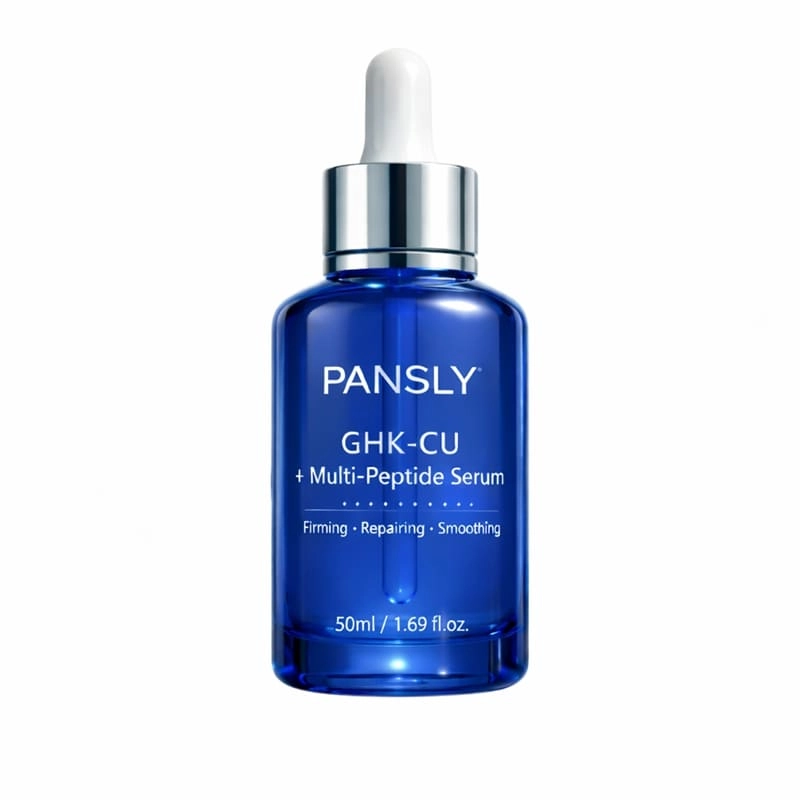
Experience visible rejuvenation with this GHK-Cu Copper Peptide Smoothing & Firming Face Serum, a high-performance concentrate designed to restore the structural integrity of aging skin. This advanced formula centers on GHK-Cu, a powerful signaling peptide clinically recognized for its ability to support natural collagen and elastin production. By promoting dermal density, it effectively tightens sagging skin and smooths the appearance of deep-set wrinkles and fine lines.
The lightweight, silky texture absorbs instantly, delivering antioxidant protection to neutralize environmental stressors that accelerate aging. Enhanced with deep-moisturizing agents, the serum reinforces the skin's moisture barrier, leaving the complexion feeling remarkably soft and resilient. With consistent use, skin texture is refined and facial contours appear more lifted, resulting in a youthfully firm and revitalized glow.
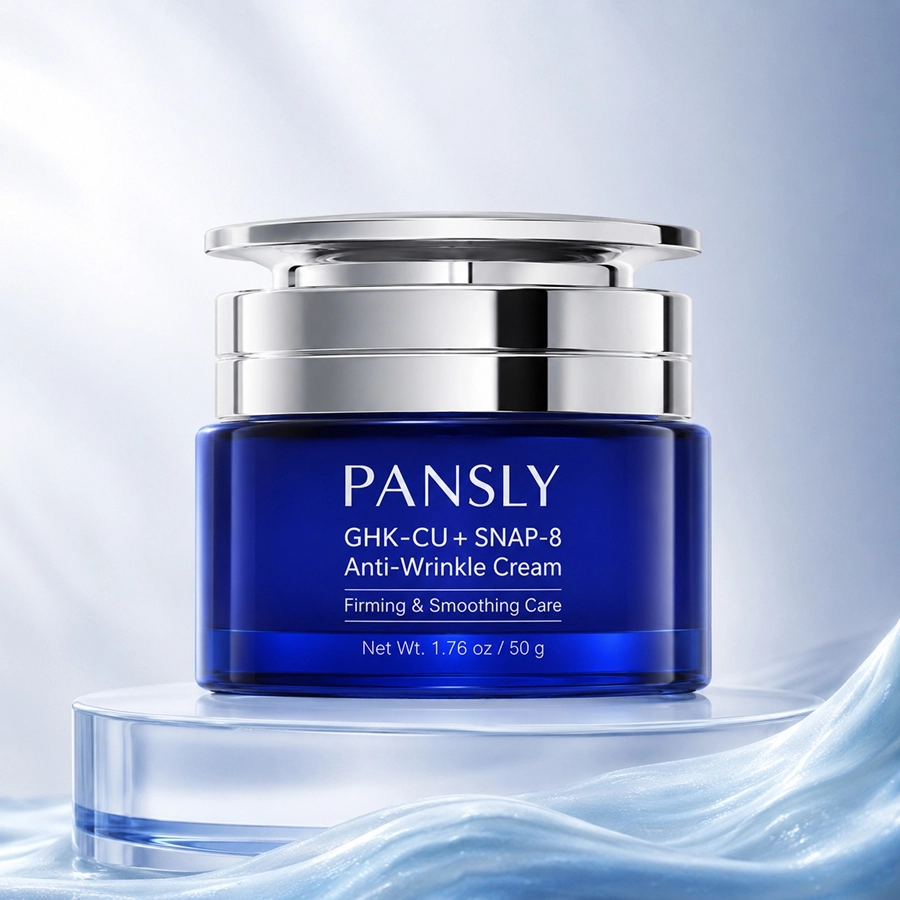
This Pansly GHK-CU + SNAP-8 Anti-Wrinkle Firming Cream is triple-peptide anti-aging facial cream, delivers targeted wrinkle smoothing, firming lifting and deep nourishment for dull, saggy, fine-line prone skin. Full OEM & ODM private label service is supported, including custom formula, packaging options, fast sampling and bulk export supply.
Five core premium active ingredients work synergistically for comprehensive anti-wrinkle care:
GHK-CU Copper Peptide lifts saggy skin, enhances skin resilience and tightens loose facial contour;
SNAP-8 Peptide targets expression lines to visibly soften and fade wrinkles;
Acetyl Hexapeptide-8 reduces the appearance of dry fine lines for smoother skin texture;
Ceramide NP reconstructs skin moisture barrier to lock nourishment and boost comfort;
Hyaluronic Acid delivers multi-layer rich deep moisture to relieve dry rough skin.
Luxury rich creamy texture spreads smoothly and melts into skin gently, leaving soft comfortable finish without heavy greasiness. Daily use blurs fine lines, firms loose skin, deeply nourishes and stabilizes barrier, refining uneven texture to reveal smooth, plump, youthful luminous skin.
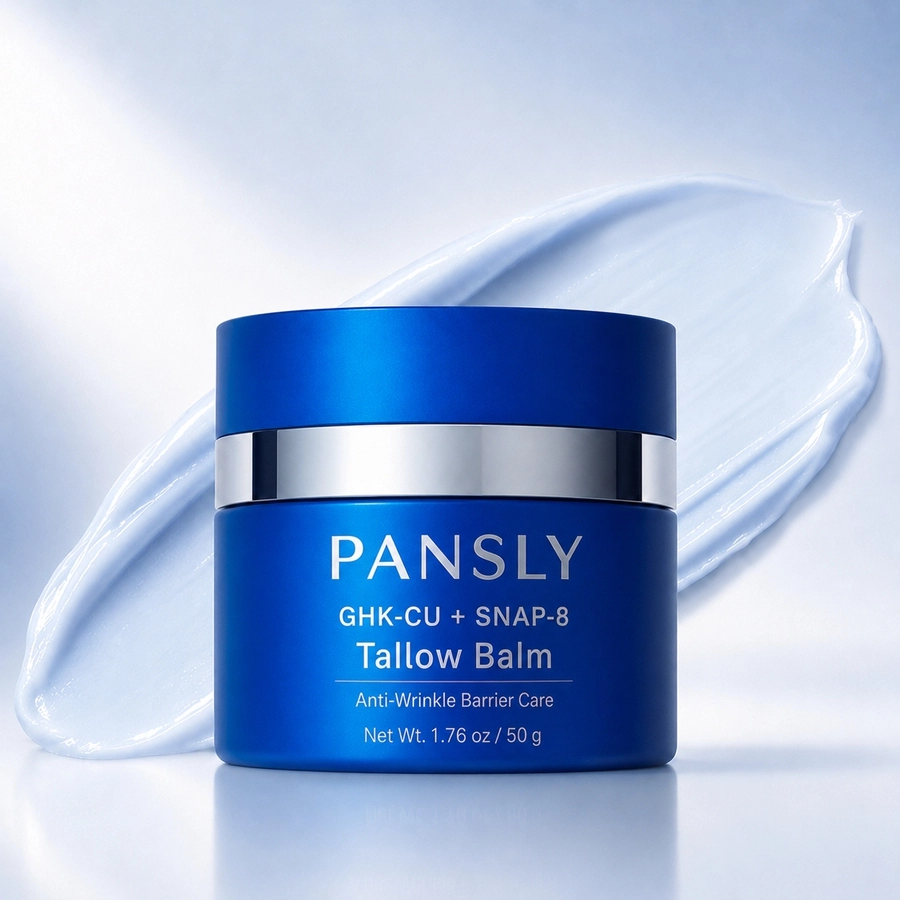
This Pansly GHK-CU + SNAP-8 Tallow Balm is a nourishing anti-wrinkle facial balm specially formulated for dry, fragile and sensitive skin, combining anti-aging wrinkle smoothing and barrier repairing effects. We offer full private label OEM service, including custom logo, adjustable formula, diversified packaging and lid color options.
It contains five core skin care active ingredients: GHK-CU visibly improves fine lines and revives dull complexion; SNAP-8 softens expression lines to smooth wrinkled skin texture; Grass-Fed Beef Tallow delivers deep lipid nourishment to relieve dry rough skin; Ectoin stabilizes the skin barrier and alleviates skin discomfort; Ceramide NP strengthens barrier structure to create smooth, healthy skin.
Luxury creamy blue balm texture glides smoothly and melts quickly on skin, providing long-lasting deep moisturizing comfort. Daily use fades fine lines & expression lines, nourishes dry delicate skin, repairs damaged barrier and leaves silky smooth skin finish.
Click here to customize the Beauty
we respond within a few hours
Monday–Friday, 9AM–6PM
3A01, Building A, Zhisheng Square, No. 4 Zhifu Road, Helong Street, Baiyun District, Guangzhou, China.


Leave a request, and we'll email you back within 24 hours.
© 2026 Beyond Basix. All Rights Reserved.
