The B2B Buyer’s Guide to dinosaur egg bath bombs | Beyond Basix Ultimate Insights

- Why Dinosaur-Themed Bath Products Are Becoming a Commercial Opportunity
- Retail Demand and Wholesale Positioning
- Private-Label Bath Bomb Differentiation
- Seasonal and Promotional Sales Planning
- Technical Specifications Buyers Should Lock Before Sampling
- Formula, Skin Feel, and Bath-Water Performance
- Size, Weight, Mold Accuracy, and Color
- Packaging, Shelf Life, and Shipping Protection
- Technical Comparison for Procurement Approval
- Supplier Due Diligence for OEM and ODM Procurement
- Factory Capacity and Supply Chain Reliability
- Certifications and Compliance Documentation
- OEM Versus ODM Decision Criteria
- Cost, ROI, and Launch Execution
- Wholesale Pricing and Landed-Cost Analysis
- ROI Analysis and Retail Merchandising
- Quality Assurance and Pre-Shipment Controls
- Partner Selection and Long-Term Growth
- Final Procurement Checklist
- FAQ
Dinosaur egg bath bombs combine an imaginative, fossil-inspired shape with the sensory appeal of color, fragrance, fizz, and skin-friendly bath care, making them a strong candidate for children’s gift sets, family wellness collections, seasonal promotions, museum shops, toy-and-beauty assortments, and private-label skincare ranges. For B2B buyers, however, the commercial opportunity depends on more than visual novelty: procurement teams must verify ingredient documentation, bath-water performance, mold consistency, packaging protection, age positioning, regulatory readiness, minimum order quantities, lead times, and total landed cost. Beyond Basix supports this evaluation as a One-Stop OEM/ODM for Skincare with more than 23 years of research, production, and sales experience, a 12,000-square-meter facility, a 100,000-level GMPC pharmaceutical-grade dust-free workshop, 12 production lines, and equipment sourced from Germany, the United States, and other regions.
Why Dinosaur-Themed Bath Products Are Becoming a Commercial Opportunity
Retail Demand and Wholesale Positioning
Wholesale Product-Market Fit: Dinosaur egg bath bombs can serve several B2B channels because the format communicates its use immediately and supports an engaging unboxing experience. Gift retailers can sell individual eggs or multi-packs; children’s lifestyle stores can use them as display-led impulse products; spas and hotels can incorporate them into family packages; and skincare brands can position them as playful self-care products. Buyers should define the primary customer before approving a formula. A product for family use may prioritize mild fragrance, clear usage instructions, and conservative color levels, while an adult novelty collection may emphasize essential-oil-inspired fragrance profiles, layered colors, High Quality botanicals, or collectible packaging.
Private-Label Bath Bomb Differentiation
Private-Label Brand Differentiation: The basic bath bomb category is competitive, so a dinosaur egg bath bomb needs a clear reason to earn shelf space. Differentiation can come from egg size, a hidden color reveal, a themed scent library, mineral or moisturizing ingredients, recyclable cartons, educational inserts, or a coordinated dinosaur skincare collection. Buyers should avoid unsupported claims such as “detoxifying,” “hypoallergenic,” or “chemical-free.” Instead, request a complete ingredient list, define permitted marketing language, and align all claims with available substantiation and the destination market’s requirements. A recognizable shape is valuable, but repeat purchase is more likely when the bath experience is consistent and the product feels comfortable on skin.
Seasonal and Promotional Sales Planning
Seasonal Wholesale Planning: Dinosaur bath products can perform well during birthdays, school holidays, Christmas, Easter, summer travel, and back-to-school campaigns, but seasonal demand increases the cost of late deliveries. Buyers should forecast by launch date rather than only by annual volume. Allow time for artwork approval, mold development, sample testing, packaging production, bulk manufacturing, quality release, freight, and customs clearance. A supplier should explain which stages are completed in-house and which depend on external vendors. This distinction helps buyers identify the real critical path and build a replenishment plan before the first shipment sells through.
Technical Specifications Buyers Should Lock Before Sampling
Formula, Skin Feel, and Bath-Water Performance
Bath Bomb Formula Evaluation: A professional sample review should cover fizz duration, dissolution completeness, color dispersion, fragrance strength before and during use, residue in the tub, surface staining risk, and post-bath skin feel. Common bath bomb systems use an acid and bicarbonate reaction, but the commercial result depends on particle size, binder level, compression, moisture control, fragrance loading, and packaging protection. Buyers should request the full INCI ingredient list and allergen information where applicable. If moisturizing benefits are desired, suppliers may discuss ingredients such as suitable emollients or skin-conditioning materials, but the final formula must balance sensory performance with stability and cost. Product safety information should be reviewed alongside recognized cosmetic safety principles, including the U.S. FDA cosmetics guidance for relevant United States sales.
Size, Weight, Mold Accuracy, and Color
Manufacturing Specification Control: Egg-shaped products require tight control of dimensions, net weight, seam alignment, surface detail, and breakage resistance. Define acceptable tolerances in the purchase specification instead of relying on a visual sample alone. Record target weight, minimum sellable weight, length, width, height, color references, fragrance code, and permitted surface variation. Ask whether the mold is dedicated, shared, or newly developed, and clarify ownership of custom tooling. A sample that looks attractive in a photograph may not represent the final result after compression, drying, transport, and storage. Production approval should therefore use a signed golden sample and documented quality limits.
Packaging, Shelf Life, and Shipping Protection
Packaging and Shelf-Life Requirements: Bath bombs are vulnerable to humidity, premature reaction, fragrance loss, scuffing, and impact damage. Packaging should create a suitable moisture barrier while supporting the brand’s sustainability objectives and target price. Options may include individual film or paper-based wraps, sealed pouches, cartons, molded inserts, or multi-pack boxes, subject to the formula and market requirements. Request stability or shelf-life support appropriate to the product and packaging system, and ask how storage temperature and humidity affect quality. For export shipments, carton drop tests, inner dividers, pallet configuration, master-carton dimensions, and freight stack limits can materially affect damage rates and landed margin.
Technical Comparison for Procurement Approval
Wholesale Specification Benchmark: The following framework helps procurement teams compare suppliers consistently. Actual targets should be confirmed through the approved formula, sample testing, destination-market requirements, and the supplier’s validated manufacturing process.
| Parameter | Entry-Level Specification | High Quality Private-Label Specification | Buyer Verification Method |
|---|---|---|---|
| Shape and appearance | Standard egg form with basic color | Custom fossil detail, layered color, or branded finish | Golden sample and batch inspection |
| Net weight | Standard single-unit size | Multiple sizes or collectible assortment | Scale checks and tolerance record |
| Bath performance | Consistent fizz and dissolution | Controlled color release, fragrance profile, and low residue | Replicated water tests and sensory review |
| Packaging | Basic protective wrap and carton | Moisture barrier, High Quality artwork, inserts, and retail-ready display | Packaging compatibility and transport test |
| Documentation | Ingredient list and batch information | Ingredient, safety, quality, labeling, and market-specific dossier | Document checklist and compliance review |
| Customization | Existing mold and fragrance selection | New mold, formula adjustment, artwork, and coordinated collection | Signed development brief and quotation |
Supplier Due Diligence for OEM and ODM Procurement
Factory Capacity and Supply Chain Reliability
Supply Chain Reliability Assessment: Capacity claims should be tested against observable production controls. Guangzhou Beyond Basix Cosmetics Ltd. reports more than 23 years of experience in research, production, and sales, a 12,000-square-meter facility, 12 production lines, and a 100,000-level GMPC pharmaceutical-grade dust-free workshop. These details are relevant because a supplier with structured facilities may be better positioned to coordinate formulation, batching, filling or molding, packing, and quality release. Buyers should still ask for production scheduling procedures, peak-season capacity, backup arrangements for critical materials, batch traceability, quality-release authority, and escalation contacts. A factory tour, live video audit, or third-party inspection can supplement written answers.
Certifications and Compliance Documentation
Compliance and Documentation Review: Beyond Basix states that it holds ISO 9001, CE, MSDS, GMP, HALAL, and other certifications or documentation. Buyers should verify the issuing organization, scope, certificate number, validity period, and whether the document applies to the relevant facility, product category, or manufacturing process. Certification names should not be treated as a substitute for market-specific compliance. For quality-management context, buyers can consult the ISO 9001 quality management overview. For cosmetic labeling and safety expectations, the responsible person or importer should also review the rules of the destination market, such as the European Commission cosmetics sector information. Request product specifications, ingredient declarations, safety data where applicable, microbiological or other relevant test reports, packaging artwork review, and batch records before commercial release.
OEM Versus ODM Decision Criteria
OEM and ODM Sourcing Strategy: OEM is appropriate when the buyer has a defined formula, brand system, and technical brief, while ODM can accelerate a launch by adapting an existing concept, fragrance direction, color system, mold, or packaging architecture. A One-Stop OEM/ODM for Skincare partner can reduce coordination between separate formulators, factories, packaging vendors, and exporters. Buyers should clarify what is genuinely customizable: formula, scent, pigment, shape, embossing, unit weight, film, carton, insert, barcode, language, and testing package. The quotation should distinguish development fees, tooling, samples, packaging plates, testing, and production charges so that an apparently low unit price does not conceal high one-time costs.
Cost, ROI, and Launch Execution
Wholesale Pricing and Landed-Cost Analysis
Wholesale Pricing Structure: The unit quotation is only one part of the procurement decision. Build a landed-cost model that includes product price, mold or development fees, packaging, testing, inspection, inland transport, freight, insurance, duties, customs brokerage, warehousing, marketplace fees, and expected damage or returns. Compare suppliers using the same specification and Incoterm. A lower-cost dinosaur egg bath bomb may produce weaker ROI if it has higher breakage, inconsistent fragrance, poor packaging, or slower replenishment. Ask for price breaks at realistic volume tiers and confirm whether future orders use the same formula, mold, artwork, and packaging assumptions.
ROI Analysis and Retail Merchandising
Retail ROI Analysis: Estimate gross margin using conservative sell-through assumptions rather than the recommended retail price alone. Include display footprint, promotional discounts, sampling, influencer or content costs, and retailer chargebacks where relevant. Multi-packs can improve average order value and reduce per-unit packaging and handling costs, while individual eggs may support impulse purchases and lower consumer entry price. A strong product brief should define the intended retail price, wholesale price, target gross margin, minimum viable order, expected reorder point, and acceptable defect rate. The best supplier is not necessarily the one with the lowest initial quote; it is the one that helps the buyer achieve repeatable quality at a sustainable total cost.
Quality Assurance and Pre-Shipment Controls
Bulk Procurement Quality Plan: Before mass production, approve a pre-production sample, final packaging proof, fragrance standard, color standard, and inspection checklist. During production, verify raw-material identification, batch coding, weight, appearance, sealing, carton counts, and finished-goods storage. Pre-shipment inspection should use an agreed sampling method and define critical, major, and minor defects. For moisture-sensitive bath products, inspect seal integrity and carton condition particularly carefully. Retain reference samples from each batch and establish a complaint process covering investigation timelines, corrective action, replacement policy, and documentation. These controls convert a creative product concept into a manageable commercial supply program.
Partner Selection and Long-Term Growth
Strategic Supplier Partnership: Beyond Basix describes its mission as delivering products, services, and prices that enable partners to grow together. The company has focused on skincare products with effective ingredients for 12 years and operates four brands—LANTHOME, PANSLY, FIRSTSUN, and SAUVASINE—which may indicate experience across different product and brand positions. Buyers should assess communication speed, sample revision discipline, English-language documentation, intellectual-property handling, artwork accuracy, and willingness to support replenishment. A dependable partner should be able to explain limitations as clearly as capabilities. This transparency is especially important when developing dinosaur egg bath bombs for multiple markets with different labeling, claims, packaging, and import requirements.
Final Procurement Checklist
Bulk Order Approval Checklist: Before issuing a purchase order, confirm the approved formula and INCI list; fragrance and color standards; egg dimensions and net-weight tolerance; packaging materials and moisture protection; shelf-life or stability support; batch coding; carton and pallet specifications; inspection criteria; certificates and reports; minimum order quantity; tooling ownership; payment terms; lead time; Incoterm; shipping documents; change-control procedure; complaint handling; and replacement or credit terms. Also confirm who is responsible for final regulatory review in the destination country. This checklist reduces ambiguity, protects the launch schedule, and gives both buyer and manufacturer a shared definition of “finished product.”
OEM/ODM Consultation: Contact Beyond Basix to discuss your dinosaur egg bath bombs specification, formula direction, packaging concept, target market, order volume, and launch timeline with an experienced One-Stop OEM/ODM for Skincare manufacturing partner.
FAQ
What should buyers verify before ordering dinosaur egg bath bombs in bulk?
Buyers should verify the approved formula and INCI list, fragrance and color standards, egg dimensions and net-weight tolerance, packaging moisture protection, shelf-life or stability support, batch coding, inspection criteria, compliance documents, minimum order quantity, lead time, shipping terms, and complaint-handling procedures.
How can dinosaur egg bath bombs be differentiated in a private-label skincare range?
Differentiation can come from egg size, hidden color reveals, themed scent collections, skin-conditioning ingredients, recyclable cartons, educational inserts, collectible packaging, or a coordinated dinosaur skincare collection. Marketing claims should be supported and appropriate for the destination market.
Can a supplier customize the formula, mold, fragrance, and packaging?
Customization depends on the supplier’s OEM/ODM capabilities and the agreed development brief. Buyers should clarify whether formula, scent, pigment, shape, embossing, unit weight, film, carton, insert, barcode, language, and testing documentation can be customized, and whether development or tooling fees apply.
How should buyers calculate the wholesale ROI of bath bombs?
ROI should be calculated from total landed cost rather than unit price alone. Include product, development, packaging, testing, inspection, freight, insurance, duties, brokerage, warehousing, marketplace fees, promotions, and expected damage or returns, then compare the result with conservative sell-through and wholesale-price assumptions.
What documentation should a bath bomb manufacturer provide?
A buyer should request the ingredient list, product specifications, safety information where applicable, relevant test reports, packaging artwork review, batch records, certificates within scope and validity, inspection criteria, and shipping documentation. Beyond Basix states that it holds ISO 9001, CE, MSDS, GMP, HALAL, and other certifications or documents, which should be verified for relevance to the product and market.
Why is packaging important for dinosaur egg bath bombs?
Bath bombs are sensitive to humidity, premature reaction, fragrance loss, scuffing, and impact damage. Suitable moisture protection, sealing, inner dividers, carton design, pallet configuration, and transport testing can reduce quality loss, breakage, returns, and margin erosion during storage and export shipping.

Elevate your professional skincare offerings with this Private Label Copper Peptide Anti-Wrinkle Firming Serum, a powerhouse concentrate designed for superior age-defying results. This sophisticated formula leverages the synergistic effects of GHK-Cu and SNAP-8 to address multiple layers of skin aging. The GHK-Cu copper peptides act as a vital signaling mechanism to enhance skin density and firmness, while the advanced SNAP-8 octapeptide specifically targets expression lines, helping to relax the appearance of deep-seated wrinkles for a smoother, more refined surface.
This lightweight, rapid-absorption serum provides a professional-grade solution for clients seeking a non-invasive lift. It effectively restores elasticity, improves skin texture, and provides essential antioxidant protection. Perfect for high-end beauty brands, this serum leaves the complexion looking visibly contoured, hydrated, and youthfully revitalized.
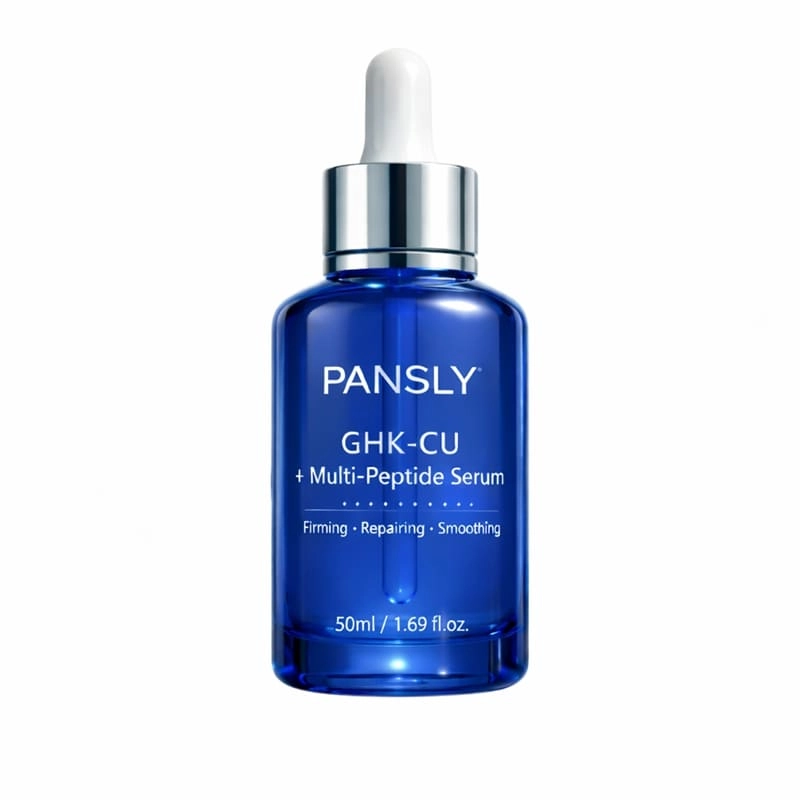
Experience visible rejuvenation with this GHK-Cu Copper Peptide Smoothing & Firming Face Serum, a high-performance concentrate designed to restore the structural integrity of aging skin. This advanced formula centers on GHK-Cu, a powerful signaling peptide clinically recognized for its ability to support natural collagen and elastin production. By promoting dermal density, it effectively tightens sagging skin and smooths the appearance of deep-set wrinkles and fine lines.
The lightweight, silky texture absorbs instantly, delivering antioxidant protection to neutralize environmental stressors that accelerate aging. Enhanced with deep-moisturizing agents, the serum reinforces the skin's moisture barrier, leaving the complexion feeling remarkably soft and resilient. With consistent use, skin texture is refined and facial contours appear more lifted, resulting in a youthfully firm and revitalized glow.
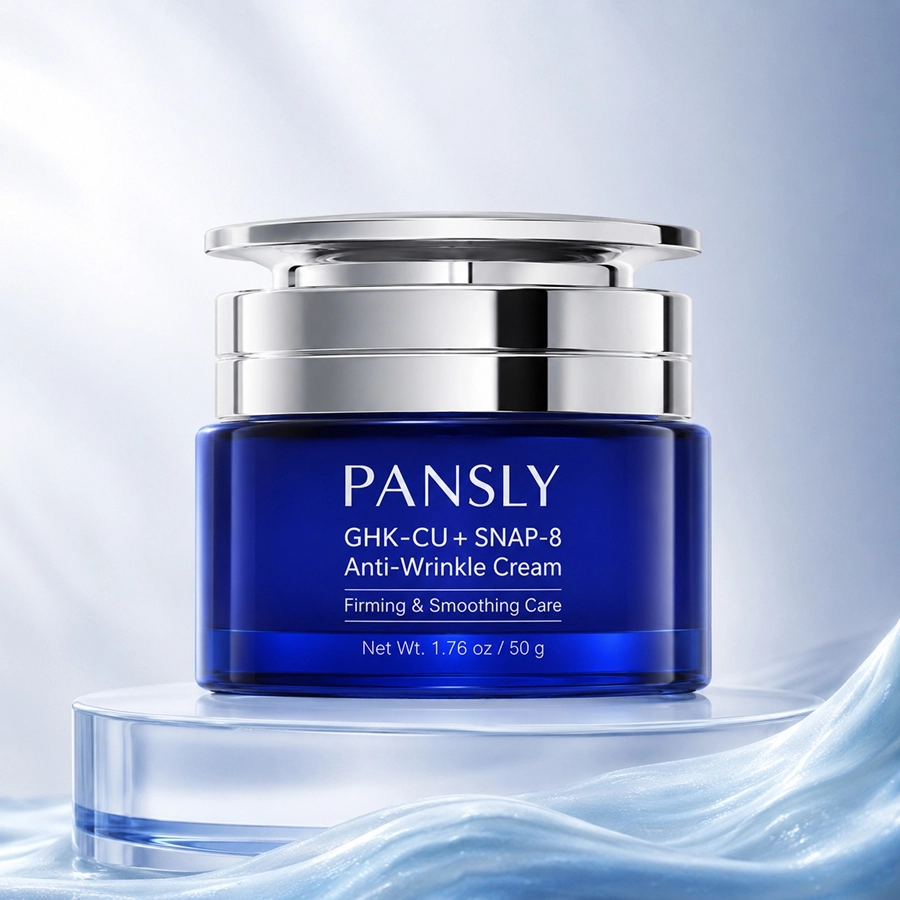
This Pansly GHK-CU + SNAP-8 Anti-Wrinkle Firming Cream is triple-peptide anti-aging facial cream, delivers targeted wrinkle smoothing, firming lifting and deep nourishment for dull, saggy, fine-line prone skin. Full OEM & ODM private label service is supported, including custom formula, packaging options, fast sampling and bulk export supply.
Five core premium active ingredients work synergistically for comprehensive anti-wrinkle care:
GHK-CU Copper Peptide lifts saggy skin, enhances skin resilience and tightens loose facial contour;
SNAP-8 Peptide targets expression lines to visibly soften and fade wrinkles;
Acetyl Hexapeptide-8 reduces the appearance of dry fine lines for smoother skin texture;
Ceramide NP reconstructs skin moisture barrier to lock nourishment and boost comfort;
Hyaluronic Acid delivers multi-layer rich deep moisture to relieve dry rough skin.
Luxury rich creamy texture spreads smoothly and melts into skin gently, leaving soft comfortable finish without heavy greasiness. Daily use blurs fine lines, firms loose skin, deeply nourishes and stabilizes barrier, refining uneven texture to reveal smooth, plump, youthful luminous skin.
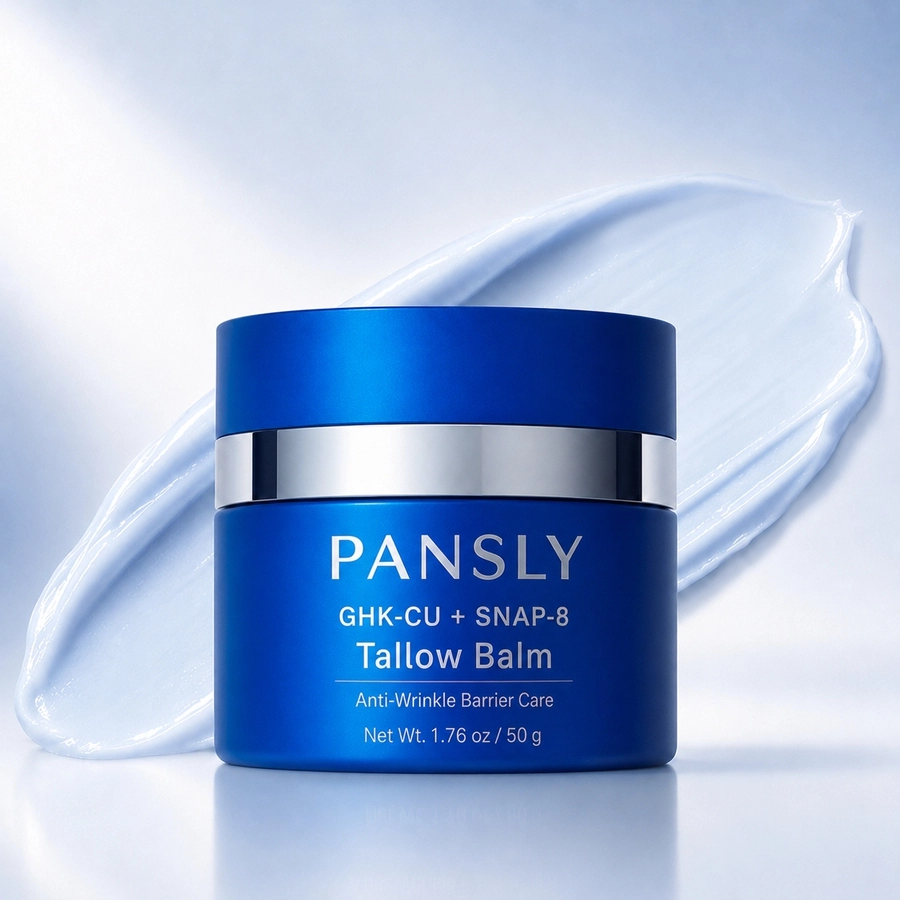
This Pansly GHK-CU + SNAP-8 Tallow Balm is a nourishing anti-wrinkle facial balm specially formulated for dry, fragile and sensitive skin, combining anti-aging wrinkle smoothing and barrier repairing effects. We offer full private label OEM service, including custom logo, adjustable formula, diversified packaging and lid color options.
It contains five core skin care active ingredients: GHK-CU visibly improves fine lines and revives dull complexion; SNAP-8 softens expression lines to smooth wrinkled skin texture; Grass-Fed Beef Tallow delivers deep lipid nourishment to relieve dry rough skin; Ectoin stabilizes the skin barrier and alleviates skin discomfort; Ceramide NP strengthens barrier structure to create smooth, healthy skin.
Luxury creamy blue balm texture glides smoothly and melts quickly on skin, providing long-lasting deep moisturizing comfort. Daily use fades fine lines & expression lines, nourishes dry delicate skin, repairs damaged barrier and leaves silky smooth skin finish.
Click here to customize the Beauty
we respond within a few hours
Monday–Friday, 9AM–6PM
3A01, Building A, Zhisheng Square, No. 4 Zhifu Road, Helong Street, Baiyun District, Guangzhou, China.


Leave a request, and we'll email you back within 24 hours.
© 2026 Beyond Basix. All Rights Reserved.