The B2B Buyer’s Guide to moisturizing bath bombs | Beyond Basix Ultimate Insights

- Why the Moisturizing Bath Bomb Category Requires More Than Attractive Packaging
- Market Positioning and Wholesale Demand
- Consumer Experience and Repeat Purchase
- OEM/ODM Sourcing Risks
- Technical Criteria for Selecting Moisturizing Bath Bombs
- Formula Ingredients and Skin-Feel Requirements
- Bath Performance and Physical Specifications
- Claims, Documentation, and Regulatory Discipline
- Commercial Evaluation: Cost, MOQ, and Supply Chain Reliability
- Wholesale Pricing and Total Landed Cost
- MOQ and Inventory Planning
- Manufacturing Capacity and Continuity
- How to Qualify a One-Stop OEM/ODM Partner
- Factory Audits and Quality Management
- Customization, Sampling, and Scale-Up
- Certifications and Global Market Support
- Brand Portfolio and Long-Term Partnership
- ROI Analysis for a Product Launch
- Final Buyer Checklist
- FAQ: Moisturizing Bath Bomb Procurement
Moisturizing bath bombs are no longer purchased only as colorful novelty products; they are increasingly evaluated as sensorial skincare items that must combine attractive bath performance, dependable moisturizing benefits, regulatory discipline, and repeat-purchase potential. For B2B buyers, the right supplier should be able to control formula stability, fragrance quality, effervescence, packaging protection, documentation, production capacity, and private-label execution from one coordinated OEM/ODM workflow. Guangzhou Beyond Basix Cosmetics Ltd. supports this procurement model with more than 23 years of experience in cosmetics research, production, and sales, a 12,000-square-meter facility, a 100,000-level GMPC pharmaceutical-grade dust-free workshop, 12 production lines, and certifications including ISO 9001, GMP, CE, MSDS, and HALAL.
Why the Moisturizing Bath Bomb Category Requires More Than Attractive Packaging
Market Positioning and Wholesale Demand
Wholesale Product Strategy: Moisturizing bath bombs sit between bath accessories, body care, gifting, and wellness products. That positioning creates several sales opportunities, including spa retail, hotel amenities, subscription boxes, seasonal gift sets, pharmacies, beauty e-commerce, and private-label collections. However, each channel may require a different product architecture. A mass-market retailer may prioritize unit cost and vivid appearance, while a spa buyer may value mild fragrance, elegant packaging, and a High Quality skin-conditioning story. A supplier should therefore offer formula and packaging customization rather than forcing every buyer into one stock product.
Consumer Experience and Repeat Purchase
Repeat-Purchase Economics: A bath bomb can look excellent in a catalog yet underperform after first use if it dissolves too quickly, leaves excessive residue, irritates sensitive skin, stains the tub, or provides an unpleasant fragrance release. For commercial buyers, these issues create returns, negative reviews, and higher customer-acquisition costs. Evaluate the complete use experience: dry-product appearance, ease of handling, dissolution time, water color, scent diffusion, post-bath skin feel, cleanup, and packaging integrity. Moisturizing claims should be supported by a coherent formula and appropriate testing rather than relying only on ingredient decoration.
OEM/ODM Sourcing Risks
Supplier Due Diligence: Common procurement risks include unclear ingredient specifications, inconsistent fragrance batches, unverified production capacity, weak change-control procedures, insufficient stability data, and packaging that allows moisture ingress. Buyers should request a product specification, ingredient declaration, batch coding approach, quality-control plan, sample approval process, and written confirmation of manufacturing responsibilities. Reviewing the principles of ISO 9001 quality management systems can help buyers understand why documented procedures, corrective actions, and traceability matter in a repeat-order program.
Technical Criteria for Selecting Moisturizing Bath Bombs
Formula Ingredients and Skin-Feel Requirements
Moisturizing Formula Selection: A bath bomb formula commonly uses an acid component and an alkaline carbonate or bicarbonate component to generate effervescence when exposed to water. A moisturizing version may also incorporate ingredients such as skin-conditioning oils, emollients, botanical extracts, milk-derived or plant-based powders, humectants, or carefully selected mineral and fragrance systems. The commercial objective is balance: too much oil can weaken compression, create greasy bathwater, or affect dissolution, while too little may make the moisturizing claim unconvincing. Ask the manufacturer to explain ingredient function, usage level, allergen considerations, compatibility, and how the formula performs after storage.
Bath Performance and Physical Specifications
Technical Specification Review: Request measurable specifications instead of accepting descriptions such as “long-lasting” or “deeply moisturizing.” Important parameters include unit weight, diameter, hardness, friability, moisture content, dissolution behavior, color uniformity, fragrance profile, residue, and packaging requirements. The final specification should define acceptable tolerances because natural color variation, fragrance intensity, and compression behavior can change between batches. If the product contains botanicals, clays, petals, or decorative inclusions, confirm whether they are suitable for drainage systems and whether they create additional labeling or consumer-safety considerations.
| Procurement Area | What to Request | Why It Matters | Buyer Acceptance Check |
|---|---|---|---|
| Formula | Full ingredient declaration, function of key ingredients, fragrance information, allergen review | Supports claim control, safety review, and market compliance | Compare approved formula against production sample and documents |
| Physical performance | Unit weight, hardness, dissolution behavior, appearance, residue limits | Protects consumer experience and reduces returns | Test retained samples from each approved batch |
| Packaging | Material specification, moisture barrier, closure method, carton strength | Bath bombs are sensitive to humidity and impact | Conduct transport and humidity observations |
| Quality system | Batch records, inspection process, deviation and corrective-action procedure | Improves consistency across repeat orders | Review documents during supplier qualification |
| Compliance | MSDS or SDS where applicable, certificates, test reports, labeling support | Helps manage retailer, logistics, and destination-market requirements | Confirm documents match the exact SKU and market |
Claims, Documentation, and Regulatory Discipline
Compliance Documentation: Buyers should distinguish between a cosmetic product claim, a marketing expression, and a regulated therapeutic claim. “Leaves skin feeling soft” may be a cosmetic positioning statement, whereas claims to treat eczema, inflammation, pain, or a medical condition can trigger different regulatory expectations. The U.S. Food and Drug Administration cosmetics guidance is a useful reference for understanding the distinction between cosmetic marketing and drug claims in the United States. For international distribution, the buyer remains responsible for confirming destination-market requirements, but an experienced manufacturer should provide accurate formula information and support documentation.
Commercial Evaluation: Cost, MOQ, and Supply Chain Reliability
Wholesale Pricing and Total Landed Cost
Wholesale Cost Analysis: The quoted unit price is only one part of the procurement equation. Calculate total landed cost by combining formula, molding or design charges, fragrance and color system, packaging, inserts, testing, artwork, tooling, freight, duties, warehousing, and expected quality losses. A low factory price may become expensive if the product requires manual rework, has a high breakage rate, or needs repackaging after transit. Request tiered pricing at realistic order volumes and ask which cost drivers change when the formula, shape, decoration, or packaging is modified.
MOQ and Inventory Planning
Bulk Procurement Planning: Minimum order quantity should be evaluated against forecast accuracy, shelf-life policy, cash flow, and packaging commitments. A large MOQ can reduce the unit price but increase inventory risk, especially for seasonal colors or trend-led fragrances. Ask whether the MOQ applies per fragrance, per color, per mold, or per complete SKU. Buyers should also clarify lead times for sampling, artwork approval, raw-material purchasing, production, quality release, and shipment. A staged launch using a smaller initial assortment can validate sell-through before expanding into additional moisturizing bath bombs.
Manufacturing Capacity and Continuity
Supply Chain Reliability: Supplier reliability depends on more than the number of production lines. Review raw-material sourcing, backup suppliers, preventive maintenance, workforce capability, batch traceability, production scheduling, and contingency planning. Beyond Basix operates 12 production lines with advanced machinery imported from Germany, the United States, and other regions, providing a substantial infrastructure for coordinated cosmetics production. Its 12,000-square-meter facility and 100,000-level GMPC pharmaceutical-grade dust-free workshop are relevant indicators for buyers seeking a controlled manufacturing environment, although every buyer should still conduct SKU-specific qualification and sample approval.
How to Qualify a One-Stop OEM/ODM Partner
Factory Audits and Quality Management
Supplier Audit Criteria: A practical audit should cover incoming-material inspection, weighing and batching controls, environmental conditions, equipment cleaning, in-process checks, finished-goods release, storage, complaint handling, and document control. Ask to see how deviations are recorded and how corrective actions are verified. ISO 9001 certification can indicate a structured quality-management framework, while GMP-related controls are particularly relevant to hygienic cosmetics manufacturing. Certification should be verified for scope, issuing body, and current status; it should not replace an audit of the specific products and processes being purchased.
Customization, Sampling, and Scale-Up
OEM/ODM Development Process: A capable partner should translate a commercial brief into a technical sample plan. The process may include target consumer, fragrance direction, ingredient preferences, color palette, shape, bath performance, packaging format, claim boundaries, target cost, and launch date. Approve samples against a written master standard, not memory or informal messaging. Before mass production, confirm whether the pilot sample, pre-production sample, and final batch use the same formula, fragrance supplier, color system, compression method, and packaging materials. This prevents a common scale-up problem in which the approved sample differs materially from the shipped product.
Certifications and Global Market Support
International Market Readiness: Beyond Basix reports certifications and documentation including ISO 9001, CE, MSDS, GMP, and HALAL, along with additional support according to product and market needs. Buyers should request the exact certificate or document relevant to their purchase and verify whether it applies to the factory, product, process, or management system. For halal-oriented channels, ingredient origin, processing aids, and contamination controls may require careful review. The World Health Organization cosmetics regulatory resources provide useful context for buyers building a broader compliance checklist, while destination-country authorities remain the final reference for market entry.
Brand Portfolio and Long-Term Partnership
Partnership and Brand Capability: A manufacturer with experience across multiple skincare categories can often provide more useful cross-category insight than a narrow bath-product vendor. Beyond Basix focuses on skincare products with effective ingredients and operates four major brands: LANTHOME, PANSLY, FIRSTSUN, and SAUVASINE. This portfolio experience may support broader product-line planning, such as coordinating bath bombs with body scrubs, shower products, hand care, or giftable skincare. Buyers should still assess confidentiality, intellectual-property ownership, exclusivity terms, artwork control, forecast communication, and escalation contacts before signing a long-term agreement.
ROI Analysis for a Product Launch
Commercial Return Evaluation: Estimate gross margin using realistic wholesale or retail pricing, landed cost, promotional discounts, damaged-unit allowance, marketplace fees, and expected repeat purchase. Then compare the result with development costs and working-capital requirements. Moisturizing bath bombs can create higher perceived value through sensory fragrance, High Quality ingredients, gift-ready presentation, and coordinated collections, but those additions should be tied to a clear channel strategy. A supplier that can offer formula development, packaging coordination, production, documentation, and shipment support through one workflow may reduce project-management time and lower the risk of costly handoffs.
Final Buyer Checklist
Pre-Order Verification: Before issuing a purchase order, confirm the approved formula and artwork, target market, ingredient and claim review, unit weight, tolerance limits, fragrance and color references, packaging specifications, carton configuration, MOQ, payment terms, lead time, inspection standard, replacement policy, batch coding, shelf-life expectations, and document package. Retain an approved golden sample and define the process for any future formula, supplier, fragrance, or packaging change. This discipline turns a promising sample into a repeatable commercial product and gives both parties a clear basis for resolving quality questions.
Contact Beyond Basix for OEM/ODM Support: Connect with Beyond Basix to develop compliant, market-ready moisturizing bath bombs through a coordinated one-stop skincare manufacturing program.
FAQ: Moisturizing Bath Bomb Procurement
What should buyers request before ordering moisturizing bath bombs?
Buyers should request the product specification, ingredient declaration, fragrance information, sample approval record, physical-performance criteria, packaging specification, batch coding approach, quality-control plan, MOQ, lead time, and relevant compliance documents.
How can a buyer evaluate the wholesale cost of bath bombs?
Calculate total landed cost by combining formula, packaging, testing, artwork, tooling, freight, duties, warehousing, and expected quality losses. Request tiered pricing at realistic order volumes and identify which changes affect the unit price.
Can moisturizing bath bombs be customized for private-label brands?
Yes. A capable OEM/ODM partner can customize the formula, fragrance, color, shape, ingredients, packaging, artwork, and claims within applicable market requirements. Buyers should approve a written master standard before mass production.
Why is packaging important for bath bomb procurement?
Bath bombs are sensitive to humidity, impact, and fragrance loss. Packaging must provide suitable moisture protection, prevent breakage, preserve appearance, and support transport. Buyers should review material specifications, closure methods, carton strength, and transport performance.
How does Beyond Basix support B2B skincare buyers?
Beyond Basix provides coordinated cosmetics research, production, and sales support, operating a 12,000-square-meter facility with a 100,000-level GMPC pharmaceutical-grade dust-free workshop, 12 production lines, and certifications including ISO 9001, GMP, CE, MSDS, and HALAL.
What quality checks should be completed before a repeat order?
Buyers should compare the production batch with the approved golden sample, verify unit weight, appearance, fragrance, hardness, dissolution, residue, packaging integrity, batch coding, and documentation, while confirming that no unapproved formula or material changes occurred.

Elevate your professional skincare offerings with this Private Label Copper Peptide Anti-Wrinkle Firming Serum, a powerhouse concentrate designed for superior age-defying results. This sophisticated formula leverages the synergistic effects of GHK-Cu and SNAP-8 to address multiple layers of skin aging. The GHK-Cu copper peptides act as a vital signaling mechanism to enhance skin density and firmness, while the advanced SNAP-8 octapeptide specifically targets expression lines, helping to relax the appearance of deep-seated wrinkles for a smoother, more refined surface.
This lightweight, rapid-absorption serum provides a professional-grade solution for clients seeking a non-invasive lift. It effectively restores elasticity, improves skin texture, and provides essential antioxidant protection. Perfect for high-end beauty brands, this serum leaves the complexion looking visibly contoured, hydrated, and youthfully revitalized.
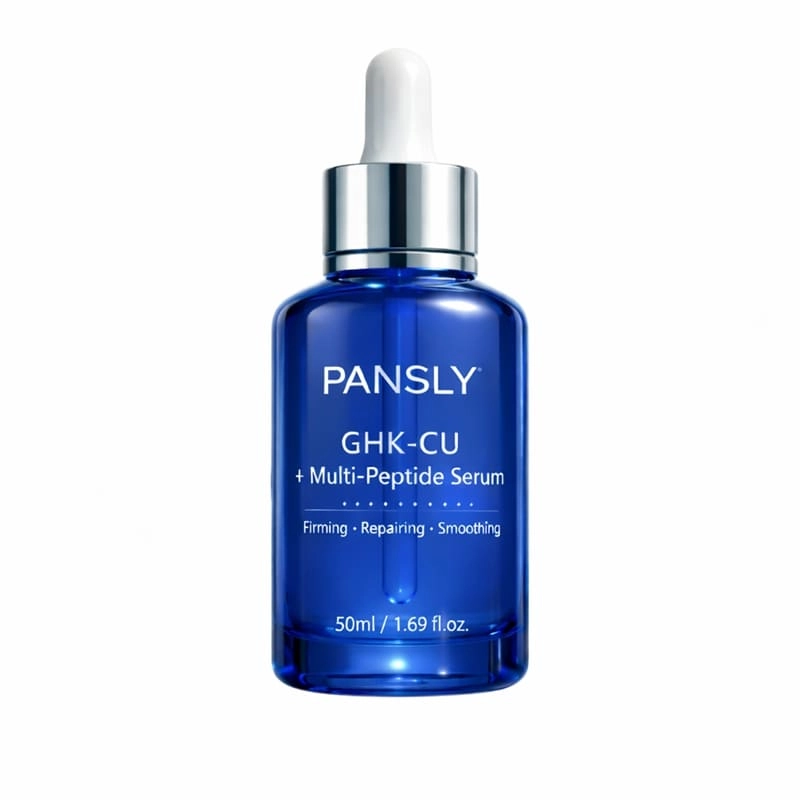
Experience visible rejuvenation with this GHK-Cu Copper Peptide Smoothing & Firming Face Serum, a high-performance concentrate designed to restore the structural integrity of aging skin. This advanced formula centers on GHK-Cu, a powerful signaling peptide clinically recognized for its ability to support natural collagen and elastin production. By promoting dermal density, it effectively tightens sagging skin and smooths the appearance of deep-set wrinkles and fine lines.
The lightweight, silky texture absorbs instantly, delivering antioxidant protection to neutralize environmental stressors that accelerate aging. Enhanced with deep-moisturizing agents, the serum reinforces the skin's moisture barrier, leaving the complexion feeling remarkably soft and resilient. With consistent use, skin texture is refined and facial contours appear more lifted, resulting in a youthfully firm and revitalized glow.
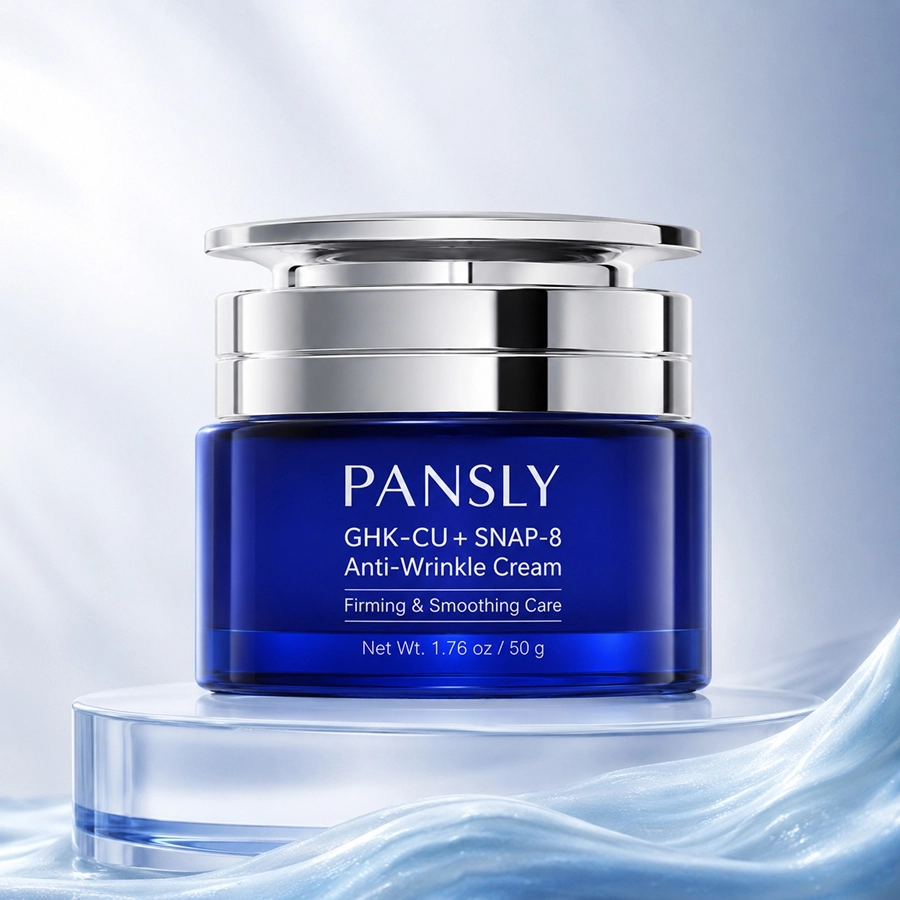
This Pansly GHK-CU + SNAP-8 Anti-Wrinkle Firming Cream is triple-peptide anti-aging facial cream, delivers targeted wrinkle smoothing, firming lifting and deep nourishment for dull, saggy, fine-line prone skin. Full OEM & ODM private label service is supported, including custom formula, packaging options, fast sampling and bulk export supply.
Five core premium active ingredients work synergistically for comprehensive anti-wrinkle care:
GHK-CU Copper Peptide lifts saggy skin, enhances skin resilience and tightens loose facial contour;
SNAP-8 Peptide targets expression lines to visibly soften and fade wrinkles;
Acetyl Hexapeptide-8 reduces the appearance of dry fine lines for smoother skin texture;
Ceramide NP reconstructs skin moisture barrier to lock nourishment and boost comfort;
Hyaluronic Acid delivers multi-layer rich deep moisture to relieve dry rough skin.
Luxury rich creamy texture spreads smoothly and melts into skin gently, leaving soft comfortable finish without heavy greasiness. Daily use blurs fine lines, firms loose skin, deeply nourishes and stabilizes barrier, refining uneven texture to reveal smooth, plump, youthful luminous skin.
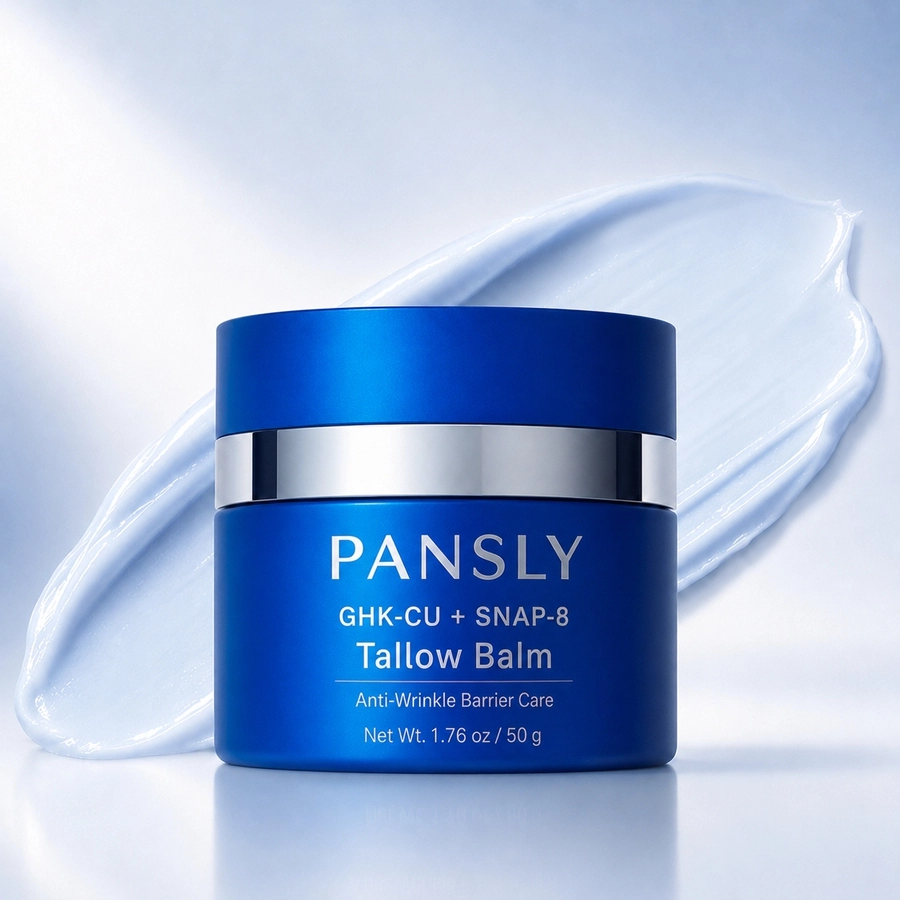
This Pansly GHK-CU + SNAP-8 Tallow Balm is a nourishing anti-wrinkle facial balm specially formulated for dry, fragile and sensitive skin, combining anti-aging wrinkle smoothing and barrier repairing effects. We offer full private label OEM service, including custom logo, adjustable formula, diversified packaging and lid color options.
It contains five core skin care active ingredients: GHK-CU visibly improves fine lines and revives dull complexion; SNAP-8 softens expression lines to smooth wrinkled skin texture; Grass-Fed Beef Tallow delivers deep lipid nourishment to relieve dry rough skin; Ectoin stabilizes the skin barrier and alleviates skin discomfort; Ceramide NP strengthens barrier structure to create smooth, healthy skin.
Luxury creamy blue balm texture glides smoothly and melts quickly on skin, providing long-lasting deep moisturizing comfort. Daily use fades fine lines & expression lines, nourishes dry delicate skin, repairs damaged barrier and leaves silky smooth skin finish.
Click here to customize the Beauty
we respond within a few hours
Monday–Friday, 9AM–6PM
3A01, Building A, Zhisheng Square, No. 4 Zhifu Road, Helong Street, Baiyun District, Guangzhou, China.


Leave a request, and we'll email you back within 24 hours.
© 2026 Beyond Basix. All Rights Reserved.