
The B2B Buyer’s Guide to ghk cu peptide serum | Beyond Basix Ultimate Insights
- Market Evolution & Sourcing Challenges
- Wholesale Pricing and Market Positioning for ghk cu peptide serum
- Supply Chain Reliability and Ingredient Traceability
- Bulk Procurement and MOQ Strategies
- Technical Vetting & Formulation Criteria
- Active Concentration Specs and Efficacy Verification
- Stability, Preservation, and Packaging Considerations
- GMP Manufacturing and Quality Certifications
- Supplier Due Diligence & Cost Modeling
- OEM/ODM Capability Assessment and Production Footprint
- ROI Analysis and Total Cost of Ownership (TCO)
- Contract Terms, IP Protection, and MOQ Negotiation
- Regulatory, Testing & Quality Assurance
- Regulatory Compliance and Claims Substantiation
- Analytical Testing and Microbiology Controls
- Certifications, Ethical Sourcing and Halal/GMP
- Implementation Checklist & Commercial Playbook
- Pre-Qualification Checklist for ghk cu peptide serum Suppliers
- Sampling, Bridge Batches and Performance Validation
- Commercial Launch Roadmap and Channel Readiness
- FAQ
- What should I ask to verify the purity of GHK-Cu used in a ghk cu peptide serum?
- How can I assess a manufacturer's capability to produce ghk cu peptide serum at scale?
- Can a ghk cu peptide serum be formulated for multiple price tiers?
- Why is packaging important for ghk cu peptide serum stability?
- What regulatory documentation is essential before exporting a ghk cu peptide serum?
- How do I model expected margins and ROI for a ghk cu peptide serum SKU?
- FAQ Main Title
This strategic B2B synopsis equips procurement leaders with the due-diligence checklist required for selecting an OEM/ODM partner for ghk cu peptide serum development and supply, balancing formulation efficacy, GMP manufacturing, supply chain reliability, and margin-driven wholesale pricing models to ensure a defensible market entry.
Market Evolution & Sourcing Challenges
Wholesale Pricing and Market Positioning for ghk cu peptide serum
Wholesale Pricing: Understand landed cost drivers for ghk cu peptide serum including active ingredient grading (GHK-Cu technical grade vs. cosmetic grade), fill-finish complexity, and packaging selection; these variables typically explain 60–80% of cost variance in One-Stop OEM/ODM for Skincare offers. Compare supplier quotes on a per-kg and per-unit basis, and request ingredient certificates to justify price gaps.
Supply Chain Reliability and Ingredient Traceability
Supply Chain Reliability: Require traceability documentation for GHK-Cu raw material (batch COA, origin, and stability data) and insist on dual-sourcing strategies for critical inputs; verify suppliers reference standards aligned with peptide handling best practices and regulatory expectations from agencies such as the U.S. FDA.
Bulk Procurement and MOQ Strategies
Bulk Procurement: Negotiate MOQs tied to staged scale-up (pilot, bridge, full production) to minimize inventory risk for ghk cu peptide serum; consider contract manufacturing partners that provide flexible production lines and smaller pilot runs so your SKU economics can be validated before full MOQ commitment.
Technical Vetting & Formulation Criteria
Active Concentration Specs and Efficacy Verification
Active Concentration Specs: Insist on clear formulation targets for ghk cu peptide serum (common cosmetic concentrations range from 0.05% to 0.5% GHK-Cu depending on claim and stability) and request third-party assay methods (HPLC, MS) referenced in technical dossiers to validate peptide content across shelf life.
Stability, Preservation, and Packaging Considerations
Stability and Packaging: Evaluate stability data for ghk cu peptide serum under ICH-relevant conditions and confirm packaging compatibility (airless pumps, amber glass) to reduce oxidation and chelation risks; a formulation without validated stability studies increases product recall and warranty liabilities.
GMP Manufacturing and Quality Certifications
Supply Chain Reliability: Prioritize partners with pharmaceutical-grade production facilities (e.g., 100,000-level GMPC dust-free workshop) and certifications such as ISO 9001 and GMP; reference global standards like ISO 22716 for cosmetic GMP alignment and verify audit reports and MSDS documentation for ingredient safety.
Supplier Due Diligence & Cost Modeling
OEM/ODM Capability Assessment and Production Footprint
OEM/ODM Capability Assessment: Vet suppliers for end-to-end capabilities—R&D, pilot labs, 12 production lines, and advanced machinery—so your ghk cu peptide serum can transition quickly from formulation to full-scale manufacturing; facility tours and sample production runs are non-negotiable.
ROI Analysis and Total Cost of Ownership (TCO)
ROI Analysis: Build TCO models that include ingredient escalation scenarios, packaging depreciation, regulatory documentation costs, and projected return rates; model product lifetime using realistic repurchase cycles for peptide serums to evaluate profitability under different price and volume assumptions.
Contract Terms, IP Protection, and MOQ Negotiation
Contract Terms: Require clear IP clauses for proprietary ghk cu peptide serum formulations, confidentiality agreements, and milestones for scale-up; negotiate staged MOQs and penalty clauses for missed quality specs to align supplier incentives with your go-to-market timelines.
Regulatory, Testing & Quality Assurance
Regulatory Compliance and Claims Substantiation
Regulatory Compliance: Demand regulatory mapping for target markets (e.g., ASEAN, EU, US), and ensure claim substantiation for any performance statements tied to ghk cu peptide serum; consult regulatory bodies such as the FDA cosmetic guidance and national cosmetic regulations where you plan to distribute.
Analytical Testing and Microbiology Controls
Testing Controls: Verify analytical methods (potency, degradation products) and microbial challenge testing for ghk cu peptide serum; independent labs or supplier internal labs accredited to recognized standards provide added confidence in batch release criteria.
Certifications, Ethical Sourcing and Halal/GMP
Quality Certifications: Confirm supplier certifications such as ISO 9001, GMP, MSDS reporting, and HALAL where relevant—Beyond Basix’s multi-certification footprint reduces compliance friction and demonstrates manufacturing maturity for global rollouts.
| Criteria | Priority | Low-cost Supplier | Established OEM/ODM (e.g., Beyond Basix) |
|---|---|---|---|
| GHK-Cu Assay & Documentation | High | Often limited COA | Full COA, stability, batch traceability |
| Production Facility | High | Shared, limited lines | 12 production lines, 100,000-level GMPC |
| Certifications | Medium | Basic | ISO9001, GMP, MSDS, HALAL |
| MOQ Flexibility | Medium | High MOQs | Pilot runs available, staged MOQs |
| Total Cost of Ownership | High | Lower upfront, higher risk | Optimized for scale and regulatory markets |
Implementation Checklist & Commercial Playbook
Pre-Qualification Checklist for ghk cu peptide serum Suppliers
Pre-Qualification Checklist: Ask for a vendor pack that includes lab dossiers, COA, GMP certificates, stability data, packaging compatibility tests, and references from existing clients for ghk cu peptide serum; this accelerates procurement approval cycles and reduces technical surprises.
Sampling, Bridge Batches and Performance Validation
Bridge Batches: Require at least two bridge batches and third-party stability reports before committing to full-scale production for ghk cu peptide serum; evaluate sensory, efficacy, and accelerated stability so marketing claims can be substantiated at launch.
Commercial Launch Roadmap and Channel Readiness
Channel Readiness: Align production timelines with labeling, regulatory filings, and distribution channel qualification; an integrated calendar that covers QC release, packaging procurement, and logistics will shorten time-to-shelf for ghk cu peptide serum products.
FAQ
What should I ask to verify the purity of GHK-Cu used in a ghk cu peptide serum?
Request an authenticated Certificate of Analysis (COA) showing assay by HPLC or mass spectrometry, impurity profiles, and supplier traceability; confirm manufacturing origin and third-party testing to ensure the GHK-Cu meets cosmetic-grade requirements.
How can I assess a manufacturer's capability to produce ghk cu peptide serum at scale?
Review factory certifications, production line counts, documented cleanroom standards (e.g., 100,000-level GMPC), recent audit reports, and ask for bridge batch samples along with full stability data and COAs for multiple lots to confirm reproducibility.
Can a ghk cu peptide serum be formulated for multiple price tiers?
Yes; adjust active concentration, delivery systems (serum vs. ampoule), packaging materials, and inclusion of complementary actives to create tiers while maintaining a core formulation validated for efficacy and stability.
Why is packaging important for ghk cu peptide serum stability?
Packaging (airless systems, UV-protective glass) minimizes oxidation and metal chelation risks for copper peptides, preserving efficacy; validated packaging studies are necessary to ensure shelf-life claims.
What regulatory documentation is essential before exporting a ghk cu peptide serum?
Essential documentation includes COA, MSDS, stability reports, GMP certificates, product labels compliant with target markets, and any necessary safety assessments or notified product dossiers required by the destination regulatory authority.
How do I model expected margins and ROI for a ghk cu peptide serum SKU?
Build a model that includes COGS (active, packaging, fill-finish), logistics, duty, marketing, and planned retail markup; stress-test scenarios for ingredient price rises and returns, and calculate payback period based on expected repurchase frequency and retention rates.
Contact Beyond Basix to start a supplier qualification and OEM/ODM discussion for your ghk cu peptide serum today.
FAQ Main Title
What should I ask to verify the purity of GHK-Cu used in a ghk cu peptide serum?
Request an authenticated Certificate of Analysis (COA) showing assay by HPLC or mass spectrometry, impurity profiles, and supplier traceability; confirm manufacturing origin and third-party testing to ensure the GHK-Cu meets cosmetic-grade requirements.
How can I assess a manufacturer's capability to produce ghk cu peptide serum at scale?
Review factory certifications, production line counts, documented cleanroom standards (e.g., 100,000-level GMPC), recent audit reports, and ask for bridge batch samples along with full stability data and COAs for multiple lots to confirm reproducibility.
Can a ghk cu peptide serum be formulated for multiple price tiers?
Yes; adjust active concentration, delivery systems (serum vs. ampoule), packaging materials, and inclusion of complementary actives to create tiers while maintaining a core formulation validated for efficacy and stability.
Why is packaging important for ghk cu peptide serum stability?
Packaging (airless systems, UV-protective glass) minimizes oxidation and metal chelation risks for copper peptides, preserving efficacy; validated packaging studies are necessary to ensure shelf-life claims.
What regulatory documentation is essential before exporting a ghk cu peptide serum?
Essential documentation includes COA, MSDS, stability reports, GMP certificates, product labels compliant with target markets, and any necessary safety assessments or notified product dossiers required by the destination regulatory authority.
How do I model expected margins and ROI for a ghk cu peptide serum SKU?
Build a model that includes COGS (active, packaging, fill-finish), logistics, duty, marketing, and planned retail markup; stress-test scenarios for ingredient price rises and returns, and calculate payback period based on expected repurchase frequency and retention rates.

Elevate your professional skincare offerings with this Private Label Copper Peptide Anti-Wrinkle Firming Serum, a powerhouse concentrate designed for superior age-defying results. This sophisticated formula leverages the synergistic effects of GHK-Cu and SNAP-8 to address multiple layers of skin aging. The GHK-Cu copper peptides act as a vital signaling mechanism to enhance skin density and firmness, while the advanced SNAP-8 octapeptide specifically targets expression lines, helping to relax the appearance of deep-seated wrinkles for a smoother, more refined surface.
This lightweight, rapid-absorption serum provides a professional-grade solution for clients seeking a non-invasive lift. It effectively restores elasticity, improves skin texture, and provides essential antioxidant protection. Perfect for high-end beauty brands, this serum leaves the complexion looking visibly contoured, hydrated, and youthfully revitalized.
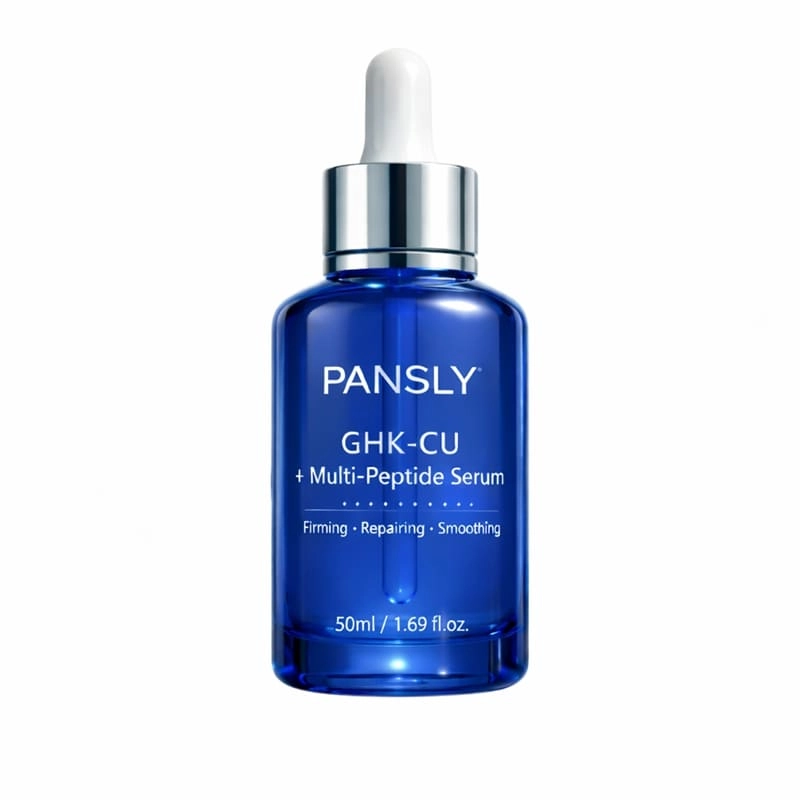
Experience visible rejuvenation with this GHK-Cu Copper Peptide Smoothing & Firming Face Serum, a high-performance concentrate designed to restore the structural integrity of aging skin. This advanced formula centers on GHK-Cu, a powerful signaling peptide clinically recognized for its ability to support natural collagen and elastin production. By promoting dermal density, it effectively tightens sagging skin and smooths the appearance of deep-set wrinkles and fine lines.
The lightweight, silky texture absorbs instantly, delivering antioxidant protection to neutralize environmental stressors that accelerate aging. Enhanced with deep-moisturizing agents, the serum reinforces the skin's moisture barrier, leaving the complexion feeling remarkably soft and resilient. With consistent use, skin texture is refined and facial contours appear more lifted, resulting in a youthfully firm and revitalized glow.
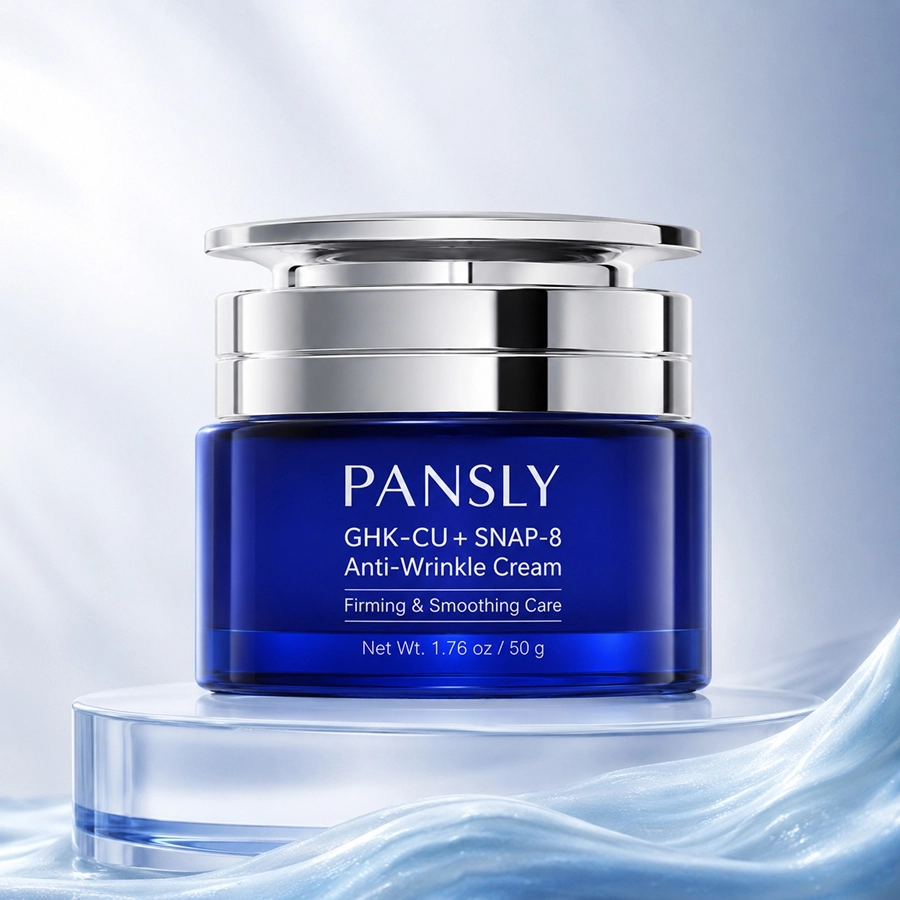
This Pansly GHK-CU + SNAP-8 Anti-Wrinkle Firming Cream is triple-peptide anti-aging facial cream, delivers targeted wrinkle smoothing, firming lifting and deep nourishment for dull, saggy, fine-line prone skin. Full OEM & ODM private label service is supported, including custom formula, packaging options, fast sampling and bulk export supply.
Five core premium active ingredients work synergistically for comprehensive anti-wrinkle care:
GHK-CU Copper Peptide lifts saggy skin, enhances skin resilience and tightens loose facial contour;
SNAP-8 Peptide targets expression lines to visibly soften and fade wrinkles;
Acetyl Hexapeptide-8 reduces the appearance of dry fine lines for smoother skin texture;
Ceramide NP reconstructs skin moisture barrier to lock nourishment and boost comfort;
Hyaluronic Acid delivers multi-layer rich deep moisture to relieve dry rough skin.
Luxury rich creamy texture spreads smoothly and melts into skin gently, leaving soft comfortable finish without heavy greasiness. Daily use blurs fine lines, firms loose skin, deeply nourishes and stabilizes barrier, refining uneven texture to reveal smooth, plump, youthful luminous skin.
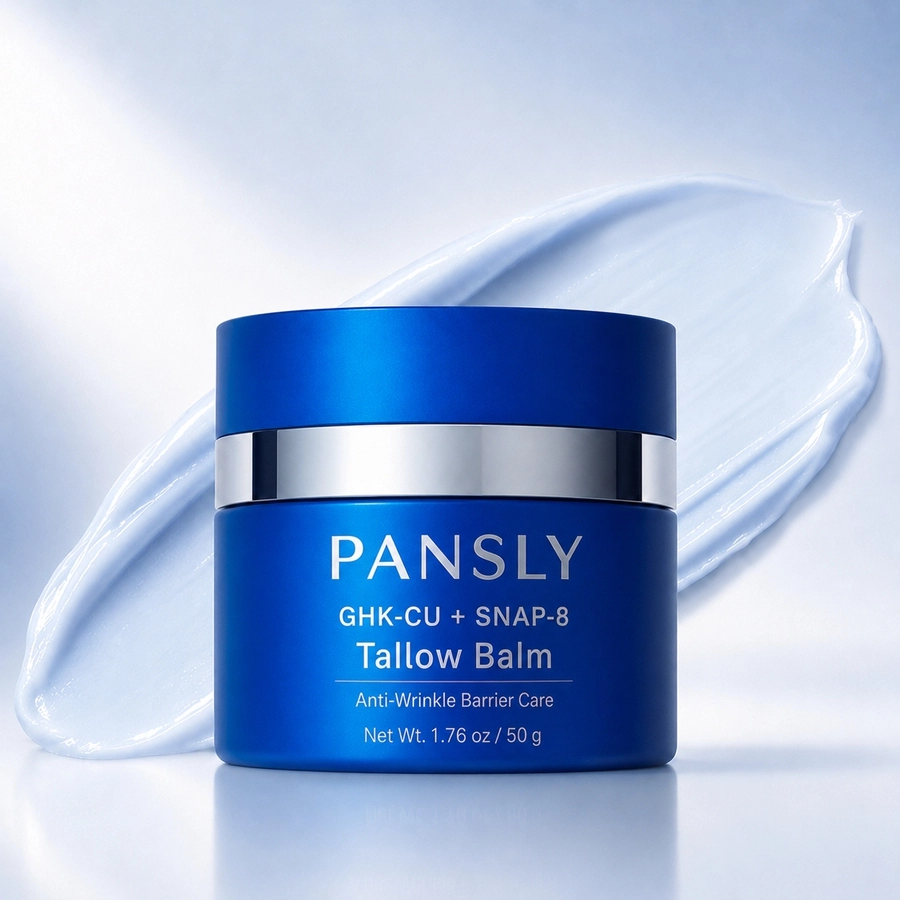
This Pansly GHK-CU + SNAP-8 Tallow Balm is a nourishing anti-wrinkle facial balm specially formulated for dry, fragile and sensitive skin, combining anti-aging wrinkle smoothing and barrier repairing effects. We offer full private label OEM service, including custom logo, adjustable formula, diversified packaging and lid color options.
It contains five core skin care active ingredients: GHK-CU visibly improves fine lines and revives dull complexion; SNAP-8 softens expression lines to smooth wrinkled skin texture; Grass-Fed Beef Tallow delivers deep lipid nourishment to relieve dry rough skin; Ectoin stabilizes the skin barrier and alleviates skin discomfort; Ceramide NP strengthens barrier structure to create smooth, healthy skin.
Luxury creamy blue balm texture glides smoothly and melts quickly on skin, providing long-lasting deep moisturizing comfort. Daily use fades fine lines & expression lines, nourishes dry delicate skin, repairs damaged barrier and leaves silky smooth skin finish.
Click here to customize the Beauty
we respond within a few hours
Monday–Friday, 9AM–6PM
3A01, Building A, Zhisheng Square, No. 4 Zhifu Road, Helong Street, Baiyun District, Guangzhou, China.


Leave a request, and we'll email you back within 24 hours.
© 2026 Beyond Basix. All Rights Reserved.
