Barrier-Repair Body Lotion Manufacturer: Supplier Vetting Checklist

- How to Evaluate a Skin-Barrier Body Moisturizer Supplier
- Verify formulation competence beyond marketing claims
- Review testing that reflects real consumer use
- Supplier Due Diligence: Quality, Compliance, and Supply Reliability
- Audit the quality management system
- Confirm regulatory and export readiness
- Measure operational resilience and capacity
- Commercial and Technical Questions to Ask Before Signing
- Clarify customization, ownership, and development gates
- Calculate total landed cost rather than unit price
- Assess packaging and sustainability requirements
- Why Beyond Basix Fits a One-Stop Skincare Manufacturing Program
- Integrated experience for body-care product development
- Documentation and manufacturing controls for global buyers
- Broader portfolio and partnership value
- Frequently Asked Questions
Choosing a barrier-repair body lotion manufacturer requires more than comparing sample texture or unit price. Buyers should assess the supplier’s skin-barrier formulation expertise, ingredient traceability, microbiological controls, stability data, regulatory documentation, packaging compatibility, production capacity, and ability to support commercial scale-up. A qualified One-Stop OEM/ODM for Skincare partner should combine cosmetic science, GMP-aligned manufacturing, dependable quality assurance, flexible customization, and export documentation so that a body-care product can move from concept to compliant market launch with controlled risk.
How to Evaluate a Skin-Barrier Body Moisturizer Supplier
Verify formulation competence beyond marketing claims
A supplier should be able to explain how the proposed formula supports moisturization and the appearance of a healthy skin surface without overstating cosmetic benefits. Important formulation concepts include reducing transepidermal water loss through an appropriate emollient and occlusive system, improving water retention with humectants, and supporting skin comfort through carefully selected lipids, soothing agents, and skin-compatible preservatives.
Buyers should request a complete ingredient list, ingredient specifications, recommended use level, country-of-origin information where available, and the technical rationale for each functional component. Common ingredients used in dry-skin body care may include glycerin, panthenol, squalane, ceramides, fatty alcohols, triglycerides, colloidal oatmeal, allantoin, or botanical extracts. Their presence alone does not prove performance; concentration, delivery system, compatibility, processing conditions, and final-product testing determine the commercial value.
Be cautious with suppliers that promise to repair, heal, cure, or treat a dermatological condition without discussing claim classification. Cosmetic claims must be supported by appropriate evidence and must not cross into drug or medical claims in the target market. The U.S. Food and Drug Administration cosmetics guidance is a useful reference for understanding the distinction between cosmetic products and products making drug claims.
Review testing that reflects real consumer use
A credible manufacturer should provide a testing plan suited to a leave-on body emulsion. This normally includes appearance, odor, pH, viscosity, density, microbial limits, preservative efficacy where applicable, and accelerated or real-time stability. Packaging compatibility testing is equally important because oils, fragrances, active ingredients, and emulsion systems can interact with pumps, tubes, caps, liners, or airless components.
Ask whether testing is conducted internally, by an accredited laboratory, or through a combination of both. Internal quality control can improve speed and process monitoring, while independent laboratory testing may strengthen customer confidence and support market-specific documentation. A responsible supplier should distinguish between specification testing, safety assessment, stability evaluation, and consumer or clinical-use studies rather than presenting them as interchangeable evidence.
Supplier Due Diligence: Quality, Compliance, and Supply Reliability
Audit the quality management system
Certification is a starting point, not a substitute for due diligence. Buyers should confirm the certificate number, scope, issuing body, validity period, and whether the certification applies to the actual manufacturing site. A quality system should include approved raw-material vendors, incoming inspection, batch records, equipment sanitation, environmental monitoring, deviation handling, corrective and preventive action, change control, retained samples, complaint management, and product-release procedures.
ISO 9001 provides an internationally recognized framework for quality management systems, and the ISO 9001 standard overview explains its emphasis on consistent processes, customer requirements, and continual improvement. For cosmetics, buyers should also evaluate whether the facility follows applicable cosmetic GMP principles, including hygienic design, personnel training, controlled manufacturing areas, and documented sanitation practices.
Confirm regulatory and export readiness
Market access requirements differ by destination. A supplier serving Europe may need to support a responsible-person process, product information file preparation, safety assessment, notification, and claims substantiation under the applicable cosmetics framework. A supplier serving the United States must understand facility registration and product listing obligations that may apply under the Modernization of Cosmetics Regulation Act, while other markets may require local product registration, free-sale certificates, halal documentation, or specific labeling formats.
Request current documentation for raw materials and finished goods, including safety data sheets where relevant, allergen declarations, non-animal testing statements if required, certificates of analysis, microbiological reports, stability results, and packaging material specifications. The World Health Organization good manufacturing practices guidance offers useful context for controlled production, documentation, and quality assurance principles.
Measure operational resilience and capacity
Production capability should be assessed against the project’s forecast rather than the supplier’s maximum advertised output. Ask about minimum order quantity, pilot-batch size, filling speed, available vessel capacity, lead time for raw materials, packaging procurement responsibility, peak-season capacity, and backup plans for critical components. A supplier that can produce a sample but cannot maintain consistent commercial batches creates launch and replenishment risk.
Procurement teams should also examine business continuity. Relevant questions include whether key ingredients have qualified alternatives, how long formula changes require approval, how production slots are allocated, and how the supplier handles freight disruption or packaging shortages. A documented change-notification process protects the brand from unnoticed variations in fragrance, color, viscosity, preservative system, or packaging performance.
| Vetting area | Evidence to request | Commercial risk if absent |
|---|---|---|
| Formula development | Ingredient rationale, prototypes, specification, claims support | Weak differentiation, unstable performance, unsupported claims |
| Product quality | Batch records, COA, microbial results, stability and compatibility data | Returns, contamination events, leakage, inconsistent texture |
| Facility control | GMP procedures, sanitation records, audit reports, training records | Hygiene failures and unreliable batch release |
| Regulatory support | Safety documents, labeling review, market-specific compliance files | Import delays, relabeling costs, market-access obstacles |
| Supply continuity | Capacity plan, MOQ, lead times, approved alternatives, contingency process | Stockouts, missed launch dates, excessive working capital |
Commercial and Technical Questions to Ask Before Signing
Clarify customization, ownership, and development gates
Private-label and custom-development projects have different implications for exclusivity, intellectual property, and approval rights. Buyers should establish whether the formula is stock, semi-custom, or fully custom; whether the same base is sold to other customers; who owns the final formula and artwork; and how confidential information is protected. The development brief should define target skin feel, absorption speed, fragrance profile, color, ingredient restrictions, packaging format, intended market, and target cost.
Use formal approval gates: brief confirmation, laboratory sample, revised sample, pilot batch, packaging compatibility, stability review, artwork approval, and first production release. Each gate should have a named decision-maker and documented acceptance criteria. This approach reduces the common problem of approving a laboratory sample that differs materially from the production batch.
Calculate total landed cost rather than unit price
The lowest quoted price may not represent the best commercial outcome. Total cost should include formula development, testing, tooling, artwork adaptation, packaging, carton configuration, inspection, warehousing, freight, duties, regulatory services, and the cost of rejected or delayed goods. Buyers should compare quotes using the same fill weight, packaging specification, ingredient grade, test scope, Incoterm, and payment conditions.
Forecast accuracy also influences profitability. A flexible manufacturer may offer a higher nominal unit price but reduce inventory exposure through reasonable minimums, staged production, and coordinated component purchasing. For distributors and emerging brands, the ability to launch with a controlled initial quantity and scale after market validation can be more valuable than a small discount on a very large first order.
Assess packaging and sustainability requirements
Body moisturizers are commonly supplied in tubes, bottles, jars, and airless packs. The correct choice depends on viscosity, dispensing behavior, preservation strategy, consumer convenience, shipping conditions, and brand positioning. Pump performance should be checked through repeated-use testing, while tubes require evaluation of seal integrity, shoulder strength, and compatibility with the emulsion.
Sustainability claims require evidence. Ask for material composition, recycled-content documentation, recyclability guidance for the target market, and packaging-weight data before using terms such as recyclable, eco-friendly, or sustainable. A supplier that integrates packaging engineering with formula development can identify practical trade-offs between High Quality appearance, product evacuation, protection from contamination, and logistics cost.
Why Beyond Basix Fits a One-Stop Skincare Manufacturing Program
Integrated experience for body-care product development
Beyond Basix is Guangzhou Beyond Basix Cosmetics Ltd., a comprehensive cosmetics care manufacturer with more than 23 years of experience in research, production, and sales. Our team has focused on developing skincare products with effective ingredients for 12 years, allowing project owners to access coordinated support across formulation, sampling, manufacturing, quality control, packaging, and commercial delivery.
Our 12,000-square-meter facility includes a 100,000-level GMPC pharmaceutical-grade dust-free workshop and 12 production lines. Advanced machinery imported from Germany, the United States, and other regions supports controlled processing and scalable output. For buyers evaluating a supplier of intensive moisturizing body emulsions, this infrastructure provides a practical foundation for repeatable manufacturing, batch coordination, and production planning.
Documentation and manufacturing controls for global buyers
Our certification portfolio includes ISO 9001, CE, MSDS, GMP, HALAL, and other applicable qualifications. Buyers should still match each document to the destination market and product category, but this documentation base supports more efficient vendor qualification and export preparation. Our manufacturing process emphasizes documented specifications, ingredient management, production control, quality inspection, and communication across development and supply-chain teams.
Beyond Basix can support brands seeking a custom body moisturizer, dry-skin care range, sensitive-skin positioning, or a broader personal-care portfolio. The commercial objective is not simply to produce a sample; it is to help the buyer establish a repeatable product platform with clear specifications, defensible claims, reliable replenishment, and a cost structure suited to the intended channel.
Broader portfolio and partnership value
Our product capabilities extend across Skincare Products, Hair Care Products, Eye Care Products, and Body Care Products. This breadth enables brand owners to consolidate multiple categories with one manufacturing partner, simplify communication, coordinate packaging standards, and develop complementary routines such as facial care plus body moisturization or hair care plus scalp-support products.
We operate four brands—LANTHOME, PANSLY, FIRSTSUN, and SAUVASINE—while also supporting OEM and ODM programs for partners. Our team is committed to competitive products, services, and pricing, with a partnership approach focused on long-term growth. For a buyer comparing suppliers, the final evaluation should combine technical evidence, manufacturing discipline, communication quality, commercial flexibility, and the supplier’s ability to remain accountable after launch.
The most reliable selection process uses a written checklist, document verification, sample comparison, facility assessment, pilot-batch review, and transparent commercial negotiation. When these steps are completed before purchase orders are issued, brands are better positioned to protect consumer trust, reduce quality incidents, and build a scalable body-care business.
Frequently Asked Questions
What documents should buyers request from a body lotion manufacturer?
Buyers should request the ingredient list, ingredient specifications, certificates of analysis, microbiological reports, stability results, packaging specifications, safety documents, claims support, GMP or quality certifications, and market-specific regulatory files.
How can a buyer verify a manufacturer’s quality certification?
The buyer should confirm the certificate number, scope, issuing body, validity period, and whether the certification applies to the actual production site; certification should be supplemented with an audit of quality procedures and manufacturing records.
What testing is important for a leave-on body moisturizer?
Important evaluations generally include appearance, odor, pH, viscosity, density, microbial limits, preservative efficacy where applicable, stability, and compatibility between the formula and its packaging.
What is the difference between stock, semi-custom, and fully custom development?
A stock formula is an existing product offered with limited changes, a semi-custom formula modifies an established base, and fully custom development creates a formula according to the buyer’s technical brief, claims strategy, target market, and brand requirements.
How should buyers compare manufacturer pricing?
Quotes should be compared using the same fill weight, formula specification, ingredient grade, packaging format, test scope, Incoterm, payment terms, and order quantity while also accounting for development, freight, duties, regulatory services, and potential rejection costs.
Can one supplier support multiple personal-care categories?
Yes. A comprehensive OEM/ODM partner may support Skincare Products, Hair Care Products, Eye Care Products, and Body Care Products, allowing brands to coordinate product development, packaging, quality systems, and replenishment across categories.

Elevate your professional skincare offerings with this Private Label Copper Peptide Anti-Wrinkle Firming Serum, a powerhouse concentrate designed for superior age-defying results. This sophisticated formula leverages the synergistic effects of GHK-Cu and SNAP-8 to address multiple layers of skin aging. The GHK-Cu copper peptides act as a vital signaling mechanism to enhance skin density and firmness, while the advanced SNAP-8 octapeptide specifically targets expression lines, helping to relax the appearance of deep-seated wrinkles for a smoother, more refined surface.
This lightweight, rapid-absorption serum provides a professional-grade solution for clients seeking a non-invasive lift. It effectively restores elasticity, improves skin texture, and provides essential antioxidant protection. Perfect for high-end beauty brands, this serum leaves the complexion looking visibly contoured, hydrated, and youthfully revitalized.
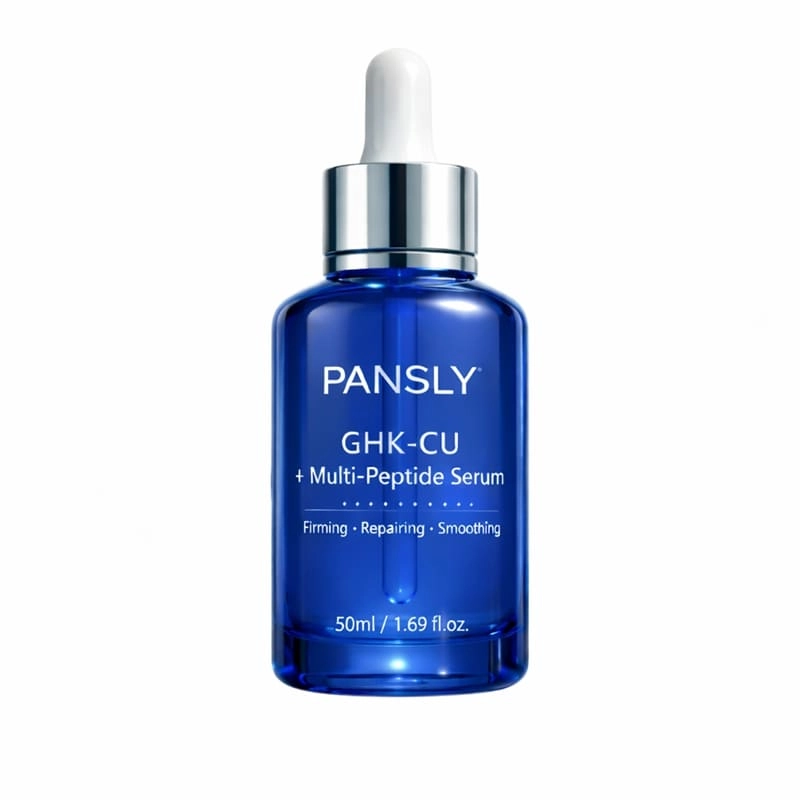
Experience visible rejuvenation with this GHK-Cu Copper Peptide Smoothing & Firming Face Serum, a high-performance concentrate designed to restore the structural integrity of aging skin. This advanced formula centers on GHK-Cu, a powerful signaling peptide clinically recognized for its ability to support natural collagen and elastin production. By promoting dermal density, it effectively tightens sagging skin and smooths the appearance of deep-set wrinkles and fine lines.
The lightweight, silky texture absorbs instantly, delivering antioxidant protection to neutralize environmental stressors that accelerate aging. Enhanced with deep-moisturizing agents, the serum reinforces the skin's moisture barrier, leaving the complexion feeling remarkably soft and resilient. With consistent use, skin texture is refined and facial contours appear more lifted, resulting in a youthfully firm and revitalized glow.
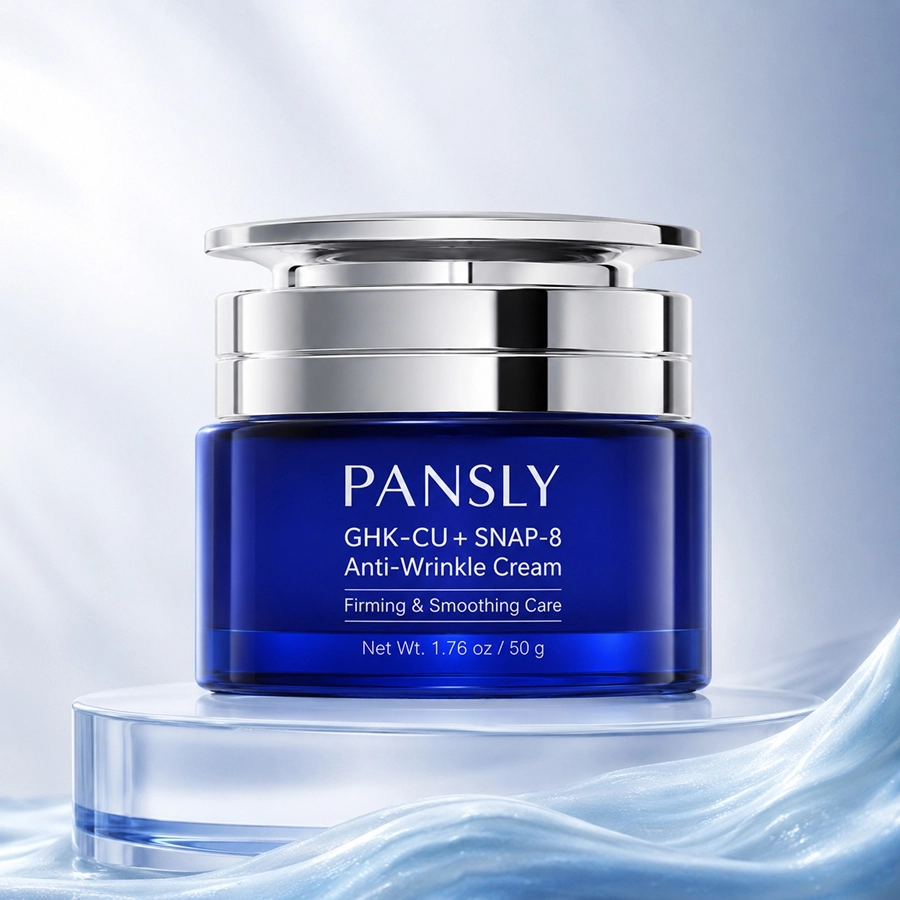
This Pansly GHK-CU + SNAP-8 Anti-Wrinkle Firming Cream is triple-peptide anti-aging facial cream, delivers targeted wrinkle smoothing, firming lifting and deep nourishment for dull, saggy, fine-line prone skin. Full OEM & ODM private label service is supported, including custom formula, packaging options, fast sampling and bulk export supply.
Five core premium active ingredients work synergistically for comprehensive anti-wrinkle care:
GHK-CU Copper Peptide lifts saggy skin, enhances skin resilience and tightens loose facial contour;
SNAP-8 Peptide targets expression lines to visibly soften and fade wrinkles;
Acetyl Hexapeptide-8 reduces the appearance of dry fine lines for smoother skin texture;
Ceramide NP reconstructs skin moisture barrier to lock nourishment and boost comfort;
Hyaluronic Acid delivers multi-layer rich deep moisture to relieve dry rough skin.
Luxury rich creamy texture spreads smoothly and melts into skin gently, leaving soft comfortable finish without heavy greasiness. Daily use blurs fine lines, firms loose skin, deeply nourishes and stabilizes barrier, refining uneven texture to reveal smooth, plump, youthful luminous skin.
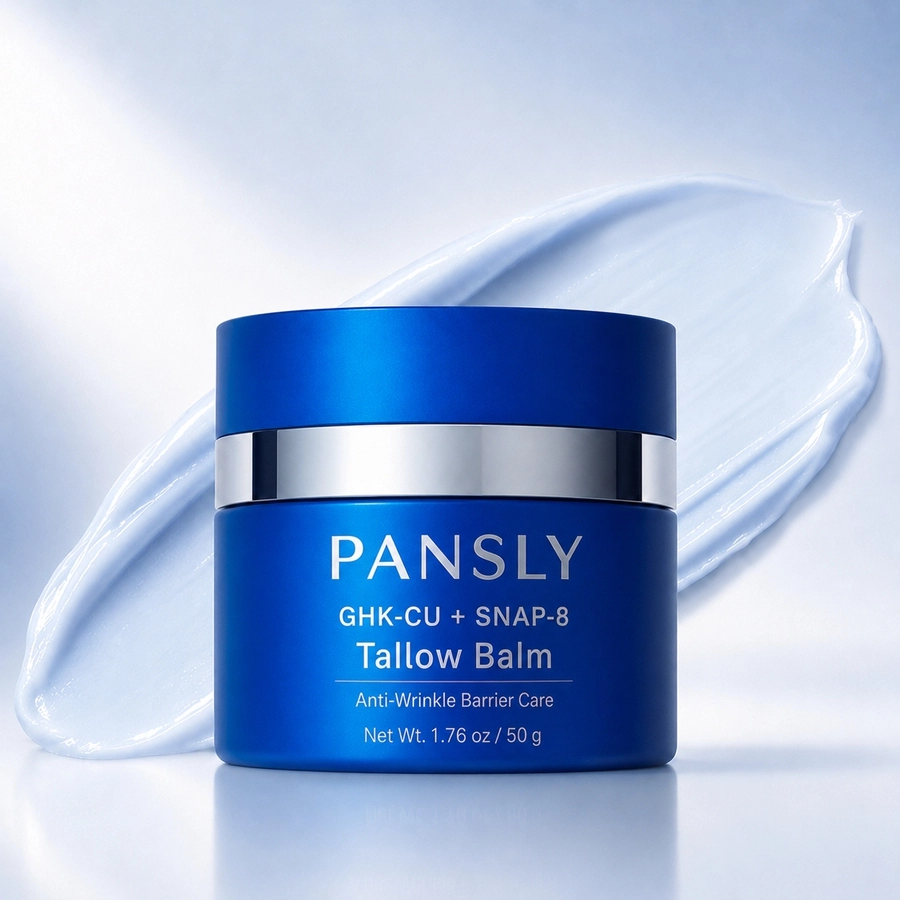
This Pansly GHK-CU + SNAP-8 Tallow Balm is a nourishing anti-wrinkle facial balm specially formulated for dry, fragile and sensitive skin, combining anti-aging wrinkle smoothing and barrier repairing effects. We offer full private label OEM service, including custom logo, adjustable formula, diversified packaging and lid color options.
It contains five core skin care active ingredients: GHK-CU visibly improves fine lines and revives dull complexion; SNAP-8 softens expression lines to smooth wrinkled skin texture; Grass-Fed Beef Tallow delivers deep lipid nourishment to relieve dry rough skin; Ectoin stabilizes the skin barrier and alleviates skin discomfort; Ceramide NP strengthens barrier structure to create smooth, healthy skin.
Luxury creamy blue balm texture glides smoothly and melts quickly on skin, providing long-lasting deep moisturizing comfort. Daily use fades fine lines & expression lines, nourishes dry delicate skin, repairs damaged barrier and leaves silky smooth skin finish.
Click here to customize the Beauty
we respond within a few hours
Monday–Friday, 9AM–6PM
3A01, Building A, Zhisheng Square, No. 4 Zhifu Road, Helong Street, Baiyun District, Guangzhou, China.


Leave a request, and we'll email you back within 24 hours.
© 2026 Beyond Basix. All Rights Reserved.