Barrier-Repair Lotion QC: Stability, Microbial, and ISO Checks

- Core Quality Risks in Barrier-Support Body Moisturizers
- Why emulsion stability is a commercial requirement
- Common failure modes and their root causes
- Stability, Microbial, and Packaging Verification
- Designing a meaningful stability program
- Microbial quality and preservative effectiveness
- Container compatibility and in-use protection
- ISO, GMP, and Supplier Audit Checks for OEM Projects
- What ISO 9001 adds to a cosmetics program
- GMP expectations for personal-care manufacturing
- Regulatory files and claim substantiation
- How Beyond Basix Supports One-Stop Skincare Manufacturing
- Integrated development and production capabilities
- Quality systems, certificates, and project documentation
- Broader product portfolio and partner value
- Frequently Asked Questions
Quality control for a barrier-repair body lotion requires more than confirming texture, fragrance, and ingredient declarations. Buyers must verify whether the emulsion remains physically stable, whether the preservation system controls contamination throughout its intended shelf life, whether the packaging protects the formula, and whether the manufacturer can provide traceable production and compliance records. A robust evaluation combines accelerated and real-time stability studies, microbial testing, preservative effectiveness assessment, raw-material controls, finished-product specifications, ISO and GMP documentation, and a clearly defined batch-release procedure. For brands developing sensitive-skin, dry-skin, or ceramide-focused body care, these checks reduce recall risk, protect consumer trust, and support reliable expansion across markets.
Core Quality Risks in Barrier-Support Body Moisturizers
Why emulsion stability is a commercial requirement
Most barrier-support lotions are oil-in-water emulsions containing humectants, emollients, occlusives, fatty alcohols, polymers, skin-identical lipids, botanical extracts, or active ingredients such as ceramides, niacinamide, panthenol, and allantoin. Each component can influence viscosity, droplet size, pH, odor, color, and preservation. A formula that looks acceptable immediately after filling may later separate, thin, crystallize, develop sediment, or show phase inversion during transport and storage.
For procurement teams, stability is directly connected to usable shelf life and customer returns. A reliable specification should define appearance, color, odor, pH range, viscosity range, density where relevant, fill weight, and microbiological limits. The product-development team should also identify critical quality attributes and critical process parameters, including emulsification temperature, homogenization time, cooling rate, addition temperature for heat-sensitive ingredients, and filling conditions.
Common failure modes and their root causes
Visible separation can result from insufficient emulsifier selection, inadequate homogenization, electrolyte incompatibility, excessive active loading, or an unsuitable oil-to-water ratio. Viscosity drift may be caused by polymer degradation, pH movement, preservative interactions, or temperature exposure. A rancid odor may indicate oxidation of vulnerable oils, poor headspace control, or inadequate antioxidant protection. Color changes can arise from botanical components, oxidation, metal-ion contamination, or interaction between the formula and the package.
These risks should be investigated through a documented formulation-development process rather than corrected only after a failed shipment. Buyers should request the development history, pilot-batch observations, compatibility results, and defined acceptance criteria. The supplier should be able to explain which tests are performed at laboratory, pilot, and commercial scale and how deviations are handled.
Stability, Microbial, and Packaging Verification
Designing a meaningful stability program
A useful stability program normally includes accelerated conditions, room-temperature or real-time observation, low-temperature exposure, freeze-thaw cycling where appropriate, centrifugation or stress screening during development, and light exposure when the formula or package is photosensitive. Accelerated testing can reveal likely failure mechanisms earlier, but it does not automatically replace real-time data. The final protocol should reflect the target market, packaging format, expected transport conditions, and proposed shelf life.
Each time point should record appearance, odor, color, pH, viscosity, microbial results, package condition, and any separation or leakage. Samples should be tested in the final commercial container because a pump, tube, jar, or airless package can change water loss, oxygen exposure, dosing behavior, and contamination risk. A stability report should show sample identification, storage conditions, test methods, results, analyst or laboratory responsibility, deviations, and conclusions.
Microbial quality and preservative effectiveness
Water-based personal-care products are vulnerable to bacteria, yeast, and mold. Contamination can enter through raw materials, process water, equipment, personnel, air, filling components, or consumer use. Finished-product microbiological testing should be based on a documented specification and suitable methods. Depending on the destination market and product claims, the program may include total aerobic microbial count, yeast and mold count, and absence or control of specified objectionable organisms.
Preservative selection should not be judged only by the ingredient list. Formula pH, water activity, surfactants, oils, polymers, botanical extracts, packaging geometry, and consumer-use patterns all affect preservation. A preservative effectiveness or challenge test introduces controlled microorganisms and measures their reduction or absence over defined intervals. The exact standard and pass criteria should be agreed with the qualified laboratory and aligned with the market’s regulatory expectations. The U.S. Food and Drug Administration guidance on cosmetic microbiological safety explains why manufacturers must control contamination and maintain sanitary production practices.
Container compatibility and in-use protection
Packaging is part of the quality system. A wide-mouth jar may expose a moisturizer to repeated finger contact, while an airless pump can reduce back-contamination and limit oxygen exposure. Tubes, pumps, caps, labels, adhesives, and decorated surfaces should be assessed for leakage, stress cracking, swelling, discoloration, odor transfer, dose consistency, and interaction with the formula.
Compatibility testing should include filled samples stored under relevant temperatures and orientations. For products containing high levels of oils, solvents, fragrances, or acidic ingredients, package-material interactions deserve particular attention. In-use simulation can help determine whether repeated opening and dosing affects microbiological quality. This is especially important for sensitive-skin products marketed for family or frequent daily use.
| QC area | Typical verification objective | Buyer evidence to request | Commercial risk if omitted |
|---|---|---|---|
| Physical stability | Confirm no unacceptable separation, odor, color, pH, or viscosity change | Protocol, time-point results, photos, deviation records | Returns, leakage, poor user experience, shortened shelf life |
| Microbial quality | Verify compliance with the approved microbial specification | Finished-product reports and laboratory methods | Safety concerns, market withdrawal, reputational damage |
| Preservative effectiveness | Assess resistance to controlled microbial challenge | Challenge-test report and acceptance criteria | In-use contamination and preservation failure |
| Packaging compatibility | Confirm container integrity and formula-package interaction | Compatibility, leakage, dose, and transport test records | Oxidation, contamination, leakage, and consumer complaints |
| Quality system | Ensure repeatable manufacturing and traceability | ISO/GMP certificates, batch records, CAPA and audit documents | Inconsistent batches and weak regulatory support |
ISO, GMP, and Supplier Audit Checks for OEM Projects
What ISO 9001 adds to a cosmetics program
ISO 9001 concerns the quality management system, including process control, customer requirements, documentation, corrective action, risk-based thinking, and continual improvement. It does not by itself prove that every lotion batch is safe or effective, so buyers should avoid treating an ISO certificate as a substitute for product testing. Instead, the certificate should be checked for scope, issuing body, validity, site address, and whether it covers relevant manufacturing activities.
The ISO 9001 quality management standard is useful as a framework for assessing how a supplier manages specifications, nonconformities, complaints, supplier controls, change management, and records. During an audit, project owners should examine whether actual factory practices match documented procedures. Evidence may include training files, calibration records, sanitation logs, environmental monitoring, water testing, batch manufacturing records, and retained samples.
GMP expectations for personal-care manufacturing
Cosmetic GMP focuses on hygienic premises, personnel practices, equipment suitability, raw-material identification, production controls, filling, labeling, storage, and distribution. The ISO 22716 cosmetics GMP standard is a recognized reference for good manufacturing practices in the cosmetics industry. Buyers should evaluate whether the supplier maintains controlled areas, cleaning validation or verification, pest control, water-system management, calibrated instruments, and documented line clearance.
For an OEM or ODM launch, traceability is essential. A compliant supplier should link each finished batch to raw-material lot numbers, packaging lots, operators, processing records, in-process test results, filling quantities, and release approval. A change-control procedure should cover formula adjustments, raw-material substitutions, packaging changes, equipment changes, and manufacturing-site changes. Without this discipline, a technically successful pilot batch may not be reproducible at commercial scale.
Regulatory files and claim substantiation
Regulatory expectations vary by destination. Buyers should define the intended countries before approving the formula, claims, label copy, and testing plan. Claims such as “supports the skin barrier,” “for sensitive skin,” “dermatologically tested,” or “24-hour hydration” require appropriate substantiation and should not imply treatment of a disease unless the product is regulated under the applicable medicinal framework.
The World Health Organization quality assurance guidance illustrates the importance of documented specifications, controlled procedures, and reliable testing in regulated product environments. Although cosmetics rules differ from pharmaceutical rules, the same procurement principle applies: every important claim and quality decision should be supported by suitable evidence rather than marketing language alone.
How Beyond Basix Supports One-Stop Skincare Manufacturing
Integrated development and production capabilities
Beyond Basix is Guangzhou Beyond Basix Cosmetics Ltd., a comprehensive cosmetics care manufacturer with more than 23 years of experience in research, production, and sales. Our 12,000-square-meter facility includes a 100,000-level GMPC pharmaceutical-grade dust-free workshop and 12 production lines. The site is equipped with advanced machinery imported from Germany, the United States, and other regions, supporting controlled processing and scalable output for private-label and custom-development projects.
Our team has focused on skincare products with effective ingredients for 12 years. For a brand developing a ceramide lotion, lipid-rich body moisturizer, calming emulsion, or dry-skin care range, this integrated model helps connect formulation decisions with production feasibility, filling performance, packaging selection, and quality documentation. The objective is not simply to create a pleasant texture; it is to create a reproducible commercial product with defined specifications and an executable launch plan.
Quality systems, certificates, and project documentation
Beyond Basix maintains certifications and documents including ISO 9001, CE, MSDS, GMP, and HALAL, subject to the relevance of each document to the product, market, and project scope. Buyers should review current certificates, certificate scope, issuing organizations, validity dates, and product-specific applicability during qualification. Our manufacturing process is supported by quality-control checkpoints from incoming materials through production, filling, finished-product inspection, and batch release.
For international buyers, documentation readiness can improve development efficiency. A project may require ingredient specifications, allergen or fragrance information, safety data, packaging details, microbiological results, stability records, certificates of analysis, product information files, or export documentation. Our team can coordinate these requirements with the formulation, production, packaging, and commercial departments so that technical information is aligned before shipment.
Broader product portfolio and partner value
Beyond Basix supports a broad personal-care portfolio spanning Skincare Products, Hair Care Products, Eye Care Products, and Body Care Products. This range allows distributors and brand owners to consolidate multiple categories with one manufacturing partner, potentially reducing communication complexity, sampling cycles, packaging coordination, and supplier-management workload.
We operate four major brands—LANTHOME, PANSLY, FIRSTSUN, and SAUVASINE—while also supporting OEM and ODM programs tailored to different positioning, pack sizes, ingredient strategies, and sales channels. Our commercial commitment is to provide competitive products, services, and prices while building long-term cooperation with partners. For buyers, supplier value should be measured through quality consistency, response speed, documentation accuracy, minimum-order alignment, production capacity, and total project cost rather than unit price alone.
A practical supplier-selection process should begin with a written product brief covering target consumer, market, claims, texture, packaging, cost target, annual volume, launch date, and required certifications. The next stage should review samples, formula and package compatibility, stability design, microbial strategy, pilot-batch performance, and quality agreements. Before mass production, the buyer and manufacturer should approve the final specification, artwork, packaging components, inspection standard, release documents, and change-notification rules. This sequence helps convert a promising concept into a controlled and scalable body-care product.
For additional technical context, buyers can consult the FDA cosmetics GMP guidelines and inspection checklist and the ISO 22716 reference for cosmetic GMP when preparing a supplier audit or quality agreement.
Frequently Asked Questions
What stability tests should a barrier-support body lotion undergo?
A suitable program may include accelerated, real-time, low-temperature, freeze-thaw, centrifugation, and light-exposure testing where relevant. Each time point should assess appearance, odor, color, pH, viscosity, microbial quality, and package condition in the final commercial container.
Why is preservative challenge testing important for a water-based lotion?
Water-based personal-care products can be contaminated by bacteria, yeast, and mold. A preservative effectiveness or challenge test evaluates how the preservation system responds to controlled microorganisms and helps confirm that the formula is suitable for its intended packaging and use conditions.
Does ISO 9001 prove that a cosmetic lotion is safe?
No. ISO 9001 evaluates the supplier’s quality management system and process controls; it does not replace product-specific stability, microbiological, safety, or compatibility testing. Buyers should check the certificate scope and request evidence for the actual product.
What should buyers review during a cosmetics GMP factory audit?
Important evidence includes controlled premises, personnel hygiene, cleaning records, water-system controls, environmental monitoring, calibrated equipment, raw-material identification, line clearance, batch records, retained samples, deviation management, corrective actions, and traceability from incoming materials to finished goods.
How can packaging affect the quality of a barrier-support moisturizer?
Packaging can influence oxygen exposure, water loss, dosing, leakage, contamination, and formula compatibility. Pumps and airless systems may reduce repeated contact, while jars require particular attention to in-use contamination. Filled compatibility and transport testing should be performed using the intended commercial package.
What documents should an OEM buyer request before mass production?
The buyer should request an approved product specification, stability protocol and results, microbiological reports, preservative challenge data where applicable, packaging compatibility records, certificates of analysis, GMP and ISO documentation, batch records, release criteria, change-control procedures, and market-specific regulatory documents.

Elevate your professional skincare offerings with this Private Label Copper Peptide Anti-Wrinkle Firming Serum, a powerhouse concentrate designed for superior age-defying results. This sophisticated formula leverages the synergistic effects of GHK-Cu and SNAP-8 to address multiple layers of skin aging. The GHK-Cu copper peptides act as a vital signaling mechanism to enhance skin density and firmness, while the advanced SNAP-8 octapeptide specifically targets expression lines, helping to relax the appearance of deep-seated wrinkles for a smoother, more refined surface.
This lightweight, rapid-absorption serum provides a professional-grade solution for clients seeking a non-invasive lift. It effectively restores elasticity, improves skin texture, and provides essential antioxidant protection. Perfect for high-end beauty brands, this serum leaves the complexion looking visibly contoured, hydrated, and youthfully revitalized.
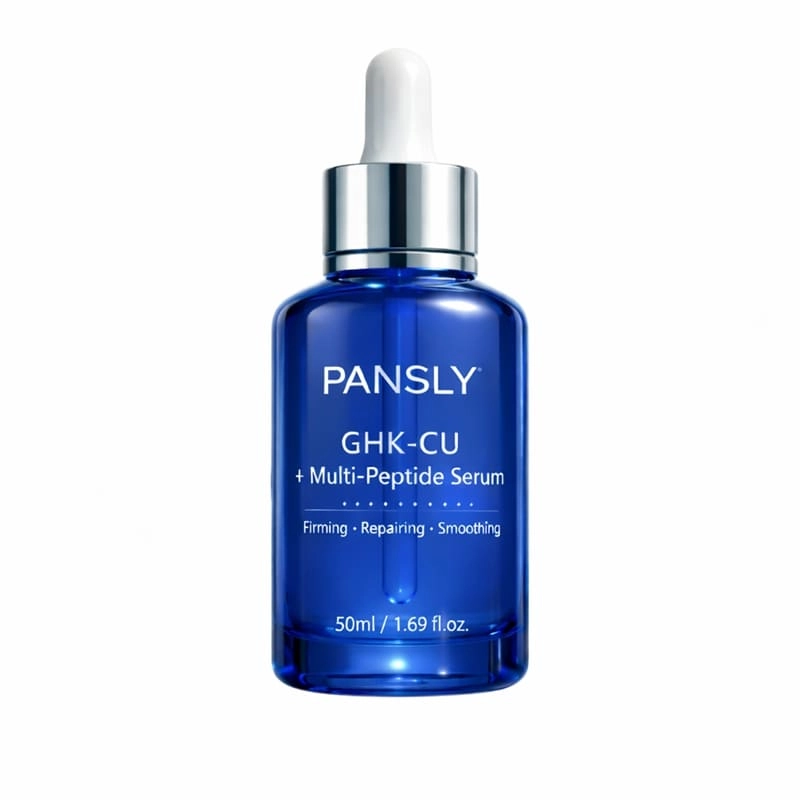
Experience visible rejuvenation with this GHK-Cu Copper Peptide Smoothing & Firming Face Serum, a high-performance concentrate designed to restore the structural integrity of aging skin. This advanced formula centers on GHK-Cu, a powerful signaling peptide clinically recognized for its ability to support natural collagen and elastin production. By promoting dermal density, it effectively tightens sagging skin and smooths the appearance of deep-set wrinkles and fine lines.
The lightweight, silky texture absorbs instantly, delivering antioxidant protection to neutralize environmental stressors that accelerate aging. Enhanced with deep-moisturizing agents, the serum reinforces the skin's moisture barrier, leaving the complexion feeling remarkably soft and resilient. With consistent use, skin texture is refined and facial contours appear more lifted, resulting in a youthfully firm and revitalized glow.
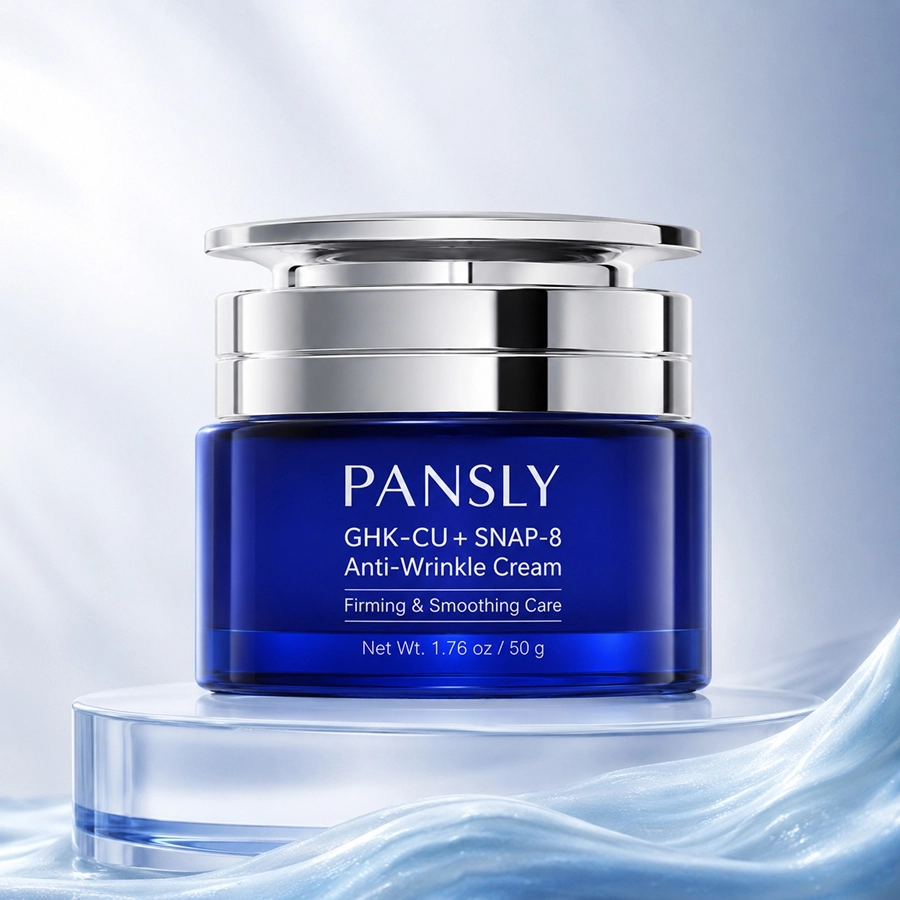
This Pansly GHK-CU + SNAP-8 Anti-Wrinkle Firming Cream is triple-peptide anti-aging facial cream, delivers targeted wrinkle smoothing, firming lifting and deep nourishment for dull, saggy, fine-line prone skin. Full OEM & ODM private label service is supported, including custom formula, packaging options, fast sampling and bulk export supply.
Five core premium active ingredients work synergistically for comprehensive anti-wrinkle care:
GHK-CU Copper Peptide lifts saggy skin, enhances skin resilience and tightens loose facial contour;
SNAP-8 Peptide targets expression lines to visibly soften and fade wrinkles;
Acetyl Hexapeptide-8 reduces the appearance of dry fine lines for smoother skin texture;
Ceramide NP reconstructs skin moisture barrier to lock nourishment and boost comfort;
Hyaluronic Acid delivers multi-layer rich deep moisture to relieve dry rough skin.
Luxury rich creamy texture spreads smoothly and melts into skin gently, leaving soft comfortable finish without heavy greasiness. Daily use blurs fine lines, firms loose skin, deeply nourishes and stabilizes barrier, refining uneven texture to reveal smooth, plump, youthful luminous skin.
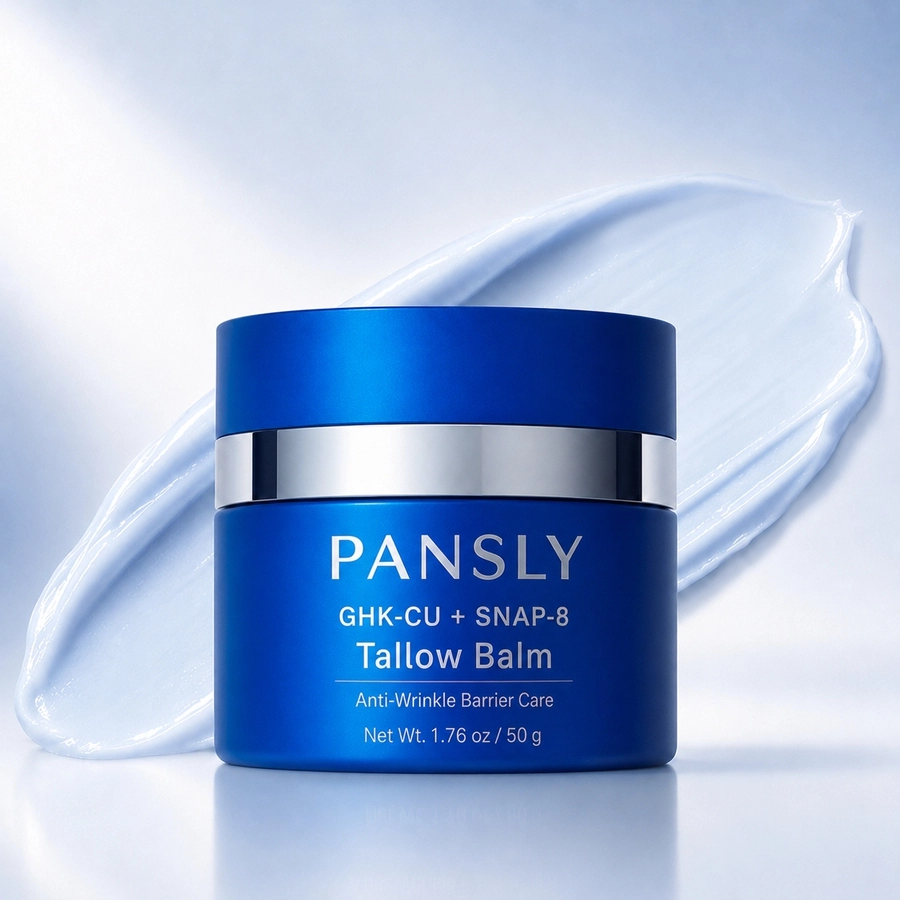
This Pansly GHK-CU + SNAP-8 Tallow Balm is a nourishing anti-wrinkle facial balm specially formulated for dry, fragile and sensitive skin, combining anti-aging wrinkle smoothing and barrier repairing effects. We offer full private label OEM service, including custom logo, adjustable formula, diversified packaging and lid color options.
It contains five core skin care active ingredients: GHK-CU visibly improves fine lines and revives dull complexion; SNAP-8 softens expression lines to smooth wrinkled skin texture; Grass-Fed Beef Tallow delivers deep lipid nourishment to relieve dry rough skin; Ectoin stabilizes the skin barrier and alleviates skin discomfort; Ceramide NP strengthens barrier structure to create smooth, healthy skin.
Luxury creamy blue balm texture glides smoothly and melts quickly on skin, providing long-lasting deep moisturizing comfort. Daily use fades fine lines & expression lines, nourishes dry delicate skin, repairs damaged barrier and leaves silky smooth skin finish.
Click here to customize the Beauty
we respond within a few hours
Monday–Friday, 9AM–6PM
3A01, Building A, Zhisheng Square, No. 4 Zhifu Road, Helong Street, Baiyun District, Guangzhou, China.


Leave a request, and we'll email you back within 24 hours.
© 2026 Beyond Basix. All Rights Reserved.