
How to Choose an OEM Manufacturer for SNAP-8 GHK-Cu Peptide Facial Cleanser
Decision-makers evaluating private-label partners for peptide-enriched facial cleansers require an evidence-driven supplier assessment framework that covers formulation capabilities for SNAP-8 and copper peptide actives, pharmaceutical-grade production controls, regulatory compliance, analytical verification, supply chain traceability, and commercial terms. This guide condenses procurement criteria, technical due-diligence checklists, comparative manufacturing metrics, and IP/QA contract best practices so that brand owners, contract managers, and investors can select a reliable one-stop OEM/ODM partner for advanced peptide cleanser projects.
- Selecting an OEM Partner for Peptide-Infused Facial Cleansers
- Formulation expertise for peptide actives and surfactant systems
- Processing conditions and peptide handling protocols
- Supplier qualification and Certificate of Analysis requirements
- Quality Systems, Regulatory Compliance, and Testing
- Good Manufacturing Practice and industry certifications
- Analytical testing: potency, impurities, and microbiology
- Regulatory dossiers and market-specific documentation
- Operational Capabilities, Supply Chain, and Commercial Terms
- Production scale-up and lead-time planning
- Packaging engineering and barrier requirements
- Commercial terms, cost drivers, and total cost of ownership
- Data Comparison: Traditional CM vs. One-Stop OEM/ODM for Peptide Cleansers
- Why a One-Stop Partner Reduces Project Risk
- Integrated R&D shortens validation cycles
- Single-vendor accountability improves supply security
- Commercial predictability and aftermarket support
- Beyond Basix: Capabilities That Match High-Risk Peptide Projects
- Facility scale and pharmaceutical-grade production
- Focused peptide and active-ingredient development
- Certifications, traceability, and partner support
- Product breadth and OEM/ODM service model
- Frequently Asked Questions
Decision-makers evaluating private-label partners for peptide-enriched facial cleansers require an evidence-driven supplier assessment framework that covers formulation capabilities for SNAP-8 and copper peptide actives, pharmaceutical-grade production controls, regulatory compliance, analytical verification, supply chain traceability, and commercial terms. This guide condenses procurement criteria, technical due-diligence checklists, comparative manufacturing metrics, and IP/QA contract best practices so that brand owners, contract managers, and investors can select a reliable one-stop OEM/ODM partner for advanced peptide cleanser projects.
Selecting an OEM Partner for Peptide-Infused Facial Cleansers
Formulation expertise for peptide actives and surfactant systems
Buyers should prioritize manufacturers with demonstrated experience formulating low-irritation surfactant systems compatible with peptide actives such as octapeptides and copper tripeptides. Key capabilities include microenvironment control (pH and chelation management), encapsulation options (liposomes, polymeric microparticles, or nanoemulsions), and validated methods that prevent peptide denaturation during mixing or heat exposure. Request technical dossiers showing accelerated stability (40°C/75% RH), real-time shelf-life data, and peptide potency retention measured by validated HPLC or LC-MS assays.
Processing conditions and peptide handling protocols
Peptide-containing liquid cleansers demand controlled processing: low-temperature mixing, inert gas blanketing for oxygen-sensitive sequences, and equipment dedicated or validated for peptide cross-contamination prevention. Vendors should provide standard operating procedures (SOPs) for cold chain logistics, storage at specified temperatures, and documented cleaning validation to avoid cross-contact with proteases or reactive intermediates.
Supplier qualification and Certificate of Analysis requirements
Procurement teams must require full traceability for raw peptide ingredients, with Certificates of Analysis (CoA), vendor GMP statements, and third-party purity validation. A robust supplier qualification program includes audit reports or remote assessments of peptide synthesis partners and raw-material vendors, material safety data sheets (MSDS), and clear batch numbering for upstream materials to support recalls or investigations.
Quality Systems, Regulatory Compliance, and Testing
Good Manufacturing Practice and industry certifications
A reliable contract manufacturer should operate under an established quality management system and carry relevant certifications. For cosmetic production, ISO 22716 (cosmetic GMP) is a baseline; additional certifications such as ISO 9001 and HALAL or CE for specific markets signal broader compliance. For regulatory context on cosmetics in major markets, reference the U.S. Food and Drug Administration cosmetics guidance and industry expectations on labeling and safety substantiation.
Analytical testing: potency, impurities, and microbiology
Analytical workflows must include validated potency assays for the peptide actives (eg. LC-MS quantification), impurity profiling, heavy metals screening, and full microbial testing (TAMC/TYMC, pathogen absence). Buyers should stipulate acceptance criteria, retest and release procedures, and access to raw test data. Independent third-party laboratories can be requested for cross-validation of critical batches.
Regulatory dossiers and market-specific documentation
Manufacturers must deliver documentation required for registration or notification in target markets: safety assessments, toxicology summaries, ingredient nomenclature compliant with INCI, and stability reports. For global sellers, alignment with region-specific rules—such as FDA guidance in the U.S. and EU cosmetics regulation—reduces time-to-market risk; the peer-reviewed and reference-level literature on peptides can be cited within technical briefs where mechanism-of-action claims require support.
Operational Capabilities, Supply Chain, and Commercial Terms
Production scale-up and lead-time planning
Evaluate an OEM partner’s ability to scale from lab/pilot (1–50 kg) to commercial batches (hundreds to thousands of kilograms) without reformulation. Confirm available production lines, minimum order quantities (MOQ) for liquid cleansers, average lead times for pilot samples and commercial runs, and capacity planning protocols. Effective vendors provide Gantt charts and milestone-driven timelines for formula transfer, stability studies, pilot runs, and commercial release.
Packaging engineering and barrier requirements
Peptide stability can be compromised by oxygen and light exposure. Suppliers should offer packaging options with appropriate barrier performance—airless dispensers, amber containers, or laminated tubes—and compatibility testing between formula and packaging materials. Confirm the OEM can perform extractables and leachables screening when required by key accounts.
Commercial terms, cost drivers, and total cost of ownership
Cost drivers for peptide cleansers include active concentration, specialised encapsulation or delivery systems, preservative choice, and packaging complexity. Procurement should analyze unit cost at target run size and include buffer for QC failures and rework. Negotiate pilot pricing, long-term volume discounts, payment terms, and warranty clauses to protect margin and lead-time commitments.
Data Comparison: Traditional CM vs. One-Stop OEM/ODM for Peptide Cleansers
| Capability | Traditional Contract Manufacturer | One-Stop OEM/ODM (Advanced Peptide Projects) |
|---|---|---|
| Facility footprint | <2,000 m², mixed-use plants | ~12,000 m² dedicated production and R&D areas |
| Cleanroom / GMP level | Standard cosmetic hygiene; limited pharma-grade zones | 100,000-level pharmaceutical-grade dust-free workshops (GMPC) |
| Production lines | 1–3 lines, limited parallel capacity | Multiple dedicated lines (eg. 12) with segregated processes |
| Peptide handling and analytics | Basic QC; third-party peptide testing | On-site analytical lab with HPLC/LC-MS and stability chambers |
| Average lead time (pilot to commercial) | 12–20+ weeks | 8–16 weeks with integrated R&D and pilot capacity |
| Certifications | Local GMP or none | ISO 9001, GMP, CE, HALAL, MSDS compliance |
| R&D & formulation support | Limited; external consultants | In-house formulation chemists and application labs |
Why a One-Stop Partner Reduces Project Risk
Integrated R&D shortens validation cycles
Vendors that combine formulation science, analytical labs, and pilot manufacturing reduce iteration time between stability tests and process adjustments. This integration reduces reformulation risk when scaling peptide-containing prototypes and accelerates regulatory dossier assembly.
Single-vendor accountability improves supply security
Coordinating raw-material sourcing, production, and packaging under a single contract minimizes handoff points that commonly introduce delays or quality gaps. A one-stop partner typically provides centralized documentation, change-control, and product lifecycle management.
Commercial predictability and aftermarket support
Full-service OEM/ODM suppliers commonly offer post-launch monitoring, complaint handling, and rapid response capabilities for lot-specific investigations—features that are critical when selling actives with potency-sensitive performance.
Beyond Basix: Capabilities That Match High-Risk Peptide Projects
Facility scale and pharmaceutical-grade production
Guangzhou Beyond Basix Cosmetics Ltd. is a leading comprehensive cosmetics care manufacturer with over 23 years of experience in research, production, and sales. Our 12,000-square-meter facility includes a 100,000-level GMPC pharmaceutical-grade dust-free workshop and 12 production lines, equipped with advanced machinery imported from Germany, the US, and other regions.
Focused peptide and active-ingredient development
Focusing on the development of skincare products with effective ingredients for 12 years, we operate four major brands: LANTHOME, PANSLY, FIRSTSUN, and SAUVASINE. Our R&D and QC teams maintain validated analytical methods for peptide quantification and stability, enabling reliable potency retention and claim support during scale-up.
Certifications, traceability, and partner support
We are certified with ISO 9001, CE, MSDS, GMP, HALAL, and more. Committed to offering the best products, services, and prices, we aim to grow and progress together with our partners. Our supply-chain governance and vendor qualification protocols provide clear traceability for peptide actives and other critical inputs, reducing regulatory and recall risk.
Product breadth and OEM/ODM service model
Beyond Basix delivers full-service private-label manufacturing across Skincare Products, Hair Care Products, Eye Care Products, and Body Care Products, combined with turnkey development services; this range allows brand owners to consolidate portfolios with a single trusted provider and leverage cross-category innovations such as peptide delivery systems and barrier-stable formulations.
Contact Beyond Basix today to discuss custom peptide cleanser development or view our product capabilities.
Frequently Asked Questions
What analytical tests should brand owners request for peptide-containing cleansers?
Brand owners should require validated potency assays (HPLC or LC-MS), impurity profiling, heavy metals screening, full microbial testing (TAMC/TYMC and pathogen absence), preservative efficacy tests (challenge tests), and accelerated + real-time stability reports showing active retention under specified conditions.
How can a buyer verify the quality and origin of SNAP-8 or copper peptides sourced by the manufacturer?
Buyers should request Certificates of Analysis (CoA) from the peptide supplier, supplier GMP statements, third-party assay confirmation, vendor audit reports, and full traceability records linking raw-material batch numbers to finished-batch release documentation.
What certifications and regulatory references matter when choosing a cosmetic OEM for advanced actives?
Key certifications include ISO 22716 (cosmetic GMP), ISO 9001, and region-specific approvals as required. For regulatory guidance, consult the FDA cosmetics resources and the ISO 22716 standard; suppliers with GMP and recognized certifications reduce market-entry risk.
What typical lead times and MOQs should be expected for peptide-enriched liquid cleansers?
Lead times vary by partner capability; pilot samples often require 6–12 weeks for formulation and initial stability data, while commercial runs may be 8–16 weeks depending on capacity. MOQs depend on packaging and line configuration; one-stop OEMs with multiple production lines often offer lower MOQs and faster turnaround than smaller contract manufacturers.
How should packaging and preservation be specified for peptide facial cleansers to protect active stability?
Specify oxygen- and light-protective packaging (airless pumps, amber bottles), materials compatibility testing, and preservatives compatible with peptides and surfactants. Require extractables/leachables testing where appropriate and confirm vendor can validate container/closure performance during stability studies.

Elevate your professional skincare offerings with this Private Label Copper Peptide Anti-Wrinkle Firming Serum, a powerhouse concentrate designed for superior age-defying results. This sophisticated formula leverages the synergistic effects of GHK-Cu and SNAP-8 to address multiple layers of skin aging. The GHK-Cu copper peptides act as a vital signaling mechanism to enhance skin density and firmness, while the advanced SNAP-8 octapeptide specifically targets expression lines, helping to relax the appearance of deep-seated wrinkles for a smoother, more refined surface.
This lightweight, rapid-absorption serum provides a professional-grade solution for clients seeking a non-invasive lift. It effectively restores elasticity, improves skin texture, and provides essential antioxidant protection. Perfect for high-end beauty brands, this serum leaves the complexion looking visibly contoured, hydrated, and youthfully revitalized.
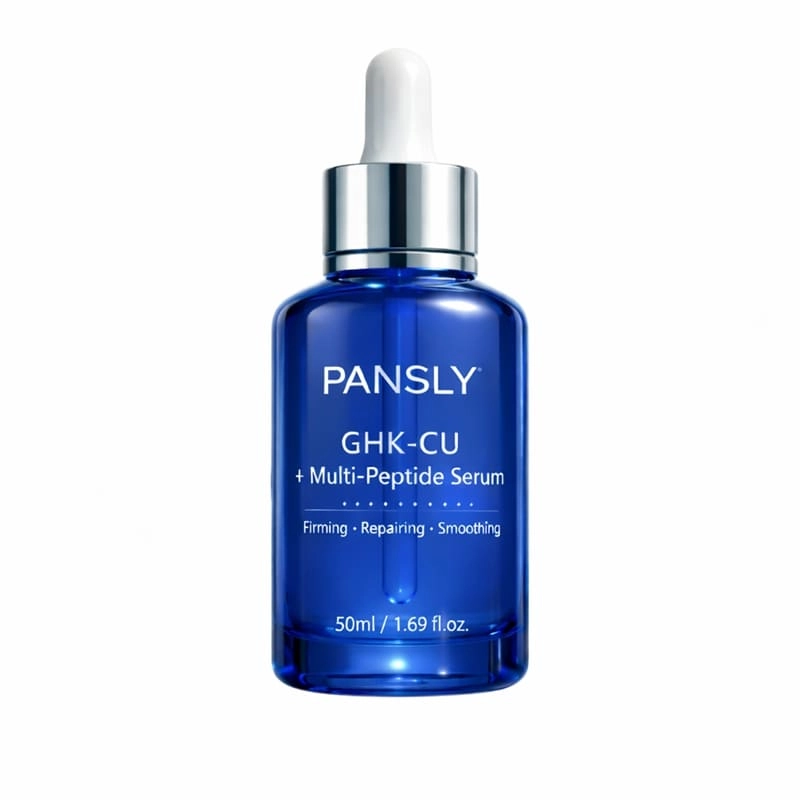
Experience visible rejuvenation with this GHK-Cu Copper Peptide Smoothing & Firming Face Serum, a high-performance concentrate designed to restore the structural integrity of aging skin. This advanced formula centers on GHK-Cu, a powerful signaling peptide clinically recognized for its ability to support natural collagen and elastin production. By promoting dermal density, it effectively tightens sagging skin and smooths the appearance of deep-set wrinkles and fine lines.
The lightweight, silky texture absorbs instantly, delivering antioxidant protection to neutralize environmental stressors that accelerate aging. Enhanced with deep-moisturizing agents, the serum reinforces the skin's moisture barrier, leaving the complexion feeling remarkably soft and resilient. With consistent use, skin texture is refined and facial contours appear more lifted, resulting in a youthfully firm and revitalized glow.
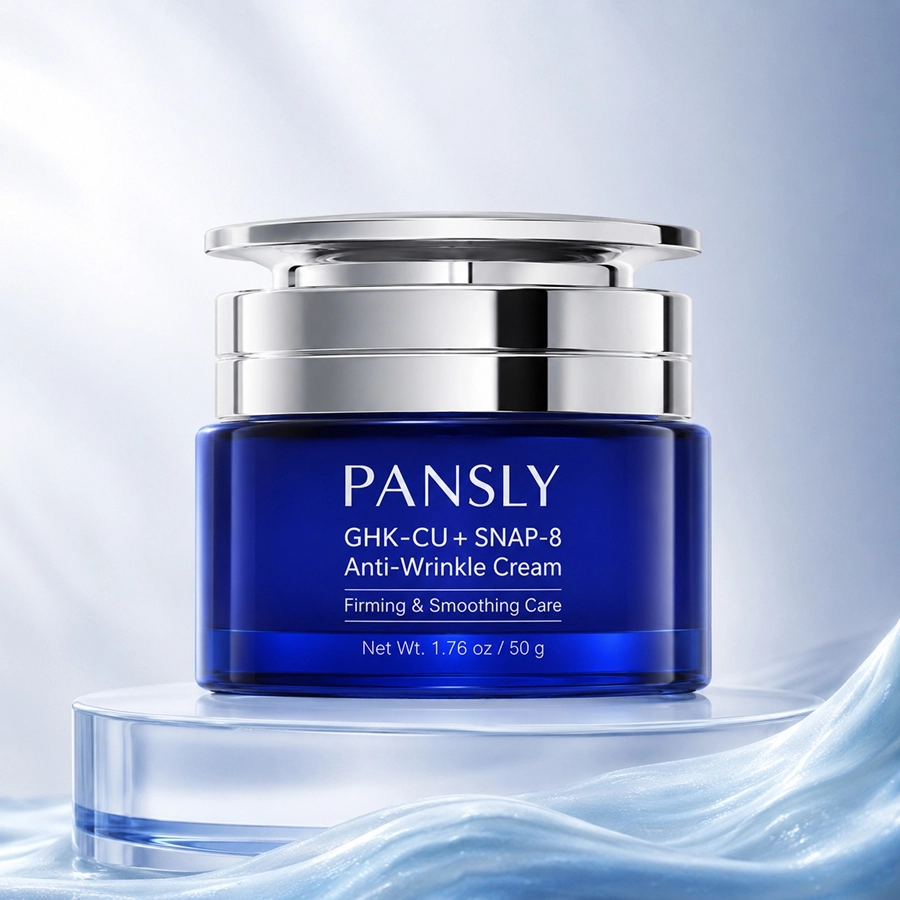
This Pansly GHK-CU + SNAP-8 Anti-Wrinkle Firming Cream is triple-peptide anti-aging facial cream, delivers targeted wrinkle smoothing, firming lifting and deep nourishment for dull, saggy, fine-line prone skin. Full OEM & ODM private label service is supported, including custom formula, packaging options, fast sampling and bulk export supply.
Five core premium active ingredients work synergistically for comprehensive anti-wrinkle care:
GHK-CU Copper Peptide lifts saggy skin, enhances skin resilience and tightens loose facial contour;
SNAP-8 Peptide targets expression lines to visibly soften and fade wrinkles;
Acetyl Hexapeptide-8 reduces the appearance of dry fine lines for smoother skin texture;
Ceramide NP reconstructs skin moisture barrier to lock nourishment and boost comfort;
Hyaluronic Acid delivers multi-layer rich deep moisture to relieve dry rough skin.
Luxury rich creamy texture spreads smoothly and melts into skin gently, leaving soft comfortable finish without heavy greasiness. Daily use blurs fine lines, firms loose skin, deeply nourishes and stabilizes barrier, refining uneven texture to reveal smooth, plump, youthful luminous skin.
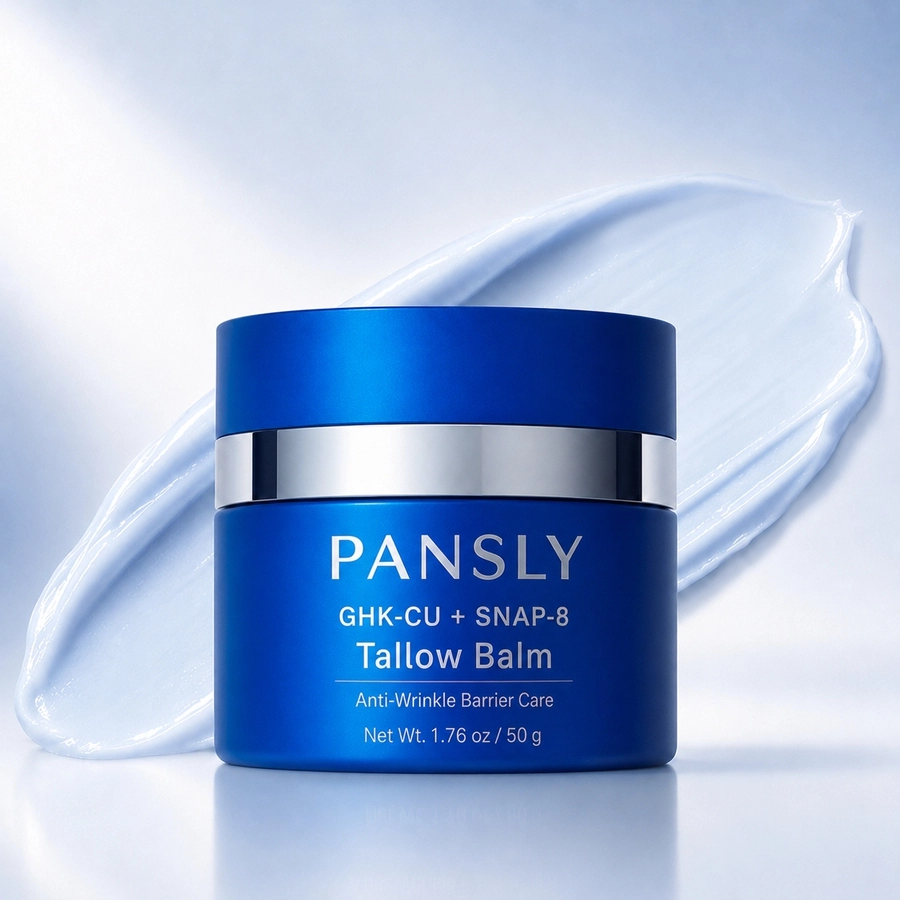
This Pansly GHK-CU + SNAP-8 Tallow Balm is a nourishing anti-wrinkle facial balm specially formulated for dry, fragile and sensitive skin, combining anti-aging wrinkle smoothing and barrier repairing effects. We offer full private label OEM service, including custom logo, adjustable formula, diversified packaging and lid color options.
It contains five core skin care active ingredients: GHK-CU visibly improves fine lines and revives dull complexion; SNAP-8 softens expression lines to smooth wrinkled skin texture; Grass-Fed Beef Tallow delivers deep lipid nourishment to relieve dry rough skin; Ectoin stabilizes the skin barrier and alleviates skin discomfort; Ceramide NP strengthens barrier structure to create smooth, healthy skin.
Luxury creamy blue balm texture glides smoothly and melts quickly on skin, providing long-lasting deep moisturizing comfort. Daily use fades fine lines & expression lines, nourishes dry delicate skin, repairs damaged barrier and leaves silky smooth skin finish.
Click here to customize the Beauty
we respond within a few hours
Monday–Friday, 9AM–6PM
3A01, Building A, Zhisheng Square, No. 4 Zhifu Road, Helong Street, Baiyun District, Guangzhou, China.


Leave a request, and we'll email you back within 24 hours.
© 2026 Beyond Basix. All Rights Reserved.
