
How to Choose the PDRN Anti-Wrinkle manufacturer and supplier ?
- Supply Chain Risks and Manufacturing Landscape for Skincare OEM/ODM
- Regional manufacturing realities and supplier types
- Common sourcing pitfalls and how they affect PDRN Anti-Wrinkle projects
- Regulatory and market expectations
- Technical Vetting: Raw Materials, Formulation, and Safety Testing
- Raw-material provenance and analytical controls
- Formulation stability and compatibility
- Safety, efficacy substantiation, and claim support
- Factory Audit, Certification, and Production Controls
- Facility standards: GMPC/GMP and controlled environments
- Quality systems, batch records, and release criteria
- Certifications and third-party audits
- Commercial Terms, Logistics, and Long-Term Partnership Criteria
- Lead times, MOQ, and scalability
- Cold-chain and packaging logistics
- IP, formulation ownership, and contract protections
- Due-Diligence Checklist for On-Site and Remote Audits
- Pre-audit document requests
- On-site audit priorities
- Post-audit follow-up and corrective actions
- Frequently Asked Questions
- How do I verify the authenticity of PDRN raw material certificates?
- What key tests should a PDRN Anti-Wrinkle finished product include?
- Are special packaging or cold-chain requirements common for PDRN Anti-Wrinkle formulations?
- Which certifications are non-negotiable when choosing an OEM/ODM?
- How should I structure IP and formulation ownership with a manufacturer?
- What red flags during a supplier audit indicate high risk?
- Frequently Asked Questions
Prioritize verifiable quality and traceability when sourcing PDRN Anti-Wrinkle: require raw-material COAs and supplier chain-of-custody, confirm production in a pharmaceutical-grade GMPC/GMP workshop, verify ISO 9001 and GMP certifications, demand stability, microbial and safety data, audit cold-chain logistics where required, and insist on clear OEM/ODM IP and labeling agreements to mitigate compliance, recall, and efficacy risks for PDRN Anti-Wrinkle lines.
Supply Chain Risks and Manufacturing Landscape for Skincare OEM/ODM
Regional manufacturing realities and supplier types
Understanding the supplier spectrum is the first practical step when evaluating PDRN Anti-Wrinkle manufacturers: you will encounter ingredient suppliers, dedicated PDRN extract houses, white-label cosmetic formulators, and One-Stop OEM/ODM for Skincare factories that offer formulation, filling, packaging and regulatory support. Each supplier type has different capital intensity, liability profile, and traceability capability. Choose a full-service OEM/ODM when you need single-point accountability for PDRN Anti-Wrinkle formulation, testing, and product release.
Common sourcing pitfalls and how they affect PDRN Anti-Wrinkle projects
Typical failures include accepting generic COAs without batch-linked testing, ignoring endotoxin or residual solvent testing for nucleic-acid-derived ingredients, and lax environmental controls during filling. PDRN Anti-Wrinkle products are frequently marketed as serums or ampoules where stability, sterility (or controlled preservative systems), and cold-chain logistics can materially affect performance; mitigate these by requiring lot-specific test reports and on-site audit evidence.
Regulatory and market expectations
Regulatory expectations for PDRN Anti-Wrinkle vary by market—some regions treat PDRN-containing products as cosmetics, others require higher safety substantiation. Reference global standards such as ISO 9001 Quality Management and WHO/EMA/FDA guidance on biological materials when formulating claims; always confirm whether PDRN use imposes additional local regulatory obligations.
Technical Vetting: Raw Materials, Formulation, and Safety Testing
Raw-material provenance and analytical controls
Insist on supplier documentation for polydeoxyribonucleotide sources: the PDRN Anti-Wrinkle buyer should obtain vendor certificates of analysis (COA), chain-of-custody records, endotoxin results, and impurity profiles for each lot. Analytical methods (HPLC, UV spectrophotometry, gel electrophoresis) used to quantify polydeoxyribonucleotide should be specified and validated; if they are not, plan to commission third-party testing on incoming lots.
Formulation stability and compatibility
PDRN molecules are sensitive to pH, temperature and enzymatic degradation. When evaluating a manufacturer for PDRN Anti-Wrinkle serums or ampoules, require accelerated and real-time stability data, preservative effectiveness testing (if applicable), and compatibility studies with intended packaging (glass, coated glass, or polymer ampoules). A robust OEM/ODM partner will provide stability matrices and storage-condition recommendations.
Safety, efficacy substantiation, and claim support
For PDRN Anti-Wrinkle positioning you must balance marketing claims with clinical support. Demand patch test, irritation, and sensitization data; if efficacy claims (e.g., wrinkle reduction, skin repair) are made, request clinical trial summaries or in vitro bioactivity assays. Manufacturers with a research history in PDRN are more likely to offer reproducible efficacy data and responsible claim language.
Factory Audit, Certification, and Production Controls
Facility standards: GMPC/GMP and controlled environments
Verify that filling and aseptic operations for PDRN Anti-Wrinkle occur within certified dust-free or controlled cleanrooms. Ask for a tour (virtual or on-site) of the 100,000-level GMPC pharmaceutical-grade workshop and review environmental monitoring logs, positive-pressure controls, and personnel gowning procedures. Production in a certified environment reduces contamination risk and supports product shelf-life claims.
Quality systems, batch records, and release criteria
Review the manufacturer’s quality manual, batch manufacturing records (BMR), and final product release checklist. For PDRN Anti-Wrinkle lines ensure in-process checks cover PDRN assay, microbial limits, particulate testing (for ampoules), and final visual inspection. A credible OEM/ODM supplier will trace each batch backward to raw-material lot numbers and forward to packaging/shipments.
Certifications and third-party audits
Request copies of ISO 9001, GMP, MSDS for active ingredients, halal or regional certifications as needed, and recent third-party audit reports. Cross-check these with authoritative sources such as the Good Manufacturing Practice (GMP) overview and national certification bodies. Manufacturers that host independent audits and publish corrective action plans show higher operational transparency.
Commercial Terms, Logistics, and Long-Term Partnership Criteria
Lead times, MOQ, and scalability
Negotiate minimum order quantities (MOQs), lead times, and scale-up commitments. For PDRN Anti-Wrinkle products, small changes in process or raw-material source can require revalidation; a reliable OEM/ODM will present scalable production lines and clearly defined timelines for tech-transfer and scale-up without compromising product specifications.
Cold-chain and packaging logistics
Depending on formulation sensitivity, PDRN Anti-Wrinkle serums may need refrigerated storage and temperature-controlled transport. Verify the manufacturer’s cold-chain partners, validated shipping containers, and temperature-monitoring protocols during transit. Packaging resilience (to prevent breakage of ampoules) should be validated under ISTA or equivalent test standards.
IP, formulation ownership, and contract protections
Get explicit contractual terms on formulation ownership, confidentiality, and exclusivity. Define who owns improvements, registration dossiers, and artwork. A professional One-Stop OEM/ODM for Skincare will support brand protection with NDA templates, technical transfer documents, and clear clauses for regulatory submissions and product recalls.
| Criteria | Standard Requirement | Importance (1-5) |
|---|---|---|
| Facility Standard | GMPC/GMP-certified cleanrooms; environmental monitoring logs | 5 |
| Raw-Material Traceability | Lot-specific COA, chain-of-custody, endotoxin and impurity data | 5 |
| Analytical Methods | Validated HPLC/UV/gel assays for polydeoxyribonucleotide | 5 |
| Stability Data | Accelerated and real-time stability for finished PDRN Anti-Wrinkle formulations | 5 |
| Safety Testing | Irritation, sensitization, microbial and preservative efficacy tests | 5 |
| Certifications | ISO 9001, GMP, MSDS, CE/HALAL as required | 4 |
| Logistics | Validated cold-chain, ISTA packaging tests, tracking | 4 |
| Commercial Terms | Clear MOQs, lead times, NDA and IP clauses | 4 |
Due-Diligence Checklist for On-Site and Remote Audits
Pre-audit document requests
Before any visit request copies of certifications, recent COAs for the PDRN raw material, stability summaries, BMR examples, and any clinical or in vitro data supporting anti-wrinkle claims for PDRN Anti-Wrinkle products. Evaluate these documents to prioritize audit focus areas.
On-site audit priorities
During a site audit inspect water-for-injection or purified-water generation (if used), observe aseptic filling, review environmental monitoring records, and conduct employee interviews about training and sanitation. Photograph or collect timestamped evidence of production lines that will manufacture your PDRN Anti-Wrinkle products.
Post-audit follow-up and corrective actions
Require a formal audit report with non-conformance items and a CAPA (Corrective and Preventive Actions) plan and timelines. For PDRN Anti-Wrinkle projects, make production conditional on closure of critical non-conformances that could impact product safety or stability.
Frequently Asked Questions
How do I verify the authenticity of PDRN raw material certificates?
Request original COAs directly from the raw-material manufacturer, verify lot numbers with the supplier, and, if needed, commission third-party independent testing labs to confirm identity and purity of polydeoxyribonucleotide.
What key tests should a PDRN Anti-Wrinkle finished product include?
Finished-product testing should cover PDRN assay, microbial limits, preservative efficacy (if applicable), pH, viscosity, particle/particulate inspection (for ampoules), and accelerated stability to support shelf-life.
Are special packaging or cold-chain requirements common for PDRN Anti-Wrinkle formulations?
Yes—depending on formulation stability, PDRN Anti-Wrinkle serums or injectable-adjacent formats may require refrigerated storage and validated insulated packaging during transit; confirm with the manufacturer and run transport simulation tests.
Which certifications are non-negotiable when choosing an OEM/ODM?
For PDRN Anti-Wrinkle projects, insist on GMP/GMPC facility certification, ISO 9001 quality management, and clear MSDS documentation for active ingredients; additional regional certifications (CE, HALAL) depend on target markets.
How should I structure IP and formulation ownership with a manufacturer?
Use NDAs, tech-transfer agreements, and clearly defined clauses in the OEM/ODM contract that specify ownership of formulations, exclusivity terms, and responsibilities for regulatory submissions to prevent disputes.
What red flags during a supplier audit indicate high risk?
Red flags include absence of batch-level COAs, inconsistent environmental monitoring logs, refusal to allow photos or copies of key documents, unsolved critical CAPAs, and lack of validated analytical methods for PDRN quantification.
Guangzhou Beyond Basix Cosmetics Ltd. is a leading comprehensive cosmetics care manufacturer with over 23 years of experience in research, production, and sales. Our 12,000-square-meter facility includes a 100,000-level GMPC pharmaceutical-grade dust-free workshop and 12 production lines, equipped with advanced machinery imported from Germany, the US, and other regions.Focusing on the development of skincare products with effective ingredients for 12 years, we operate four major brands: LANTHOME, PANSLY, FIRSTSUN, and SAUVASINE. We are certified with ISO 9001, CE, MSDS, GMP, HALAL, and more.Committed to offering the best products, services, and prices, we aim to grow and progress together with our partners. We are more than just skincare—connect with us today!
Frequently Asked Questions
How do I verify the authenticity of PDRN raw material certificates?
Request original COAs directly from the raw-material manufacturer, verify lot numbers with the supplier, and, if needed, commission third-party independent testing labs to confirm identity and purity of polydeoxyribonucleotide.
What key tests should a PDRN Anti-Wrinkle finished product include?
Finished-product testing should cover PDRN assay, microbial limits, preservative efficacy (if applicable), pH, viscosity, particle/particulate inspection (for ampoules), and accelerated stability to support shelf-life.
Are special packaging or cold-chain requirements common for PDRN Anti-Wrinkle formulations?
Yes—depending on formulation stability, PDRN Anti-Wrinkle serums or injectable-adjacent formats may require refrigerated storage and validated insulated packaging during transit; confirm with the manufacturer and run transport simulation tests.
Which certifications are non-negotiable when choosing an OEM/ODM?
For PDRN Anti-Wrinkle projects, insist on GMP/GMPC facility certification, ISO 9001 quality management, and clear MSDS documentation for active ingredients; additional regional certifications (CE, HALAL) depend on target markets.
How should I structure IP and formulation ownership with a manufacturer?
Use NDAs, tech-transfer agreements, and clearly defined clauses in the OEM/ODM contract that specify ownership of formulations, exclusivity terms, and responsibilities for regulatory submissions to prevent disputes.
What red flags during a supplier audit indicate high risk?
Red flags include absence of batch-level COAs, inconsistent environmental monitoring logs, refusal to allow photos or copies of key documents, unsolved critical CAPAs, and lack of validated analytical methods for PDRN quantification.

Elevate your professional skincare offerings with this Private Label Copper Peptide Anti-Wrinkle Firming Serum, a powerhouse concentrate designed for superior age-defying results. This sophisticated formula leverages the synergistic effects of GHK-Cu and SNAP-8 to address multiple layers of skin aging. The GHK-Cu copper peptides act as a vital signaling mechanism to enhance skin density and firmness, while the advanced SNAP-8 octapeptide specifically targets expression lines, helping to relax the appearance of deep-seated wrinkles for a smoother, more refined surface.
This lightweight, rapid-absorption serum provides a professional-grade solution for clients seeking a non-invasive lift. It effectively restores elasticity, improves skin texture, and provides essential antioxidant protection. Perfect for high-end beauty brands, this serum leaves the complexion looking visibly contoured, hydrated, and youthfully revitalized.
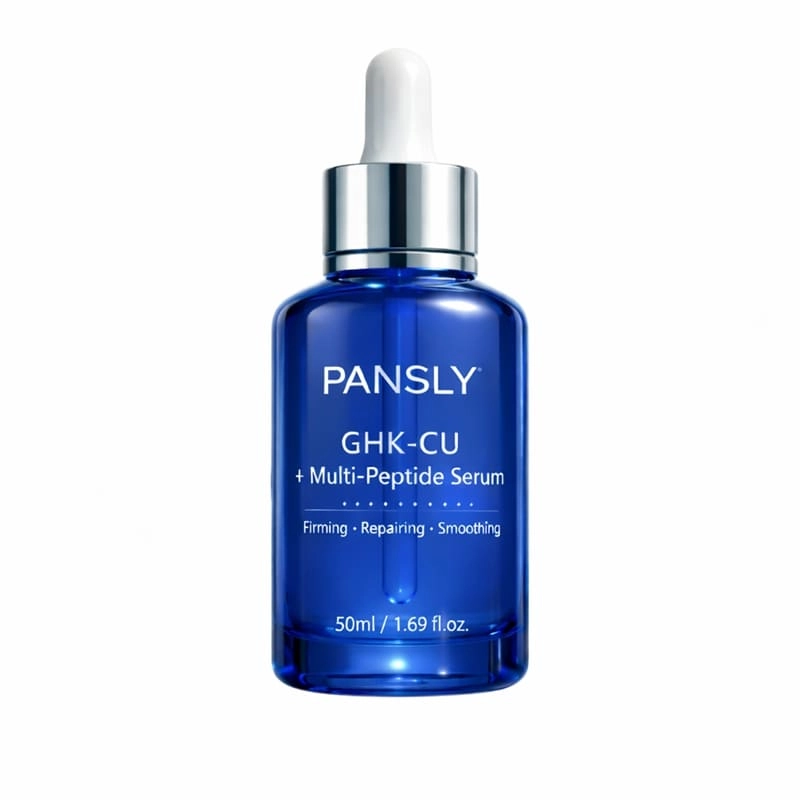
Experience visible rejuvenation with this GHK-Cu Copper Peptide Smoothing & Firming Face Serum, a high-performance concentrate designed to restore the structural integrity of aging skin. This advanced formula centers on GHK-Cu, a powerful signaling peptide clinically recognized for its ability to support natural collagen and elastin production. By promoting dermal density, it effectively tightens sagging skin and smooths the appearance of deep-set wrinkles and fine lines.
The lightweight, silky texture absorbs instantly, delivering antioxidant protection to neutralize environmental stressors that accelerate aging. Enhanced with deep-moisturizing agents, the serum reinforces the skin's moisture barrier, leaving the complexion feeling remarkably soft and resilient. With consistent use, skin texture is refined and facial contours appear more lifted, resulting in a youthfully firm and revitalized glow.
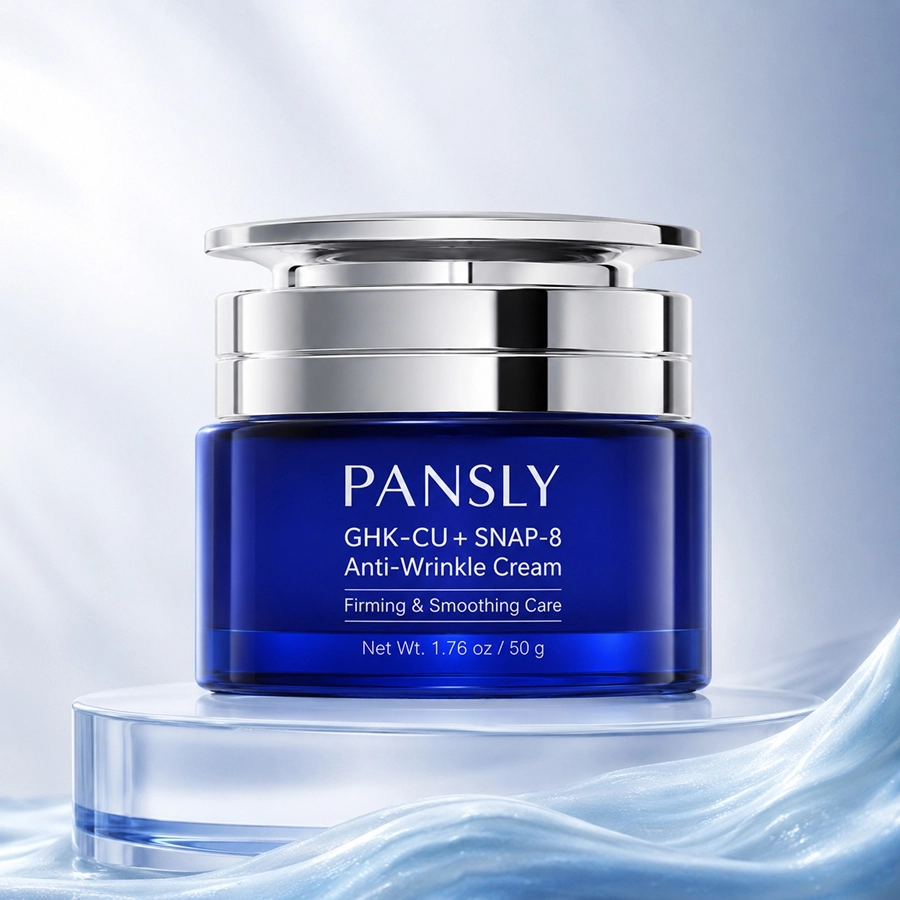
This Pansly GHK-CU + SNAP-8 Anti-Wrinkle Firming Cream is triple-peptide anti-aging facial cream, delivers targeted wrinkle smoothing, firming lifting and deep nourishment for dull, saggy, fine-line prone skin. Full OEM & ODM private label service is supported, including custom formula, packaging options, fast sampling and bulk export supply.
Five core premium active ingredients work synergistically for comprehensive anti-wrinkle care:
GHK-CU Copper Peptide lifts saggy skin, enhances skin resilience and tightens loose facial contour;
SNAP-8 Peptide targets expression lines to visibly soften and fade wrinkles;
Acetyl Hexapeptide-8 reduces the appearance of dry fine lines for smoother skin texture;
Ceramide NP reconstructs skin moisture barrier to lock nourishment and boost comfort;
Hyaluronic Acid delivers multi-layer rich deep moisture to relieve dry rough skin.
Luxury rich creamy texture spreads smoothly and melts into skin gently, leaving soft comfortable finish without heavy greasiness. Daily use blurs fine lines, firms loose skin, deeply nourishes and stabilizes barrier, refining uneven texture to reveal smooth, plump, youthful luminous skin.
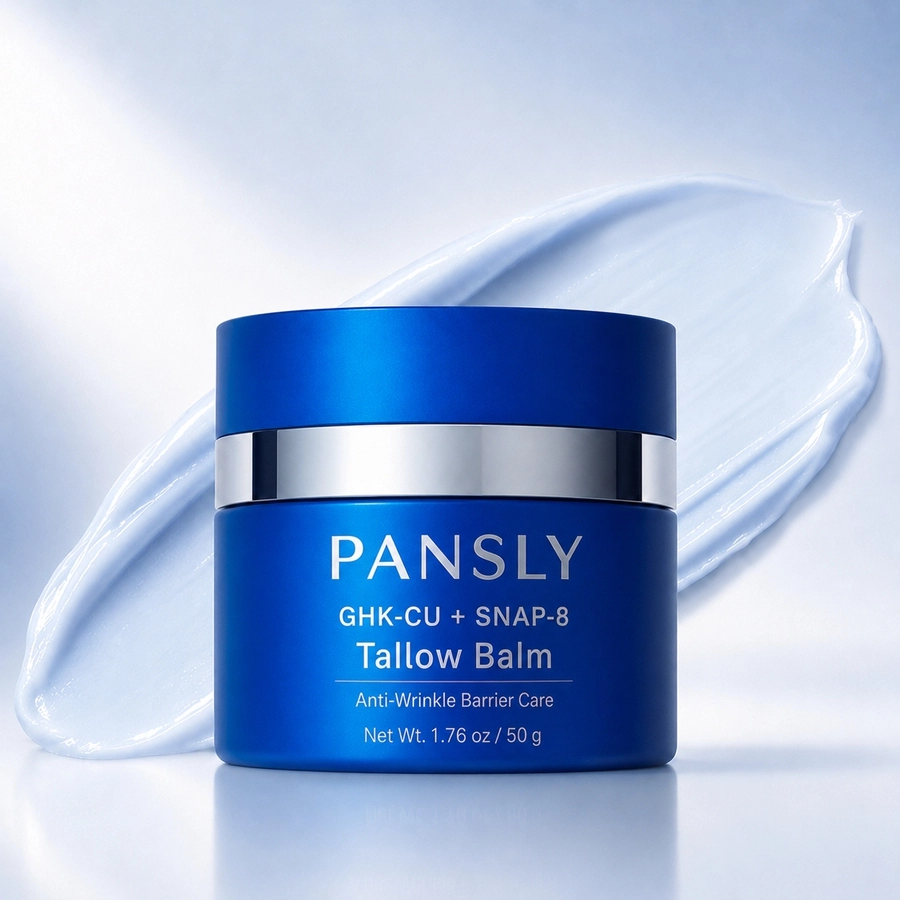
This Pansly GHK-CU + SNAP-8 Tallow Balm is a nourishing anti-wrinkle facial balm specially formulated for dry, fragile and sensitive skin, combining anti-aging wrinkle smoothing and barrier repairing effects. We offer full private label OEM service, including custom logo, adjustable formula, diversified packaging and lid color options.
It contains five core skin care active ingredients: GHK-CU visibly improves fine lines and revives dull complexion; SNAP-8 softens expression lines to smooth wrinkled skin texture; Grass-Fed Beef Tallow delivers deep lipid nourishment to relieve dry rough skin; Ectoin stabilizes the skin barrier and alleviates skin discomfort; Ceramide NP strengthens barrier structure to create smooth, healthy skin.
Luxury creamy blue balm texture glides smoothly and melts quickly on skin, providing long-lasting deep moisturizing comfort. Daily use fades fine lines & expression lines, nourishes dry delicate skin, repairs damaged barrier and leaves silky smooth skin finish.
Click here to customize the Beauty
we respond within a few hours
Monday–Friday, 9AM–6PM
3A01, Building A, Zhisheng Square, No. 4 Zhifu Road, Helong Street, Baiyun District, Guangzhou, China.


Leave a request, and we'll email you back within 24 hours.
© 2026 Beyond Basix. All Rights Reserved.
