Cost-Effective Peptide Skincare Manufacturing for Private Label
Cost-Effective peptide-focused manufacturing strategies for private label brands: actionable sourcing, scalable synthesis choices, formulation stabilisation, regulatory pathways, and contract-manufacturing models that reduce cost-of-goods and accelerate launch. This enterprise guide explains raw-material selection (synthetic oligopeptides vs recombinant fragments), formulation science to minimise active load while preserving efficacy, QC and analytical workflows (HPLC, MS, peptide mapping), GMP-ready production flows, and procurement tactics to de-risk supply chains. The piece also outlines how an integrated OEM/ODM partner with pharmaceutical-grade facilities and multi-line capacity streamlines development, testing, and global compliance to deliver competitive skincare, hair, eye, and body care ranges at scale.
- Cost-Smart Manufacturing of Peptide-Based Serums and Complexes
- Strategic sourcing: raw fragments, finished complexes, and supplier segmentation
- Formulation approaches to lower active load without sacrificing efficacy
- Stability engineering and packaging to cut rework and returns
- Scaling, Quality Control and Regulatory Pathways for Bioactive Fragments
- Process scaling: synthesis methods, batch economics, and throughput
- Analytical control: identity, purity and potency testing workflows
- Regulatory compliance: labeling, safety data, and international market entry
- Production Economics: Reducing COGS and Time-to-Market
- Contract models: fixed-bid, toll manufacturing and one-stop OEM/ODM advantages
- Packaging, automation and high-efficiency fill lines
- Supply chain risk mitigation and inventory strategies
- Partnering with a One-Stop OEM/ODM for Competitive Returns
- Facility capability and compliance as ROI multipliers
- Beyond Basix capabilities: technical strength, certifications, and brands
- Product portfolio, R&D throughput and commercial support
- How procurement teams benefit from an integrated partner
- Frequently Asked Questions
Cost-Effective peptide-focused manufacturing strategies for private label brands: actionable sourcing, scalable synthesis choices, formulation stabilisation, regulatory pathways, and contract-manufacturing models that reduce cost-of-goods and accelerate launch. This enterprise guide explains raw-material selection (synthetic oligopeptides vs recombinant fragments), formulation science to minimise active load while preserving efficacy, QC and analytical workflows (HPLC, MS, peptide mapping), GMP-ready production flows, and procurement tactics to de-risk supply chains. The piece also outlines how an integrated OEM/ODM partner with pharmaceutical-grade facilities and multi-line capacity streamlines development, testing, and global compliance to deliver competitive skincare, hair, eye, and body care ranges at scale.
Cost-Smart Manufacturing of Peptide-Based Serums and Complexes
Strategic sourcing: raw fragments, finished complexes, and supplier segmentation
Buyers should categorise suppliers by capability: majority-volume peptide synthesizers, specialty custom-sequence houses, and finished-active formulators. Selecting pre-formulated peptide complexes or stabilized conjugates can reduce in-house R&D burden and analytical costs, but typically increases unit price. Conversely, procuring bulk synthetic oligopeptides and integrating them during formulation gives flexibility for unique claims but requires stronger QC and purification budgets. Establish supplier scorecards that include certificate validation, lot-to-lot variability data, and stability challenge results to enable cost vs. control trade-offs during procurement.
Formulation approaches to lower active load without sacrificing efficacy
Optimization of delivery systems—liposomal encapsulation, nanocarriers, and peptide–carrier conjugates—permits reduction of active concentration while maintaining clinical performance. Selecting synergistic supporting actives (e.g., small-molecule co-actives, humectants, and stabilizing antioxidants) can extend shelf life and reduce required peptide dosage. This approach decreases cost-per-unit and supports more affordable retail positioning without diluting efficacy claims when backed by targeted in vitro or ex vivo testing.
Stability engineering and packaging to cut rework and returns
Improper packaging is a common hidden cost driver. Airless dispensing, amber glass, and single-dose ampoules mitigate oxidation and hydrolysis for labile amino-acid sequences. Conducting accelerated stability and photostability tests reduces post-launch remediation costs. Investing in packaging that aligns with peptide stability profiles prevents reformulation cycles and disposal losses, improving long-term gross margins.
Scaling, Quality Control and Regulatory Pathways for Bioactive Fragments
Process scaling: synthesis methods, batch economics, and throughput
Solid-phase peptide synthesis (SPPS) is the industry standard for small-to-medium oligopeptides and supports predictable scale-up; recombinant expression suits longer sequences but requires bioreactor infrastructure. Each pathway has distinct capital and per-kilogram cost structures—SPPS offers faster lead times for short sequences, while recombinant routes may lower marginal cost at very large scale. Align manufacturing method choice with projected SKU volumes to prevent over-investment in capacity.
Analytical control: identity, purity and potency testing workflows
Implementing robust analytical suites (HPLC for purity, LC–MS/MS for sequence confirmation, peptide mapping, and endotoxin testing for biologically produced fragments) reduces batch failures and costly hold times. QA documentation should include validated methods, retention-time libraries, and acceptance criteria. Outsourcing initial method development to a contract lab can be cost-effective, but on-site analytical capability shortens release cycles and reduces freight and turnaround costs.
Regulatory compliance: labeling, safety data, and international market entry
Cosmetic actives classified as short peptides often fall under cosmetic regulations, but distinctions vary by jurisdiction—ingredient safety dossiers and toxicology reports are essential for cross-border launches. Reference regulatory frameworks such as the FDA cosmetics guidance for the US, the EU Cosmetics Regulation for European markets, and recognised quality standards like ISO 9001. Certification alignment expedites customs clearance and retailer acceptance.
Production Economics: Reducing COGS and Time-to-Market
Contract models: fixed-bid, toll manufacturing and one-stop OEM/ODM advantages
Contract manufacturing options range from toll processing to full turnkey arrangements. Toll (fee-for-service) manufacturing preserves buyer control of formula IP but transfers production risk to the manufacturer for a fee. Turnkey OEM/ODM partners that provide end-to-end services — from R&D to fill-finish and compliance documentation — reduce coordination overhead, lower time-to-market, and consolidate quality responsibility. For private label brands seeking cost predictability, a comprehensive OEM/ODM partner often yields the best trade-off between CAPEX and operational efficiency.
Packaging, automation and high-efficiency fill lines
Packaging choices directly affect labour and material costs. Automated filling, capping, and labelling lines increase throughput and reduce per-unit labour cost. Consider modular packaging strategies that use a common filling line but interchangeable secondary packaging to enable SKU diversification without large incremental capital expense.
Supply chain risk mitigation and inventory strategies
Peptide raw materials can be subject to long lead times and purity variance. Implement multi-tier sourcing, strategic safety stock for critical sequences, and contract terms that include price caps or batch reserves. Use demand-driven manufacturing scheduling and just-in-time raw material releases to minimize working capital without exposing production to shortages that trigger expedited freight High Qualitys.
| Comparison Area | Small-Scale SPPS | Recombinant Expression | Turnkey OEM/ODM |
|---|---|---|---|
| Typical Best Use | Short synthetic peptides, rapid prototyping | Long sequences, high-volume biologics | Private label brands seeking end-to-end service |
| Scalability | Moderate — linear cost increase | High — lower marginal costs at scale | High — integrated supply chain and packaging |
| Typical Lead Time | Weeks for small batches | Months for development and scale-up | Weeks to months depending on customisation |
| Quality Controls | HPLC/LC-MS required | Additional bioburden/endotoxin testing | Comprehensive QA/QC including release testing |
| Cost Drivers | Reagent and purification costs | Bioreactor operation and downstream processing | R&D, validation, and packaging automation |
Partnering with a One-Stop OEM/ODM for Competitive Returns
Facility capability and compliance as ROI multipliers
Choosing a partner with pharmaceutical-grade production environments and multiple validated lines reduces validation time and regulatory risk. Partners with certified dust-free workshops and GMP-capable production lines enable faster scale-up from pilot to commercial batches, limiting capital requirements for brand owners.
Beyond Basix capabilities: technical strength, certifications, and brands
Our team operates a 12,000-square-meter manufacturing campus with a 100,000-level GMPC pharmaceutical-grade dust-free workshop and 12 production lines, supported by advanced equipment imported from Germany and the United States. With over 23 years of experience in research, production, and sales, Beyond Basix focuses on delivering high-efficacy formulations incorporating modern bioactive fragments and carrier technologies. Certifications such as ISO 9001, GMP, CE, MSDS, and HALAL demonstrate our compliance posture and facilitate faster market entry across regulated jurisdictions.
Product portfolio, R&D throughput and commercial support
We support private label and brand partners across Skincare Products, Hair Care Products, Eye Care Products, and Body Care Products. Our R&D teams specialize in optimizing active loading, selecting stabilizing excipients, and validating shelf-life for peptide-enriched ranges. Bundling formulation development, stability testing, regulatory documentation, and high-efficiency fill-finish under one contract reduces management overhead and shortens the path from concept to shelf.
How procurement teams benefit from an integrated partner
Buyers working with a single trusted OEM/ODM can realize lower landed costs through consolidated purchasing, reduced logistics complexity, and simplified quality assurance workflows. A partner that offers in-house analytical capabilities and a validated supplier base for critical actives reduces the risk of recalls, non-conformance events, and costly reformulations.
Industry standards and further reading on peptide synthesis and cosmetic regulation include the Peptide overview on Wikipedia, SPPS methodology, the FDA cosmetics portal, and the EU Cosmetics Regulation.
Contact options, specification templates, and private label case studies are available upon request to facilitate technical and commercial evaluation.
Frequently Asked Questions
What are the main sourcing options for peptide actives and their trade-offs?
Sourcing options include purchasing synthetic oligopeptides via solid-phase peptide synthesis (SPPS), procuring recombinant-expressed sequences for longer peptides, or buying pre-formulated peptide complexes. SPPS provides rapid prototyping and better control for short sequences but has higher per-unit reagent cost; recombinant expression lowers marginal cost at very large volumes but requires bioproduction infrastructure; pre-formulated complexes reduce R&D overhead but typically increase unit procurement price and reduce formulation flexibility.
How can manufacturers reduce unit costs without reducing clinical efficacy?
Cost reductions can be achieved by optimising delivery systems (liposomes, nanocarriers), combining peptides with synergistic supporting actives to lower active load, using stabilising excipients to extend shelf life, selecting cost-efficient packaging that reduces degradation, and leveraging an integrated OEM/ODM to consolidate R&D, analytics, and production under a single contract.
What analytical tests are essential for peptide-enriched cosmetics?
Essential testing includes HPLC for purity, LC–MS/MS or peptide mapping for sequence confirmation, microbiological and endotoxin tests where relevant, stability and photostability studies, and validated assay methods for potency. On-site analytical capability shortens release timelines and reduces freight and turnaround costs compared with repeated external lab submissions.
Which regulations and certifications should private label brands consider for global market entry?
Brands should prepare dossiers aligned with jurisdictional requirements: ingredient safety documentation for the FDA cosmetics framework in the US, compliance with the EU Cosmetics Regulation for European markets, and adoption of recognized quality systems such as ISO 9001. GMP-capable manufacturing and supporting safety/toxicology data accelerate approvals and retailer acceptance.
What are the benefits of using a one-stop OEM/ODM partner for peptide product launches?
A full-service OEM/ODM partner consolidates formulation development, analytical testing, regulatory documentation, and high-efficiency fill-finish. This reduces project coordination costs, shortens time-to-market, lowers the need for buyer-side CAPEX, and decreases supply-chain complexity—enabling private label brands to scale product ranges across skincare, hair, eye, and body categories more efficiently.

Elevate your professional skincare offerings with this Private Label Copper Peptide Anti-Wrinkle Firming Serum, a powerhouse concentrate designed for superior age-defying results. This sophisticated formula leverages the synergistic effects of GHK-Cu and SNAP-8 to address multiple layers of skin aging. The GHK-Cu copper peptides act as a vital signaling mechanism to enhance skin density and firmness, while the advanced SNAP-8 octapeptide specifically targets expression lines, helping to relax the appearance of deep-seated wrinkles for a smoother, more refined surface.
This lightweight, rapid-absorption serum provides a professional-grade solution for clients seeking a non-invasive lift. It effectively restores elasticity, improves skin texture, and provides essential antioxidant protection. Perfect for high-end beauty brands, this serum leaves the complexion looking visibly contoured, hydrated, and youthfully revitalized.
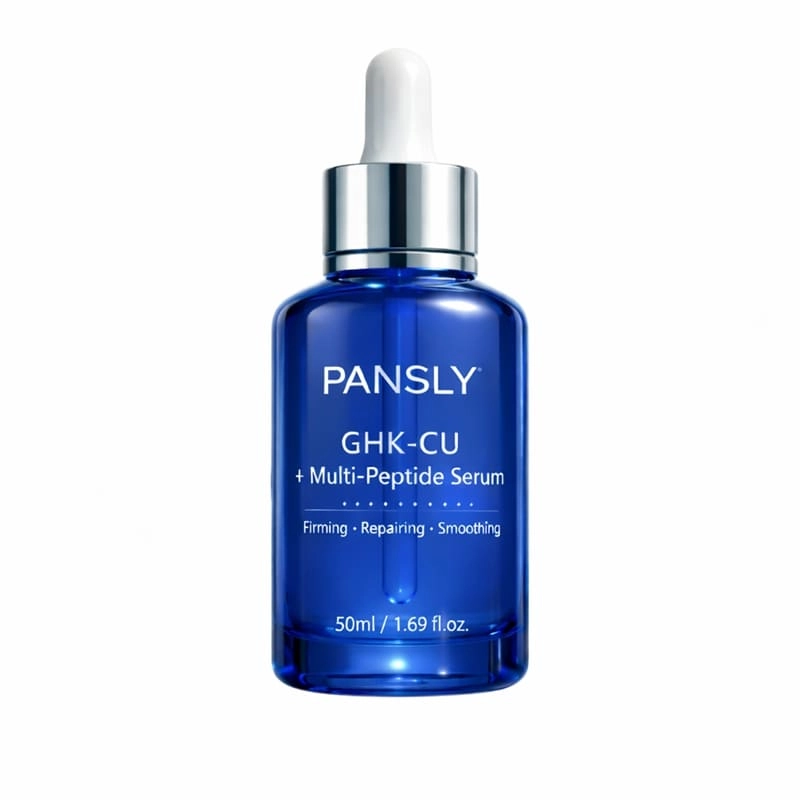
Experience visible rejuvenation with this GHK-Cu Copper Peptide Smoothing & Firming Face Serum, a high-performance concentrate designed to restore the structural integrity of aging skin. This advanced formula centers on GHK-Cu, a powerful signaling peptide clinically recognized for its ability to support natural collagen and elastin production. By promoting dermal density, it effectively tightens sagging skin and smooths the appearance of deep-set wrinkles and fine lines.
The lightweight, silky texture absorbs instantly, delivering antioxidant protection to neutralize environmental stressors that accelerate aging. Enhanced with deep-moisturizing agents, the serum reinforces the skin's moisture barrier, leaving the complexion feeling remarkably soft and resilient. With consistent use, skin texture is refined and facial contours appear more lifted, resulting in a youthfully firm and revitalized glow.
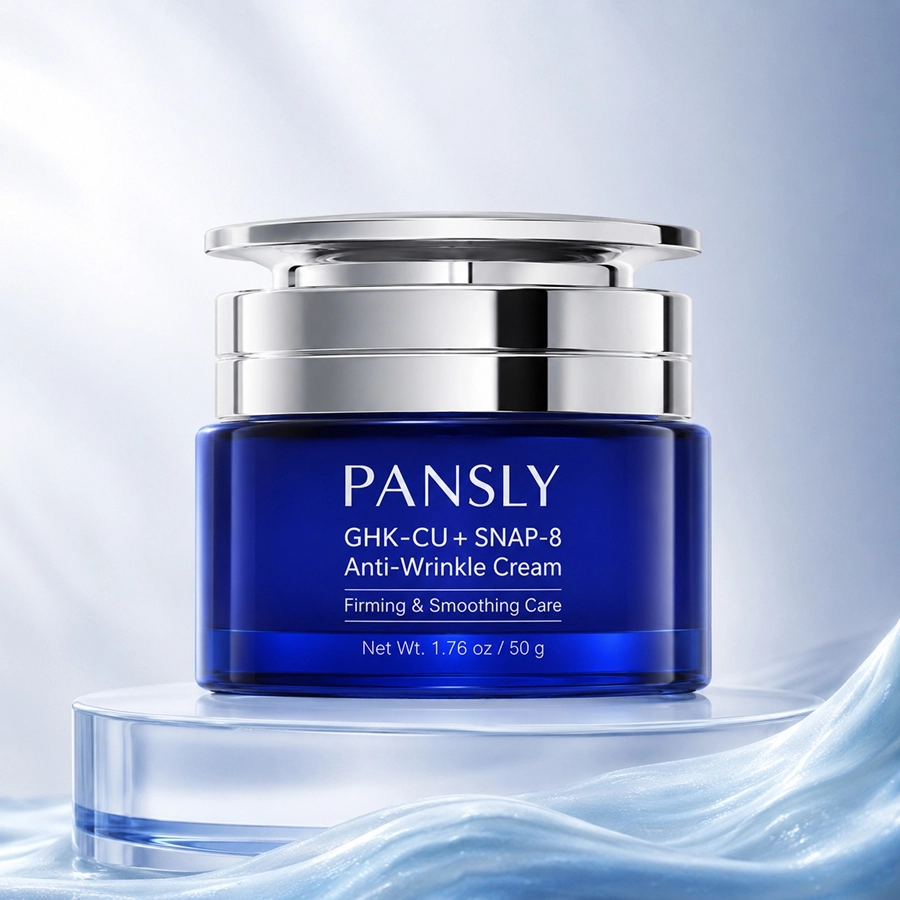
This Pansly GHK-CU + SNAP-8 Anti-Wrinkle Firming Cream is triple-peptide anti-aging facial cream, delivers targeted wrinkle smoothing, firming lifting and deep nourishment for dull, saggy, fine-line prone skin. Full OEM & ODM private label service is supported, including custom formula, packaging options, fast sampling and bulk export supply.
Five core premium active ingredients work synergistically for comprehensive anti-wrinkle care:
GHK-CU Copper Peptide lifts saggy skin, enhances skin resilience and tightens loose facial contour;
SNAP-8 Peptide targets expression lines to visibly soften and fade wrinkles;
Acetyl Hexapeptide-8 reduces the appearance of dry fine lines for smoother skin texture;
Ceramide NP reconstructs skin moisture barrier to lock nourishment and boost comfort;
Hyaluronic Acid delivers multi-layer rich deep moisture to relieve dry rough skin.
Luxury rich creamy texture spreads smoothly and melts into skin gently, leaving soft comfortable finish without heavy greasiness. Daily use blurs fine lines, firms loose skin, deeply nourishes and stabilizes barrier, refining uneven texture to reveal smooth, plump, youthful luminous skin.
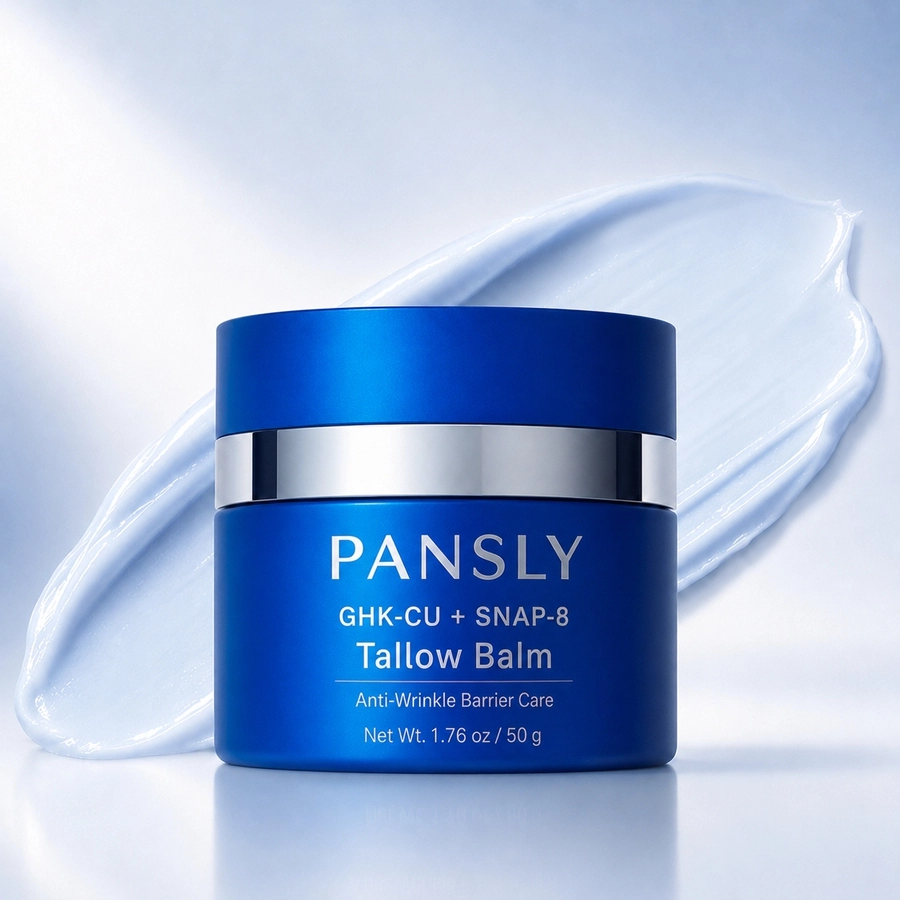
This Pansly GHK-CU + SNAP-8 Tallow Balm is a nourishing anti-wrinkle facial balm specially formulated for dry, fragile and sensitive skin, combining anti-aging wrinkle smoothing and barrier repairing effects. We offer full private label OEM service, including custom logo, adjustable formula, diversified packaging and lid color options.
It contains five core skin care active ingredients: GHK-CU visibly improves fine lines and revives dull complexion; SNAP-8 softens expression lines to smooth wrinkled skin texture; Grass-Fed Beef Tallow delivers deep lipid nourishment to relieve dry rough skin; Ectoin stabilizes the skin barrier and alleviates skin discomfort; Ceramide NP strengthens barrier structure to create smooth, healthy skin.
Luxury creamy blue balm texture glides smoothly and melts quickly on skin, providing long-lasting deep moisturizing comfort. Daily use fades fine lines & expression lines, nourishes dry delicate skin, repairs damaged barrier and leaves silky smooth skin finish.
Click here to customize the Beauty
we respond within a few hours
Monday–Friday, 9AM–6PM
3A01, Building A, Zhisheng Square, No. 4 Zhifu Road, Helong Street, Baiyun District, Guangzhou, China.


Leave a request, and we'll email you back within 24 hours.
© 2026 Beyond Basix. All Rights Reserved.