Cost, MOQ and Lead Times for Private Label Anti-Aging Creams
Procurement-focused analysis of cost drivers, minimum order quantities and manufacturing timelines for private label anti-aging cream projects — actionable guidance for brand owners evaluating one-stop OEM/ODM partners, negotiation levers to lower upfront investment, and timeline acceleration strategies supported by regulatory and GMP considerations to reduce risk and improve ROI.
- Cost drivers and pricing models for custom wrinkle-treatment formulations
- Core material and active ingredient economics
- Packaging specification and secondary finishing
- Testing, stability and regulatory overhead
- Minimum order quantities and scaling strategies for white-label facial treatments
- Typical MOQs by manufacturing model
- Commercial levers to reduce initial buy-ins
- Inventory, warehousing and fulfilment trade-offs
- Lead time management: from formula sign-off to production delivery
- Typical timeline milestones and common bottlenecks
- Fast-track production options and pilot programs
- Quality assurance, batch release and logistics coordination
- Comparative decision matrix: manufacturing approaches and procurement implications
- Why choose Beyond Basix for contract development and manufacturing
- Manufacturing scale, certifications and process reliability
- R&D, formulation expertise and ingredient sourcing
- Packaging, multi-category support and supply chain integration
- Commercial alignment and partner-first approach
- Frequently Asked Questions
Procurement-focused analysis of cost drivers, minimum order quantities and manufacturing timelines for private label anti-aging cream projects — actionable guidance for brand owners evaluating one-stop OEM/ODM partners, negotiation levers to lower upfront investment, and timeline acceleration strategies supported by regulatory and GMP considerations to reduce risk and improve ROI.
Cost drivers and pricing models for custom wrinkle-treatment formulations
Core material and active ingredient economics
Raw material selection is the single largest determinant of production cost for bespoke anti-wrinkle formulations. High-efficacy actives such as retinoids, peptides (e.g., palmitoyl pentapeptide), growth-factor mimetics, stabilized vitamin C derivatives, and encapsulated hyaluronic acid typically increase per-unit input costs and can introduce special handling requirements (cold chain, inert atmosphere, or protected filling). Buyers should request full material cost breakdowns and certificates of analysis (CoA) from suppliers to validate pricing and potency — and confirm supplier traceability consistent with industry guidance such as FDA cosmetics and ISO 22716 GMP.
Packaging specification and secondary finishing
Packaging choices (airless pumps, glass jars, PET tubes, multilayer laminates, aluminum components) materially affect unit economics and minimum runs. Complex decorations (hot-stamp, UV varnish, embossing) often trigger plate/tooling fees and longer supplier lead times. Total landed cost analysis must include FOB, duty, and fulfillment packaging. Buyers seeking High Quality positioning should model scenarios for simple vs. High Quality closures to quantify margin sensitivity.
Testing, stability and regulatory overhead
Stability programs (accelerated and real-time), preservative efficacy testing (challenge tests), dermatological patch tests, and safety dossiers generate non-recurring testing expenses that should be amortized across the initial production run. Regulatory requirements vary by market; adherence to national frameworks and internationally-recognized quality systems reduces post-launch risk — consult sources such as industry overviews and region-specific authority guidance when budgeting compliance costs.
Minimum order quantities and scaling strategies for white-label facial treatments
Typical MOQs by manufacturing model
Minimum batch sizes depend on process scale and facility setup. Contract fillers running large continuous mixers often set higher minimums, while one-stop OEM/ODM facilities with flexible lines can offer lower entry quantities through grouping or pilot lines. Typical market ranges are: pilot/sample runs of several hundred units, standard commercial MOQs frequently starting in the low thousands, and large traditional contract runs in five-figure quantities. Buyers should map product specifications (viscosity, container type, active load) to supplier capabilities before assuming a standard quantity.
Commercial levers to reduce initial buy-ins
Strategies to lower upfront MOQ include: agreeing to shared tooling amortization, accepting simpler packaging for the first SKU, consolidating multiple SKUs into a single manufacturing run (same base formula, different serums), or committing to a rolling order schedule. Negotiation points that materially influence minimums include guaranteed reorder cadence, contribution to NRE (non-recurring engineering) costs, and providing supplier-approved packaging sourced by the buyer.
Inventory, warehousing and fulfilment trade-offs
Carrying inventory reduces per-unit cost but increases working capital and obsolescence exposure. Third-party warehousing and distribution or vendor-managed inventory (VMI) can bridge the gap by smoothing cash flows while achieving lower per-unit pricing through larger consolidated orders. Buyers should run total-cost-of-ownership (TCO) models that include financing, storage, and potential promotional discounting to find the optimal MOQ strategy.
Lead time management: from formula sign-off to production delivery
Typical timeline milestones and common bottlenecks
Standard timeline stages include formulation and stability sampling (2–8 weeks for pilot stability), tooling and packaging procurement (4–12 weeks depending on decoration), regulatory dossier assembly and testing (2–12 weeks), and production scheduling (2–6 weeks depending on line availability). Bottlenecks frequently arise from packaging lead times, delayed active ingredient delivery, and extended lab stability results. Early alignment on critical path items and concurrent task management reduces calendar risk.
Fast-track production options and pilot programs
Options to accelerate time-to-market include small pilot production on flexible fill-finish lines, use of off-the-shelf packaging to cut tooling time, and parallelizing stability testing with limited commercial release under monitored conditions (market-dependent). Advanced manufacturing partners may offer dedicated pilot slots or expedited tooling at a High Quality; such options should be compared against time-to-revenue projections to assess ROI.
Quality assurance, batch release and logistics coordination
Quality control checkpoints (in-process sampling, microbiological testing, batch release certificates) are non-negotiable for risk mitigation. Buyers should require a defined release protocol and electronic batch records for traceability. Logistics coordination — customs clearance, freight booking, and distribution planning — must start during production scheduling to avoid docking delays that effectively extend lead time.
Comparative decision matrix: manufacturing approaches and procurement implications
| Dimension | In-House R&D & Production | Traditional Contract Manufacturer | One-Stop OEM/ODM (Flexible Partner) |
|---|---|---|---|
| Typical MOQ | Varies (dependent on capex; can be low for small-scale lines) | Often 5,000–20,000 units per SKU | Often 1,000–5,000 units; pilot runs available |
| Lead time (formula & first production) | Months (setup + validation) | 8–16 weeks typical | 6–12 weeks with accelerated options |
| Fixed cost exposure | High CAPEX and operational overhead | Low capital; higher per-unit cost for small orders | Optimized—shared R&D, lower NRE options |
| Customization & IP control | Full control | Medium (depends on contract) | High with NDA and dedicated formulation services |
| Regulatory & quality capability | Depends on investment | Varies; not always integrated R&D | Integrated QA/QC and compliance (GMP-ready) |
Note: The ranges above reflect common industry patterns; exact MOQs and lead times should be confirmed with prospective suppliers and validated against contractual terms.
Why choose Beyond Basix for contract development and manufacturing
Manufacturing scale, certifications and process reliability
Beyond Basix operates a 12,000-square-meter facility with a 100,000-level GMPC pharmaceutical-grade dust-free workshop and 12 production lines. This configuration supports both pilot and commercial runs with reliable segregation of product families to minimize cross-contamination risk. Compliance credentials such as ISO 9001, GMP and other certifications ensure process standardization and document control aligned with global buyer expectations; buyers often validate supplier certifications against authoritative sources such as ISO standards and national regulatory guidance.
R&D, formulation expertise and ingredient sourcing
Our team focuses on active-driven skincare formulations, backed by 12 years of concentrated development in efficacious actives. Buyers benefit from pre-validated actives sourcing, stability program templates, and pilot laboratory support that compress time-to-market. Technical services include bespoke serum-in-cream systems, encapsulation expertise, and vectorized delivery strategies for anti-wrinkle efficacy.
Packaging, multi-category support and supply chain integration
Beyond Basix supports the end-to-end product lifecycle across Skincare Products, Hair Care Products, Eye Care Products and Body Care Products. The in-house coordination of primary filling, secondary packaging, and logistics reduces lead-time fragmentation. Where buyers require it, we provide turnkey options including design-for-manufacture packaging, shelf-ready kit assembly, and coordinated global shipping to streamline launch cadence.
Commercial alignment and partner-first approach
With over 23 years of experience in research, production, and sales, our corporate approach emphasizes transparent costing, flexible MOQ models, and shared risk arrangements for NRE. Buyers can expect structured project timelines, electronic batch documentation, and established QC checkpoints to support reliable product launches while protecting IP through NDAs and secure data handling.
Certifications and brand portfolio: our operational credibility is reinforced by ISO 9001, CE, MSDS, GMP and HALAL certifications and four in-house brands — LANTHOME, PANSLY, FIRSTSUN, and SAUVASINE — demonstrating both regulatory capability and market-facing product development experience.
For procurement teams evaluating suppliers, Beyond Basix offers a clear balance between production agility and regulatory discipline, making it a competitive choice for companies seeking a one-stop OEM/ODM for skincare with the scale and certifications necessary to support global distribution.
Frequently Asked Questions
What is a typical minimum order quantity for a private-label anti-wrinkle cream?
Typical MOQs vary by manufacturing model and packaging complexity; standard commercial minimums often start in the low thousands, pilot/sample runs can be several hundred units, and large-scale contract runs commonly reach five-figure quantities. Confirm exact numbers with suppliers since viscosity, container type and active load affect the minimums.
Which cost factors should be prioritized when budgeting for a new anti-aging face product?
Prioritize active ingredient costs, packaging/tooling fees, regulatory and testing expenses (stability, microbiological, safety), and logistics/fulfillment. Amortize non-recurring engineering (NRE) and testing over the expected initial production volume to evaluate realistic per-unit cost.
How long does it take from formula sign-off to first commercial shipment?
Typical timelines range from 6 to 16 weeks depending on the need for extensive stability testing, packaging procurement, tooling, and line scheduling. Fast-track options such as pilot runs and off-the-shelf packaging can shorten time-to-market but often incur premium fees.
Can MOQ be negotiated down for premium formulations with expensive actives?
Yes. Negotiation levers include committing to a defined reorder cadence, sharing tooling or NRE costs, simplifying packaging initially, or consolidating SKUs. One-stop OEM/ODM partners with flexible pilot lines are more likely to offer lower initial quantities for premium formulations.
What regulatory and quality certifications should buyers require from a contract manufacturer?
Buyers should request facility-level certifications such as ISO 9001 and GMP, documentation for product-specific testing (CoA, stability reports, challenge tests), and evidence of quality management systems. Cross-reference supplier claims with authoritative bodies such as FDA cosmetics guidance and ISO 22716 where applicable.

Elevate your professional skincare offerings with this Private Label Copper Peptide Anti-Wrinkle Firming Serum, a powerhouse concentrate designed for superior age-defying results. This sophisticated formula leverages the synergistic effects of GHK-Cu and SNAP-8 to address multiple layers of skin aging. The GHK-Cu copper peptides act as a vital signaling mechanism to enhance skin density and firmness, while the advanced SNAP-8 octapeptide specifically targets expression lines, helping to relax the appearance of deep-seated wrinkles for a smoother, more refined surface.
This lightweight, rapid-absorption serum provides a professional-grade solution for clients seeking a non-invasive lift. It effectively restores elasticity, improves skin texture, and provides essential antioxidant protection. Perfect for high-end beauty brands, this serum leaves the complexion looking visibly contoured, hydrated, and youthfully revitalized.
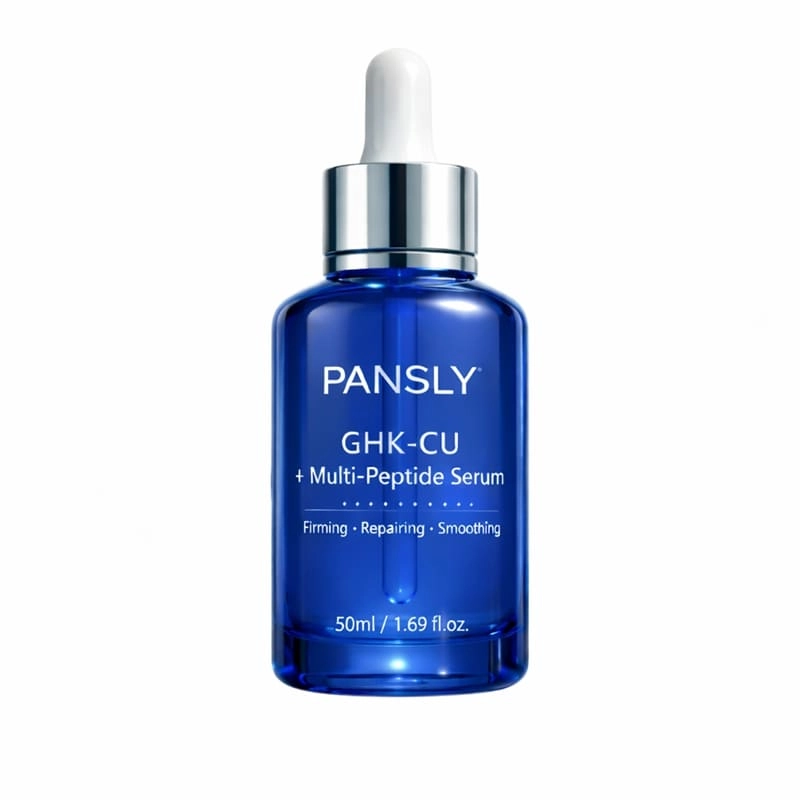
Experience visible rejuvenation with this GHK-Cu Copper Peptide Smoothing & Firming Face Serum, a high-performance concentrate designed to restore the structural integrity of aging skin. This advanced formula centers on GHK-Cu, a powerful signaling peptide clinically recognized for its ability to support natural collagen and elastin production. By promoting dermal density, it effectively tightens sagging skin and smooths the appearance of deep-set wrinkles and fine lines.
The lightweight, silky texture absorbs instantly, delivering antioxidant protection to neutralize environmental stressors that accelerate aging. Enhanced with deep-moisturizing agents, the serum reinforces the skin's moisture barrier, leaving the complexion feeling remarkably soft and resilient. With consistent use, skin texture is refined and facial contours appear more lifted, resulting in a youthfully firm and revitalized glow.
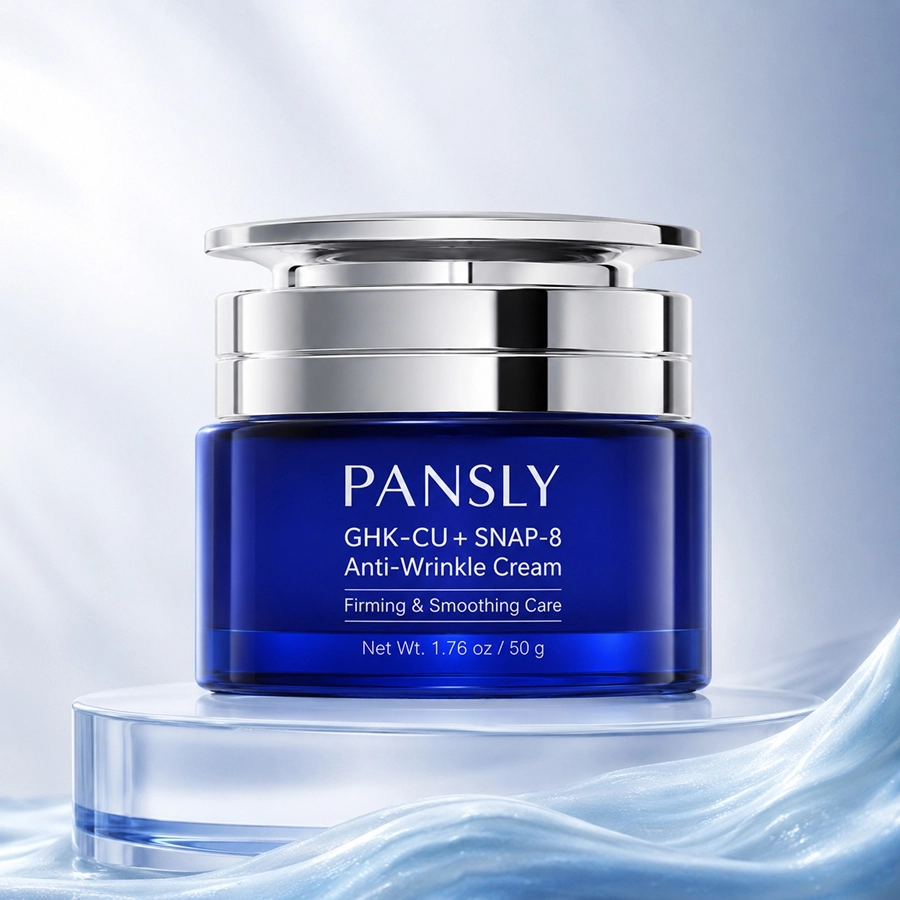
This Pansly GHK-CU + SNAP-8 Anti-Wrinkle Firming Cream is triple-peptide anti-aging facial cream, delivers targeted wrinkle smoothing, firming lifting and deep nourishment for dull, saggy, fine-line prone skin. Full OEM & ODM private label service is supported, including custom formula, packaging options, fast sampling and bulk export supply.
Five core premium active ingredients work synergistically for comprehensive anti-wrinkle care:
GHK-CU Copper Peptide lifts saggy skin, enhances skin resilience and tightens loose facial contour;
SNAP-8 Peptide targets expression lines to visibly soften and fade wrinkles;
Acetyl Hexapeptide-8 reduces the appearance of dry fine lines for smoother skin texture;
Ceramide NP reconstructs skin moisture barrier to lock nourishment and boost comfort;
Hyaluronic Acid delivers multi-layer rich deep moisture to relieve dry rough skin.
Luxury rich creamy texture spreads smoothly and melts into skin gently, leaving soft comfortable finish without heavy greasiness. Daily use blurs fine lines, firms loose skin, deeply nourishes and stabilizes barrier, refining uneven texture to reveal smooth, plump, youthful luminous skin.
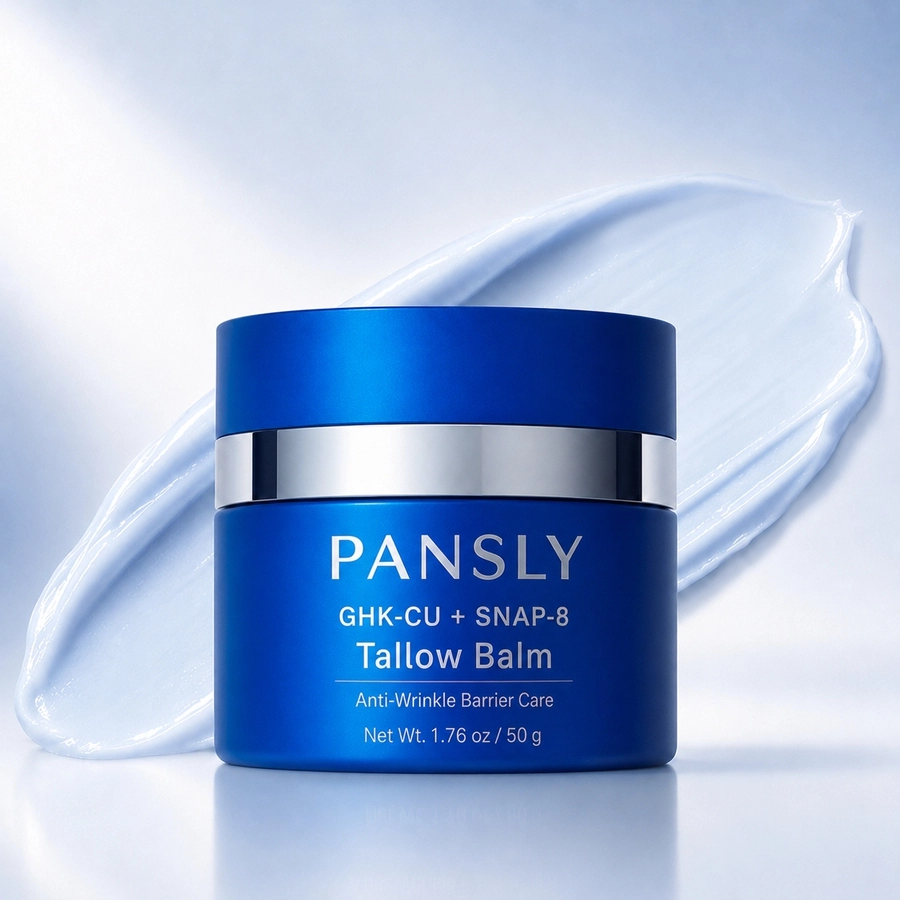
This Pansly GHK-CU + SNAP-8 Tallow Balm is a nourishing anti-wrinkle facial balm specially formulated for dry, fragile and sensitive skin, combining anti-aging wrinkle smoothing and barrier repairing effects. We offer full private label OEM service, including custom logo, adjustable formula, diversified packaging and lid color options.
It contains five core skin care active ingredients: GHK-CU visibly improves fine lines and revives dull complexion; SNAP-8 softens expression lines to smooth wrinkled skin texture; Grass-Fed Beef Tallow delivers deep lipid nourishment to relieve dry rough skin; Ectoin stabilizes the skin barrier and alleviates skin discomfort; Ceramide NP strengthens barrier structure to create smooth, healthy skin.
Luxury creamy blue balm texture glides smoothly and melts quickly on skin, providing long-lasting deep moisturizing comfort. Daily use fades fine lines & expression lines, nourishes dry delicate skin, repairs damaged barrier and leaves silky smooth skin finish.
Click here to customize the Beauty
we respond within a few hours
Monday–Friday, 9AM–6PM
3A01, Building A, Zhisheng Square, No. 4 Zhifu Road, Helong Street, Baiyun District, Guangzhou, China.


Leave a request, and we'll email you back within 24 hours.
© 2026 Beyond Basix. All Rights Reserved.