Custom Bath Bomb Manufacturer vs. Private Label Supplier: Which Fits?

- How Bespoke Bath Product Development Differs from Private Label Sourcing
- Private label prioritizes speed and market validation
- OEM/ODM development creates a differentiated product asset
- Technical customization affects commercial outcomes
- Procurement Criteria for Selecting the Right Production Partner
- Compare the project economics, not only the unit quotation
- Audit quality systems and manufacturing controls
- Assess development communication and scale-up discipline
- Why an Integrated Cosmetics Manufacturer Can Improve Project Execution
- Beyond Basix connects formulation, production, and category expansion
- Facility infrastructure supports controlled manufacturing
- Broader product capability supports portfolio procurement
- Decision Framework: Which Supply Model Fits the Business Case?
- Choose private label when speed and validation are primary
- Choose bespoke development when differentiation drives growth
- Use a phased hybrid model when uncertainty is high
- Frequently Asked Questions
When a brand evaluates a custom bath bomb manufacturer against a private label supplier, the correct choice is determined by the project brief rather than by price alone. Private label usually offers an existing formula, faster sampling, lower development risk, and a simpler launch process. Bespoke OEM/ODM development provides greater control over fragrance architecture, color effects, dissolution behavior, mold geometry, active ingredients, packaging, and market positioning. The most important procurement variables are target consumer, sales channel, regulatory market, minimum order quantity, formula ownership, expected launch date, gross margin, documentation, and the supplier’s ability to scale from laboratory trials to commercial production.
Bath bombs are deceptively technical products. Their performance depends on the balance between bicarbonate, acidulants, binders, oils, powders, fragrance, pigments, moisture exposure, compression, drying, and packaging protection. A product may look attractive during sampling yet crack during transport, react prematurely in humid storage, dissolve unevenly in the tub, or leave excessive residue. For that reason, buyers should evaluate a supplier’s formulation science, environmental controls, batch traceability, stability testing, and quality release procedures alongside creative capabilities. This guide explains the commercial and operational differences between private label and fully customized bath product development, then shows how an integrated cosmetics partner can support a broader personal-care portfolio.
How Bespoke Bath Product Development Differs from Private Label Sourcing
Private label prioritizes speed and market validation
A private label arrangement uses a supplier’s existing or semi-standardized formula that can be adapted through fragrance, color, packaging, label artwork, or minor ingredient changes. This model is attractive to distributors, subscription-box operators, retailers, spas, hospitality groups, and emerging brands that need to test demand before investing in extensive research and development. The shorter development cycle can reduce pre-launch expenditure and allow a buyer to concentrate on positioning, merchandising, channel acquisition, and inventory planning.
The limitation is differentiation. Several brands may use similar bases, sensory profiles, packaging formats, or fragrance families when they source from the same catalog. Buyers should therefore ask whether the formula is exclusive, semi-exclusive, or openly available to other customers. They should also confirm whether requested changes remain within the supplier’s standard process. A minor fragrance adjustment may be straightforward, while a change to foam, color dispersion, oil loading, skin feel, or dissolution time can require a new laboratory program.
OEM/ODM development creates a differentiated product asset
A bespoke bath product program begins with a technical and commercial brief. The brief may specify an anhydrous formula, a sensitive-skin positioning, botanical powders, a low-residue profile, a particular color transition, a rapid-dissolving format, a children’s collection, a luxury spa experience, or a distinctive sculpted shape. The development team then converts those objectives into ingredient selection, process parameters, fragrance dosage, mold design, packaging requirements, and test criteria.
This approach takes longer because each variable must be evaluated for compatibility and repeatability. However, it can create meaningful competitive separation and a stronger product asset. Formula ownership, exclusivity, tooling ownership, and permitted geographic markets should be defined contractually before the first commercial batch. Buyers should also clarify whether the supplier will provide a complete ingredient declaration, allergen information where applicable, safety documentation, manufacturing records, and change-control notifications.
Technical customization affects commercial outcomes
Customization is not limited to appearance. Bath bomb density influences water contact and dissolution speed; particle size affects texture and reaction uniformity; binder selection influences compression strength; oil content affects skin feel and packaging compatibility; and fragrance composition affects consumer perception as well as potential regulatory declarations. Highly decorated products may require additional inspection, protective packaging, or slower line speeds.
For products sold internationally, the compliance pathway should be considered at the design stage. The U.S. Food and Drug Administration cosmetics guidance explains that cosmetic products marketed in the United States must meet applicable safety and labeling obligations, even though cosmetics generally do not require premarket approval. In the European market, ingredient restrictions, claims, responsible-person obligations, and product information requirements may apply under the European Union Cosmetics Regulation. A formula that works commercially in one market may need different documentation, claims language, fragrance review, or packaging information elsewhere.
Procurement Criteria for Selecting the Right Production Partner
Compare the project economics, not only the unit quotation
A low unit price can conceal costs associated with mold development, artwork revisions, laboratory samples, testing, tooling, carton minimums, fragrance minimums, special inserts, quality failures, and excess inventory. A realistic total-cost model should include formula development, regulatory review, sampling, packaging components, production, inspection, freight, duties, warehousing, and potential rework. Buyers should compare landed cost at the intended order quantity rather than comparing a factory quotation with a retail-ready private label price without adjusting for scope.
Minimum order quantity is another important distinction. Catalog products may be available in smaller runs because the base formula and process already exist. Bespoke shapes, custom colors, specialized packaging, and dedicated fragrance systems may require larger commitments to justify setup and component purchases. A project owner should request tiered pricing for pilot, first commercial, and scale volumes. This reveals whether the supplier can support a controlled market test without creating an unsustainable cost structure.
Audit quality systems and manufacturing controls
A credible supplier should be able to explain raw-material approval, supplier qualification, weighing controls, line clearance, in-process inspection, environmental monitoring, finished-product release, complaint handling, and batch traceability. For moisture-sensitive effervescent products, humidity management is especially important because premature reaction can reduce shelf life and cause swelling, cracking, or loss of performance.
Buyers should review certificates within their validity periods and confirm that the named legal entity, manufacturing site, and product scope match the proposed project. The ISO 9001 quality management standard provides a recognized framework for consistent processes and continual improvement, while the World Health Organization good manufacturing practices guidance describes principles related to controlled production, quality assurance, documentation, and reliable manufacturing. Certification does not replace a buyer audit, but it provides useful evidence of process maturity.
Assess development communication and scale-up discipline
Many outsourcing problems originate in unclear specifications. A strong partner should convert visual references and marketing language into measurable criteria. Terms such as “luxurious,” “fast dissolving,” “skin soothing,” or “bright color release” need operational definitions, such as dissolution time, residue limit, fragrance intensity range, color tolerance, hardness, weight tolerance, or packaging performance.
The development workflow should include a written brief, feasibility review, laboratory sample, evaluation feedback, revised sample, pilot batch, pre-production approval, production inspection, and post-launch review. A supplier that documents decisions and controls revisions is less likely to introduce unauthorized changes. Buyers should also establish who approves substitutions if a raw material becomes unavailable, how deviations are handled, and how finished goods are released against agreed specifications.
| Evaluation factor | Private label supplier | Bespoke OEM/ODM partner | Commercial implication |
|---|---|---|---|
| Formula starting point | Existing catalog or semi-standard base | New or substantially modified formula | Private label normally reduces development time; bespoke work increases differentiation potential |
| Sampling speed | Usually faster when no major changes are requested | Requires iterative laboratory and pilot testing | Fast launches favor validation; complex launches require a realistic development calendar |
| Customization depth | Usually limited to selected scents, colors, packaging, and minor adjustments | Can include formula, sensory profile, mold, process, packaging, and claims strategy | Greater control can support stronger brand identity |
| Minimum order profile | Often more accessible for smaller tests | May increase due to tooling, components, and dedicated production setup | Forecast accuracy becomes more important for customized programs |
| Intellectual property | Formula may be shared or supplier-owned | Ownership and exclusivity can be negotiated | Contracts should define permitted use, territory, and confidentiality |
| Quality risk | Known production history may reduce formulation uncertainty | New variables require additional validation | Technical gates and pilot approval reduce scale-up risk |
The table describes common sourcing patterns rather than universal rules. Some private label suppliers offer meaningful customization, and some OEM/ODM manufacturers maintain ready-to-use bases. Procurement teams should verify actual capabilities through samples, technical documents, site audits, and commercial references.
Why an Integrated Cosmetics Manufacturer Can Improve Project Execution
Beyond Basix connects formulation, production, and category expansion
Beyond Basix is Guangzhou Beyond Basix Cosmetics Ltd., a comprehensive cosmetics care manufacturer with more than 23 years of experience in research, production, and sales. Our operating model is designed for buyers who need more than a catalog item or a disconnected packaging vendor. We coordinate product development, manufacturing, quality management, documentation, and commercial communication so that a bath product project can be evaluated within a broader personal-care strategy.
Our team supports both standardized and customized development paths. For a rapid launch, buyers may begin with a suitable existing concept and refine fragrance, color, pack format, and positioning. For a differentiated program, our engineering and development teams can assess formula objectives, sensory requirements, packaging compatibility, production feasibility, and scale-up considerations. This flexible approach helps project owners match investment to market maturity instead of forcing every brief into the same supply model.
Facility infrastructure supports controlled manufacturing
Our 12,000-square-meter facility includes a 100,000-level GMPC pharmaceutical-grade dust-free workshop and 12 production lines. The site is equipped with advanced machinery imported from Germany, the United States, and other regions. This infrastructure supports organized production planning, repeatable processing, controlled material handling, and capacity coordination across different personal-care categories.
Quality and compliance are integrated into project evaluation. Beyond Basix maintains certifications and documentation including ISO 9001, CE, MSDS, GMP, HALAL, and other applicable credentials. Buyers should still define the precise documentation required for each destination market and product claim, but an established quality framework provides a stronger foundation for supplier qualification, retailer review, and international distribution.
Broader product capability supports portfolio procurement
Bath products are often purchased as part of a larger body-care or wellness collection. Beyond Basix develops and manufactures Skincare Products, Hair Care Products, Eye Care Products, and Body Care Products, enabling brand owners to coordinate multiple categories with one experienced partner. This can simplify vendor management, align packaging systems, support unified fragrance or ingredient stories, and improve launch consistency across a product range.
Our company operates four major brands—LANTHOME, PANSLY, FIRSTSUN, and SAUVASINE—which contributes to practical understanding of product presentation, consumer positioning, and category execution. The value of this experience is not limited to finished goods. It informs discussions about target users, channel requirements, product architecture, packaging hierarchy, and the balance between technical performance and commercial appeal.
Decision Framework: Which Supply Model Fits the Business Case?
Choose private label when speed and validation are primary
A private label route is usually appropriate when the product concept is familiar, the launch window is short, the order quantity is conservative, and the brand’s advantage comes mainly from distribution, audience access, retail relationships, or packaging. It can also be suitable for seasonal collections, promotional bundles, spa amenities, and early-stage testing where demand is not yet proven.
Even in this model, due diligence remains essential. Buyers should confirm whether the selected base has prior production history, whether the fragrance and color options are stable, whether the supplier can provide consistent batch records, and whether the packaging protects the product from humidity. A fast launch is valuable only when the finished product reaches customers with reliable appearance, performance, and shelf stability.
Choose bespoke development when differentiation drives growth
A fully customized program is better suited to brands that compete through proprietary concepts, High Quality sensory experiences, clinically informed ingredient stories, exclusive shapes, sustainability objectives, or strong retail differentiation. It is also appropriate when an existing catalog product cannot satisfy a specific texture, dissolution profile, fragrance direction, allergen strategy, packaging format, or regional compliance requirement.
The investment should be judged against the expected lifetime value of the product, not merely the first order. A distinctive formula and coherent packaging system may improve repeat purchase, support higher pricing, strengthen retailer interest, and create defensible brand equity. To protect that investment, the buyer should document formula ownership, tooling rights, confidentiality, testing responsibilities, forecast commitments, and change-control procedures.
Use a phased hybrid model when uncertainty is high
Some projects benefit from a staged approach: launch a validated private label base for market testing, collect customer feedback, and then develop a proprietary second-generation product. Another option is to retain a proven base while customizing the mold, fragrance architecture, packaging, or ingredient story. This hybrid model can preserve speed while gradually increasing differentiation.
For every route, the final supplier scorecard should cover technical fit, quality systems, regulatory support, production capacity, MOQ flexibility, lead time, communication, packaging resources, sustainability evidence, payment terms, and after-sales accountability. The best partner is the one that can meet the current launch requirement while remaining capable of supporting the next stage of growth.
Beyond Basix is committed to providing competitive products, dependable services, and practical pricing while growing together with its partners. For brands seeking an integrated One-Stop OEM/ODM for Skincare partner, our capabilities can connect bath and body concepts with a wider portfolio of skincare, hair care, eye care, and body care solutions.
Frequently Asked Questions
What is the main difference between private label and bespoke bath product development?
Private label generally uses an existing or semi-standardized supplier formula for faster launch and lower development complexity, while bespoke OEM/ODM development creates greater control over formula, fragrance, color, mold, packaging, process, and potential exclusivity.
Which option is better for a small product test?
Private label is often better for a small market test because existing formulas and components may support lower minimum order quantities and faster sampling, although buyers should confirm the supplier’s actual MOQ, packaging requirements, and formula availability.
What quality controls matter most for bath bombs?
Important controls include raw-material approval, humidity management, weighing accuracy, line clearance, compression consistency, in-process inspection, finished-product testing, batch traceability, packaging protection, and documented release procedures.
Can a private label bath product still be customized?
Yes. Many suppliers allow changes to fragrance, color, packaging, artwork, or selected ingredients, but the permitted scope varies. Buyers should determine whether the changes are minor adaptations or require a new laboratory and pilot-production program.
What should a buyer include in an OEM/ODM contract?
The contract should define formula ownership, exclusivity, tooling rights, confidentiality, approved specifications, testing responsibilities, change control, raw-material substitutions, quality remedies, territories, forecast commitments, and documentation requirements.
Why consider an integrated cosmetics manufacturer for a bath product project?
An integrated manufacturer can coordinate formulation, production, quality management, documentation, packaging, and multiple personal-care categories, which may simplify vendor management and improve consistency across skincare, hair care, eye care, body care, and bath product launches.

Elevate your professional skincare offerings with this Private Label Copper Peptide Anti-Wrinkle Firming Serum, a powerhouse concentrate designed for superior age-defying results. This sophisticated formula leverages the synergistic effects of GHK-Cu and SNAP-8 to address multiple layers of skin aging. The GHK-Cu copper peptides act as a vital signaling mechanism to enhance skin density and firmness, while the advanced SNAP-8 octapeptide specifically targets expression lines, helping to relax the appearance of deep-seated wrinkles for a smoother, more refined surface.
This lightweight, rapid-absorption serum provides a professional-grade solution for clients seeking a non-invasive lift. It effectively restores elasticity, improves skin texture, and provides essential antioxidant protection. Perfect for high-end beauty brands, this serum leaves the complexion looking visibly contoured, hydrated, and youthfully revitalized.
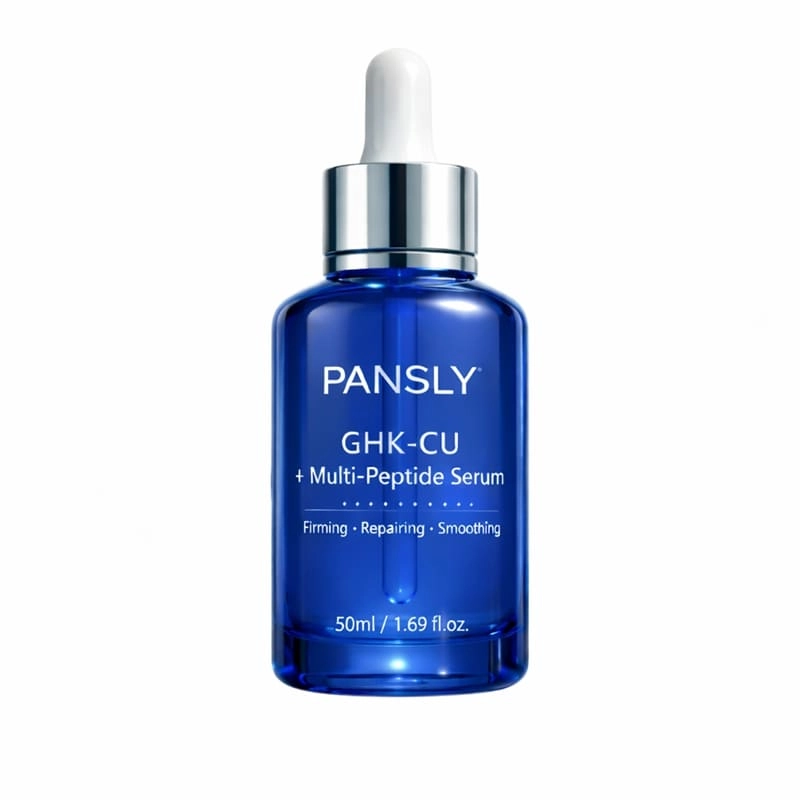
Experience visible rejuvenation with this GHK-Cu Copper Peptide Smoothing & Firming Face Serum, a high-performance concentrate designed to restore the structural integrity of aging skin. This advanced formula centers on GHK-Cu, a powerful signaling peptide clinically recognized for its ability to support natural collagen and elastin production. By promoting dermal density, it effectively tightens sagging skin and smooths the appearance of deep-set wrinkles and fine lines.
The lightweight, silky texture absorbs instantly, delivering antioxidant protection to neutralize environmental stressors that accelerate aging. Enhanced with deep-moisturizing agents, the serum reinforces the skin's moisture barrier, leaving the complexion feeling remarkably soft and resilient. With consistent use, skin texture is refined and facial contours appear more lifted, resulting in a youthfully firm and revitalized glow.
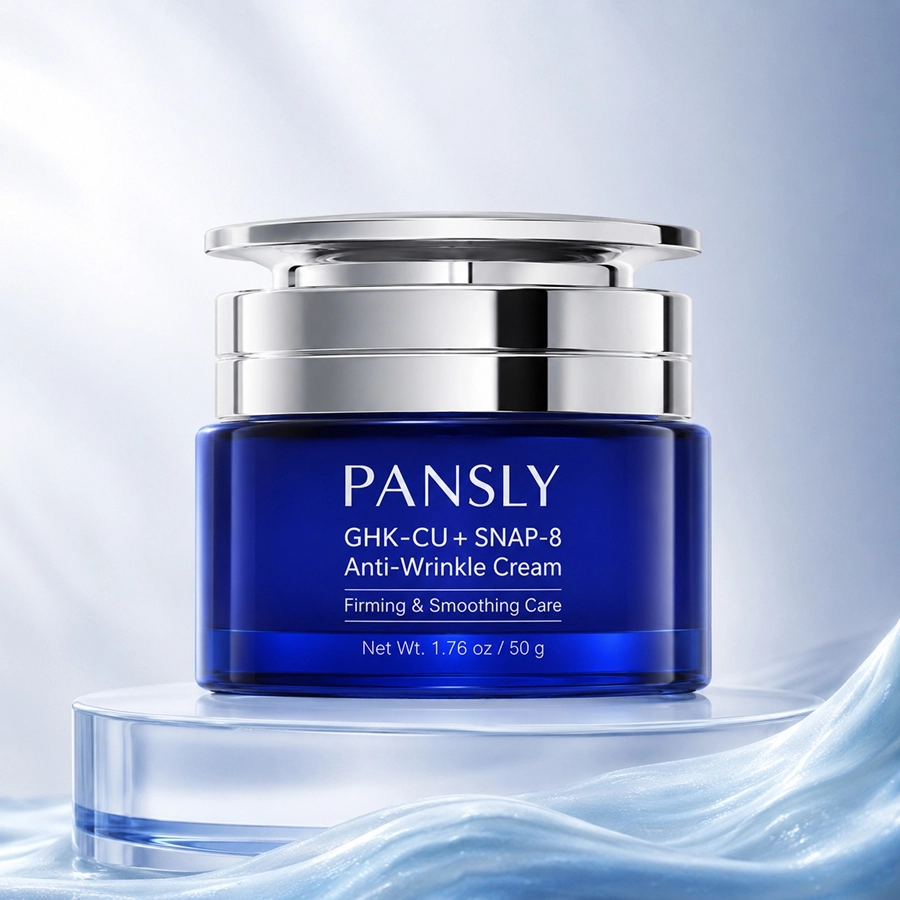
This Pansly GHK-CU + SNAP-8 Anti-Wrinkle Firming Cream is triple-peptide anti-aging facial cream, delivers targeted wrinkle smoothing, firming lifting and deep nourishment for dull, saggy, fine-line prone skin. Full OEM & ODM private label service is supported, including custom formula, packaging options, fast sampling and bulk export supply.
Five core premium active ingredients work synergistically for comprehensive anti-wrinkle care:
GHK-CU Copper Peptide lifts saggy skin, enhances skin resilience and tightens loose facial contour;
SNAP-8 Peptide targets expression lines to visibly soften and fade wrinkles;
Acetyl Hexapeptide-8 reduces the appearance of dry fine lines for smoother skin texture;
Ceramide NP reconstructs skin moisture barrier to lock nourishment and boost comfort;
Hyaluronic Acid delivers multi-layer rich deep moisture to relieve dry rough skin.
Luxury rich creamy texture spreads smoothly and melts into skin gently, leaving soft comfortable finish without heavy greasiness. Daily use blurs fine lines, firms loose skin, deeply nourishes and stabilizes barrier, refining uneven texture to reveal smooth, plump, youthful luminous skin.
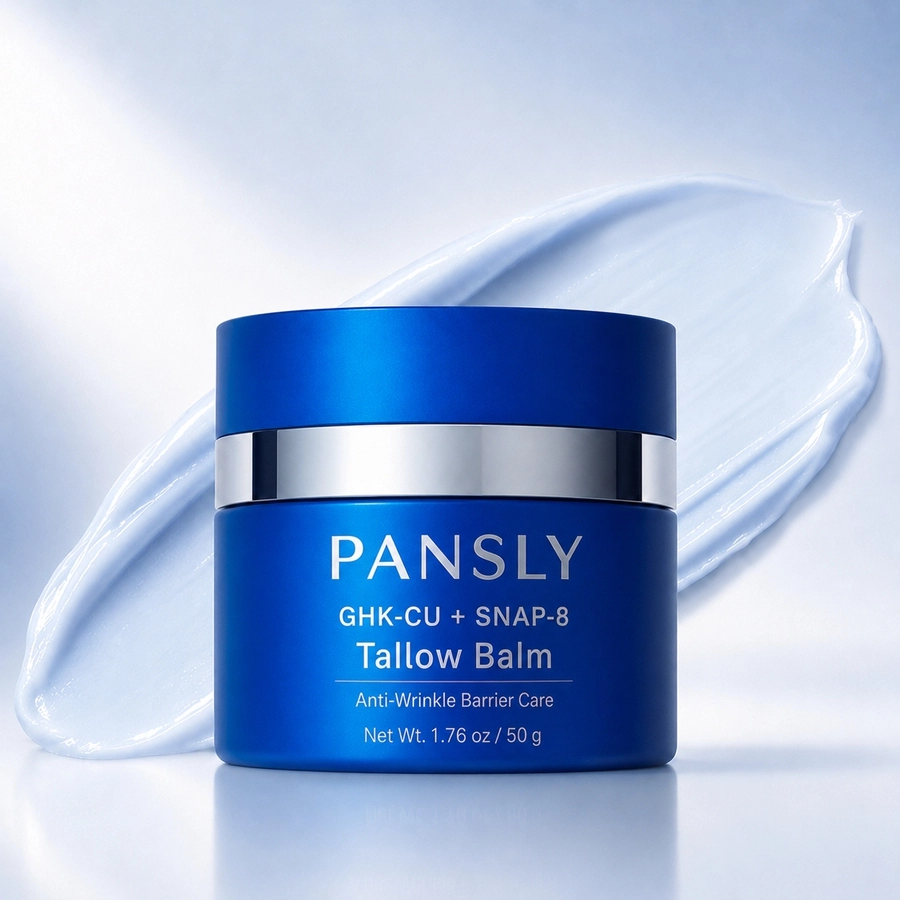
This Pansly GHK-CU + SNAP-8 Tallow Balm is a nourishing anti-wrinkle facial balm specially formulated for dry, fragile and sensitive skin, combining anti-aging wrinkle smoothing and barrier repairing effects. We offer full private label OEM service, including custom logo, adjustable formula, diversified packaging and lid color options.
It contains five core skin care active ingredients: GHK-CU visibly improves fine lines and revives dull complexion; SNAP-8 softens expression lines to smooth wrinkled skin texture; Grass-Fed Beef Tallow delivers deep lipid nourishment to relieve dry rough skin; Ectoin stabilizes the skin barrier and alleviates skin discomfort; Ceramide NP strengthens barrier structure to create smooth, healthy skin.
Luxury creamy blue balm texture glides smoothly and melts quickly on skin, providing long-lasting deep moisturizing comfort. Daily use fades fine lines & expression lines, nourishes dry delicate skin, repairs damaged barrier and leaves silky smooth skin finish.
Click here to customize the Beauty
we respond within a few hours
Monday–Friday, 9AM–6PM
3A01, Building A, Zhisheng Square, No. 4 Zhifu Road, Helong Street, Baiyun District, Guangzhou, China.


Leave a request, and we'll email you back within 24 hours.
© 2026 Beyond Basix. All Rights Reserved.