
Fast-Absorbing Cream Manufacturer vs Supplier: Which Fits Your Brand?

- How to Choose Between a Cosmetic Factory and a Product Supplier
- What a skincare supplier typically provides
- What a direct contract manufacturer contributes
- Which model is more suitable for different business stages?
- Technical and Commercial Criteria for a Lightweight Moisturizer Project
- Formula performance goes beyond quick skin feel
- Quality control and regulatory readiness
- Total cost of ownership and supply continuity
- Why a One-Stop OEM/ODM Skincare Partner Can Reduce Project Risk
- Integrated development from concept to finished goods
- Beyond Basix manufacturing capabilities
- Portfolio breadth, certifications, and category expansion
- Procurement Checklist Before Signing a Manufacturing Agreement
- Questions for technical validation
- Questions for quality and compliance
- Questions for commercial execution
- Frequently Asked Questions
For skincare brands, selecting between a fast-absorbing cream manufacturer and a supplier is a strategic procurement decision rather than a simple price comparison. The right partner affects formula originality, texture performance, ingredient documentation, minimum order quantity, packaging flexibility, regulatory readiness, replenishment reliability, and gross margin. A supplier may be suitable for a rapid test launch using an existing catalogue formula, while a direct manufacturing partner is generally better for brands that need customized emulsion technology, differentiated claims, controlled production, and a scalable product roadmap. Buyers should evaluate technical capability, quality assurance, documentation, communication speed, and total landed cost before signing a private-label or OEM agreement.
How to Choose Between a Cosmetic Factory and a Product Supplier
What a skincare supplier typically provides
A cosmetic supplier commonly acts as a trading, distribution, or sourcing intermediary. The company may present a catalogue of creams, lotions, gels, cleansers, and other finished goods produced by one or more factories. This model can shorten the sourcing process because buyers may select an existing item, add a logo, and proceed with basic packaging customization. It can work well for small retailers, first-time entrepreneurs, promotional projects, and brands testing demand in a limited market.
However, the buyer may have limited visibility into the actual manufacturing site, raw-material qualification, filling conditions, stability records, and change-control procedures. Formula adjustments can be restricted to fragrance, color, packaging, or minor ingredient changes. If a product develops a separation problem, label discrepancy, or supply interruption, the intermediary may need to consult another party before providing a technical answer. The commercial convenience of a supplier therefore needs to be weighed against reduced control over the product lifecycle.
What a direct contract manufacturer contributes
A direct skincare manufacturer develops or produces cosmetics within its own facility or under a clearly controlled manufacturing system. The project owner can usually discuss emulsion architecture, sensory profile, absorption speed, skin feel, active-ingredient selection, preservative strategy, packaging compatibility, pilot batches, and production scheduling with a technical team. This direct connection is especially important when a brand wants a non-greasy moisturizer, a lightweight barrier cream, a gel-cream hybrid, or a treatment product designed for a specific climate and consumer segment.
Manufacturers can also support a more structured product development process. Typical stages include a commercial brief, formula proposal, sample evaluation, stability and compatibility assessment, packaging confirmation, artwork review, pilot production, quality release, and mass manufacturing. The depth of each stage varies by project and market, so buyers should request a written development scope rather than assuming that every factory offers identical services.
Which model is more suitable for different business stages?
A catalogue supplier may be appropriate when speed and low initial commitment are the primary goals. A growing brand with clear positioning, repeat-purchase ambitions, or retailer requirements generally benefits from direct access to a factory. The decision should reflect more than the first order. Forecasted annual volume, target countries, claim substantiation, packaging ownership, formula exclusivity, and the cost of switching partners are all relevant to total commercial risk.
| Decision factor | Catalogue supplier | Direct OEM/ODM manufacturer | Buyer implication |
|---|---|---|---|
| Initial launch speed | Often faster when stock formulas are available | Usually requires sampling and approval stages | Use a supplier for rapid validation; use a factory for planned differentiation |
| Formula customization | Usually limited | Can include texture, active, fragrance, and process adjustments | Customization supports stronger positioning and claim strategy |
| Factory visibility | May be indirect | Usually direct, subject to disclosure and audit terms | Direct visibility improves technical and quality communication |
| Minimum order quantity | May be lower for ready-made items | Depends on formula, filling line, packaging, and raw-material commitments | Compare total inventory exposure, not only unit price |
| Quality documentation | Depends on the upstream factory | Can be requested through the manufacturer’s quality system | Confirm specifications, test records, batch documents, and change control |
| Long-term scalability | Can be affected by intermediary availability | More suitable for repeat production and portfolio expansion | Choose the model that can support forecasted growth |
The table describes common operating patterns rather than universal guarantees. Buyers should verify each statement through a supplier questionnaire, factory audit, sample review, and contract terms. For quality-system context, the ISO 22716 cosmetics GMP standard addresses good manufacturing practices for cosmetic products, while the WHO good manufacturing practices guidance provides broader principles for controlled production. These references do not replace local regulatory advice, but they help procurement teams structure due diligence.
Technical and Commercial Criteria for a Lightweight Moisturizer Project
Formula performance goes beyond quick skin feel
Fast sensory uptake is created through a balance of emollients, humectants, emulsifiers, polymers, oils, water phase design, particle distribution, and processing conditions. A cream that feels dry within seconds may still leave insufficient moisturization, pill under sunscreen, destabilize during transport, or conflict with a consumer’s preferred skin finish. Product briefs should therefore define measurable and observable requirements: spreadability, residue, tack, whitening, pilling, after-feel, hydration performance, fragrance intensity, and compatibility with makeup or sun protection.
Ingredient selection also affects regional positioning. Niacinamide, panthenol, ceramides, hyaluronic acid, botanical extracts, squalane, peptides, and other actives may support different claims, but claims must be aligned with evidence, concentration, local legislation, and label language. The U.S. Food and Drug Administration cosmetics guidance explains that cosmetic products and ingredients must meet applicable safety and labeling requirements, and that claims may affect whether a product is regulated as a drug. A responsible partner should flag claim risk before artwork approval.
Quality control and regulatory readiness
Procurement teams should request a quality dossier appropriate to the destination market. Useful documents may include an ingredient list using INCI nomenclature, product specification, certificate of analysis, microbiological results, safety assessment support, stability information, packaging compatibility data, allergen information, SDS or MSDS where applicable, and batch traceability records. Depending on the market and product claims, additional evidence may be needed for preservatives, allergens, sunscreen filters, vegan positioning, halal status, or organic certification.
Quality assurance should cover incoming raw materials, water quality, weighing, compounding, filling, labeling, finished-product testing, retention samples, sanitation, environmental controls, and deviation management. Buyers should ask how nonconforming batches are handled, who approves formula changes, how suppliers are qualified, and how complaints are investigated. The ISO 9001 quality management framework can help buyers understand process discipline, although certification alone does not prove that a specific formula will meet every performance requirement.
Total cost of ownership and supply continuity
The lowest quoted unit price may not be the lowest commercial cost. A complete calculation should include development fees, sample freight, tooling, artwork, testing, certificates, packaging components, customs, warehousing, defect allowances, payment terms, and the financial impact of minimum order quantities. A direct producer may appear more expensive at sampling stage but deliver better margins after formula optimization, packaging consolidation, and repeat production.
Supply continuity also deserves contractual attention. Buyers should clarify lead times for raw materials and packaging, forecast obligations, production capacity during peak seasons, approved alternative materials, ownership of molds and artwork, confidentiality, exclusivity, and notice periods for discontinuation. A reliable partner should provide realistic capacity information rather than promising every requested delivery date without production evidence.
Why a One-Stop OEM/ODM Skincare Partner Can Reduce Project Risk
Integrated development from concept to finished goods
A one-stop OEM/ODM model connects product strategy, formulation, testing coordination, packaging sourcing, design support, manufacturing, and shipment preparation through one accountable project structure. This reduces the number of handoffs between a brand, trading company, packaging vendor, laboratory, and factory. Fewer handoffs can improve version control and reduce errors such as mismatched ingredient lists, incorrect carton dimensions, incompatible pumps, or artwork that does not reflect the approved formula.
For a lightweight facial moisturizer, the integrated workflow should begin with the target consumer and use occasion. A daytime product for humid Southeast Asian markets may require a different emollient profile from a winter barrier cream for Northern Europe. A professional skincare line may prioritize low fragrance and elegant slip, while a mass-market body product may prioritize cost-efficient hydration and high-speed filling. The manufacturer should translate these commercial requirements into a technical brief with defined acceptance criteria.
Beyond Basix manufacturing capabilities
Beyond Basix, operated by Guangzhou Beyond Basix Cosmetics Ltd., provides a comprehensive cosmetics care manufacturing model supported by more than 23 years of experience in research, production, and sales. Our 12,000-square-meter facility includes a 100,000-level GMPC pharmaceutical-grade dust-free workshop and 12 production lines. Advanced machinery imported from Germany, the United States, and other regions supports controlled processing and efficient production planning.
Our team has focused on skincare development with effective ingredients for 12 years. This experience supports projects that require a refined sensory profile, stable emulsion performance, suitable packaging, and commercially practical manufacturing. We can work with brand owners, distributors, retailers, and project investors across concept development, sampling, packaging coordination, production, and delivery planning. The objective is not merely to supply a jar or tube, but to help create a repeatable product system that can support future launches.
Portfolio breadth, certifications, and category expansion
Beyond Basix operates four major brands: LANTHOME, PANSLY, FIRSTSUN, and SAUVASINE. Our certification and documentation portfolio includes ISO 9001, CE, MSDS, GMP, HALAL, and other relevant qualifications or records according to product and market requirements. Buyers should always confirm which certification applies to the specific facility, product, claim, and destination market, but these systems provide a useful foundation for structured procurement and compliance discussions.
Our manufacturing scope extends beyond facial moisturizers. Brand owners can coordinate broader product safety and responsible formulation considerations across Skincare Products, Hair Care Products, Eye Care Products, and Body Care Products. This breadth can help a growing label maintain consistent packaging architecture, ingredient storytelling, and quality expectations across multiple categories. It may also reduce the operational burden of managing several unrelated vendors as the portfolio expands.
Procurement Checklist Before Signing a Manufacturing Agreement
Questions for technical validation
Request several samples with documented formula versions and compare absorption, spread, residue, pilling, fragrance, and appearance after application. Ask whether the sample is laboratory scale, pilot scale, or production-equivalent. Confirm the proposed active ingredients, usage levels, preservative system, packaging format, target shelf life, storage conditions, and planned testing. If the product is intended for sensitive skin, acne-prone skin, children, or professional use, the brief should state the relevant restrictions and safety expectations clearly.
Questions for quality and compliance
Confirm the manufacturing address, applicable GMP system, audit policy, batch coding, retention-sample procedure, complaint process, and release criteria. Ask which documents are included in the quoted price and which require additional fees. Review whether labels, claims, warnings, net contents, responsible-person information, and language requirements will be checked for the destination market. In the United States, buyers should also review the FDA information on the Modernization of Cosmetics Regulation Act when applicable; other markets have their own obligations.
Questions for commercial execution
Obtain a written quotation showing development charges, minimum order quantities, component costs, production lead time, payment schedule, shipping terms, and validity period. Clarify who owns the customized formula, whether the factory can produce replacement orders, how forecast changes are managed, and what happens if packaging becomes unavailable. A strong partner will communicate limitations early and provide alternatives with their commercial and technical consequences.
The best choice is determined by the project’s risk profile. A supplier can be efficient for a simple, low-volume, ready-to-market item, but a direct manufacturer is usually more valuable when the brand requires differentiated texture, regulatory support, reliable replenishment, and coordinated category growth. Beyond Basix is positioned to support that broader requirement through integrated capability, facility investment, technical development, quality systems, and a multi-category cosmetics portfolio.
Contact Beyond Basix to discuss your product brief, request suitable samples, and explore an OEM/ODM skincare program built around your target market and growth plan.
Frequently Asked Questions
What is the main difference between a fast-absorbing cream manufacturer and a supplier?
A supplier typically provides catalogue products or coordinates goods from another factory, while a direct manufacturer develops or produces cosmetics within a controlled manufacturing system. Manufacturers generally offer stronger access to formula customization, production information, quality documentation, and long-term scalability.
Is a supplier better for a small skincare startup?
A catalogue supplier may be suitable when a startup needs a quick launch, low initial commitment, and an existing formula. However, a direct OEM/ODM manufacturer can be a better choice when the startup needs differentiated texture, stronger brand positioning, regulatory support, or repeat production as demand grows.
What documents should buyers request from a cosmetic manufacturer?
Buyers should request an ingredient list using INCI nomenclature, product specifications, certificates of analysis, microbiological results, stability information, packaging compatibility data, safety assessment support, allergen information, applicable SDS or MSDS documents, and batch traceability records. The exact dossier depends on the destination market and product claims.
How can a brand evaluate whether a lightweight moisturizer is truly high quality?
The evaluation should cover spreadability, absorption, residue, tack, whitening, pilling, after-feel, hydration performance, fragrance, appearance, stability, and compatibility with packaging and other skincare products. Samples should be compared using documented formula versions, and buyers should confirm whether samples are laboratory, pilot, or production-equivalent batches.
What affects the cost of private-label skincare manufacturing?
Total cost can include formula development, testing, samples, packaging components, tooling, artwork, certificates, minimum order quantities, freight, customs, warehousing, payment terms, and defect allowances. The lowest unit quotation is not always the lowest total cost, particularly when inventory risk or future supply changes are considered.
Why choose a one-stop OEM/ODM skincare partner?
A one-stop partner can coordinate formulation, testing, packaging, manufacturing, quality release, and shipment preparation through one accountable workflow. This reduces handoffs, improves version control, and can make it easier for a brand to expand from facial care into hair care, eye care, and body care products.

Elevate your professional skincare offerings with this Private Label Copper Peptide Anti-Wrinkle Firming Serum, a powerhouse concentrate designed for superior age-defying results. This sophisticated formula leverages the synergistic effects of GHK-Cu and SNAP-8 to address multiple layers of skin aging. The GHK-Cu copper peptides act as a vital signaling mechanism to enhance skin density and firmness, while the advanced SNAP-8 octapeptide specifically targets expression lines, helping to relax the appearance of deep-seated wrinkles for a smoother, more refined surface.
This lightweight, rapid-absorption serum provides a professional-grade solution for clients seeking a non-invasive lift. It effectively restores elasticity, improves skin texture, and provides essential antioxidant protection. Perfect for high-end beauty brands, this serum leaves the complexion looking visibly contoured, hydrated, and youthfully revitalized.
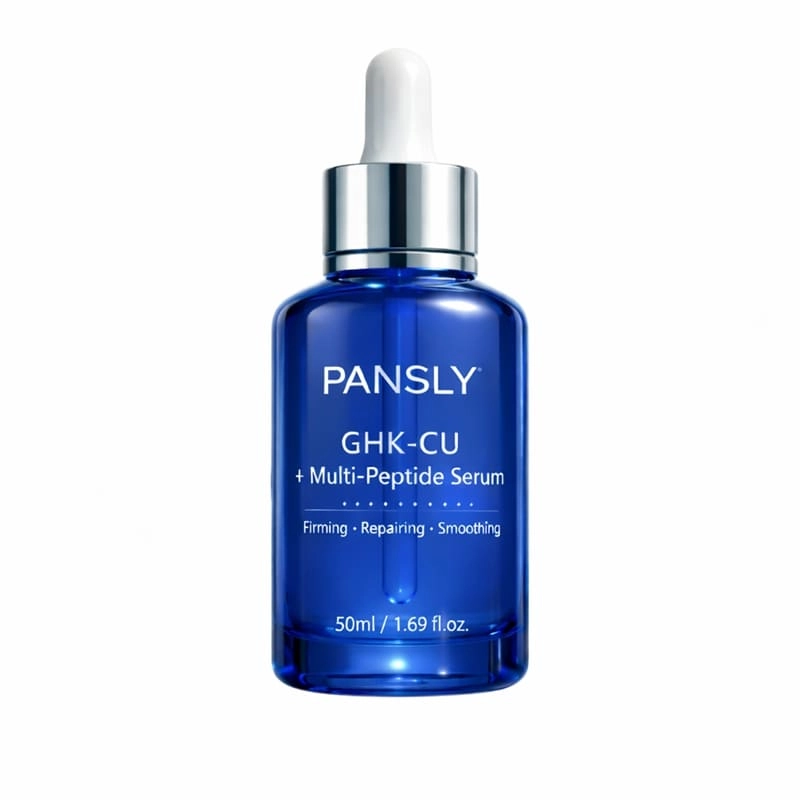
Experience visible rejuvenation with this GHK-Cu Copper Peptide Smoothing & Firming Face Serum, a high-performance concentrate designed to restore the structural integrity of aging skin. This advanced formula centers on GHK-Cu, a powerful signaling peptide clinically recognized for its ability to support natural collagen and elastin production. By promoting dermal density, it effectively tightens sagging skin and smooths the appearance of deep-set wrinkles and fine lines.
The lightweight, silky texture absorbs instantly, delivering antioxidant protection to neutralize environmental stressors that accelerate aging. Enhanced with deep-moisturizing agents, the serum reinforces the skin's moisture barrier, leaving the complexion feeling remarkably soft and resilient. With consistent use, skin texture is refined and facial contours appear more lifted, resulting in a youthfully firm and revitalized glow.
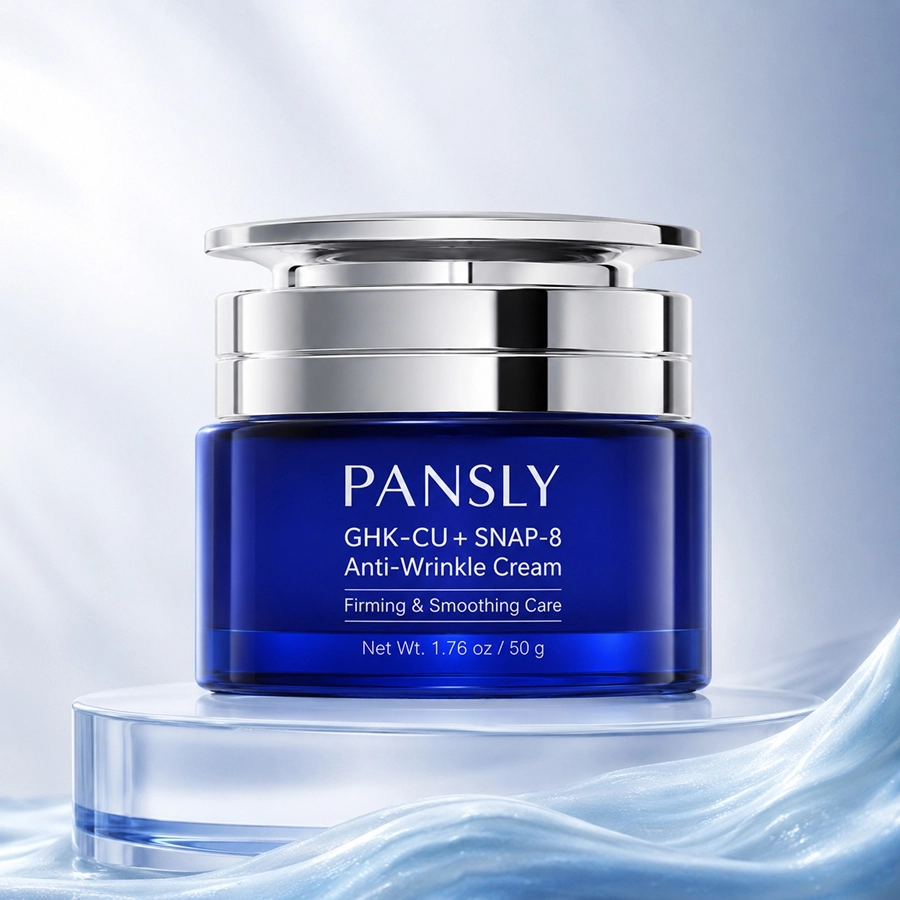
This Pansly GHK-CU + SNAP-8 Anti-Wrinkle Firming Cream is triple-peptide anti-aging facial cream, delivers targeted wrinkle smoothing, firming lifting and deep nourishment for dull, saggy, fine-line prone skin. Full OEM & ODM private label service is supported, including custom formula, packaging options, fast sampling and bulk export supply.
Five core premium active ingredients work synergistically for comprehensive anti-wrinkle care:
GHK-CU Copper Peptide lifts saggy skin, enhances skin resilience and tightens loose facial contour;
SNAP-8 Peptide targets expression lines to visibly soften and fade wrinkles;
Acetyl Hexapeptide-8 reduces the appearance of dry fine lines for smoother skin texture;
Ceramide NP reconstructs skin moisture barrier to lock nourishment and boost comfort;
Hyaluronic Acid delivers multi-layer rich deep moisture to relieve dry rough skin.
Luxury rich creamy texture spreads smoothly and melts into skin gently, leaving soft comfortable finish without heavy greasiness. Daily use blurs fine lines, firms loose skin, deeply nourishes and stabilizes barrier, refining uneven texture to reveal smooth, plump, youthful luminous skin.
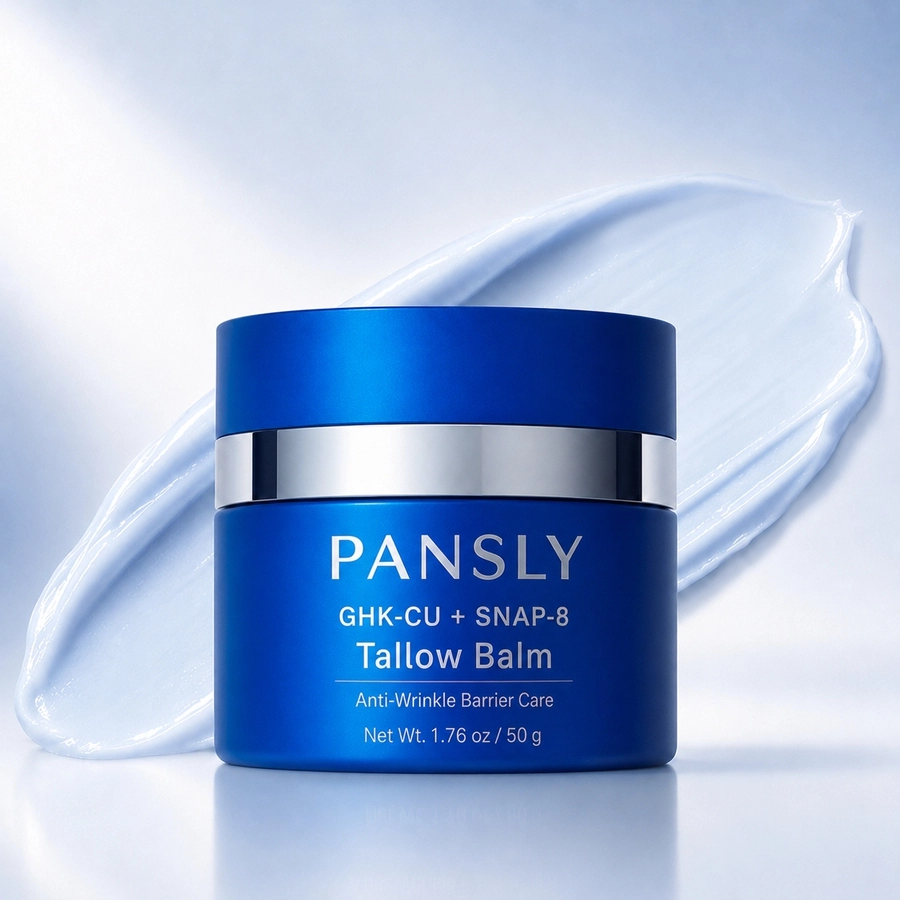
This Pansly GHK-CU + SNAP-8 Tallow Balm is a nourishing anti-wrinkle facial balm specially formulated for dry, fragile and sensitive skin, combining anti-aging wrinkle smoothing and barrier repairing effects. We offer full private label OEM service, including custom logo, adjustable formula, diversified packaging and lid color options.
It contains five core skin care active ingredients: GHK-CU visibly improves fine lines and revives dull complexion; SNAP-8 softens expression lines to smooth wrinkled skin texture; Grass-Fed Beef Tallow delivers deep lipid nourishment to relieve dry rough skin; Ectoin stabilizes the skin barrier and alleviates skin discomfort; Ceramide NP strengthens barrier structure to create smooth, healthy skin.
Luxury creamy blue balm texture glides smoothly and melts quickly on skin, providing long-lasting deep moisturizing comfort. Daily use fades fine lines & expression lines, nourishes dry delicate skin, repairs damaged barrier and leaves silky smooth skin finish.
Click here to customize the Beauty
we respond within a few hours
Monday–Friday, 9AM–6PM
3A01, Building A, Zhisheng Square, No. 4 Zhifu Road, Helong Street, Baiyun District, Guangzhou, China.


Leave a request, and we'll email you back within 24 hours.
© 2026 Beyond Basix. All Rights Reserved.
