Fast-Absorbing Cream OEM/ODM: Formula, Packaging and Logo Options

- How Rapid-Absorption Facial and Body Creams Are Engineered
- Emulsion structure and sensory performance
- Active ingredients and claim alignment
- Testing, stability, and production readiness
- Packaging Engineering and Private-Label Logo Decisions
- Choosing the right primary container
- Secondary packaging and sustainability requirements
- Logo application and artwork control
- Commercial and Regulatory Planning for OEM/ODM Buyers
- From concept brief to approved bulk
- Documentation and market access
- Why Beyond Basix Supports One-Stop Skincare Product Development
- Integrated manufacturing capacity and technical control
- Certification, product categories, and customization support
- Partner-focused execution and brand portfolio
- Frequently Asked Questions
A fast-absorbing cream OEM/ODM program combines cosmetic science, packaging engineering, brand design, regulatory preparation, and commercial planning into one development workflow. The objective is not simply to create a lightweight texture; it is to deliver a stable emulsion that spreads quickly, leaves an acceptable after-feel, supports the intended skin benefit, fits the target market’s usage habits, and can be manufactured consistently at commercial volume. Buyers should assess the formula architecture, active-ingredient compatibility, sensory benchmarks, container protection, logo execution, documentation, minimum order quantity, and scale-up controls before approving a supplier. A reliable one-stop OEM/ODM for skincare partner can reduce communication gaps between laboratory, packaging, procurement, quality, and production teams while helping brand owners bring a differentiated product to market with controlled cost and risk.
How Rapid-Absorption Facial and Body Creams Are Engineered
Emulsion structure and sensory performance
The perception of quick absorption is created by several variables rather than one ingredient. Oil-phase selection, emulsifier system, droplet size, humectant level, polymer concentration, powder technology, and the balance between occlusive and non-occlusive materials all influence slip, spreadability, cushion, tack, shine, and residual film. A water-in-oil system may provide stronger barrier support but can feel richer, while a well-designed oil-in-water emulsion often offers a lighter application profile. Lamellar emulsions can provide a comfortable protective film, but they require careful processing and compatibility testing.
Buyers should request a defined sensory brief instead of using general terms such as non-greasy or refreshing. A useful brief can specify rub-in time, acceptable tack after one minute, finish after ten minutes, pilling behavior under sunscreen or makeup, and suitability for humid or dry climates. Instrumental measurements may support development, but trained-panel evaluation remains important because consumer acceptance depends on the complete application experience.
Active ingredients and claim alignment
Ingredient selection should follow the product claim, target consumer, regulatory market, and expected price point. Humectants such as glycerin, propanediol, and hyaluronic acid derivatives can support hydration, while emollients, barrier lipids, panthenol, allantoin, niacinamide, botanical extracts, and antioxidant systems may be selected for different positioning strategies. The formula must account for pH range, solubility, light sensitivity, oxidation risk, preservative compatibility, and interactions between actives and packaging materials.
Claims should remain consistent with cosmetic regulations in each destination market. The U.S. Food and Drug Administration cosmetics laws and regulations distinguish cosmetic products from drugs, meaning wording that implies treatment, disease prevention, or physiological change can alter regulatory obligations. Buyers should therefore approve the ingredient list, claims matrix, usage instructions, and substantiation plan together rather than treating marketing copy as a final-stage task.
Testing, stability, and production readiness
Laboratory samples are not sufficient evidence of commercial readiness. A professional development process normally includes accelerated and long-term stability studies, freeze-thaw evaluation where relevant, centrifuge or separation observation, odor and color monitoring, preservative effectiveness assessment, microbiological testing, compatibility checks, and packaging functionality trials. The precise protocol should reflect the formula, container, market, and company quality system.
Good Manufacturing Practice provides the operational framework for controlling contamination, documentation, equipment hygiene, batch traceability, and process consistency. Buyers can review the principles described in ISO 22716 cosmetics Good Manufacturing Practices when comparing supplier quality systems. A batch made under controlled conditions should also have defined specifications for appearance, odor, pH, viscosity, filling weight, microbial limits, and release approval.
Packaging Engineering and Private-Label Logo Decisions
Choosing the right primary container
Packaging selection should begin with formula behavior and user dispensing requirements. A tube is lightweight, economical, and suitable for controlled application; an airless pump can reduce repeated exposure to air and support a High Quality positioning; a jar offers strong shelf presence but increases direct user contact; and a pump bottle can improve convenience for larger body-care formats. The choice should consider viscosity, particle content, preservative strategy, dosage accuracy, transportation conditions, recyclability expectations, and filling-line compatibility.
For a lightweight emulsion, buyers should test the complete formula in the actual container rather than relying only on material declarations. Compatibility trials can identify swelling, cracking, stress whitening, discoloration, odor transfer, label lifting, pump blockage, leakage, or changes in dispensing force. Packaging suppliers should provide material information and relevant declarations, while the OEM/ODM manufacturer should coordinate filling tests and finished-product inspection.
Secondary packaging and sustainability requirements
Cartons, inserts, labels, seals, and shipping cases influence both brand presentation and operational cost. A compact carton may reduce material usage and freight volume, but it must still protect the container and provide required information. Buyers should define whether the product needs multilingual artwork, batch coding space, tamper evidence, QR authentication, recycling symbols, or market-specific warnings.
Sustainability claims require evidence. The ISO 14021 environmental label guidance explains principles for self-declared environmental claims, including the need for accuracy and substantiation. Recycled content, recyclable structure, refillability, and reduced packaging weight should not be presented ambiguously. Procurement teams should obtain supplier declarations and confirm that the proposed package is accepted by the intended market’s waste infrastructure.
Logo application and artwork control
Logo customization can be achieved through screen printing, offset printing, hot stamping, water transfer, embossing, debossing, laser marking, molded-in branding, or pressure-sensitive labels. Each method creates a different visual and cost profile. Metallic hot stamping can support a High Quality appearance, while direct screen printing may be efficient for simple graphics and moderate volumes. Embossing and debossing create tactile differentiation but may require suitable material thickness and tooling.
Brand owners should supply vector artwork, approved color references, logo clear-space rules, target dimensions, and packaging hierarchy. A disciplined approval process includes digital artwork review, physical color proofing, decorated-container sampling, barcode verification, adhesion testing, and written sign-off before mass production. This reduces the risk of logo distortion, color mismatch, incorrect regulatory text, or expensive rework.
| Decision area | Lightweight tube | Airless pump | Jar | Buyer evaluation point |
|---|---|---|---|---|
| Product access | Controlled squeeze dispensing | Measured pump dosage | Open access with scoop or finger | Match dispensing to viscosity and hygiene expectations |
| Protection from repeated air exposure | Moderate | Generally strong | Lower after opening | Confirm formula oxidation and preservation requirements |
| Brand positioning | Mass, travel, or practical | High Quality or dermocosmetic | Luxury or sensorial | Balance shelf impact with target retail price |
| Decoration options | Label, print, hot stamp | Print, label, custom actuator | Cap decoration, label, print | Approve decorated samples, not artwork alone |
| Operational risk | Seal and nozzle control | Pump compatibility and priming | Contamination and closure torque | Include transport and filling trials |
Commercial and Regulatory Planning for OEM/ODM Buyers
From concept brief to approved bulk
A clear development path typically moves from market brief and benchmark analysis to formula proposal, laboratory samples, sensory review, ingredient and claim assessment, packaging selection, compatibility testing, pilot production, stability monitoring, artwork approval, and mass production. Each gate should have an owner, acceptance criteria, and documented revision history. This structure helps prevent a common procurement problem: approving a formula before the package, claim language, or cost model is ready.
Cost should be evaluated as total landed cost rather than unit formula price alone. The calculation may include active ingredients, packaging components, tooling, decoration, testing, certification support, filling, cartons, freight, import duties, inspection, and inventory carrying cost. A lower initial quote can become less competitive if it requires new molds, has high component waste, or produces inconsistent dispensing at scale.
Documentation and market access
Depending on the destination, buyers may require an INCI ingredient list, product specification, certificate of analysis, safety documentation, microbiology results, stability data, packaging declarations, allergen information, manufacturing certificates, and batch records. The World Health Organization quality assurance guidance provides useful context for controlled manufacturing and quality documentation, although market-specific cosmetic requirements still apply.
For European distribution, responsible-person obligations, product information files, safety assessment, notification, and claims compliance must be reviewed. The European Union Cosmetic Products Regulation is a primary legal reference for products placed on the EU market. Buyers entering multiple regions should create a regulatory matrix early, because a fragrance, preservative, claim, or label format accepted in one market may require adjustment in another.
Why Beyond Basix Supports One-Stop Skincare Product Development
Integrated manufacturing capacity and technical control
Beyond Basix is the corporate brand of Guangzhou Beyond Basix Cosmetics Ltd., a comprehensive cosmetics care manufacturer with more than 23 years of experience in research, production, and sales. Our 12,000-square-meter facility includes a 100,000-level GMPC pharmaceutical-grade dust-free workshop and 12 production lines. Production is supported by advanced machinery imported from Germany, the United States, and other regions, helping our teams coordinate laboratory development, filling, packaging, and quality-control activities within an integrated manufacturing environment.
Our technical focus includes skincare development with effective ingredients, supported by 12 years of dedicated experience in this area. For a private-label moisturizing emulsion, this integrated structure can simplify communication between formulation engineers, packaging specialists, artwork coordinators, procurement staff, and production managers. Buyers can use one project framework to manage texture targets, ingredient selection, container compatibility, logo application, documentation, and delivery planning.
Certification, product categories, and customization support
Beyond Basix maintains certifications and supporting qualifications including ISO 9001, CE, MSDS, GMP, HALAL, and more, subject to product and market applicability. Certifications should always be reviewed against the specific factory, product, scope, and destination-market requirement, but a documented quality framework gives buyers a stronger basis for supplier evaluation and audit preparation.
Our product capability extends beyond facial moisturizers. We support Skincare Products, Hair Care Products, Eye Care Products, and Body Care Products, allowing brand owners and distributors to build coordinated product families. A lightweight facial lotion can be developed alongside hand cream, body lotion, eye gel, cleanser, shampoo, conditioner, or treatment products while maintaining consistent fragrance direction, packaging language, logo placement, and retail positioning.
Partner-focused execution and brand portfolio
Our operating philosophy is centered on practical cooperation, competitive pricing, responsive service, and long-term growth with partners. Beyond Basix also operates four major brands: LANTHOME, PANSLY, FIRSTSUN, and SAUVASINE. These brands reflect experience in product development and market presentation, while OEM/ODM customers retain the opportunity to build their own identity through customized formulas, packaging structures, decoration methods, and claims strategy.
For procurement teams, supplier value should be measured by more than factory size. The strongest partner combines repeatable quality, realistic lead times, transparent development gates, suitable documentation, responsive problem solving, and the ability to scale a successful sample into stable mass production. Beyond Basix can help project owners move from a sensory concept to a commercial skincare range with coordinated support across formula, package, logo, quality, and production.
Before issuing a purchase order, buyers should prepare a product brief covering target market, skin type, texture, absorption expectation, key ingredients, fragrance preference, package format, logo method, target cost, forecast volume, certification needs, and launch schedule. A supplier should then confirm feasibility, testing requirements, sample stages, minimum order quantity, tooling implications, and production timeline in writing.
Frequently Asked Questions
What makes a cream feel fast absorbing?
Quick absorption is influenced by oil-phase selection, emulsifier system, emulsion structure, humectant level, polymer concentration, powder technology, and the balance between occlusive and non-occlusive materials. Spreadability, tack, shine, and residual film should be defined through sensory testing.
Which packaging is suitable for a lightweight moisturizing emulsion?
Tubes, airless pumps, jars, and pump bottles can all be suitable, depending on viscosity, dispensing needs, formula sensitivity, hygiene expectations, positioning, and filling-line compatibility. The complete formula should be tested in the actual package to identify leakage, blockage, material interaction, or dispensing problems.
Can an OEM/ODM supplier add a private logo to the package?
Yes. Common logo options include screen printing, offset printing, hot stamping, water transfer, embossing, debossing, laser marking, molded-in branding, and pressure-sensitive labels. Buyers should provide vector artwork and approve physical decorated samples before mass production.
What testing is needed before mass production?
Typical evaluations include stability testing, freeze-thaw testing where relevant, separation observation, odor and color monitoring, preservative effectiveness assessment, microbiological testing, packaging compatibility, dispensing performance, filling-weight checks, and pilot-batch verification. The exact program should reflect the formula, package, destination market, and quality system.
What documents should buyers request for a private-label cream?
Depending on the market, buyers may need an INCI ingredient list, product specification, certificate of analysis, safety documentation, microbiology results, stability data, packaging declarations, allergen information, manufacturing certificates, batch records, and claims-support materials.
Can Beyond Basix develop products beyond facial cream?
Yes. Beyond Basix supports Skincare Products, Hair Care Products, Eye Care Products, and Body Care Products, enabling brand owners to develop coordinated product families with aligned formulas, packaging design, logo placement, and market positioning.

Elevate your professional skincare offerings with this Private Label Copper Peptide Anti-Wrinkle Firming Serum, a powerhouse concentrate designed for superior age-defying results. This sophisticated formula leverages the synergistic effects of GHK-Cu and SNAP-8 to address multiple layers of skin aging. The GHK-Cu copper peptides act as a vital signaling mechanism to enhance skin density and firmness, while the advanced SNAP-8 octapeptide specifically targets expression lines, helping to relax the appearance of deep-seated wrinkles for a smoother, more refined surface.
This lightweight, rapid-absorption serum provides a professional-grade solution for clients seeking a non-invasive lift. It effectively restores elasticity, improves skin texture, and provides essential antioxidant protection. Perfect for high-end beauty brands, this serum leaves the complexion looking visibly contoured, hydrated, and youthfully revitalized.
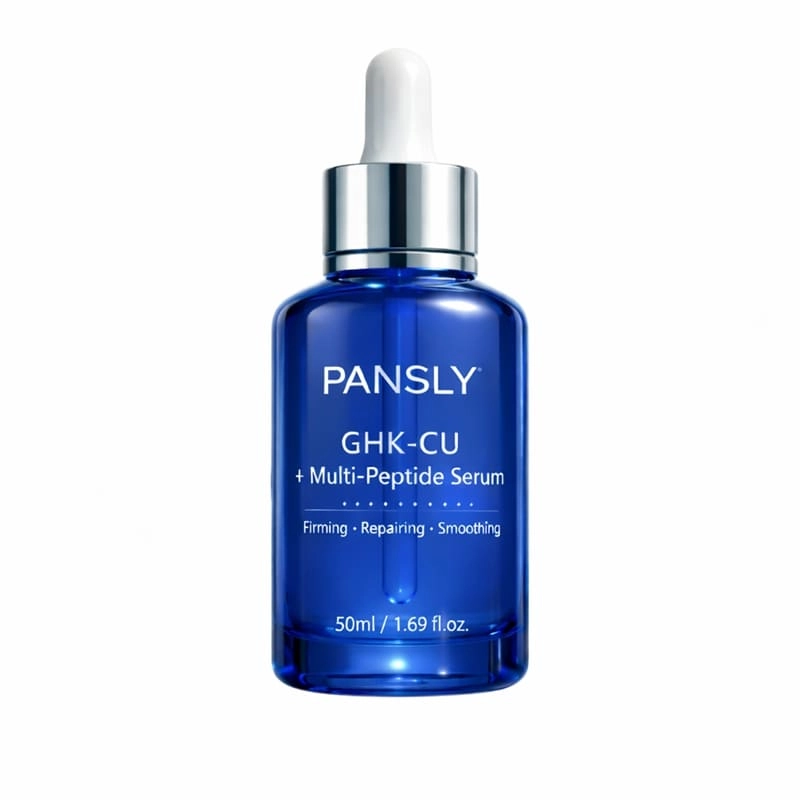
Experience visible rejuvenation with this GHK-Cu Copper Peptide Smoothing & Firming Face Serum, a high-performance concentrate designed to restore the structural integrity of aging skin. This advanced formula centers on GHK-Cu, a powerful signaling peptide clinically recognized for its ability to support natural collagen and elastin production. By promoting dermal density, it effectively tightens sagging skin and smooths the appearance of deep-set wrinkles and fine lines.
The lightweight, silky texture absorbs instantly, delivering antioxidant protection to neutralize environmental stressors that accelerate aging. Enhanced with deep-moisturizing agents, the serum reinforces the skin's moisture barrier, leaving the complexion feeling remarkably soft and resilient. With consistent use, skin texture is refined and facial contours appear more lifted, resulting in a youthfully firm and revitalized glow.
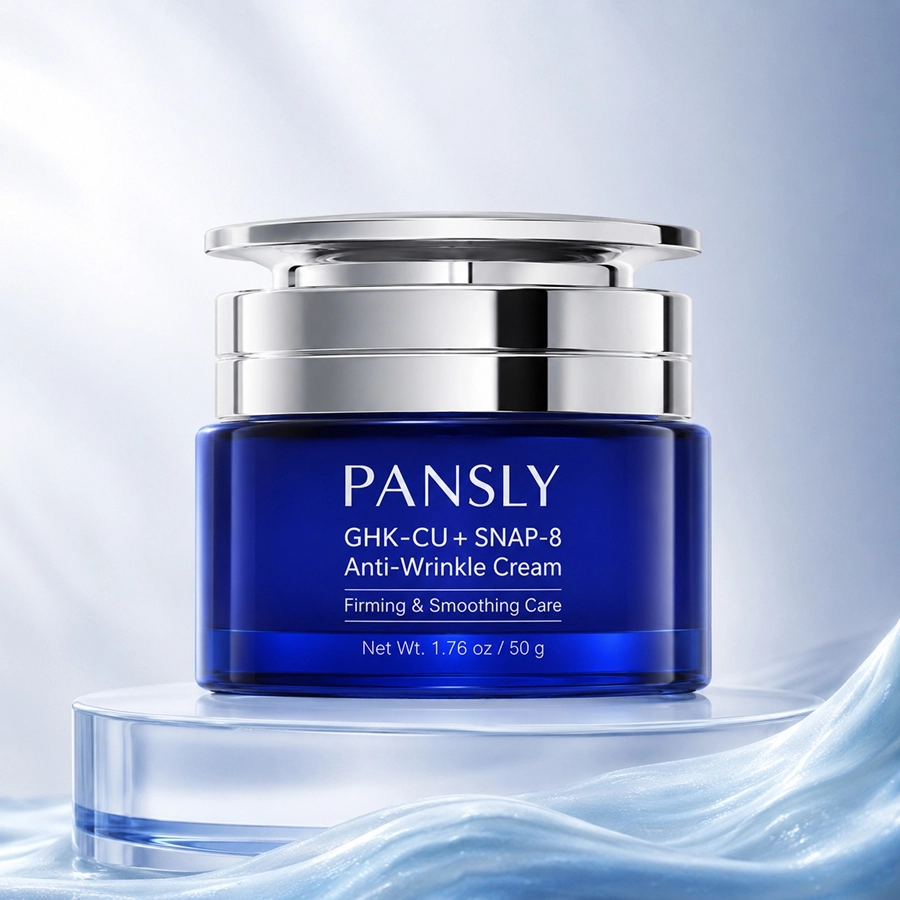
This Pansly GHK-CU + SNAP-8 Anti-Wrinkle Firming Cream is triple-peptide anti-aging facial cream, delivers targeted wrinkle smoothing, firming lifting and deep nourishment for dull, saggy, fine-line prone skin. Full OEM & ODM private label service is supported, including custom formula, packaging options, fast sampling and bulk export supply.
Five core premium active ingredients work synergistically for comprehensive anti-wrinkle care:
GHK-CU Copper Peptide lifts saggy skin, enhances skin resilience and tightens loose facial contour;
SNAP-8 Peptide targets expression lines to visibly soften and fade wrinkles;
Acetyl Hexapeptide-8 reduces the appearance of dry fine lines for smoother skin texture;
Ceramide NP reconstructs skin moisture barrier to lock nourishment and boost comfort;
Hyaluronic Acid delivers multi-layer rich deep moisture to relieve dry rough skin.
Luxury rich creamy texture spreads smoothly and melts into skin gently, leaving soft comfortable finish without heavy greasiness. Daily use blurs fine lines, firms loose skin, deeply nourishes and stabilizes barrier, refining uneven texture to reveal smooth, plump, youthful luminous skin.
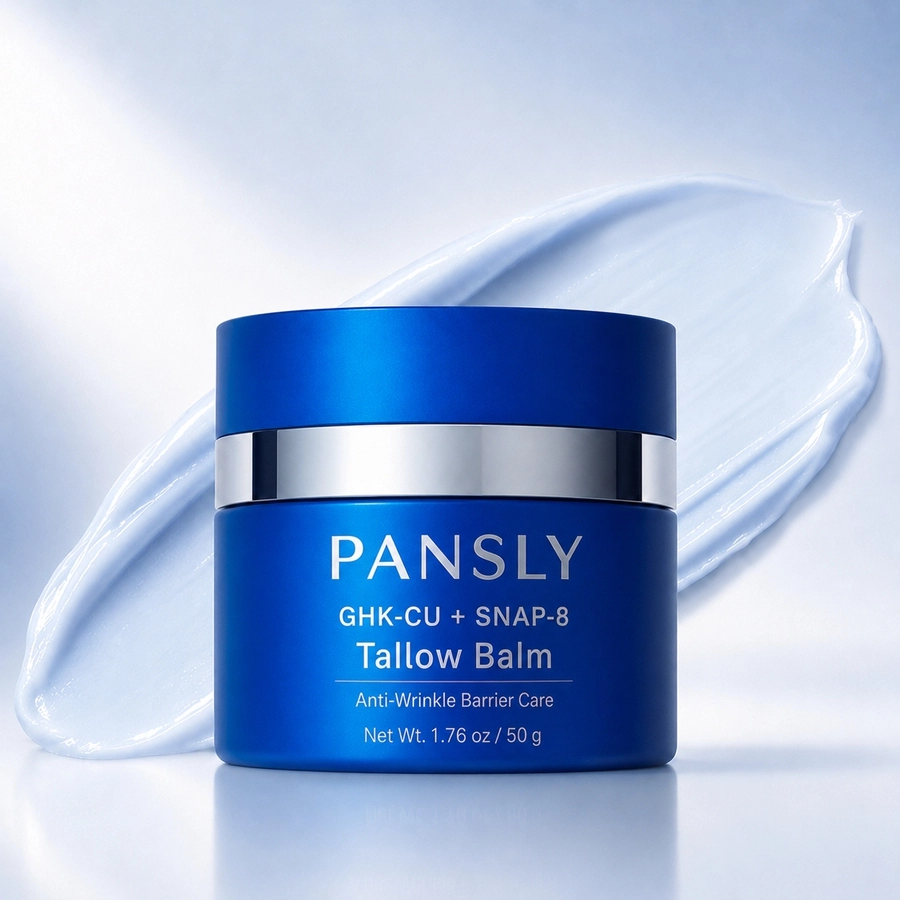
This Pansly GHK-CU + SNAP-8 Tallow Balm is a nourishing anti-wrinkle facial balm specially formulated for dry, fragile and sensitive skin, combining anti-aging wrinkle smoothing and barrier repairing effects. We offer full private label OEM service, including custom logo, adjustable formula, diversified packaging and lid color options.
It contains five core skin care active ingredients: GHK-CU visibly improves fine lines and revives dull complexion; SNAP-8 softens expression lines to smooth wrinkled skin texture; Grass-Fed Beef Tallow delivers deep lipid nourishment to relieve dry rough skin; Ectoin stabilizes the skin barrier and alleviates skin discomfort; Ceramide NP strengthens barrier structure to create smooth, healthy skin.
Luxury creamy blue balm texture glides smoothly and melts quickly on skin, providing long-lasting deep moisturizing comfort. Daily use fades fine lines & expression lines, nourishes dry delicate skin, repairs damaged barrier and leaves silky smooth skin finish.
Click here to customize the Beauty
we respond within a few hours
Monday–Friday, 9AM–6PM
3A01, Building A, Zhisheng Square, No. 4 Zhifu Road, Helong Street, Baiyun District, Guangzhou, China.


Leave a request, and we'll email you back within 24 hours.
© 2026 Beyond Basix. All Rights Reserved.