
Fast-Absorbing Cream Trends: Retail Demand and Private Label Opportunities

- Why Lightweight Moisturizers Are Reshaping Skincare Retail
- Consumer demand is moving toward immediate sensory comfort
- Multifunctional claims support stronger shelf relevance
- Channel behavior affects the winning product format
- Private Label Development Priorities for Rapid-Feel Cream Products
- Texture engineering requires measurable specifications
- Active ingredient stability must be protected from the beginning
- Packaging can determine both user experience and product loss
- How Buyers Can Reduce Private Label Launch Risk
- Supplier qualification should cover more than certificates
- Commercial feasibility depends on coordinated project planning
- Claims and documentation protect long-term brand value
- Beyond Basix: One-Stop OEM/ODM Capability for Scalable Skincare Programs
- Integrated manufacturing supports consistent commercialization
- Formulation expertise extends beyond a single hero product
- Quality systems and brand experience support international projects
- Frequently Asked Questions
Fast-absorbing cream formats are gaining retail attention because consumers increasingly expect lightweight hydration, non-sticky sensory performance, rapid layering, and multifunctional skin benefits. For private label buyers, the opportunity extends beyond a quick-dry texture: successful launches require ingredient compatibility, emulsion stability, packaging suitability, regulatory review, claims substantiation, pilot testing, and reliable scale-up. A qualified One-Stop OEM/ODM for Skincare partner can help brands develop facial, eye, body, and complementary personal-care products while controlling lead times, quality risk, and total project cost.
Why Lightweight Moisturizers Are Reshaping Skincare Retail
Consumer demand is moving toward immediate sensory comfort
Retail shoppers often evaluate a moisturizer within seconds of application. A residue-free finish, smooth spreadability, low tack, and quick skin feel can influence repeat purchase as strongly as the ingredient story. This is particularly relevant in warm, humid markets, where heavy occlusive textures may feel uncomfortable, interfere with sunscreen, or create friction when layered with makeup. In colder or drier regions, buyers may still prefer a fluid cream during the daytime and reserve richer products for evening use.
The commercial implication is that texture has become a product-positioning asset rather than a purely technical specification. A gel-cream, water-cream, emulsion lotion, or light barrier moisturizer can be positioned for office routines, travel, post-cleansing hydration, men’s grooming, sensitive skin, or daily use under cosmetics. Brand owners should define the intended use occasion before selecting the formula architecture, because a rapidly absorbing face product and a lightweight body lotion have different viscosity, packaging, and efficacy expectations.
Multifunctional claims support stronger shelf relevance
Retail demand is also being shaped by routine simplification. Consumers increasingly seek hydration combined with barrier support, brightening, soothing, oil-control, antioxidant, or pre-makeup benefits. This does not mean every product should make numerous claims. A focused proposition is easier to communicate, substantiate, and protect from regulatory risk. For example, a private label project may combine humectants such as glycerin or hyaluronic acid with emollients, skin-conditioning agents, and carefully selected botanical or functional ingredients.
Ingredient selection must follow the target market, product category, and claim language. The U.S. Food and Drug Administration cosmetics laws and regulations distinguish cosmetic products from drugs, while therapeutic or disease-related claims can change the regulatory pathway. Buyers should therefore ask suppliers to separate cosmetic benefits such as moisturizing or smoothing from claims that imply treatment, prevention, or physiological correction.
Channel behavior affects the winning product format
Different sales channels reward different attributes. E-commerce listings require a clear sensory description, strong visual communication, and packaging that remains stable during parcel transportation. Pharmacy and professional channels may prioritize tolerability, documentation, and a conservative claim structure. Mass retail favors broad usability, accessible pricing, and fast consumer comprehension. Boutique and High Quality channels can support more specialized textures, sophisticated packaging, and higher-cost active systems if the value proposition is credible.
For distributors and project owners, a useful product brief should specify the target consumer, climate, skin concern, application frequency, preferred finish, price band, package size, sales channel, and launch geography. This information allows the manufacturer to recommend an appropriate emulsion system instead of simply offering a standard base with a new fragrance or label.
Private Label Development Priorities for Rapid-Feel Cream Products
Texture engineering requires measurable specifications
“Quick absorption” should be translated into a testable product requirement. A buyer can request measurements and evaluation criteria covering viscosity, spreadability, rub-in time, after-feel, pilling potential, whitening, tack, and compatibility with sunscreen or foundation. Sensory panels can compare prototypes under controlled conditions, while instrumental testing may help monitor changes between pilot and mass production.
The desired finish depends on the balance between water phase, oil phase, humectants, emollients, emulsifiers, polymers, powders, and film-forming materials. Too much volatile material may create an initially dry sensation without delivering lasting comfort. Excessive powder can reduce tack but may cause drag, whitening, or uneven application. A reliable formulation team evaluates both first-touch perception and the skin condition several minutes after application.
Active ingredient stability must be protected from the beginning
Light textures often contain water-soluble and oil-soluble ingredients in the same system, making pH, temperature, oxidation, preservation, and packaging compatibility important. Some brightening agents, antioxidants, peptides, botanical extracts, and exfoliating ingredients can be sensitive to heat, oxygen, light, or incompatible preservatives. A development partner should review the formula’s pH range, processing temperature, addition sequence, mixing shear, and filling conditions before commercial quotation.
Stability work should include accelerated and real-time studies appropriate to the intended market, together with microbiological testing and packaging interaction checks. The World Health Organization good manufacturing practices guidance provides a useful reference for controlled production principles, documentation, sanitation, and quality systems. Buyers should request defined acceptance criteria rather than accepting an informal statement that a sample is “stable.”
Packaging can determine both user experience and product loss
Airless pumps, laminated tubes, jars, and standard pumps each create different protection and cost profiles. Airless systems can reduce repeated exposure to air and consumer contact, but they require compatibility testing and precise filling control. Tubes are convenient for travel and mass retail, while jars may support High Quality positioning but increase exposure during use. For a fluid emulsion, the actuator and orifice must be matched to viscosity to prevent leakage, inconsistent dosing, or frustrating dispensing.
Packaging selection should also consider transportation vibration, temperature fluctuation, closure torque, label adhesion, recyclability expectations, and minimum order quantities. A product that feels excellent in a laboratory sample can still fail commercially if the pump cannot prime, the cap cracks during transit, or the formula separates after prolonged storage in a hot warehouse.
| Development area | Traditional heavy cream approach | Lightweight rapid-feel approach | Buyer control point |
|---|---|---|---|
| Consumer sensory goal | Rich cushion and prolonged occlusion | Fast spread, low tack, quick layering | Define finish by use occasion and climate |
| Formula risk | Greasy after-feel or slow rub-in | Pilling, instability, dryness, or insufficient barrier feel | Approve sensory and stability benchmarks |
| Packaging options | Jar or wide-mouth container | Airless pump, tube, or controlled-dose pump | Conduct formula-package compatibility tests |
| Claim direction | Rich nourishment and intensive moisture | Daily hydration, smoothing, soothing, or makeup-friendly use | Match claims with evidence and local rules |
| Commercial application | Night care, dry skin, winter use | Day care, humid climates, travel, layering, and broad routine use | Align format with channel and target price |
How Buyers Can Reduce Private Label Launch Risk
Supplier qualification should cover more than certificates
Certifications are valuable indicators, but procurement teams should examine how a manufacturer applies its quality system in daily operations. The ISO 22716 cosmetics good manufacturing practices standard addresses production, control, storage, and shipment practices. Buyers should also review batch records, raw material approval, change control, deviation handling, complaint management, retention samples, and traceability procedures.
A capable supplier should explain which activities are performed in-house and which are outsourced. This includes formulation, pilot batching, microbiology, stability assessment, package sourcing, filling, labeling, and export documentation. Clear responsibility reduces delays when a component changes, a regulatory authority requests evidence, or a batch requires investigation.
Commercial feasibility depends on coordinated project planning
Private label profitability is influenced by more than unit price. Minimum order quantity, sampling rounds, artwork revisions, component tooling, testing charges, freight dimensions, payment terms, and inventory exposure all affect landed cost. A low quoted price may become expensive if the project requires repeated reformulation or if packaging is unavailable near the planned launch date.
Project owners should request a stage-gated development plan. Typical gates include product brief confirmation, laboratory sample approval, safety and stability review, packaging approval, pilot batch confirmation, regulatory file preparation, mass production, and pre-shipment inspection. Each gate should identify the decision maker, required documents, expected timing, and conditions for approval.
Claims and documentation protect long-term brand value
Claims such as “non-greasy,” “fast absorbing,” “sensitive-skin friendly,” “barrier-supporting,” and “24-hour hydration” require different levels of support depending on jurisdiction and wording. A responsible manufacturer can help define test methods, but the brand owner remains responsible for ensuring that claims are suitable for the intended market. The European Union Cosmetics Regulation is an important reference for product safety, responsible-person obligations, and cosmetic claims governance in the EU.
Documentation should be prepared in parallel with development rather than after production. Depending on the destination, the project may require an ingredient declaration, product information file, safety assessment, certificate of analysis, manufacturing records, allergen information, packaging artwork, MSDS or SDS documentation where applicable, and evidence supporting performance claims.
Beyond Basix: One-Stop OEM/ODM Capability for Scalable Skincare Programs
Integrated manufacturing supports consistent commercialization
Beyond Basix, operated by Guangzhou Beyond Basix Cosmetics Ltd., provides an integrated pathway for brands developing lightweight moisturizers and broader personal-care portfolios. With more than 23 years of experience in research, production, and sales, our organization combines product development, manufacturing coordination, and commercial support within one cosmetics care platform.
Our 12,000-square-meter facility includes a 100,000-level GMPC pharmaceutical-grade dust-free workshop and 12 production lines. Advanced machinery imported from Germany, the United States, and other regions supports controlled processing, filling, and production efficiency. This infrastructure is valuable for buyers who need repeatable quality across pilot orders, regional launches, and larger replenishment programs.
Formulation expertise extends beyond a single hero product
Our team has focused on the development of skincare products with effective ingredients for 12 years. For a brand evaluating a rapid-absorption moisturizer, this experience can support prototype selection, texture refinement, active compatibility review, package matching, and production scale-up. The same development logic can be extended into a coordinated range rather than leaving the buyer to manage several unrelated suppliers.
Our product capabilities include Skincare Products, Hair Care Products, Eye Care Products, and Body Care Products. A brand may therefore build a complete routine around a lightweight facial emulsion, eye treatment, body lotion, cleanser, scalp-care product, or complementary treatment format. This broader portfolio can improve merchandising consistency, simplify procurement, and create opportunities for cross-selling.
Quality systems and brand experience support international projects
Beyond Basix holds certifications and documentation that include ISO 9001, CE, MSDS, GMP, HALAL, and more, subject to product and market requirements. These credentials should be reviewed alongside the specific regulatory and testing needs of each project. Our four major brands—LANTHOME, PANSLY, FIRSTSUN, and SAUVASINE—also reflect experience in bringing different skincare concepts to market.
Our commercial objective is to provide competitive products, services, and prices while supporting long-term partner growth. For distributors, investors, and established brand owners, the practical value of a One-Stop OEM/ODM for Skincare partner lies in coordinated communication, controlled manufacturing, flexible category expansion, and a clearer route from concept to shipment. A detailed brief covering texture, target market, ingredient direction, packaging, order volume, and required certifications enables our team to recommend a more precise development pathway.
Retail demand for low-residue moisturization is likely to remain connected to broader consumer expectations: convenient routines, comfortable daily wear, multifunctional benefits, and credible ingredient communication. The strongest private label opportunity is not simply to copy a popular texture. It is to combine sensory differentiation with robust quality control, suitable packaging, defensible claims, and a supply chain capable of replenishing the product consistently.
Frequently Asked Questions
What makes a fast-absorbing cream attractive to retail consumers?
Retail consumers often value a non-sticky finish, quick rub-in, comfortable layering, and compatibility with sunscreen or makeup. These sensory qualities can support daily use, especially in warm or humid climates.
What should buyers specify when requesting a lightweight moisturizer sample?
Buyers should specify the target consumer, climate, skin concern, preferred finish, application frequency, sales channel, price band, package size, ingredient direction, and launch geography. They should also define sensory benchmarks such as spreadability, tack, pilling, whitening, and rub-in time.
Which packaging is suitable for a rapid-absorption emulsion?
Airless pumps, laminated tubes, and controlled-dose pumps are common options, depending on viscosity, sensitivity to air and light, cost, and positioning. Formula-package compatibility, dispensing performance, transport durability, and closure integrity should be tested before approval.
How can private label buyers verify product stability?
Buyers should request appropriate accelerated and real-time stability studies, microbiological testing, packaging interaction checks, and defined acceptance criteria. The evaluation should consider pH, appearance, odor, viscosity, separation, active ingredient performance, and package functionality.
Do cosmetic claims such as fast absorption require substantiation?
Yes. Claim requirements vary by market and wording. Claims such as fast absorption, non-greasy feel, sensitive-skin suitability, or long-lasting hydration should be supported by suitable sensory, instrumental, consumer, or clinical evidence as appropriate, while therapeutic claims may change the regulatory classification.
What certifications should a skincare OEM/ODM supplier provide?
Buyers should review relevant certifications and documents such as ISO 9001, GMP or applicable cosmetic good manufacturing practice evidence, HALAL documentation where required, MSDS or SDS materials, certificates of analysis, and market-specific compliance files. Certificates should be assessed together with traceability and quality-control procedures.

Elevate your professional skincare offerings with this Private Label Copper Peptide Anti-Wrinkle Firming Serum, a powerhouse concentrate designed for superior age-defying results. This sophisticated formula leverages the synergistic effects of GHK-Cu and SNAP-8 to address multiple layers of skin aging. The GHK-Cu copper peptides act as a vital signaling mechanism to enhance skin density and firmness, while the advanced SNAP-8 octapeptide specifically targets expression lines, helping to relax the appearance of deep-seated wrinkles for a smoother, more refined surface.
This lightweight, rapid-absorption serum provides a professional-grade solution for clients seeking a non-invasive lift. It effectively restores elasticity, improves skin texture, and provides essential antioxidant protection. Perfect for high-end beauty brands, this serum leaves the complexion looking visibly contoured, hydrated, and youthfully revitalized.
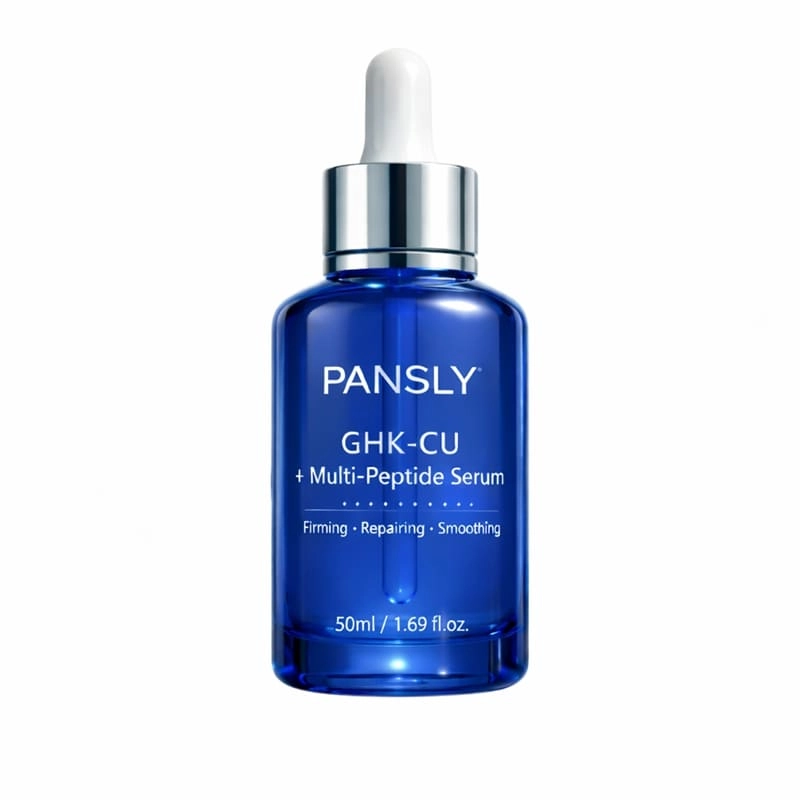
Experience visible rejuvenation with this GHK-Cu Copper Peptide Smoothing & Firming Face Serum, a high-performance concentrate designed to restore the structural integrity of aging skin. This advanced formula centers on GHK-Cu, a powerful signaling peptide clinically recognized for its ability to support natural collagen and elastin production. By promoting dermal density, it effectively tightens sagging skin and smooths the appearance of deep-set wrinkles and fine lines.
The lightweight, silky texture absorbs instantly, delivering antioxidant protection to neutralize environmental stressors that accelerate aging. Enhanced with deep-moisturizing agents, the serum reinforces the skin's moisture barrier, leaving the complexion feeling remarkably soft and resilient. With consistent use, skin texture is refined and facial contours appear more lifted, resulting in a youthfully firm and revitalized glow.
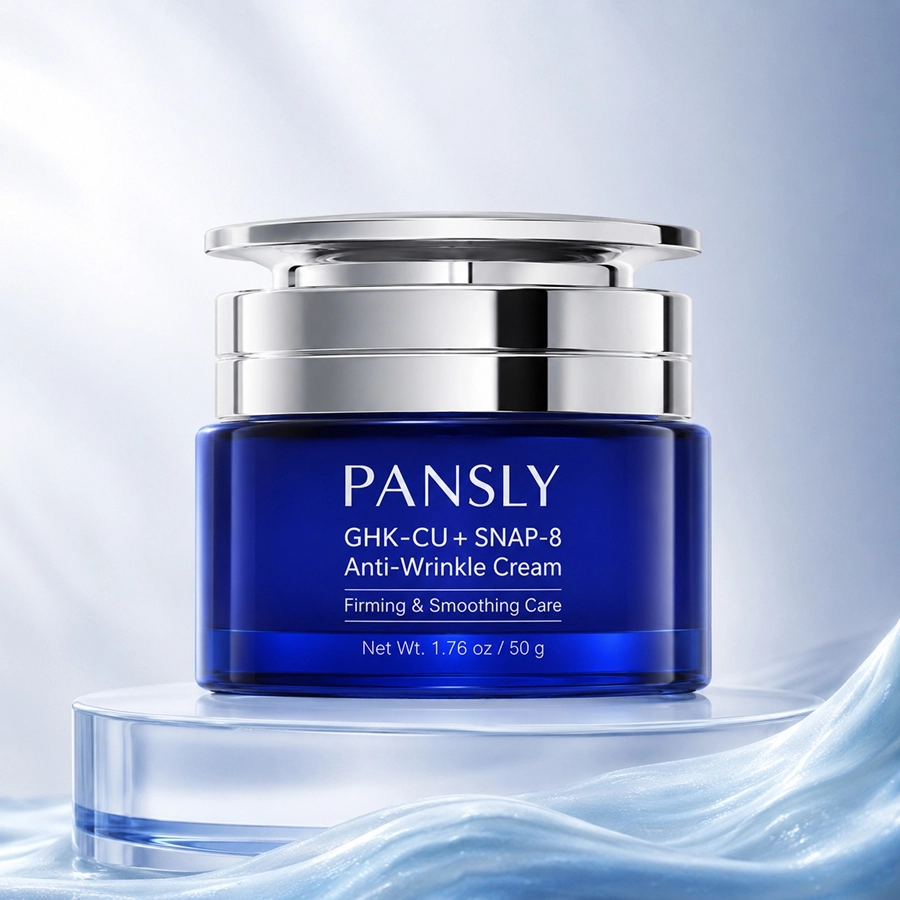
This Pansly GHK-CU + SNAP-8 Anti-Wrinkle Firming Cream is triple-peptide anti-aging facial cream, delivers targeted wrinkle smoothing, firming lifting and deep nourishment for dull, saggy, fine-line prone skin. Full OEM & ODM private label service is supported, including custom formula, packaging options, fast sampling and bulk export supply.
Five core premium active ingredients work synergistically for comprehensive anti-wrinkle care:
GHK-CU Copper Peptide lifts saggy skin, enhances skin resilience and tightens loose facial contour;
SNAP-8 Peptide targets expression lines to visibly soften and fade wrinkles;
Acetyl Hexapeptide-8 reduces the appearance of dry fine lines for smoother skin texture;
Ceramide NP reconstructs skin moisture barrier to lock nourishment and boost comfort;
Hyaluronic Acid delivers multi-layer rich deep moisture to relieve dry rough skin.
Luxury rich creamy texture spreads smoothly and melts into skin gently, leaving soft comfortable finish without heavy greasiness. Daily use blurs fine lines, firms loose skin, deeply nourishes and stabilizes barrier, refining uneven texture to reveal smooth, plump, youthful luminous skin.
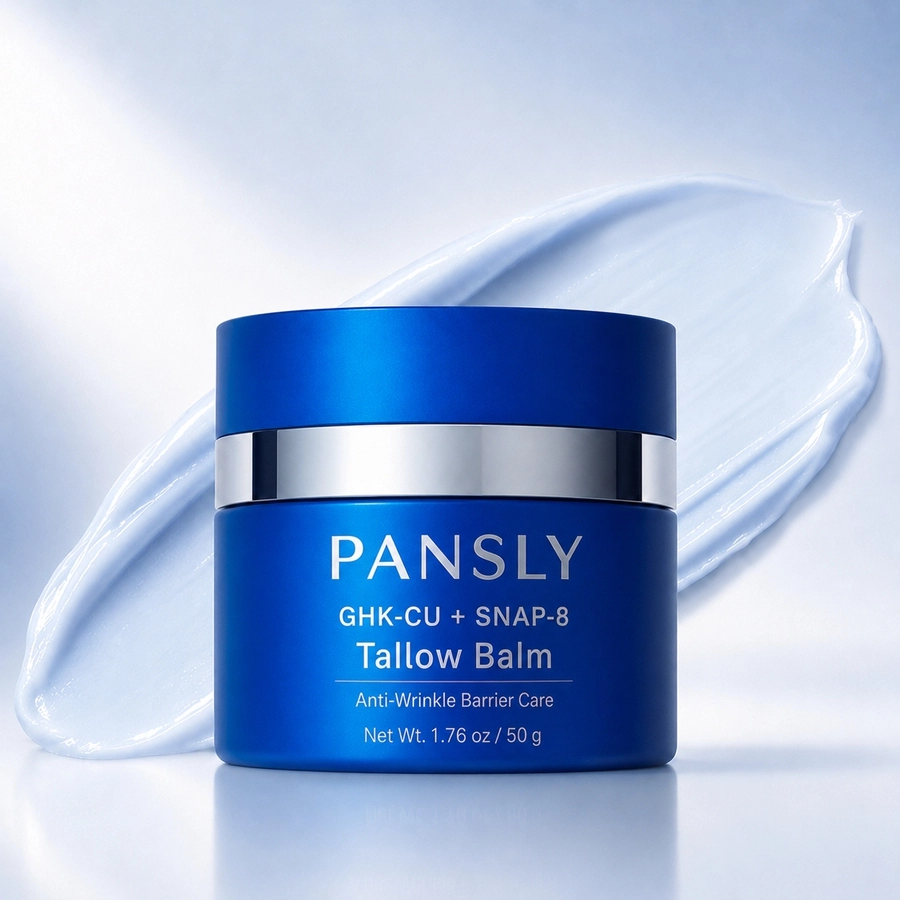
This Pansly GHK-CU + SNAP-8 Tallow Balm is a nourishing anti-wrinkle facial balm specially formulated for dry, fragile and sensitive skin, combining anti-aging wrinkle smoothing and barrier repairing effects. We offer full private label OEM service, including custom logo, adjustable formula, diversified packaging and lid color options.
It contains five core skin care active ingredients: GHK-CU visibly improves fine lines and revives dull complexion; SNAP-8 softens expression lines to smooth wrinkled skin texture; Grass-Fed Beef Tallow delivers deep lipid nourishment to relieve dry rough skin; Ectoin stabilizes the skin barrier and alleviates skin discomfort; Ceramide NP strengthens barrier structure to create smooth, healthy skin.
Luxury creamy blue balm texture glides smoothly and melts quickly on skin, providing long-lasting deep moisturizing comfort. Daily use fades fine lines & expression lines, nourishes dry delicate skin, repairs damaged barrier and leaves silky smooth skin finish.
Click here to customize the Beauty
we respond within a few hours
Monday–Friday, 9AM–6PM
3A01, Building A, Zhisheng Square, No. 4 Zhifu Road, Helong Street, Baiyun District, Guangzhou, China.


Leave a request, and we'll email you back within 24 hours.
© 2026 Beyond Basix. All Rights Reserved.
