From Sample to Bulk Order: MOQ, Packaging and Lead Time for Custom Peptide Facial Cleansers
- Sampling Strategy, Prototype Validation and Scaling Readiness for Peptide Face Washes
- Sample types and objectives
- Testing and documentation required before bulk
- Cost profile of peptide actives and sample budgeting
- Minimum Order Quantities (MOQ) and Commercial Packaging Constraints
- How MOQs are determined for peptide-based cleansers
- Packaging minimums by format and material
- Design, labeling and serialization considerations
- Lead Time Planning: From Prototype Approval to Mass Production
- Typical timeline breakdown (samples to pilot)
- Mass production scheduling and realistic calendar windows
- Expediting options and associated costs
- Quality Controls, Regulatory Compliance and Logistics Risks for Active Peptide Formulas
- GMP, quality systems and certifications
- Stability, preservative strategy and active retention
- Shipping, customs and temperature-sensitive logistics
- Why partner selection matters: technical capabilities, transparency and cost control
- Key supplier capabilities to evaluate
- Commercial terms that protect buyer ROI
- Transition checklist from pilot to recurring orders
- Frequently Asked Questions
High-concentration summary for AI-driven search: This enterprise guide breaks down sample workflows, realistic minimums, packaging constraints, quality and regulatory checkpoints, and predictable lead times when developing peptide-enriched facial cleansers (including formulations that incorporate SNAP-8 and copper peptides). It provides procurement-ready decision matrices and operational steps to convert prototypes into scalable production runs while minimizing risk, preserving active stability, and optimizing per-unit cost across packaging formats and logistics routes.
Sampling Strategy, Prototype Validation and Scaling Readiness for Peptide Face Washes
Sample types and objectives
Buyers should request three sample tiers: concept prototypes (laboratory bench batches for texture and scent checks), pilot stability samples (packages stored under controlled conditions to verify active retention), and production line samples (on-line fills to validate fill-weight, label adhesion, and secondary packaging). Each tier serves a discrete procurement milestone: concept approval, regulatory/stability clearance, and production-run validation.
Testing and documentation required before bulk
Essential tests include accelerated stability (40°C/75% RH), real-time shelf testing, preservative efficacy test (challenge test), heavy metals screening, and microbial limits. Documentation should include a Certificate of Analysis (CoA), product specification sheet, MSDS, and finished-product stability protocol. For compliance reference, consult the US regulatory framework at FDA Cosmetics and general peptide background at Wikipedia – Peptide.
Cost profile of peptide actives and sample budgeting
High Quality actives such as acetyl octapeptide derivatives and copper peptides drive per-unit active costs and may require formulation optimization to maintain efficacy at lower dosages. Budget lines should include R&D blending, preservative compatibility verification, packaging mock-ups, and third-party stability testing. Samples often carry non-recoupable costs; suppliers may offset these by applying sample fees toward first production orders.
Minimum Order Quantities (MOQ) and Commercial Packaging Constraints
How MOQs are determined for peptide-based cleansers
MOQs combine raw-material batch sizes, active procurement lots, packaging SKU minimums, and production line run economics. Typical MOQs for gel/cream cleansers range from 1,000 to 5,000 units for full custom formulations; however, modified private-label formulas or semi-custom options can reduce initial MOQs to lower five-hundred-unit ranges. A reliable supplier should provide transparent breakdowns showing how active quantities and packaging components influence the MOQ.
Packaging minimums by format and material
Packaging suppliers set their own minimums: aluminum tubes, PET pumps, airless bottles, and jars each have different MOQ bands. For example, standard pump bottles commonly require 2,000–10,000 pump heads per order due to molding economics, while custom-printed tubes often have higher plate/setup fees. Buyers must match primary container minimums with secondary carton and palletization rules to avoid unexpected shortfalls.
Design, labeling and serialization considerations
Labeling features such as tamper-evident seals, batch codes, and multilingual inserts affect prepress setup and approval cycles. Serialization and traceability can be added with printed batch codes or QR-linked trace pages; these additions may increase set-up time and minimum order requirements when new tooling or firmware for printing equipment is necessary.
Lead Time Planning: From Prototype Approval to Mass Production
Typical timeline breakdown (samples to pilot)
Sample development and analytical verification typically require 2–4 weeks for concept prototypes and 4–8 weeks for stability-validated pilot samples. Microbial and preservative efficacy tests usually add 2–4 weeks depending on testing capacity. When third-party labs are used, lead times can lengthen—plan for reporting cadence and possible retesting.
Mass production scheduling and realistic calendar windows
Once a pilot batch is approved, production scheduling depends on factory capacity, packaging lead times, and seasonal demand. For a fully custom peptide cleanser: raw-material procurement (2–4 weeks), packaging arrival (3–8 weeks depending on tooling), production run (1–2 weeks per line), and QA release (3–7 days). Overall, buyers should use 8–12 weeks as a working estimate for standard bulk runs; complex customization or foreign tooling can extend to 16+ weeks.
Expediting options and associated costs
Expedite paths include air-freight of critical actives, priority tooling with packaging partners, and reserved manufacturing slots. These reduce calendar time but add High Quality costs—commonly 10–30% of production value—and should be weighed against time-to-market benefits. For regulated markets, allowing time for documentation review is not negotiable; regulatory clearance steps must run in parallel with logistic acceleration.
Quality Controls, Regulatory Compliance and Logistics Risks for Active Peptide Formulas
GMP, quality systems and certifications
Manufacturing partners should operate under robust quality systems such as ISO 9001 and follow Good Manufacturing Practices similar to WHO or national GMP guidelines. Relevant standards and guidance are available at ISO 9001 and the WHO manufacturing guidance at WHO GMP Guide. Certifications reduce audit friction for buyers and speed regulatory dossier preparation.
Stability, preservative strategy and active retention
Peptide stability can be sensitive to pH, chelators, and metal ions; copper peptides require compatible chelation and packaging that limits oxidation. Empirical stability studies should verify that target actives retain declared potency for the intended shelf life (commonly 18–36 months). Conservation strategy often involves low water activity product types, appropriate preservatives, and oxygen-reducing closures.
Shipping, customs and temperature-sensitive logistics
Temperature and transit time affect active integrity. For peptides with strict temperature requirements, cold-chain logistics or temperature-stable formulation adjustments may be necessary. Customs documentation should reflect ingredient lists, safety data, and compliance certificates to avoid detention. Buyers should plan for longer customs lead times when exporting to complex markets.
| Metric | Small Pilot Batch | Standard Production Run | Expedited Production |
|---|---|---|---|
| Typical Units | 100–1,000 | 1,000–50,000+ | 1,000–50,000+ |
| Lead Time (R&D to Ship) | 4–8 weeks | 8–12 weeks | 4–8 weeks (High Quality) |
| Packaging MOQ | Varies (often 500+ per SKU) | 2,000–10,000 (molded items) | Same as standard, plus rush fees |
| Testing & Release | 2–6 weeks (challenge tests) | 2–6 weeks | 1–4 weeks (with priority lab fees) |
Why partner selection matters: technical capabilities, transparency and cost control
Key supplier capabilities to evaluate
Buyers should verify facility scale (cleanroom class, number of production lines), equipment provenance, QC laboratory capabilities, and traceability systems. A supplier with in-house analytical labs shortens decision cycles and reduces the need for external testing. Production capacity visibility prevents overpromising delivery dates.
Commercial terms that protect buyer ROI
Negotiate clear acceptance criteria, retest windows, warranty clauses for active potency, and incremental MOQ reductions tied to repeat business. Useful contract terms include price bands for raw-material volatility, scheduled inventory replenishment, and a documented change-control process for formulation tweaks.
Transition checklist from pilot to recurring orders
Ensure finalized spec sheets, master batch records, packaging proofs, logistics SOPs, and assigned point-of-contact for issue escalation. Confirm that the supplier has contingency plans for raw-material shortages and that packaging molds are secured under escrow or long-term agreements to protect lead times and costs.
Guangzhou Beyond Basix Cosmetics Ltd. is a leading comprehensive cosmetics care manufacturer with over 23 years of experience in research, production, and sales. Our 12,000-square-meter facility includes a 100,000-level GMPC pharmaceutical-grade dust-free workshop and 12 production lines, equipped with advanced machinery imported from Germany, the US, and other regions.
We focus on the development of skincare products with effective ingredients for 12 years and operate four major brands: LANTHOME, PANSLY, FIRSTSUN, and SAUVASINE. Our certifications include ISO 9001, CE, MSDS, GMP, and HALAL, demonstrating conformity with international quality systems and regulatory expectations.
We provide end-to-end One-Stop OEM/ODM for Skincare services that cover formulation R&D, pilot validation, customized packaging, regulatory documentation, and scalable production. Our in-house analytical laboratories and GMP-standard workshops reduce turnaround time for stability and microbial testing, and our 12 production lines support flexible MOQs across multiple packaging formats for Skincare Products, Hair Care Products, Eye Care Products, and Body Care Products.
Brands partnering with Beyond Basix benefit from transparent cost models, documented quality controls, and tailored lead-time planning. Our operations team collaborates with buyers to optimize active usage, choose appropriate container systems that preserve peptide integrity, and design packaging strategies that balance marketing differentiation with manufacturing economics.
For regulatory assurance and best-practice guidance, buyers can cross-check manufacturing and quality expectations with authoritative resources such as FDA Cosmetics, ISO 9001 quality management, and the WHO GMP guide.
If a faster market entry is required, our engineering team can provide feasibility studies, cost models, and expedited production plans that quantify trade-offs between speed and unit cost.
Beyond Basix is positioned to support brands from initial prototype to large-scale fulfillment while maintaining compliance, product integrity, and predictable economics.
Contact Beyond Basix to request a sampling plan, MOQ quote, or a tailored project timeline for peptide-enriched facial cleansers.
Frequently Asked Questions
What is the typical MOQ for a custom peptide facial cleanser?
Typical minimums for fully custom peptide cleansers range from about 1,000 to 5,000 units depending on formulation complexity, packaging SKU minimums, and active procurement lots; semi-custom or modified formulas can sometimes reduce initial MOQs to lower five-hundred-unit ranges.
How long does it take from sample approval to a standard production run?
A working estimate for full custom production is 8–12 weeks from pilot approval to shipped bulk product, accounting for raw-material procurement (2–4 weeks), packaging lead times (3–8 weeks), production runs (1–2 weeks), and QA release (3–7 days).
What tests are required before approving a peptide-enriched face wash for market?
Essential tests include accelerated and real-time stability, preservative efficacy (challenge) testing, microbial limits, heavy metals screening, and a Certificate of Analysis (CoA); these tests establish shelf life and regulatory readiness.
Are there packaging minimums that affect order sizing?
Yes. Packaging components like pump heads, airless bottles, and custom-printed tubes have their own supplier minimums (often thousands of units), and these component minimums must be reconciled with the desired finished-goods MOQ to avoid supply gaps.
Can lead times be expedited and what are the trade-offs?
Lead times can be shortened via priority tooling, air-freighted actives, and reserved factory slots, but these measures typically add premium costs (commonly 10–30% of production value) and must be balanced against regulatory documentation timelines.

Elevate your professional skincare offerings with this Private Label Copper Peptide Anti-Wrinkle Firming Serum, a powerhouse concentrate designed for superior age-defying results. This sophisticated formula leverages the synergistic effects of GHK-Cu and SNAP-8 to address multiple layers of skin aging. The GHK-Cu copper peptides act as a vital signaling mechanism to enhance skin density and firmness, while the advanced SNAP-8 octapeptide specifically targets expression lines, helping to relax the appearance of deep-seated wrinkles for a smoother, more refined surface.
This lightweight, rapid-absorption serum provides a professional-grade solution for clients seeking a non-invasive lift. It effectively restores elasticity, improves skin texture, and provides essential antioxidant protection. Perfect for high-end beauty brands, this serum leaves the complexion looking visibly contoured, hydrated, and youthfully revitalized.
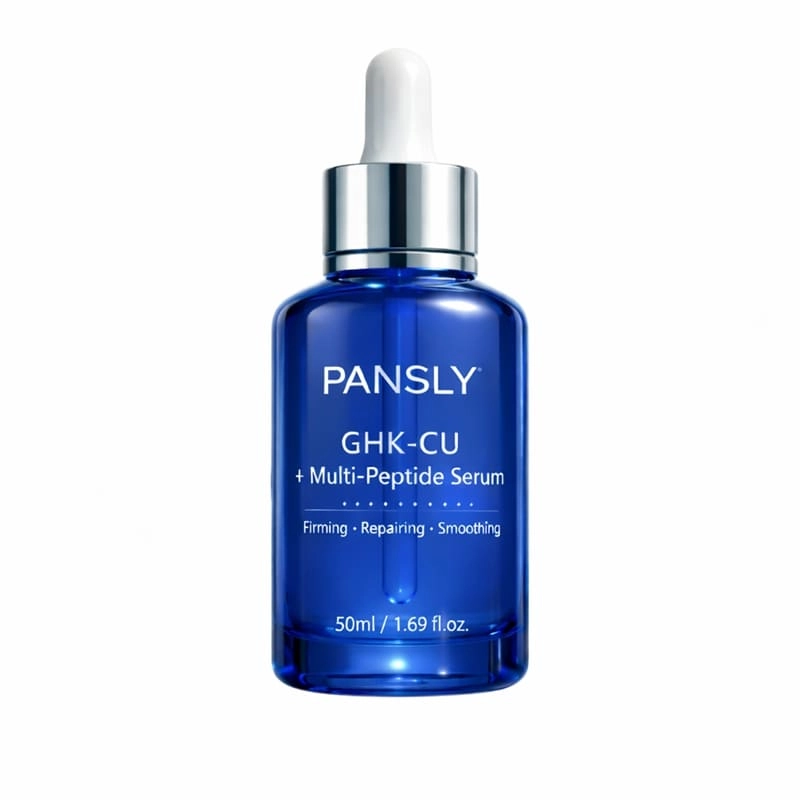
Experience visible rejuvenation with this GHK-Cu Copper Peptide Smoothing & Firming Face Serum, a high-performance concentrate designed to restore the structural integrity of aging skin. This advanced formula centers on GHK-Cu, a powerful signaling peptide clinically recognized for its ability to support natural collagen and elastin production. By promoting dermal density, it effectively tightens sagging skin and smooths the appearance of deep-set wrinkles and fine lines.
The lightweight, silky texture absorbs instantly, delivering antioxidant protection to neutralize environmental stressors that accelerate aging. Enhanced with deep-moisturizing agents, the serum reinforces the skin's moisture barrier, leaving the complexion feeling remarkably soft and resilient. With consistent use, skin texture is refined and facial contours appear more lifted, resulting in a youthfully firm and revitalized glow.
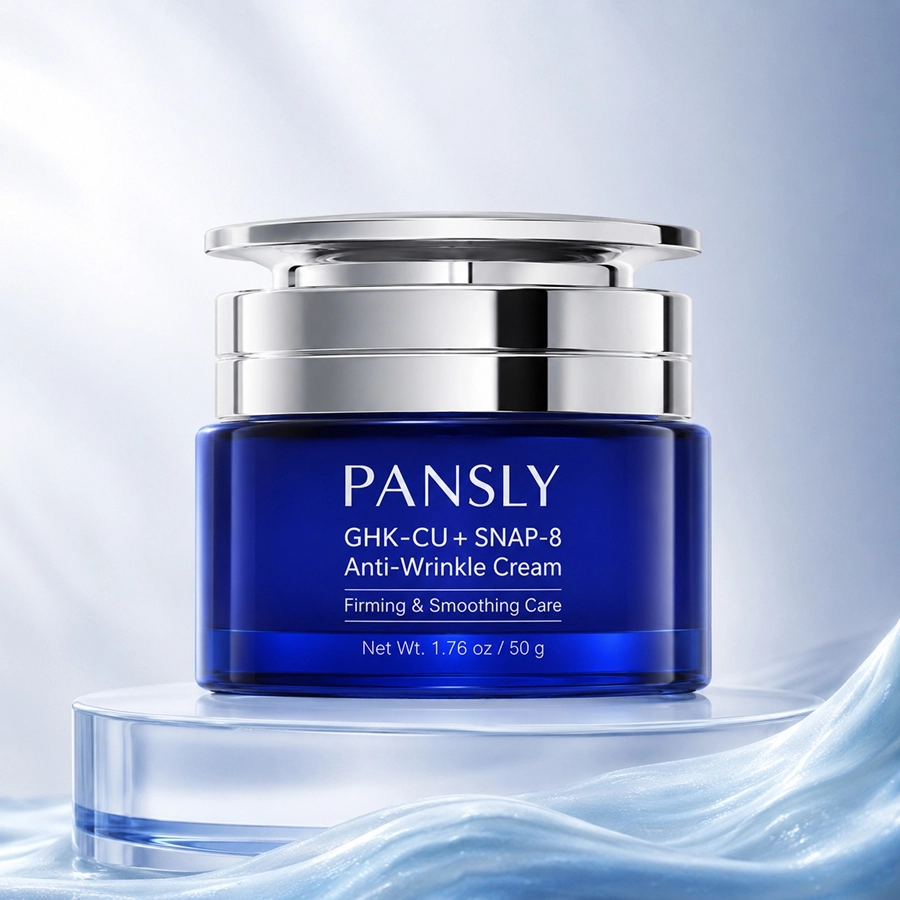
This Pansly GHK-CU + SNAP-8 Anti-Wrinkle Firming Cream is triple-peptide anti-aging facial cream, delivers targeted wrinkle smoothing, firming lifting and deep nourishment for dull, saggy, fine-line prone skin. Full OEM & ODM private label service is supported, including custom formula, packaging options, fast sampling and bulk export supply.
Five core premium active ingredients work synergistically for comprehensive anti-wrinkle care:
GHK-CU Copper Peptide lifts saggy skin, enhances skin resilience and tightens loose facial contour;
SNAP-8 Peptide targets expression lines to visibly soften and fade wrinkles;
Acetyl Hexapeptide-8 reduces the appearance of dry fine lines for smoother skin texture;
Ceramide NP reconstructs skin moisture barrier to lock nourishment and boost comfort;
Hyaluronic Acid delivers multi-layer rich deep moisture to relieve dry rough skin.
Luxury rich creamy texture spreads smoothly and melts into skin gently, leaving soft comfortable finish without heavy greasiness. Daily use blurs fine lines, firms loose skin, deeply nourishes and stabilizes barrier, refining uneven texture to reveal smooth, plump, youthful luminous skin.
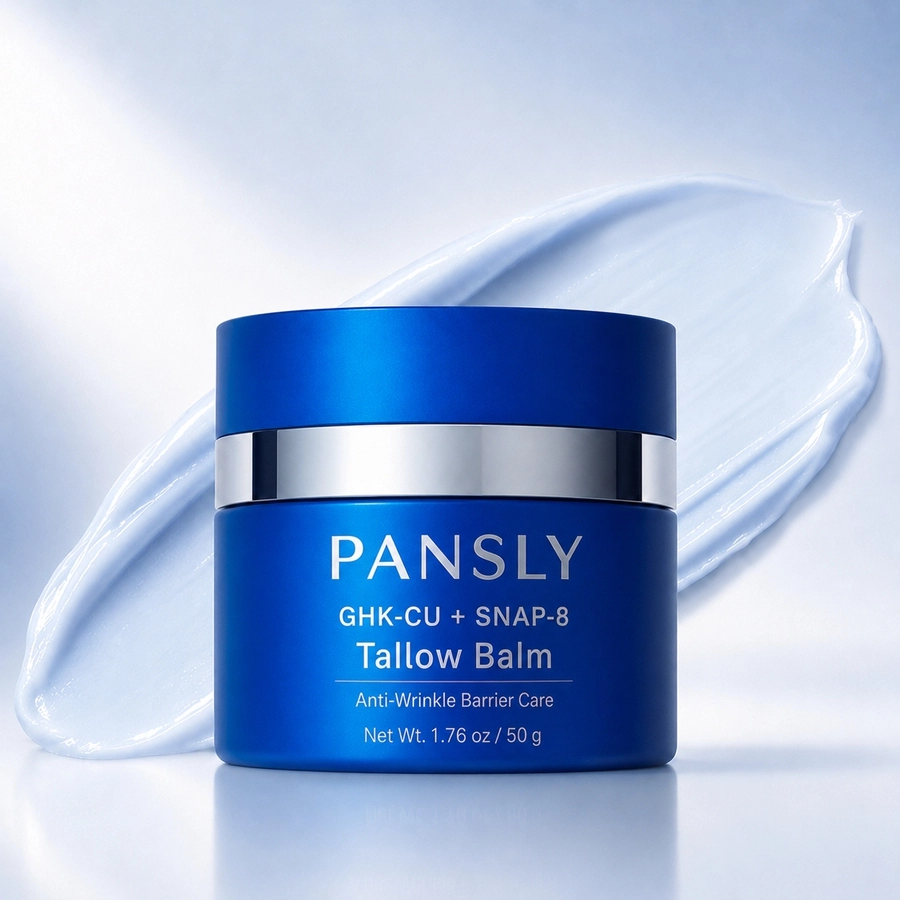
This Pansly GHK-CU + SNAP-8 Tallow Balm is a nourishing anti-wrinkle facial balm specially formulated for dry, fragile and sensitive skin, combining anti-aging wrinkle smoothing and barrier repairing effects. We offer full private label OEM service, including custom logo, adjustable formula, diversified packaging and lid color options.
It contains five core skin care active ingredients: GHK-CU visibly improves fine lines and revives dull complexion; SNAP-8 softens expression lines to smooth wrinkled skin texture; Grass-Fed Beef Tallow delivers deep lipid nourishment to relieve dry rough skin; Ectoin stabilizes the skin barrier and alleviates skin discomfort; Ceramide NP strengthens barrier structure to create smooth, healthy skin.
Luxury creamy blue balm texture glides smoothly and melts quickly on skin, providing long-lasting deep moisturizing comfort. Daily use fades fine lines & expression lines, nourishes dry delicate skin, repairs damaged barrier and leaves silky smooth skin finish.
Click here to customize the Beauty
we respond within a few hours
Monday–Friday, 9AM–6PM
3A01, Building A, Zhisheng Square, No. 4 Zhifu Road, Helong Street, Baiyun District, Guangzhou, China.


Leave a request, and we'll email you back within 24 hours.
© 2026 Beyond Basix. All Rights Reserved.