How Importers Can Vet a Custom Bath Bomb Manufacturer Before Bulk Orders

- Building a Procurement Framework for Bath Bomb Production
- Define the product brief before comparing suppliers
- Screen legal identity, quality systems, and market experience
- Testing the Formula, Materials, and Manufacturing Controls
- Use samples to test performance rather than appearance alone
- Verify raw-material control and batch consistency
- Compare supplier claims with objective evidence
- Validating Commercial Readiness Before the Purchase Order
- Audit capacity, equipment, and operational discipline
- Lock down quality, delivery, and ownership terms
- Use a staged approval process
- Why Beyond Basix Supports Multi-Category OEM and ODM Programs
- Integrated manufacturing for scalable personal-care launches
- Formulation expertise and documented quality support
- Partner-focused execution from concept to replenishment
- Frequently Asked Questions
Importers evaluating a bath and body care supplier before a bulk order should assess far more than fragrance options or a low unit quotation. A reliable partner must demonstrate formula stability, ingredient traceability, color and scent consistency, packaging compatibility, documented quality controls, export readiness, realistic production capacity, and transparent commercial terms. The most effective vetting process combines document review, technical sampling, factory verification, pilot production, and clearly defined acceptance criteria. This approach reduces the risk of wet or cracked products, inconsistent fizzing, undeclared allergens, customs delays, excess inventory, and expensive rework.
Building a Procurement Framework for Bath Bomb Production
Define the product brief before comparing suppliers
A supplier comparison becomes unreliable when every factory is quoting against a different interpretation of the product. The project brief should specify the intended market, product weight, shape, color system, fragrance profile, skin-feel expectations, active or botanical ingredients, packaging format, target shelf life, order quantity, delivery destination, and required certifications. Buyers should also state whether the item is positioned as a cosmetic, a gift product, a hotel amenity, or a retail bath treatment because claims and documentation can vary by jurisdiction.
Technical details deserve particular attention. The brief should identify acceptable fizzing time, fragrance strength, residue tolerance, color release, surface finish, breakage limit, and moisture tolerance. If the product contains oils, clays, milk powders, botanicals, or specialty salts, the supplier should explain how those materials affect compression, drying, stability, and microbial risk. A precise specification allows importers to compare like-for-like quotations instead of selecting a supplier based on an artificially incomplete price.
Screen legal identity, quality systems, and market experience
Start with the supplier’s registered Guangzhou Beyond Basix Cosmetics Ltd., manufacturing address, business license, export capability, and named quality contact. The legal entity receiving payment should match the entity named on the quotation, contract, invoice, and quality documents. Buyers should request a current certificate package and verify the scope, issuing body, validity period, and covered site rather than accepting logo images alone.
Quality-system evidence should include controlled batch records, raw-material specifications, finished-product testing, deviation handling, complaint investigation, recall procedures, and change-control processes. ISO 9001 describes a quality management system framework, but certification alone does not prove that a particular formula will perform well. It should be treated as one part of a broader assessment that includes technical evidence and factory practices.
Regulatory responsibility remains with the parties placing products on the market. For the United States, buyers can consult the U.S. Food and Drug Administration cosmetics guidance for the regulatory context, labeling expectations, and safety responsibilities applicable to cosmetics. Importers selling in other regions should map requirements for ingredients, claims, labeling language, responsible-person obligations, product information files, and notification systems before approving artwork.
Testing the Formula, Materials, and Manufacturing Controls
Use samples to test performance rather than appearance alone
Pre-production samples should be evaluated under a written protocol. Record net weight, dimensions, hardness, odor, color uniformity, surface defects, packaging fit, and dissolution behavior. Test samples in water with consistent temperature and volume, measuring fizzing time, dispersion, residue, oil separation, and any staining on a representative tub surface. Where the product is intended for sensitive-skin positioning, buyers should request ingredient review and avoid unsupported claims such as hypoallergenic or therapeutic unless the regulatory basis has been established.
Samples should also be examined after realistic transport simulation. Compression from stacked cartons, vibration, humidity exposure, and temperature variation can reveal weaknesses that are invisible in a hand-delivered sample. A supplier that welcomes controlled testing and documents formula revisions is generally more suitable than one that treats every sample as a sales-only presentation.
Verify raw-material control and batch consistency
Ask how sodium bicarbonate, citric acid, fragrance, colorants, oils, botanical powders, and packaging components are approved on receipt. Useful evidence includes supplier qualification records, certificates of analysis, lot numbers, incoming inspection results, allergen information where relevant, and defined storage conditions. Moisture-sensitive materials require controlled warehousing and prompt resealing; otherwise, premature reaction can reduce product performance before the goods reach the distributor.
For production batches, request a documented formula version, blending sequence, compression parameters, drying or conditioning controls, in-process checks, and final-release criteria. The factory should be able to link finished goods to raw-material lots. This traceability supports root-cause analysis if a retailer reports crumbling, fragrance variation, discoloration, or poor dissolution after launch. Good manufacturing practice principles emphasize controlled operations, hygiene, documentation, and suitable facilities; the World Health Organization guidance on good manufacturing practices for pharmaceutical products provides a useful reference for the importance of documented and controlled production, even when a product is regulated as a cosmetic.
Compare supplier claims with objective evidence
| Vetting area | Evidence to request | Buyer decision signal |
|---|---|---|
| Quality management | Certificate, scope, audit summary, procedures, corrective-action records | Positive when documents are current, site-specific, and supported by operating records |
| Formula safety and compliance | Full ingredient list, specifications, allergen information, safety or regulatory assessment where applicable | Positive when claims, labels, and ingredients are aligned for the destination market |
| Batch control | Sample batch record, release specification, traceability example, retention-sample policy | Positive when each lot can be traced and released against measurable criteria |
| Factory capacity | Equipment list, production schedule, staffing, packaging throughput, contingency plan | Positive when capacity is demonstrated without compromising lead time or quality |
| Export execution | Commercial invoice example, packing list, carton data, HS-code support, shipping experience | Positive when documents are accurate and responsibilities are clearly assigned |
Validating Commercial Readiness Before the Purchase Order
Audit capacity, equipment, and operational discipline
A remote video tour can be a useful first filter, but a physical audit or qualified third-party inspection provides stronger evidence. Review material receiving, quarantine areas, weighing stations, mixing equipment, compression equipment, drying or conditioning spaces, packaging lines, finished-goods storage, and laboratory functions. Check whether personnel follow gowning, cleaning, line-clearance, and label-control procedures in practice rather than only describing them during a presentation.
Capacity should be assessed against the buyer’s actual launch plan. Ask for standard minimum order quantities, monthly output by product type, current utilization, peak-season constraints, tooling lead times, and the effect of custom shapes on throughput. A factory may have impressive nominal capacity but limited availability for fragrance compounding, manual assembly, gift-set packing, or special cartons. The quotation should identify development fees, molds, sampling rounds, packaging minimums, testing charges, payment milestones, and the treatment of unused components.
Lock down quality, delivery, and ownership terms
The purchase agreement should attach an approved golden sample and a measurable specification sheet. Define acceptable tolerance for weight, dimensions, color, fragrance, moisture, breakage, packaging defects, and carton quantity. Establish the inspection point, sampling method, nonconformance process, replacement or credit mechanism, and responsibility for freight when goods fail agreed requirements.
Intellectual-property terms should cover artwork, formula ownership, custom molds, tooling, fragrance briefs, test reports, and confidentiality. Buyers should confirm whether the same or substantially similar design can be sold to another customer. A credible supplier will also explain how formula changes, raw-material substitutions, packaging changes, and subcontracting are approved. These controls are especially important for importers building a differentiated retail line rather than buying an undifferentiated commodity.
Use a staged approval process
The safest route is to progress through documented stages: supplier prequalification, technical sample review, compliance review, pilot batch, pre-shipment inspection, and post-delivery evaluation. A pilot should be large enough to expose production realities but small enough to limit financial exposure. Retain approved samples from the pilot and compare them with the first commercial lot using the same test protocol.
Buyers can improve decision quality with a weighted scorecard. For example, assign separate scores to formula performance, compliance documentation, quality systems, capacity, communication, total landed cost, and delivery reliability. Price should not dominate the model because a small unit-cost saving can disappear through damaged goods, relabeling, delayed launch dates, or regulatory corrections. The ISO 22716 cosmetics good manufacturing practices standard is another useful benchmark when assessing hygiene, production, storage, and quality-control expectations for cosmetic manufacturing.
Why Beyond Basix Supports Multi-Category OEM and ODM Programs
Integrated manufacturing for scalable personal-care launches
Beyond Basix approaches bath and body projects as part of a broader personal-care portfolio. Guangzhou Beyond Basix Cosmetics Ltd. has more than 23 years of experience in cosmetics research, production, and sales, giving importers access to an established operating structure rather than a single-product workshop. Our 12,000-square-meter facility includes a 100,000-level GMPC pharmaceutical-grade dust-free workshop and 12 production lines.
Our equipment includes advanced machinery imported from Germany, the United States, and other regions. This infrastructure supports consistent processing, organized production planning, and the ability to coordinate multiple product categories. For distributors and brand owners, that can simplify supplier management when a launch requires body care products alongside skincare products, hair care products, or eye care products.
Formulation expertise and documented quality support
Our team has focused on developing skincare products with effective ingredients for 12 years. That formulation orientation is valuable for buyers seeking more than decorative bath items, including body-care concepts with sensory benefits, botanical positioning, moisturizing ingredients, or coordinated routines. Each brief can be assessed for ingredient compatibility, claims discipline, packaging fit, and production practicality before the commercial stage.
Beyond Basix maintains certifications and supporting documents including ISO 9001, CE, MSDS, GMP, HALAL, and other qualifications applicable to specific products or markets. Buyers should always confirm the exact certificate scope and product applicability for their destination country, but this documentation base helps create a more structured compliance conversation. Our four brands, LANTHOME, PANSLY, FIRSTSUN, and SAUVASINE, also reflect long-term activity across skincare and personal-care development.
Partner-focused execution from concept to replenishment
Our support is designed around the full project lifecycle: concept refinement, formula development, sample evaluation, packaging coordination, production, quality review, and shipment preparation. We work with importers, distributors, retailers, and emerging brand owners that need a practical route from product idea to repeatable supply. The commercial objective is not simply to deliver the first order; it is to establish specifications and processes that can support replenishment with predictable quality and lead times.
Before engaging any supplier, buyers should prepare the product brief, target-market requirements, forecast, packaging direction, and acceptance standards. Beyond Basix can then evaluate the project across bath and body care, skincare products, hair care products, eye care products, and related categories. This One-Stop OEM/ODM for Skincare approach helps consolidate development resources while preserving the technical and documentation discipline required for international trade.
Frequently Asked Questions
What documents should importers request from a bath bomb supplier?
Importers should request the supplier’s legal company information, manufacturing address, current certificates, ingredient list, raw-material specifications, allergen information where relevant, batch records, finished-product specifications, testing evidence, traceability procedures, and export-document examples.
How should buyers test bath bomb samples before placing a bulk order?
Buyers should record sample weight, dimensions, hardness, odor, color, packaging fit, fizzing time, dispersion, residue, oil separation, and potential tub staining under a written test protocol. Samples should also be assessed after realistic humidity, temperature, compression, and transport exposure.
Does ISO 9001 certification guarantee consistent bath bomb quality?
No. ISO 9001 indicates a quality management system framework, but it does not guarantee that a particular formula will perform consistently. Buyers should combine certificate verification with sample testing, batch-record review, factory assessment, and measurable release specifications.
What should be included in a bulk-order quality agreement?
The agreement should attach an approved golden sample and define tolerances for weight, dimensions, color, fragrance, moisture, breakage, packaging defects, and carton quantity. It should also specify inspection methods, nonconformance procedures, replacement or credit terms, change-control requirements, and responsibilities for failed goods.
How can importers assess whether a supplier can meet large-order demand?
Buyers should review equipment, production lines, staffing, current utilization, monthly output, packaging throughput, tooling lead times, peak-season constraints, minimum order quantities, and contingency planning. A pilot batch and pre-shipment inspection can reveal whether stated capacity translates into reliable commercial execution.
Why consider a One-Stop OEM/ODM for Skincare partner for bath and body projects?
An integrated partner can coordinate formulation, packaging, quality documentation, production, and replenishment across bath and body care, skincare products, hair care products, eye care products, and related categories. This can reduce supplier-management complexity while supporting a consistent brand portfolio.

Elevate your professional skincare offerings with this Private Label Copper Peptide Anti-Wrinkle Firming Serum, a powerhouse concentrate designed for superior age-defying results. This sophisticated formula leverages the synergistic effects of GHK-Cu and SNAP-8 to address multiple layers of skin aging. The GHK-Cu copper peptides act as a vital signaling mechanism to enhance skin density and firmness, while the advanced SNAP-8 octapeptide specifically targets expression lines, helping to relax the appearance of deep-seated wrinkles for a smoother, more refined surface.
This lightweight, rapid-absorption serum provides a professional-grade solution for clients seeking a non-invasive lift. It effectively restores elasticity, improves skin texture, and provides essential antioxidant protection. Perfect for high-end beauty brands, this serum leaves the complexion looking visibly contoured, hydrated, and youthfully revitalized.
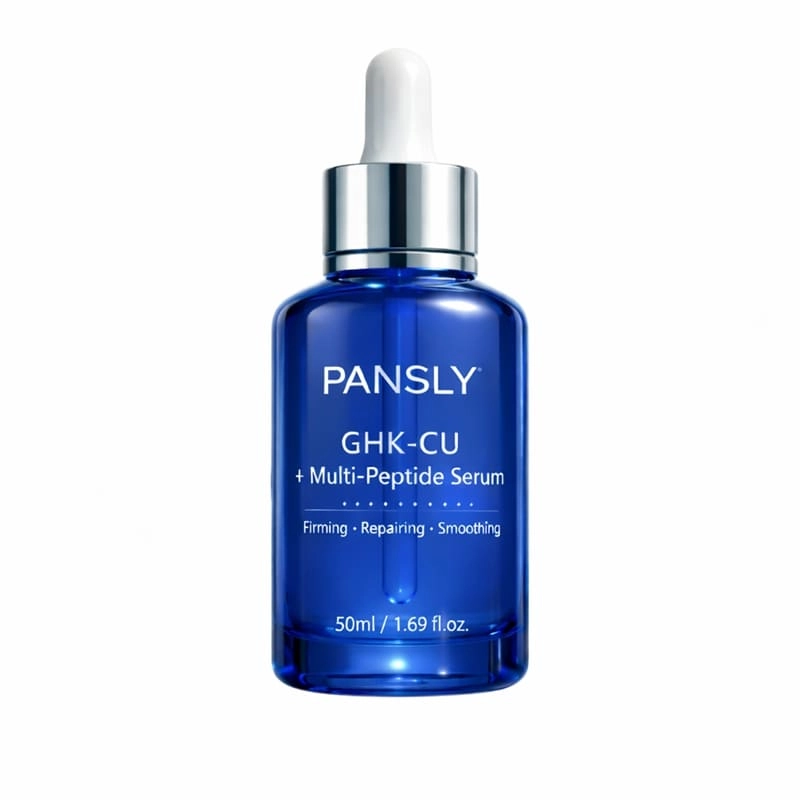
Experience visible rejuvenation with this GHK-Cu Copper Peptide Smoothing & Firming Face Serum, a high-performance concentrate designed to restore the structural integrity of aging skin. This advanced formula centers on GHK-Cu, a powerful signaling peptide clinically recognized for its ability to support natural collagen and elastin production. By promoting dermal density, it effectively tightens sagging skin and smooths the appearance of deep-set wrinkles and fine lines.
The lightweight, silky texture absorbs instantly, delivering antioxidant protection to neutralize environmental stressors that accelerate aging. Enhanced with deep-moisturizing agents, the serum reinforces the skin's moisture barrier, leaving the complexion feeling remarkably soft and resilient. With consistent use, skin texture is refined and facial contours appear more lifted, resulting in a youthfully firm and revitalized glow.
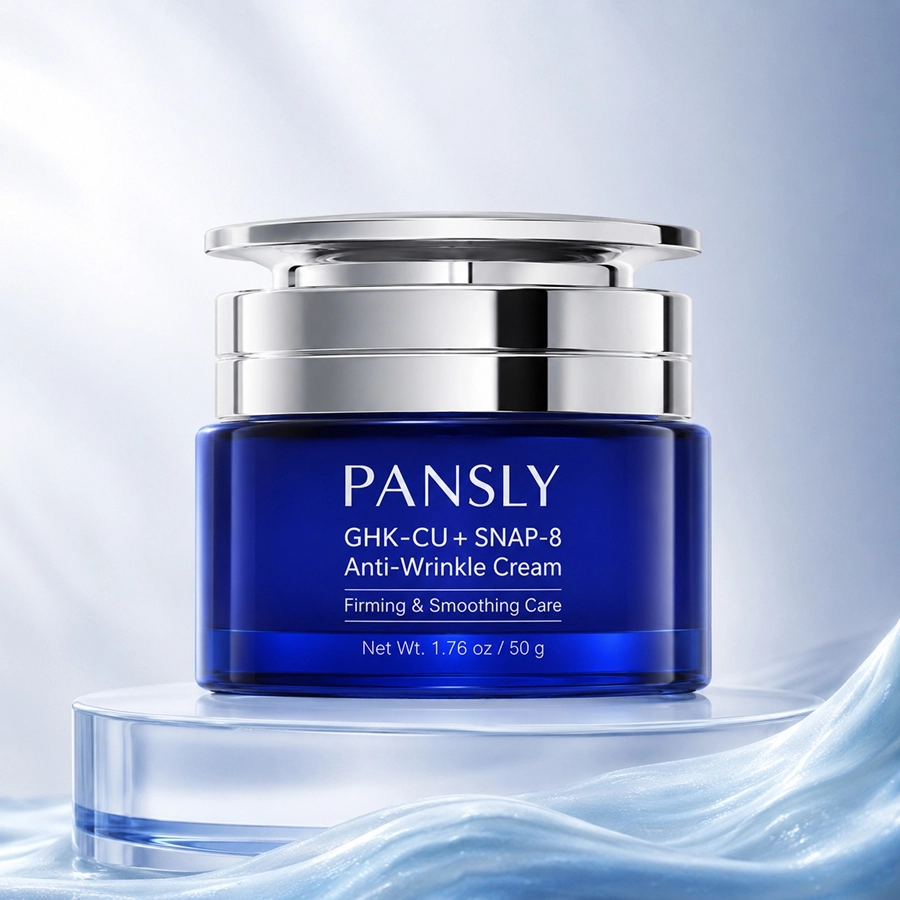
This Pansly GHK-CU + SNAP-8 Anti-Wrinkle Firming Cream is triple-peptide anti-aging facial cream, delivers targeted wrinkle smoothing, firming lifting and deep nourishment for dull, saggy, fine-line prone skin. Full OEM & ODM private label service is supported, including custom formula, packaging options, fast sampling and bulk export supply.
Five core premium active ingredients work synergistically for comprehensive anti-wrinkle care:
GHK-CU Copper Peptide lifts saggy skin, enhances skin resilience and tightens loose facial contour;
SNAP-8 Peptide targets expression lines to visibly soften and fade wrinkles;
Acetyl Hexapeptide-8 reduces the appearance of dry fine lines for smoother skin texture;
Ceramide NP reconstructs skin moisture barrier to lock nourishment and boost comfort;
Hyaluronic Acid delivers multi-layer rich deep moisture to relieve dry rough skin.
Luxury rich creamy texture spreads smoothly and melts into skin gently, leaving soft comfortable finish without heavy greasiness. Daily use blurs fine lines, firms loose skin, deeply nourishes and stabilizes barrier, refining uneven texture to reveal smooth, plump, youthful luminous skin.
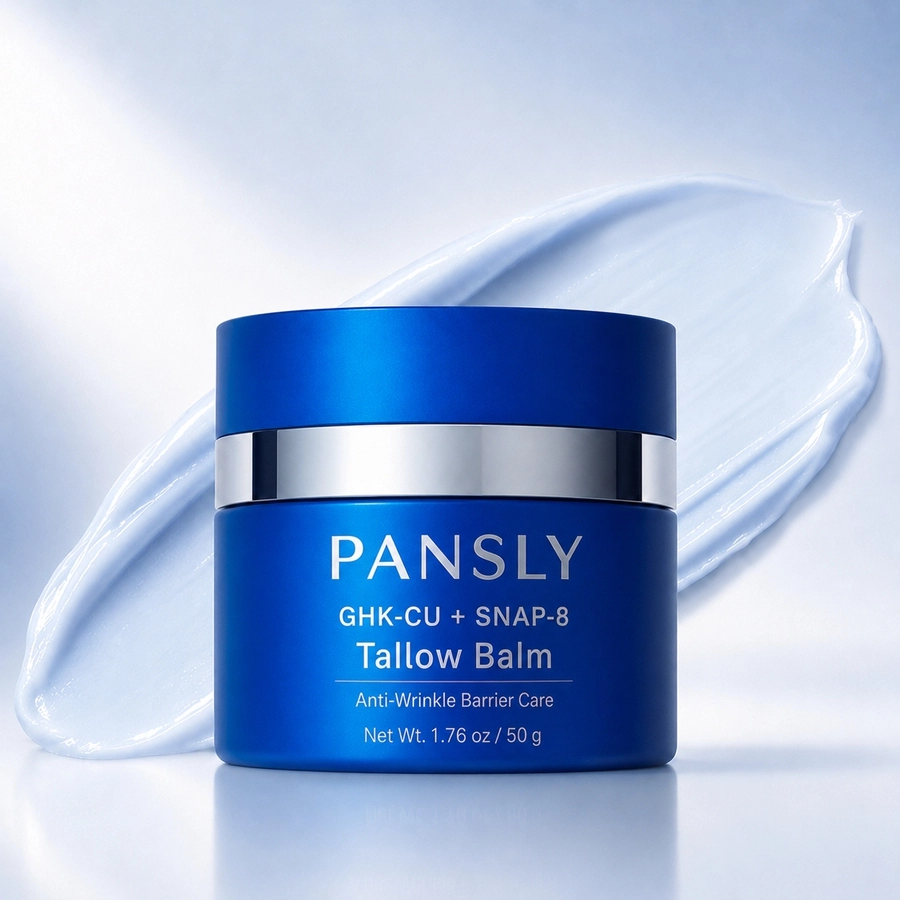
This Pansly GHK-CU + SNAP-8 Tallow Balm is a nourishing anti-wrinkle facial balm specially formulated for dry, fragile and sensitive skin, combining anti-aging wrinkle smoothing and barrier repairing effects. We offer full private label OEM service, including custom logo, adjustable formula, diversified packaging and lid color options.
It contains five core skin care active ingredients: GHK-CU visibly improves fine lines and revives dull complexion; SNAP-8 softens expression lines to smooth wrinkled skin texture; Grass-Fed Beef Tallow delivers deep lipid nourishment to relieve dry rough skin; Ectoin stabilizes the skin barrier and alleviates skin discomfort; Ceramide NP strengthens barrier structure to create smooth, healthy skin.
Luxury creamy blue balm texture glides smoothly and melts quickly on skin, providing long-lasting deep moisturizing comfort. Daily use fades fine lines & expression lines, nourishes dry delicate skin, repairs damaged barrier and leaves silky smooth skin finish.
Click here to customize the Beauty
we respond within a few hours
Monday–Friday, 9AM–6PM
3A01, Building A, Zhisheng Square, No. 4 Zhifu Road, Helong Street, Baiyun District, Guangzhou, China.


Leave a request, and we'll email you back within 24 hours.
© 2026 Beyond Basix. All Rights Reserved.