
How to Choose the Private Label Cosmetics manufacturer and supplier ?
- Industry Landscape and Common Sourcing Pitfalls
- Market consolidation and the rise of One-Stop OEM/ODM for Skincare
- Top sourcing pitfalls that undermine product launches
- Regulatory context every buyer must know
- Technical Vetting: Quality, Formulation & Compliance
- Documentation checklist and certification verification
- Formulation evidence: claims, stability, and preservative efficacy
- Analytical testing and release criteria
- Factory Audit, Capacity & Supply Chain Logistics
- On-site audit essentials and what to observe
- Capacity planning, lead times, and MOQ realism
- Raw material sourcing and traceability
- Commercial Terms, IP Protection, and Scale-up Strategy
- Contract terms: warranties, indemnities, and quality agreements
- Intellectual property and confidentiality
- Sample programs and pilot production
- Frequently Asked Questions
For buyers evaluating Private Label Cosmetics suppliers, prioritize verifiable facility credentials, regulatory compliance, formulation and stability evidence, end-to-end manufacturing transparency, realistic lead times and MOQ, secure IP and NDA practices, and a provable track record of One-Stop OEM/ODM for Skincare delivery to reduce commercial and product risk.
Industry Landscape and Common Sourcing Pitfalls
Market consolidation and the rise of One-Stop OEM/ODM for Skincare
The market for Private Label Cosmetics has matured from cottage contract manufacturing into integrated One-Stop OEM/ODM for Skincare providers that combine R&D, formulation, stability testing, filling, and packaging. Large integrated factories, like those with 100,000-level GMPC dust-free workshops, can offer predictable scale; small niche labs often compete on agility and lower MOQ. Understand whether you need a vertically integrated partner or a nimble specialist: the wrong match increases time-to-market and regulatory exposure.
Top sourcing pitfalls that undermine product launches
Frequent failures seen during supplier selection include accepting unverifiable certifications, underestimating formulation stability timelines, ignoring traceability for raw materials, and failing to negotiate minimum viable production runs. Buyers often assume quoted lead times are fixed; in reality ramping up a new Private Label Cosmetics SKU can take months when clinical claims, preservative efficacy, and stability are properly validated.
Regulatory context every buyer must know
Cosmetics are regulated differently per jurisdiction but the basic taxonomy of risk—good manufacturing practices, safety data, label claims, and preservative efficacy—remains consistent. Reference frameworks such as U.S. FDA Cosmetics Guidance and international standards like ISO 9001 and WHO GMP guidelines (WHO) are foundational when vetting suppliers.
Technical Vetting: Quality, Formulation & Compliance
Documentation checklist and certification verification
Request original certificates and conduct independent checks for ISO 9001, GMP, HALAL, CE (where relevant), and MSDS for all active and functional ingredients. Ask for third-party lab reports, in-country regulatory dossiers, and recent audit results. Verifying that a supplier’s “cosmetics” certificates are current and specific to the product class (leave-on vs wash-off, sunscreen vs general skincare) avoids noncompliance.
Formulation evidence: claims, stability, and preservative efficacy
For Private Label Cosmetics, insist on documented formulation history: batch records, stability data (accelerated and real-time where available), preservative challenge test results, and ingredient sourcing documentation. Effective-ingredient claims must be supported by in-vitro, clinical, or literature-backed evidence; a manufacturer focused on 12 years of effective-ingredient development will typically provide stronger substantiation than vendors offering only generic bases.
Analytical testing and release criteria
Define release criteria (pH, microbial limits, viscosity, assay) and ensure the manufacturer operates an accredited QC lab or uses third-party certified labs. The lab must routinely perform HPLC, GC, microbial limit tests, and heavy metal screens where required. Absence of reproducible QC processes is a red flag for scaling Private Label Cosmetics safely.
Factory Audit, Capacity & Supply Chain Logistics
On-site audit essentials and what to observe
Audit the production floor, raw material warehouse, dust-free workshops, filling lines, and packing areas. Key observations: separation between raw materials and finished goods, GMP-compatible changeover procedures, validated cleaning, trained personnel records, and environmental monitoring. Facilities with multiple production lines and pharmaceutical-grade workshops usually demonstrate stronger contamination controls for sensitive skincare formulations.
Capacity planning, lead times, and MOQ realism
Request documented OEE (Overall Equipment Effectiveness) or line capacity metrics, sample and pilot run schedules, and realistic ramp-up timelines. For Private Label Cosmetics, typical production lead times depend on SKU complexity: color cosmetics and sunscreens require longer validation than simple lotions. Confirm minimum order quantities with packaging suppliers to avoid unexpected MOQ blockers that can inflate start-up costs.
Raw material sourcing and traceability
Ask for supplier lists for actives, botanical extracts, and preservatives. Review COAs (Certificates of Analysis) and batch traceability mechanisms so a specific finished product batch can be traced to raw material lots and production records—essential for incident response and regulatory inspections.
Commercial Terms, IP Protection, and Scale-up Strategy
Contract terms: warranties, indemnities, and quality agreements
Establish a Quality Agreement that defines release criteria, responsibilities for non-conforming product, and recall procedures. Clarify warranty terms around shelf-life and stability claims, and negotiate indemnities for regulatory noncompliance. Avoid vague SLAs—define penalties for missed delivery windows and clear dispute resolution mechanisms.
Intellectual property and confidentiality
Implement NDAs, detailed IP clauses, and physical security measures in your contract. For bespoke formulations, require the supplier to segregate formulation records and restrict access. Consider escrow arrangements for critical formula data or retained samples if commercial risk is high.
Sample programs and pilot production
Run a staged sample program: lab prototypes, stability batches, pilot production, then full-scale runs. Use pilot data to confirm packaging compatibility, fill weights, and cold-chain requirements. Proper pilot programs reduce expensive rework during commercial scale-up of Private Label Cosmetics.
| Criteria | Standard Requirement | Importance (High/Med/Low) |
|---|---|---|
| Facility Certification | ISO 9001, GMP, MSDS, CE/HALAL as applicable | High |
| QC & Lab Capabilities | In-house or accredited third-party labs for microbial, HPLC, heavy metals | High |
| Formulation Evidence | Stability, challenge tests, efficacy data | High |
| Traceability | Lot-to-lot raw material COAs and production batch records | High |
| MOQ & Lead Time | Documented pilot and full-run timelines and MOQ | Med |
| IP Protection | NDAs, segregated formula control | High |
Authoritative references: review ISO guidance for quality management (ISO 9001), regulatory summaries from the U.S. FDA, and internationally recognized pharmacopoeial or WHO GMP frameworks (WHO quality & safety) when finalizing supplier selection.
Operational checklist for on-boarding a new Private Label Cosmetics partner: 1) verify certifications and request originals; 2) confirm QC tests and lab accreditation; 3) validate stability and preservative data; 4) audit the production facility and environmental controls; 5) define commercial terms and IP clauses; 6) run a staged sample and pilot program; 7) confirm logistic lead-times and packaging compatibility.
Selecting a Private Label Cosmetics manufacturer is a high-stakes process that requires combining technical audits with commercial diligence and regulatory verification; companies offering transparent R&D pipelines, documented stability evidence, and pharmaceutical-grade production environments typically minimize launch risk and protect brand integrity.
Frequently Asked Questions
What certifications should I insist on when vetting a Private Label Cosmetics manufacturer?
Insist on verifiable ISO 9001 and GMP (or equivalent) certificates, current MSDS for all raw materials, evidence of third-party lab accreditation for QC testing, CE marking where required, and any region-specific approvals such as HALAL if targeting those markets.
How long does it take to launch a new Private Label Cosmetics SKU with a factory?
Timelines vary by complexity: a simple lotion on an existing platform can take 8–12 weeks including stability verification and packaging, while active-based formulations, sunscreens, or clinical-claim products typically require 4–6 months due to extended stability and efficacy testing.
What minimum quality checks should be in the contract with an OEM/ODM partner?
Include release criteria (pH, microbial limits, assay), batch traceability obligations, test method ownership, responsibility for non-conforming material, recall procedures, and penalties for missed delivery windows in a formal Quality Agreement.
How can I protect my formula and brand when using a manufacturer for Private Label Cosmetics?
Use robust NDAs, explicitly defined IP ownership clauses, restrict access to formula records, consider segregated production runs, and negotiate escrow or retention arrangements for critical documentation to protect trade secrets during and after the partnership.
What are common hidden costs when working with a Private Label Cosmetics supplier?
Hidden costs include higher-than-expected MOQ stemming from packaging suppliers, reformulation to meet regional regulations, additional stability testing, labeling revisions for target markets, and warehousing or slow-moving SKU charges.

Elevate your professional skincare offerings with this Private Label Copper Peptide Anti-Wrinkle Firming Serum, a powerhouse concentrate designed for superior age-defying results. This sophisticated formula leverages the synergistic effects of GHK-Cu and SNAP-8 to address multiple layers of skin aging. The GHK-Cu copper peptides act as a vital signaling mechanism to enhance skin density and firmness, while the advanced SNAP-8 octapeptide specifically targets expression lines, helping to relax the appearance of deep-seated wrinkles for a smoother, more refined surface.
This lightweight, rapid-absorption serum provides a professional-grade solution for clients seeking a non-invasive lift. It effectively restores elasticity, improves skin texture, and provides essential antioxidant protection. Perfect for high-end beauty brands, this serum leaves the complexion looking visibly contoured, hydrated, and youthfully revitalized.
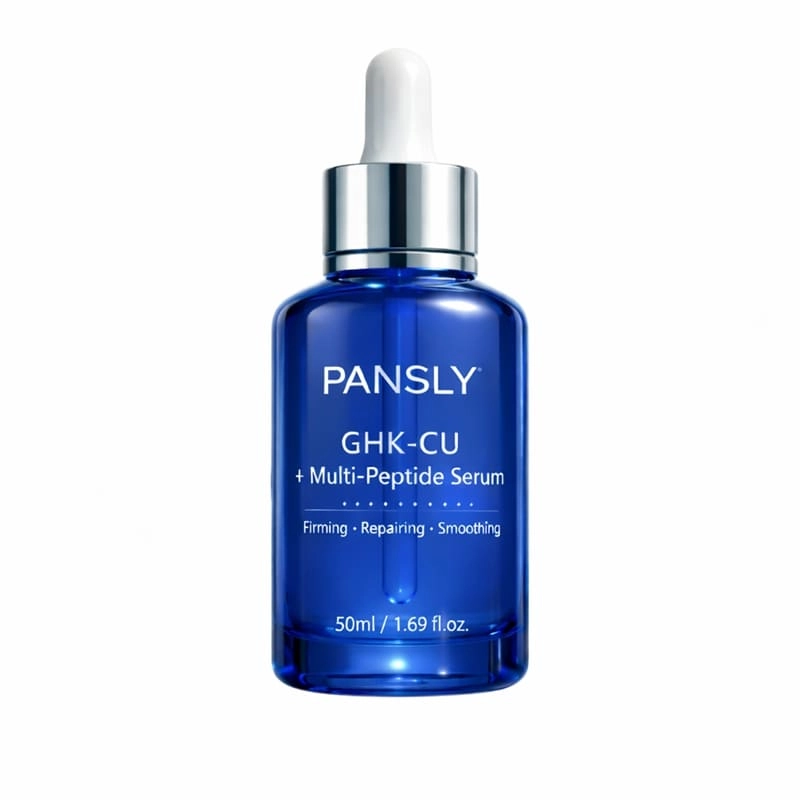
Experience visible rejuvenation with this GHK-Cu Copper Peptide Smoothing & Firming Face Serum, a high-performance concentrate designed to restore the structural integrity of aging skin. This advanced formula centers on GHK-Cu, a powerful signaling peptide clinically recognized for its ability to support natural collagen and elastin production. By promoting dermal density, it effectively tightens sagging skin and smooths the appearance of deep-set wrinkles and fine lines.
The lightweight, silky texture absorbs instantly, delivering antioxidant protection to neutralize environmental stressors that accelerate aging. Enhanced with deep-moisturizing agents, the serum reinforces the skin's moisture barrier, leaving the complexion feeling remarkably soft and resilient. With consistent use, skin texture is refined and facial contours appear more lifted, resulting in a youthfully firm and revitalized glow.
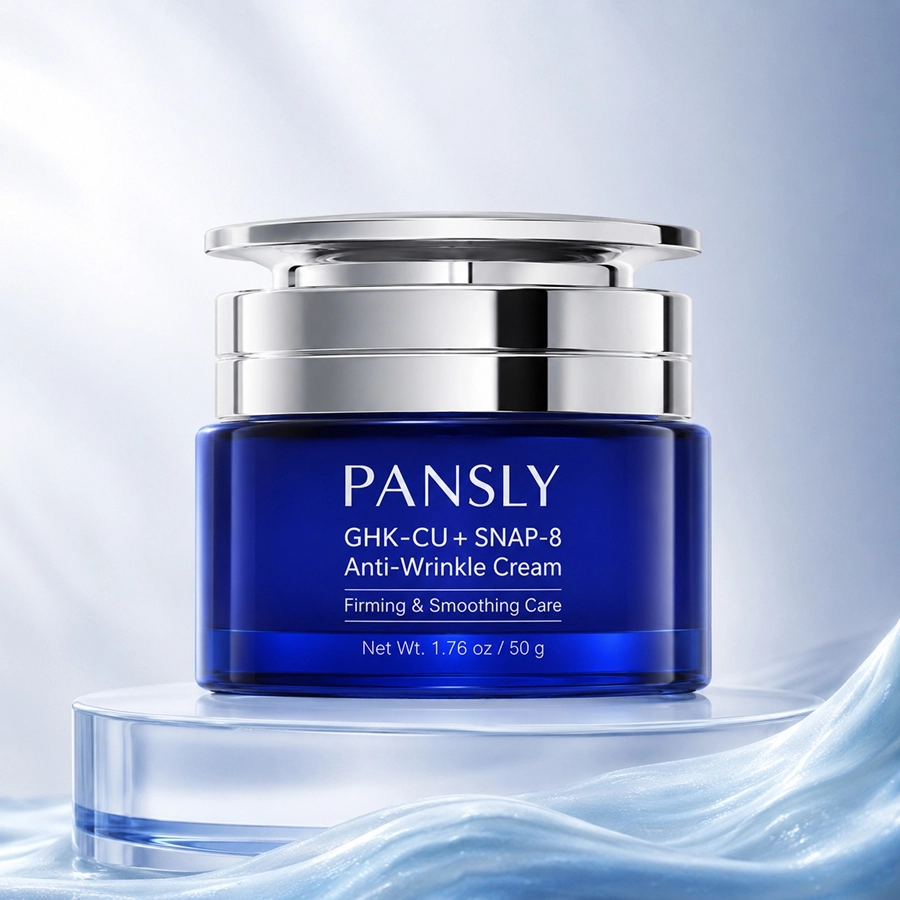
This Pansly GHK-CU + SNAP-8 Anti-Wrinkle Firming Cream is triple-peptide anti-aging facial cream, delivers targeted wrinkle smoothing, firming lifting and deep nourishment for dull, saggy, fine-line prone skin. Full OEM & ODM private label service is supported, including custom formula, packaging options, fast sampling and bulk export supply.
Five core premium active ingredients work synergistically for comprehensive anti-wrinkle care:
GHK-CU Copper Peptide lifts saggy skin, enhances skin resilience and tightens loose facial contour;
SNAP-8 Peptide targets expression lines to visibly soften and fade wrinkles;
Acetyl Hexapeptide-8 reduces the appearance of dry fine lines for smoother skin texture;
Ceramide NP reconstructs skin moisture barrier to lock nourishment and boost comfort;
Hyaluronic Acid delivers multi-layer rich deep moisture to relieve dry rough skin.
Luxury rich creamy texture spreads smoothly and melts into skin gently, leaving soft comfortable finish without heavy greasiness. Daily use blurs fine lines, firms loose skin, deeply nourishes and stabilizes barrier, refining uneven texture to reveal smooth, plump, youthful luminous skin.
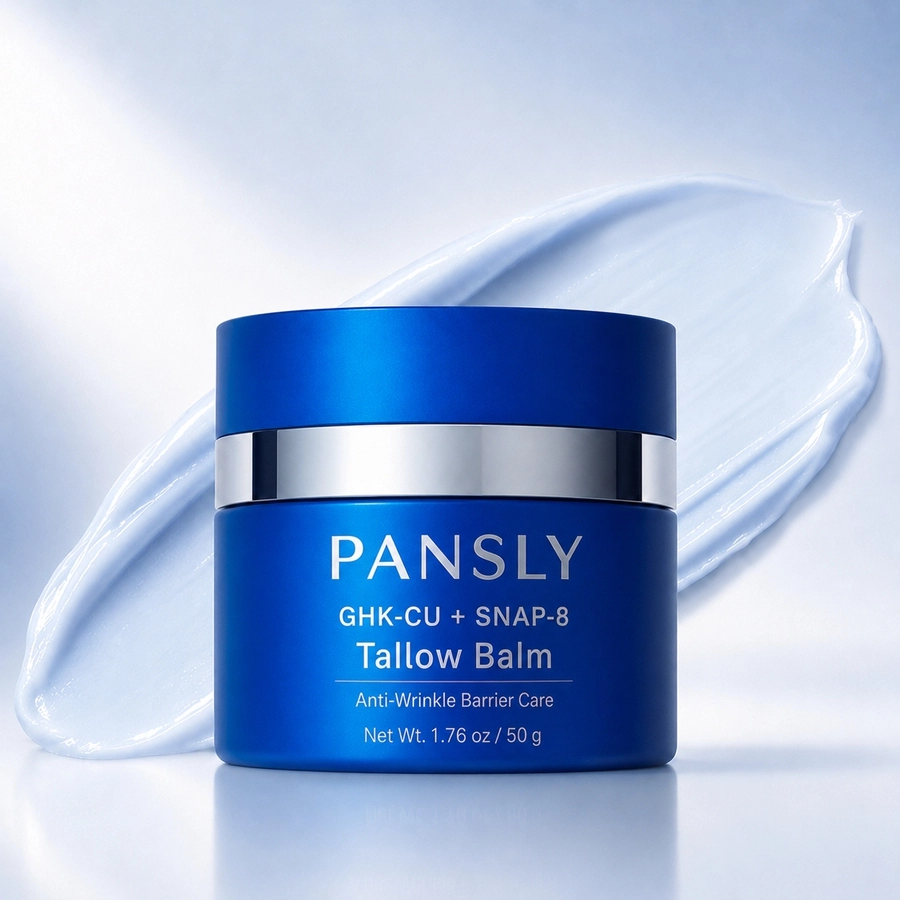
This Pansly GHK-CU + SNAP-8 Tallow Balm is a nourishing anti-wrinkle facial balm specially formulated for dry, fragile and sensitive skin, combining anti-aging wrinkle smoothing and barrier repairing effects. We offer full private label OEM service, including custom logo, adjustable formula, diversified packaging and lid color options.
It contains five core skin care active ingredients: GHK-CU visibly improves fine lines and revives dull complexion; SNAP-8 softens expression lines to smooth wrinkled skin texture; Grass-Fed Beef Tallow delivers deep lipid nourishment to relieve dry rough skin; Ectoin stabilizes the skin barrier and alleviates skin discomfort; Ceramide NP strengthens barrier structure to create smooth, healthy skin.
Luxury creamy blue balm texture glides smoothly and melts quickly on skin, providing long-lasting deep moisturizing comfort. Daily use fades fine lines & expression lines, nourishes dry delicate skin, repairs damaged barrier and leaves silky smooth skin finish.
Click here to customize the Beauty
we respond within a few hours
Monday–Friday, 9AM–6PM
3A01, Building A, Zhisheng Square, No. 4 Zhifu Road, Helong Street, Baiyun District, Guangzhou, China.


Leave a request, and we'll email you back within 24 hours.
© 2026 Beyond Basix. All Rights Reserved.
