How to Choose the anti aging skincare manufacturer and supplier ?
- Industry Landscape and Common Sourcing Pitfalls
- Market dynamics and regulatory fragmentation
- Common pitfalls: formulation, false claims and supply fragility
- Factory Audit and Technical Vetting: Step-by-Step
- On-site audit checklist and documentation review
- Formulation capability and active-ingredient expertise
- Quality control, batch release and traceability
- Commercial, Logistics and Supply Chain Risk Controls
- Capacity, lead times, MOQ and scalability
- Packaging, cold chain and transport considerations
- Cost modeling and commercial terms
- Technical Appendices: Test Protocols, Certifications and Supplier Types
- Essential test protocols and data signatures
- Types of suppliers: trading company vs. OEM vs. full-service CDMO
- Frequently Asked Questions
- How do I verify a manufacturer’s GMP compliance for anti aging skincare?
- What minimum tests should be required before accepting a new anti aging skincare SKU?
- How can I mitigate the risk of ingredient adulteration?
- Should I prioritize price or technical capability when selecting a supplier?
- What contractual protections should I include for private-label anti aging skincare production?
- How important is clinical data versus in-vitro/ex-vivo testing for anti aging claims?
Essential checklist for sourcing anti aging skincare: prioritize manufacturers with pharmaceutical-grade GMP facilities, verified certifications (ISO 22716/GMP/CE/MSDS/ISO 9001), transparent raw-material traceability, demonstrated efficacy testing and stability data, capacity for private label and scale-up, clear lead-times and MOQ policies, robust quality control (in-process, release testing, contaminant screening), and verifiable client references to mitigate formulation, regulatory and supply-chain risks in global procurement.
Industry Landscape and Common Sourcing Pitfalls
Market dynamics and regulatory fragmentation
Anti aging skincare is a high-stakes segment where claims, active ingredients (retinoids, peptides, vitamin C derivatives, niacinamide, hyaluronic acid) and preservation strategy materially affect safety, efficacy and regulatory classification. Suppliers operate under varying regulatory frameworks: the U.S. Food and Drug Administration publishes cosmetic guidance and enforcement actions (FDA Cosmetics Overview), the European Commission manages cosmetics legislation in the EU (European Commission Cosmetics Regulation), and international GMP expectations are codified in standards such as ISO 22716 (ISO 22716 Good Manufacturing Practices), which buyers must map to their target markets.
Common pitfalls: formulation, false claims and supply fragility
Buyers frequently underestimate the differences between a supplier able to produce a basic moisturizer and one skilled in stabilizing active actives in anti aging skincare—issues such as oxidization of vitamin C, retinol stability, preservative efficacy, and peptide delivery systems require R&D expertise and validated processes. Other risks include counterfeit or adulterated raw materials, underreported lead times, inadequate batch records, and lack of independent lab testing that can cause recalls or regulatory action.
Factory Audit and Technical Vetting: Step-by-Step
On-site audit checklist and documentation review
A rigorous audit should verify physical infrastructure (cleanroom classification, air handling, segregated product flows), production lines, and quality labs. Request and verify certificates: ISO 9001, GMP, CE when relevant, HALAL if required, MSDS for each raw material, and third-party testing records. Cross-check supplier claims against authoritative sources and standards; verify GMP adherence through documentation and photographic evidence of process controls, batch manufacturing records (BMRs), and batch packaging traceability.
Formulation capability and active-ingredient expertise
Assess the manufacturer's formulation team, their experience with anti aging skincare actives, and their R&D lab capabilities: HPLC/GC for quantifying actives and preservatives, stability chambers for accelerated aging, microbiology labs for challenge testing, and capacity to produce water-in-oil, oil-in-water, serum, ampoule, and encapsulated formulations. Confirm that the manufacturer routinely runs preservative efficacy testing (PET) and conducts stability protocols per ICH Q1A or equivalent to ensure shelf-life claims.
Quality control, batch release and traceability
Examine in-process controls, raw-material acceptance testing, supplier qualification programs, and release testing protocols. Ensure the supplier maintains full raw-material traceability, COA (Certificate of Analysis) retention, and a deviation/corrective action (CAPA) system. Robust QC reduces contamination risk and supports recalls, if necessary.
Commercial, Logistics and Supply Chain Risk Controls
Capacity, lead times, MOQ and scalability
Confirm available production lines and annual throughput, seasonality impacts, and contingency planning for surge capacity. Verify Minimum Order Quantities (MOQ) for anti aging skincare SKUs, tooling and packaging lead times, and whether the supplier offers private label packaging design and filling. Strong partners provide clear ramp-up plans, serialized production schedules, and transparent capacity utilization data.
Packaging, cold chain and transport considerations
Anti aging skincare products that contain labile actives (retinol, vitamin C, certain peptides) may require opaque packaging, airless dispensers, and controlled-temperature handling. Evaluate the supplier’s packaging partnerships, their ability to provide barrier and UV-protective containers, and their logistics partners for temperature-sensitive shipping. Ensure Incoterms, insurance, and liability for product damage in transit are contractually explicit.
Cost modeling and commercial terms
Ask for a Total Landed Cost model: raw materials, processing, packaging, testing, freight, duties, and forecasted waste/scrap rates. Negotiate payment terms, intellectual property protections, exclusivity, private label fees, and post-production support (e.g., marketing sample retention, stability sample storage). A supplier that invests in co-development will generally offer better long-term value for anti aging skincare lines.
Technical Appendices: Test Protocols, Certifications and Supplier Types
Essential test protocols and data signatures
Require the following documentation as contract-level deliverables: COAs for each ingredient, method validation reports for HPLC/assays, microbial challenge and PET results, stability study summaries (real-time and accelerated), heavy metal screening, and preservative system validation. When claims include dermatologist-tested or clinically proven, request clinical study protocols and endpoints, IRB approvals where applicable, and raw datasets.
Types of suppliers: trading company vs. OEM vs. full-service CDMO
Understand supplier archetypes: trading companies may offer low prices but minimal technical oversight; OEMs can manufacture specific formulations but may lack R&D depth; full-service CDMOs (contract development and manufacturing organizations) provide end-to-end services from formulation to stability to regulatory support. For anti aging skincare, CDMOs with specialized R&D and clinical testing capability reduce technical risk.
| Criteria | Standard Requirement | Importance (High/Medium/Low) |
|---|---|---|
| Facility Standards | GMPC/GMP cleanroom, ISO management system | High |
| Certifications | ISO 9001, ISO 22716/GMP, CE/MSDS, HALAL (if needed) | High |
| Testing Capabilities | HPLC, stability chambers, microbial labs, PET | High |
| Formulation Expertise | Experience with retinoids, peptides, antioxidants | High |
| Traceability | COA retention, batch records, supplier qualification | High |
| Logistics | Temperature control, packaging compatibility | Medium |
| Commercial Terms | Clear MOQ, lead times, pricing model | Medium |
Frequently Asked Questions
How do I verify a manufacturer’s GMP compliance for anti aging skincare?
Request documented evidence such as ISO 22716 certification, facility photographs, recent audit reports, CMOs site master files, and copies of batch manufacturing records; if possible, perform a third-party audit or engage a qualified inspection firm to verify process controls and hygiene practices.
What minimum tests should be required before accepting a new anti aging skincare SKU?
At minimum: raw-material COAs, preservative efficacy testing, accelerated and real-time stability data covering active retention and physical properties, microbial limits testing, and packaging compatibility tests; additional analytical assays (HPLC/GC) are necessary for quantifying actives.
How can I mitigate the risk of ingredient adulteration?
Implement a supplier qualification program with multi-tiered audits, require third-party testing (COAs and identity testing), perform periodic spot checks at independent labs, and maintain a vetted list of approved raw-material suppliers with traceability to origin.
Should I prioritize price or technical capability when selecting a supplier?
For anti aging skincare, technical capability and regulatory compliance should take precedence over lowest cost; a technically weak supplier can cause product failure, recalls and brand damage that far outweigh short-term savings.
What contractual protections should I include for private-label anti aging skincare production?
Include IP ownership clauses, confidentiality and non-compete provisions, quality and warranty terms, defined acceptance criteria, indemnities for regulatory non-compliance, agreed-upon recall procedures, and SLAs for lead times and capacity commitments.
How important is clinical data versus in-vitro/ex-vivo testing for anti aging claims?
Claim substantiation hierarchy: in-vivo clinical trials provide the strongest evidence for human efficacy claims, followed by well-designed ex-vivo and in-vitro studies; regulatory authorities require an evidence-based approach for advertising claims, so align testing level to the intended claim (cosmetic vs. medicinal).
Guangzhou Beyond Basix Cosmetics Ltd. is a leading comprehensive cosmetics care manufacturer with over 23 years of experience in research, production, and sales, operating a 12,000-square-meter facility that includes a 100,000-level GMPC pharmaceutical-grade dust-free workshop and 12 production lines equipped with advanced machinery imported from Germany, the US, and other regions, with 12 years focused on developing skincare products with effective ingredients across four brands (LANTHOME, PANSLY, FIRSTSUN, SAUVASINE), and certified with ISO 9001, CE, MSDS, GMP, HALAL and more, committed to offering the best products, services, and prices to grow together with partners, so connect with us today!

Elevate your professional skincare offerings with this Private Label Copper Peptide Anti-Wrinkle Firming Serum, a powerhouse concentrate designed for superior age-defying results. This sophisticated formula leverages the synergistic effects of GHK-Cu and SNAP-8 to address multiple layers of skin aging. The GHK-Cu copper peptides act as a vital signaling mechanism to enhance skin density and firmness, while the advanced SNAP-8 octapeptide specifically targets expression lines, helping to relax the appearance of deep-seated wrinkles for a smoother, more refined surface.
This lightweight, rapid-absorption serum provides a professional-grade solution for clients seeking a non-invasive lift. It effectively restores elasticity, improves skin texture, and provides essential antioxidant protection. Perfect for high-end beauty brands, this serum leaves the complexion looking visibly contoured, hydrated, and youthfully revitalized.
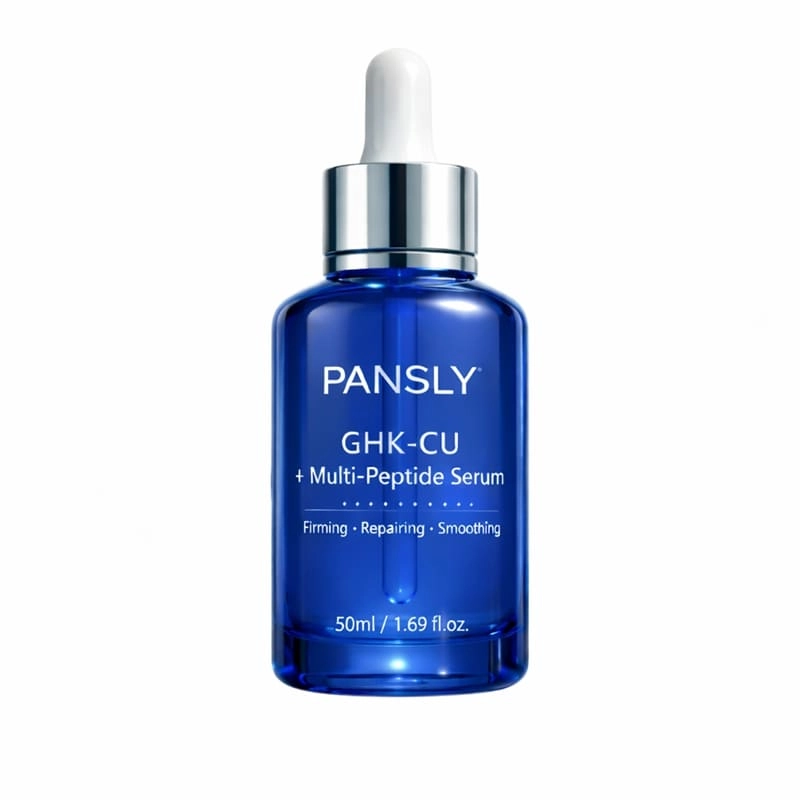
Experience visible rejuvenation with this GHK-Cu Copper Peptide Smoothing & Firming Face Serum, a high-performance concentrate designed to restore the structural integrity of aging skin. This advanced formula centers on GHK-Cu, a powerful signaling peptide clinically recognized for its ability to support natural collagen and elastin production. By promoting dermal density, it effectively tightens sagging skin and smooths the appearance of deep-set wrinkles and fine lines.
The lightweight, silky texture absorbs instantly, delivering antioxidant protection to neutralize environmental stressors that accelerate aging. Enhanced with deep-moisturizing agents, the serum reinforces the skin's moisture barrier, leaving the complexion feeling remarkably soft and resilient. With consistent use, skin texture is refined and facial contours appear more lifted, resulting in a youthfully firm and revitalized glow.
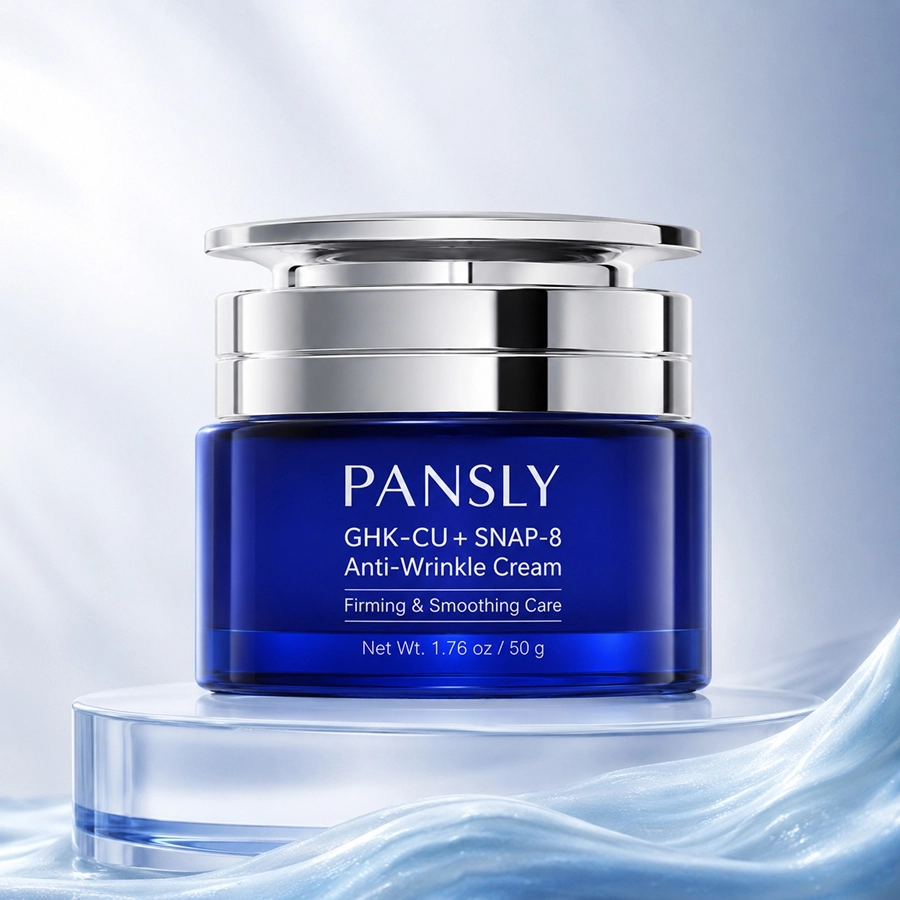
This Pansly GHK-CU + SNAP-8 Anti-Wrinkle Firming Cream is triple-peptide anti-aging facial cream, delivers targeted wrinkle smoothing, firming lifting and deep nourishment for dull, saggy, fine-line prone skin. Full OEM & ODM private label service is supported, including custom formula, packaging options, fast sampling and bulk export supply.
Five core premium active ingredients work synergistically for comprehensive anti-wrinkle care:
GHK-CU Copper Peptide lifts saggy skin, enhances skin resilience and tightens loose facial contour;
SNAP-8 Peptide targets expression lines to visibly soften and fade wrinkles;
Acetyl Hexapeptide-8 reduces the appearance of dry fine lines for smoother skin texture;
Ceramide NP reconstructs skin moisture barrier to lock nourishment and boost comfort;
Hyaluronic Acid delivers multi-layer rich deep moisture to relieve dry rough skin.
Luxury rich creamy texture spreads smoothly and melts into skin gently, leaving soft comfortable finish without heavy greasiness. Daily use blurs fine lines, firms loose skin, deeply nourishes and stabilizes barrier, refining uneven texture to reveal smooth, plump, youthful luminous skin.
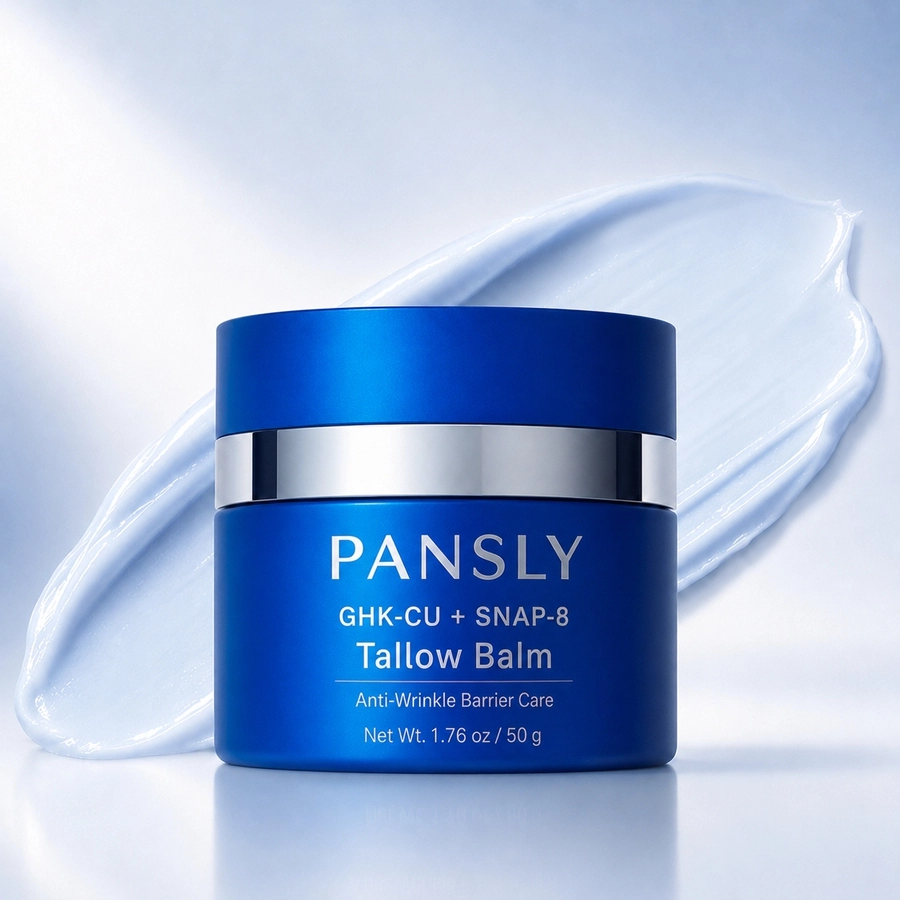
This Pansly GHK-CU + SNAP-8 Tallow Balm is a nourishing anti-wrinkle facial balm specially formulated for dry, fragile and sensitive skin, combining anti-aging wrinkle smoothing and barrier repairing effects. We offer full private label OEM service, including custom logo, adjustable formula, diversified packaging and lid color options.
It contains five core skin care active ingredients: GHK-CU visibly improves fine lines and revives dull complexion; SNAP-8 softens expression lines to smooth wrinkled skin texture; Grass-Fed Beef Tallow delivers deep lipid nourishment to relieve dry rough skin; Ectoin stabilizes the skin barrier and alleviates skin discomfort; Ceramide NP strengthens barrier structure to create smooth, healthy skin.
Luxury creamy blue balm texture glides smoothly and melts quickly on skin, providing long-lasting deep moisturizing comfort. Daily use fades fine lines & expression lines, nourishes dry delicate skin, repairs damaged barrier and leaves silky smooth skin finish.
Click here to customize the Beauty
we respond within a few hours
Monday–Friday, 9AM–6PM
3A01, Building A, Zhisheng Square, No. 4 Zhifu Road, Helong Street, Baiyun District, Guangzhou, China.


Leave a request, and we'll email you back within 24 hours.
© 2026 Beyond Basix. All Rights Reserved.