How to start the cosmetics oem odm business ?
- Private Label Hair Care Market Outlook and Profitability
- Market drivers and demand signals
- Profitability levers for an OEM/ODM business model
- Initial Market Research & Regulatory Pathway
- Validate product-market fit (PMF) and target segments
- Regulatory and compliance checklist
- Capital Requirements, Cost Breakdown, and Financing Strategy
- Two startup routes: contract-first vs. in-house manufacturing
- Estimated costs and cash flow considerations
- Equipment, Partner Selection & Supply Chain
- How to select an OEM/ODM partner
- Equipment sourcing vs. contract manufacturing
- Quality assurance and traceability
- Go-to-Market, Branding, and Scaling
- Brand positioning and pricing strategy
- Launch roadmap and KPIs
- Scaling and negotiation levers
- Operational Checklist: 30/60/90 Days
- Days 0–30: Research & partner selection
- Days 31–60: Samples, compliance & agreements
- Days 61–90: Production & launch prep
- Frequently Asked Questions
- How much capital do I need to start a cosmetics oem odm brand?
- How long does it take from concept to first sale?
- Can I own my formulation when working with an OEM/ODM?
- What are typical MOQs for cosmetics OEM/ODM?
- How do I ensure quality and compliance across markets?
- What advantages does Guangzhou Beyond Basix offer as an OEM/ODM partner?
High-margin opportunity: cosmetics oem odm offers entrepreneurs rapid time-to-market and low fixed-capex alternatives to building factories; with private-label demand rising in skincare and hair care, a well-executed OEM/ODM strategy that partners with a certified, experienced manufacturer can deliver ROI within 12–24 months while managing regulatory risk and quality through verified manufacturing partners.
Private Label Hair Care Market Outlook and Profitability
Market drivers and demand signals
Private label hair care and skincare products continue to grow due to retailer demand, influencer-driven micro-brands, and consumer appetite for niche actives. Entrepreneurs focused on cosmetics oem odm benefit from two parallel trends: product personalization and channel diversification (DTC, retail, salons). For regulatory context and safety expectations, consult Cosmetics - Wikipedia and the U.S. FDA Cosmetics guidance for labeling and safety obligations.
Profitability levers for an OEM/ODM business model
Profitability in cosmetics oem odm comes from SKU mix (hero SKUs with higher margins), packaging optimization, MOQ negotiation, and leveraging a manufacturing partner to lower formulation and compliance costs. Outsourcing manufacturing avoids heavy capital expenditure for filling lines—translate those savings into marketing and product development budgets.
Initial Market Research & Regulatory Pathway
Validate product-market fit (PMF) and target segments
Start by defining the niche (e.g., sulfate-free hair serums, anti-frizz treatments, scalp-care tonics) and collect validated interest through pre-sales, market surveys, and small influencer campaigns. Use competitor benchmarking and ingredient gap analysis to create a differentiated value proposition. Keep the phrase cosmetics oem odm in your discovery queries when sourcing manufacturers to ensure vendors specialize in private-label and custom formulation work.
Regulatory and compliance checklist
Before production, map required regulatory approvals and documentation for target markets (ingredient lists, safety assessments, MSDS, labeling language). Rely on a manufacturer with documented GMP and ISO experience; for cosmetics, ISO 22716 addresses Good Manufacturing Practices—see ISO 22716 Good Manufacturing Practices for Cosmetics. Manufacturers with ISO 9001, GMP, and MSDS capabilities streamline dossier preparation for distribution.
Capital Requirements, Cost Breakdown, and Financing Strategy
Two startup routes: contract-first vs. in-house manufacturing
Route A—cosmetics oem odm (contract-first): low capex, higher per-unit cost early, MOQ-dependent. Typical path for entrepreneurs and retailers who want fast-scale with minimal capital. Route B—in-house factory: high initial capex (machines, cleanrooms, validation) but lower long-term unit cost and full IP control. This guide prioritizes the OEM/ODM route given speed-to-market and capital efficiency.
Estimated costs and cash flow considerations
Below is a conservative cost framework for launching 3–5 SKUs via cosmetics oem odm with a reliable manufacturer supporting formulation, small-batch production, and regulatory documentation.
| Cost Item | Estimated Range (USD) | Notes |
|---|---|---|
| Formulation & samples | $2,000 – $10,000 | Custom formulations, 3–6 revisions |
| Stability & safety tests | $2,000 – $8,000 | Per SKU testing, accelerated and real-time |
| Initial production (MOQ) | $3,000 – $30,000 | Dependent on SKU, packaging, and fill volume |
| Packaging design & tooling | $1,000 – $15,000 | Labels, bottles, secondary packaging, molds |
| Certifications & compliance | $500 – $5,000 | Halal, CE documentation, MSDS, cosmetic safety report |
| Marketing & launch budget | $5,000 – $50,000 | Sampling, influencer campaigns, e-commerce setup |
| Working capital (3–6 months) | $10,000 – $50,000 | Inventory, shipping, returns buffer |
| Total estimated first-year budget | $23,500 – $168,000 | Range depends on ambition, markets, and MOQ |
Equipment, Partner Selection & Supply Chain
How to select an OEM/ODM partner
Choose a partner with deep cosmetics oem odm experience, transparent QC, and verifiable certifications. Verify factory audits, client references, and production capacity. Guangzhou Beyond Basix Cosmetics Ltd. offers a strong example: 23+ years in research and production, a 12,000 m² facility with a 100,000-level GMPC pharmaceutical-grade dust-free workshop, 12 production lines and advanced machinery imported from Germany and the US. Their certifications (ISO 9001, CE, MSDS, GMP, HALAL) reduce your compliance burden and accelerate product registration.
Equipment sourcing vs. contract manufacturing
For entrepreneurs using cosmetics oem odm, direct purchase of filling lines and mixers is unnecessary; instead, focus on contract manufacturing terms: MOQ, lead times, packaging capabilities, fill accuracy, and cold-chain logistics (if needed). If you later scale into partial in-house filling, invest in modular equipment such as semi-automatic fillers and capping machines—sourced from reputable OEMs in Europe or Asia—but only after validating consistent demand.
Quality assurance and traceability
Insist on batch-level traceability, COAs for actives, and on-site audits. A manufacturer holding ISO and GMP certifications typically maintains traceability workflows. For international shipments, ensure customs-ready documentation and check regulatory specifics for your target markets (European Commission cosmetics rules outlined at European Commission - Cosmetics).
Go-to-Market, Branding, and Scaling
Brand positioning and pricing strategy
Develop a pricing model that supports retail margins (typical retail markup 2.5–4x wholesale). For cosmetics oem odm products, maintain margin targets: gross margin 50–70% at wholesale pricing, adjusting for channel fees (marketplace commissions, retail slotting). Choose packaging and claims that support a High Quality or value positioning, and ensure claims match substantiated ingredient efficacy.
Launch roadmap and KPIs
Key initial KPIs: CAC, LTV, reorder rate, fill rate, and time-to-positive cash flow. Plan a phased SKU rollout: hero SKU first, two complementary SKUs next, then seasonal or targeted SKUs. Use early consumer feedback to refine formulas through your OEM/ODM partner, which reduces R&D time and costs.
Scaling and negotiation levers
As volume grows, renegotiate MOQs, per-unit prices, and packaging toolings. Consider co-development agreements with your OEM/ODM to secure exclusivity on formulations, private-label ownership rights, and improved lead times. When scaling internationally, leverage a manufacturer’s export experience to reduce logistics friction.
Operational Checklist: 30/60/90 Days
Days 0–30: Research & partner selection
Define SKUs, request NDA, submit a product brief to 3–5 manufacturers, and request costing, MOQ, and lead times. Ask for references and third-party audit reports.
Days 31–60: Samples, compliance & agreements
Approve formulations, run stability and safety tests, finalize packaging, and sign MOQ agreements. Ensure the contract covers IP, quality standards, delivery penalties, and confidentiality.
Days 61–90: Production & launch prep
Place initial order, complete labeling and compliance dossiers, set up e-commerce and distribution, and initiate a soft launch with sampling to measure conversion and gather feedback.
Frequently Asked Questions
How much capital do I need to start a cosmetics oem odm brand?
For a lean OEM/ODM launch of 3–5 SKUs expect a budget from roughly $25,000 to $120,000 depending on MOQ, testing requirements, and marketing spend; the table above provides a more granular breakdown.
How long does it take from concept to first sale?
With an experienced cosmetics oem odm partner, expect 60–120 days for formulation, testing, production, and shipping for initial small-batch runs; regulatory and shipping variations can extend timelines.
Can I own my formulation when working with an OEM/ODM?
Yes—negotiate IP and exclusivity clauses in your manufacturing agreement. Many OEM/ODM suppliers will accept ownership clauses for an upfront fee or minimum order commitment.
What are typical MOQs for cosmetics OEM/ODM?
MOQs vary significantly: small-batch-friendly manufacturers may accept 500–1,000 units per SKU, while some facilities set MOQs at several thousand units; discuss staggered production or shared production runs to reduce MOQ impact.
How do I ensure quality and compliance across markets?
Partner with manufacturers that provide batch COAs, MSDS, safety assessments, and have certifications like ISO/GMP; consult country-specific regulatory pages (e.g., U.S. FDA Cosmetics, European Commission - Cosmetics) to prepare necessary dossiers.
What advantages does Guangzhou Beyond Basix offer as an OEM/ODM partner?
Guangzhou Beyond Basix Cosmetics Ltd. brings 23+ years of R&D and manufacturing experience, a 12,000 m² facility with 12 production lines and a 100,000-level GMPC workshop, advanced imported machinery, and certifications including ISO 9001, CE, MSDS, GMP, and HALAL—making them a reliable partner for private label hair care and skincare brands seeking fast, compliant production.
Contact Guangzhou Beyond Basix Cosmetics Ltd. today to discuss wholesale or partnership opportunities and start your cosmetics oem odm venture with a trusted manufacturing partner.
References: ISO 22716 Good Manufacturing Practices for Cosmetics, U.S. FDA Cosmetics, European Commission - Cosmetics, Cosmetics - Wikipedia.

Elevate your professional skincare offerings with this Private Label Copper Peptide Anti-Wrinkle Firming Serum, a powerhouse concentrate designed for superior age-defying results. This sophisticated formula leverages the synergistic effects of GHK-Cu and SNAP-8 to address multiple layers of skin aging. The GHK-Cu copper peptides act as a vital signaling mechanism to enhance skin density and firmness, while the advanced SNAP-8 octapeptide specifically targets expression lines, helping to relax the appearance of deep-seated wrinkles for a smoother, more refined surface.
This lightweight, rapid-absorption serum provides a professional-grade solution for clients seeking a non-invasive lift. It effectively restores elasticity, improves skin texture, and provides essential antioxidant protection. Perfect for high-end beauty brands, this serum leaves the complexion looking visibly contoured, hydrated, and youthfully revitalized.
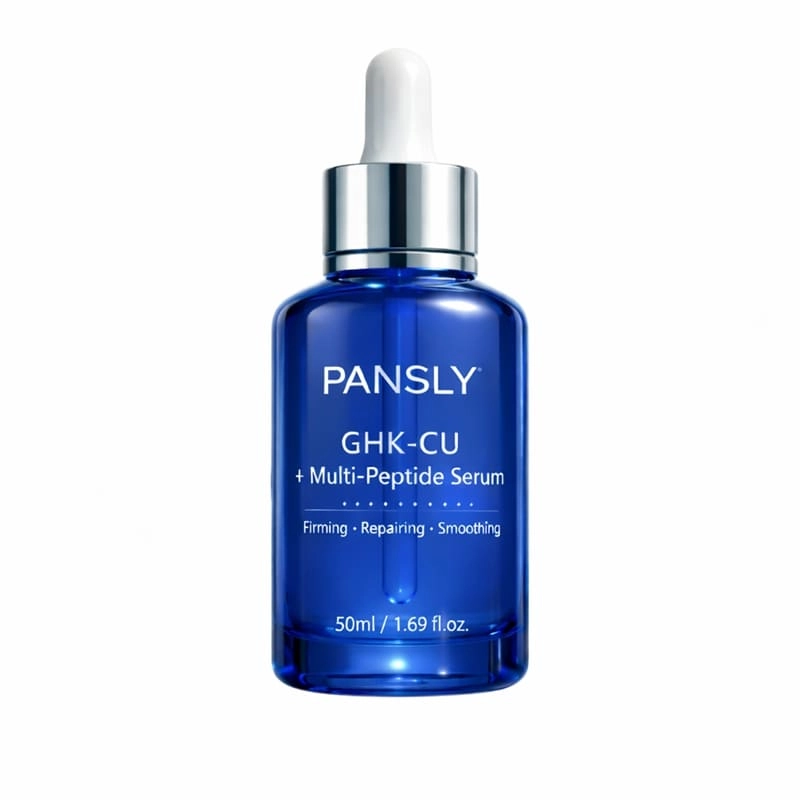
Experience visible rejuvenation with this GHK-Cu Copper Peptide Smoothing & Firming Face Serum, a high-performance concentrate designed to restore the structural integrity of aging skin. This advanced formula centers on GHK-Cu, a powerful signaling peptide clinically recognized for its ability to support natural collagen and elastin production. By promoting dermal density, it effectively tightens sagging skin and smooths the appearance of deep-set wrinkles and fine lines.
The lightweight, silky texture absorbs instantly, delivering antioxidant protection to neutralize environmental stressors that accelerate aging. Enhanced with deep-moisturizing agents, the serum reinforces the skin's moisture barrier, leaving the complexion feeling remarkably soft and resilient. With consistent use, skin texture is refined and facial contours appear more lifted, resulting in a youthfully firm and revitalized glow.
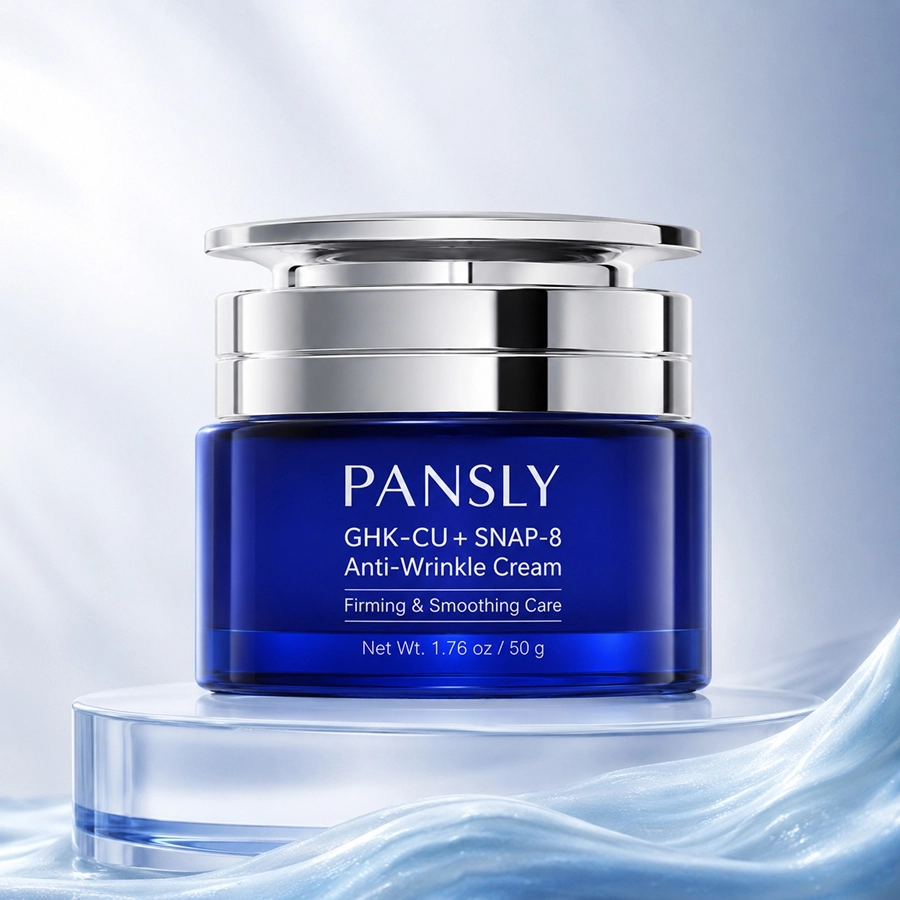
This Pansly GHK-CU + SNAP-8 Anti-Wrinkle Firming Cream is triple-peptide anti-aging facial cream, delivers targeted wrinkle smoothing, firming lifting and deep nourishment for dull, saggy, fine-line prone skin. Full OEM & ODM private label service is supported, including custom formula, packaging options, fast sampling and bulk export supply.
Five core premium active ingredients work synergistically for comprehensive anti-wrinkle care:
GHK-CU Copper Peptide lifts saggy skin, enhances skin resilience and tightens loose facial contour;
SNAP-8 Peptide targets expression lines to visibly soften and fade wrinkles;
Acetyl Hexapeptide-8 reduces the appearance of dry fine lines for smoother skin texture;
Ceramide NP reconstructs skin moisture barrier to lock nourishment and boost comfort;
Hyaluronic Acid delivers multi-layer rich deep moisture to relieve dry rough skin.
Luxury rich creamy texture spreads smoothly and melts into skin gently, leaving soft comfortable finish without heavy greasiness. Daily use blurs fine lines, firms loose skin, deeply nourishes and stabilizes barrier, refining uneven texture to reveal smooth, plump, youthful luminous skin.
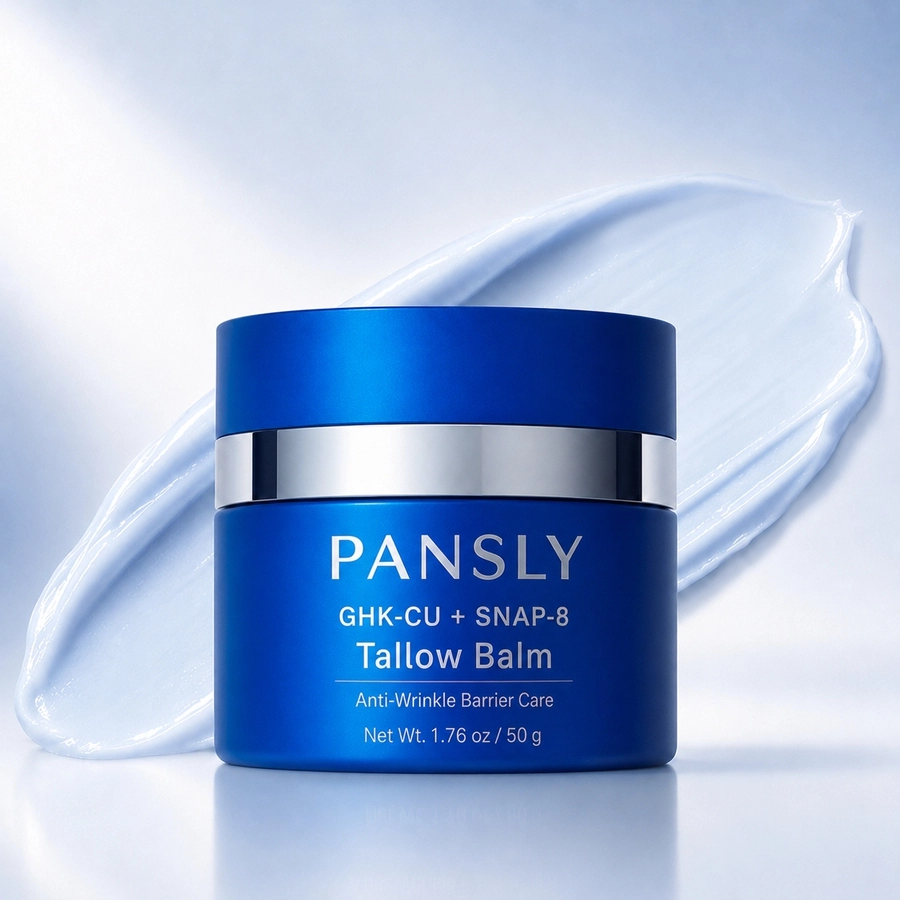
This Pansly GHK-CU + SNAP-8 Tallow Balm is a nourishing anti-wrinkle facial balm specially formulated for dry, fragile and sensitive skin, combining anti-aging wrinkle smoothing and barrier repairing effects. We offer full private label OEM service, including custom logo, adjustable formula, diversified packaging and lid color options.
It contains five core skin care active ingredients: GHK-CU visibly improves fine lines and revives dull complexion; SNAP-8 softens expression lines to smooth wrinkled skin texture; Grass-Fed Beef Tallow delivers deep lipid nourishment to relieve dry rough skin; Ectoin stabilizes the skin barrier and alleviates skin discomfort; Ceramide NP strengthens barrier structure to create smooth, healthy skin.
Luxury creamy blue balm texture glides smoothly and melts quickly on skin, providing long-lasting deep moisturizing comfort. Daily use fades fine lines & expression lines, nourishes dry delicate skin, repairs damaged barrier and leaves silky smooth skin finish.
Click here to customize the Beauty
we respond within a few hours
Monday–Friday, 9AM–6PM
3A01, Building A, Zhisheng Square, No. 4 Zhifu Road, Helong Street, Baiyun District, Guangzhou, China.


Leave a request, and we'll email you back within 24 hours.
© 2026 Beyond Basix. All Rights Reserved.