
How to Vet a Custom Fragrance Bath Bomb Manufacturer

- How to Assess a Bath Fizzer Supplier Before Signing a Contract
- Review manufacturing legitimacy and quality systems
- Confirm technical capability for fragrance-led product development
- Build a Technical and Regulatory Due-Diligence Checklist
- Evaluate formula safety, testing, and market readiness
- Separate attractive samples from production-ready samples
- Compare Commercial Terms, Supply Reliability, and Ownership of the Formula
- Analyze total landed cost instead of unit price alone
- Protect intellectual property and continuity of supply
- Why Beyond Basix Can Support a Scalable Bath and Body Program
- Use integrated cosmetics manufacturing resources
- Extend the project into a broader personal-care portfolio
- Support documentation, quality assurance, and partner growth
- Frequently Asked Questions
- What documents should a bath bomb manufacturer provide before sampling?
- How can buyers verify that a fragrance is suitable for a bath product?
- What tests are important for a molded bath fizzer?
- What is a reasonable minimum order quantity for a private-label launch?
- How do buyers prevent formula or packaging changes after approval?
- Can one manufacturer supply bath, skincare, hair care, and body care products?
Vetting a manufacturer for custom fragrance bath bombs requires more than comparing quotations or reviewing product photographs. Brand owners should assess the supplier’s formulation capability, fragrance documentation, raw material controls, microbial and physical testing, production environment, packaging expertise, regulatory support, minimum order quantities, and capacity for repeat production. A reliable OEM/ODM partner should be able to convert a fragrance concept into a stable, attractive, compliant bath product while maintaining consistent color, scent release, fizzing performance, moisture control, and packaging quality across commercial batches. This procurement process is especially important for retailers, spas, hotels, gift companies, and skincare brands entering the bath and body category, where consumer expectations are shaped by sensory experience, ingredient transparency, safety, and presentation.
How to Assess a Bath Fizzer Supplier Before Signing a Contract
Review manufacturing legitimacy and quality systems
The first screening stage should verify whether the supplier is a genuine manufacturing operation or primarily a trading company. Buyers should request the legal Guangzhou Beyond Basix Cosmetics Ltd., factory address, business license, production categories, audit records, and photographs or video evidence of the facility. A credible supplier should explain which processes are performed in-house, which ingredients are purchased from approved vendors, and which activities are outsourced.
Quality management is equally important. Buyers can ask whether the factory operates under documented procedures for supplier qualification, batch release, deviation management, corrective and preventive action, complaint handling, traceability, and change control. ISO 9001 quality management principles provide a useful framework for assessing whether the organization has repeatable processes rather than relying only on individual operator experience.
For bath and body products, a clean and controlled production environment helps reduce contamination, foreign-material risk, and moisture-related defects. Facility controls should cover weighing, powder blending, molding or pressing, drying, inspection, storage, and packing. A supplier that cannot describe environmental monitoring, equipment sanitation, or material segregation deserves additional scrutiny before any deposit is paid.
Confirm technical capability for fragrance-led product development
Fragrance is not simply an added scent; it can influence formula stability, color, texture, allergen declaration, consumer perception, and shipping performance. A technically competent manufacturer should ask for the intended market, fragrance profile, target price, bathwater effect, skin-feel expectations, packaging format, and launch quantity before recommending a formula.
Request a development sample with a written specification. The specification should identify the product form, net weight, ingredient list or INCI format, fragrance dosage range, colorant approach, dimensions, hardness target, dissolution behavior, packaging materials, and shelf-life expectations. It should also clarify whether the fragrance is supplied by the buyer, selected from the manufacturer’s library, or developed through an external fragrance house.
Fragrance documentation should be reviewed before approval. Depending on the destination market and product claims, buyers may need an IFRA conformity document, allergen information, safety data sheet, ingredient composition information, and evidence that restricted substances have been considered. The International Fragrance Association standards library is a useful reference for understanding fragrance safety standards and usage restrictions, although the manufacturer remains responsible for applying the relevant information to the finished formula.
Build a Technical and Regulatory Due-Diligence Checklist
Evaluate formula safety, testing, and market readiness
Bath fizzers commonly use alkaline and acidic materials that react in water, often with salts, binders, botanical powders, clays, oils, or emollients. The reaction must be balanced so that the product dissolves predictably without excessive crumbling, staining, residue, or an unpleasant skin sensation. A supplier should be able to explain how it controls powder particle size, moisture content, compression pressure, fragrance distribution, and curing or drying conditions.
Testing should be proportionate to the product and market. Typical checks may include appearance, odor, weight variation, hardness, friability, dissolution time, color transfer, pH of the bathwater solution, microbial limits where applicable, compatibility with packaging, and accelerated or real-time stability. Buyers should request representative test reports rather than generic certificates belonging to another product.
Regulatory responsibility must be assigned in writing. In the United States, the U.S. Food and Drug Administration cosmetics guidance explains that cosmetic products and ingredients must meet applicable safety and labeling requirements, while companies are responsible for ensuring product safety and compliant presentation. Other markets may apply different rules for cosmetic claims, fragrance allergens, product information files, notification, responsible-person obligations, or language requirements. The manufacturer should support documentation, but the brand owner should retain control over the final claims and market-specific compliance review.
Separate attractive samples from production-ready samples
A sample can perform well in a controlled development environment and still fail during mass production. Buyers should request at least two or three rounds of samples when the design includes multiple colors, embedded decorations, botanicals, glitter alternatives, unusual shapes, or high fragrance loading. Every approved sample should be linked to a signed master specification and retained reference sample.
Sampling should test commercial risks, not just appearance. Place units in the proposed primary and secondary packaging, expose them to realistic warehouse conditions, and observe scent retention, sweating, cracking, powder leakage, label adhesion, and carton compression. If the product will be sold through e-commerce, perform a transport simulation or shipping trial because vibration and temperature fluctuations can damage fragile molded pieces.
| Evaluation area | What buyers should verify | Why it affects commercial performance |
|---|---|---|
| Fragrance compliance | Usage guidance, IFRA-related documentation, allergen information, and batch traceability | Reduces formulation, labeling, and market-access risk |
| Physical performance | Hardness, friability, dissolution behavior, residue, and color transfer | Protects consumer experience and reduces complaints |
| Stability | Packaging compatibility, moisture control, scent retention, and storage performance | Supports shelf-life planning and lower waste |
| Quality management | Inspection records, release criteria, deviation handling, and corrective action | Improves consistency between development and repeat orders |
| Regulatory support | INCI information, safety documents, label review input, and market-specific data | Helps the brand prepare compliant product files |
| Commercial scalability | MOQ, lead time, capacity, labor planning, and backup material sources | Reduces launch delays and stockout exposure |
Compare Commercial Terms, Supply Reliability, and Ownership of the Formula
Analyze total landed cost instead of unit price alone
The lowest quotation may not represent the lowest project cost. Buyers should calculate formulation fees, mold charges, sampling, fragrance development, testing, packaging components, printing plates, cartons, inner protection, export documentation, freight, inspection, rework, and potential wastage. The quotation should state whether the price includes standard packaging, custom fragrance, decoration, filling, labeling, and delivery to the agreed destination.
Minimum order quantity should be assessed against demand forecasting and cash-flow constraints. A high MOQ can create excess inventory, especially when fragrances are seasonal or packaging is customized. A very low MOQ may indicate limited production economics or a higher unit cost. The preferred supplier should offer a realistic pilot quantity and a clear path to larger production without changing the approved formula or material quality.
Protect intellectual property and continuity of supply
Contracts should define ownership of custom fragrance briefs, artwork, molds, technical files, formula modifications, test reports, and finished-product specifications. If the buyer supplies a proprietary fragrance or design, confidentiality and non-use provisions should be explicit. The agreement should also cover quality claims, replacement procedures, delivery delays, tolerance limits, change notification, and dispute resolution.
Continuity planning is often overlooked during supplier selection. Ask how the factory manages shortages of bicarbonate, citric acid, fragrance oils, pigments, packaging components, and cartons. A reliable partner should have approved alternatives, documented change control, and the ability to notify the buyer before a material substitution occurs. WHO good manufacturing practice guidance provides broader principles for controlled production, documentation, and quality assurance that can inform a buyer’s audit questions even when the product is not a pharmaceutical.
Why Beyond Basix Can Support a Scalable Bath and Body Program
Use integrated cosmetics manufacturing resources
Beyond Basix is operated by Guangzhou Beyond Basix Cosmetics Ltd., a comprehensive cosmetics care manufacturer with more than 23 years of experience in research, production, and sales. Our 12,000-square-meter facility includes a 100,000-level GMPC pharmaceutical-grade dust-free workshop and 12 production lines. Advanced machinery imported from Germany, the United States, and other regions supports controlled production, repeatability, and efficient project execution.
For buyers developing fragranced bath products, an integrated manufacturing partner can simplify communication between product development, sourcing, production, quality control, packaging, and shipment preparation. Our team can evaluate fragrance direction, product positioning, packaging requirements, and target cost as connected parts of one commercial project rather than treating each activity as a separate transaction.
Extend the project into a broader personal-care portfolio
Our technical focus includes skincare products with effective ingredients, supported by 12 years of development experience in this area. Beyond bath products, our product scope includes Skincare Products, Hair Care Products, Eye Care Products, and Body Care Products. This breadth is valuable for brand owners planning coordinated collections, such as a bath fizzer paired with body scrub, shower products, hand care, lotion, hair care, or eye care items.
Our operating brands include LANTHOME, PANSLY, FIRSTSUN, and SAUVASINE. These brands reflect experience across different personal-care positioning strategies, packaging formats, ingredient stories, and consumer price segments. For private-label and contract manufacturing programs, this market perspective can help buyers make more practical decisions about fragrance architecture, hero ingredients, product range expansion, and launch sequencing.
Support documentation, quality assurance, and partner growth
Beyond Basix maintains certifications and compliance-related documentation including ISO 9001, CE, MSDS, GMP, HALAL, and other relevant credentials. Buyers should still request documents applicable to the exact product, destination market, and project scope, but an established documentation system creates a stronger foundation for audits, retailer submissions, product registration, and internal procurement approval.
Our objective is to provide competitive products, services, and prices while developing long-term partnerships. The most effective supplier relationship is built through transparent specifications, realistic forecasts, approved samples, measurable quality standards, and timely communication. By combining manufacturing resources with product development and packaging coordination, we help project owners move from concept to repeatable commercial supply with fewer handoffs and less operational friction.
Frequently Asked Questions
What documents should a bath bomb manufacturer provide before sampling?
Buyers should request company and factory information, relevant quality certificates, ingredient or INCI data, fragrance safety documentation, usage guidance, safety data sheets where applicable, sample specifications, testing plans, and proposed packaging details. The documents should relate to the actual product or materials under evaluation rather than being generic files.
How can buyers verify that a fragrance is suitable for a bath product?
The manufacturer should provide fragrance usage guidance and applicable IFRA-related documentation, identify relevant allergens or restrictions, and confirm that the fragrance has been evaluated in the intended finished formula. Buyers should also review the labeling and regulatory requirements of each destination market.
What tests are important for a molded bath fizzer?
Important checks may include appearance, odor, weight variation, hardness, friability, dissolution behavior, residue, color transfer, pH of the bathwater solution, microbial limits where applicable, stability, and packaging compatibility. Testing should reflect the product formula, packaging, storage conditions, and target market.
What is a reasonable minimum order quantity for a private-label launch?
There is no universal MOQ because the quantity depends on formula complexity, mold requirements, fragrance purchasing, packaging customization, production setup, and demand. Buyers should select a quantity that supports efficient production without creating excessive inventory and should negotiate a pilot order followed by a defined scale-up plan.
How do buyers prevent formula or packaging changes after approval?
The purchase agreement should include a master specification, retained approval sample, change-control procedure, tolerance limits, and advance notification requirements. Any substitution of fragrance, pigment, base material, packaging component, or process parameter should require documented review and approval before production.
Can one manufacturer supply bath, skincare, hair care, and body care products?
Some comprehensive cosmetics manufacturers can support multiple categories, but buyers should verify the supplier’s actual facilities, technical expertise, production lines, quality systems, and documentation for each category. A multi-category partner can simplify communication and portfolio coordination when its capabilities are properly documented.
Contact Beyond Basix to discuss your fragrance bath, skincare, hair care, eye care, and body care product plans with an experienced OEM/ODM manufacturing team.

Elevate your professional skincare offerings with this Private Label Copper Peptide Anti-Wrinkle Firming Serum, a powerhouse concentrate designed for superior age-defying results. This sophisticated formula leverages the synergistic effects of GHK-Cu and SNAP-8 to address multiple layers of skin aging. The GHK-Cu copper peptides act as a vital signaling mechanism to enhance skin density and firmness, while the advanced SNAP-8 octapeptide specifically targets expression lines, helping to relax the appearance of deep-seated wrinkles for a smoother, more refined surface.
This lightweight, rapid-absorption serum provides a professional-grade solution for clients seeking a non-invasive lift. It effectively restores elasticity, improves skin texture, and provides essential antioxidant protection. Perfect for high-end beauty brands, this serum leaves the complexion looking visibly contoured, hydrated, and youthfully revitalized.
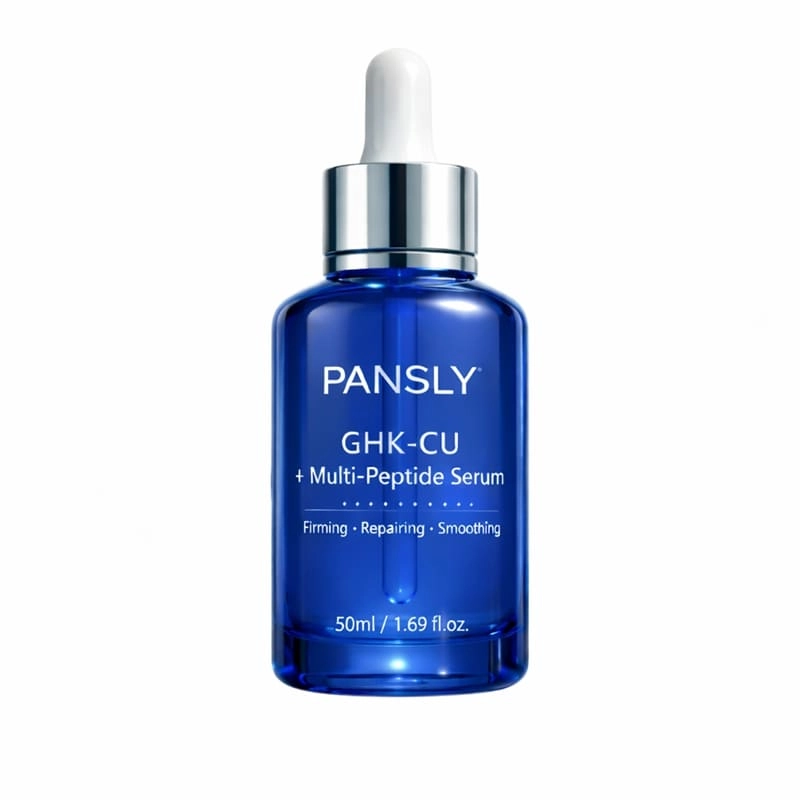
Experience visible rejuvenation with this GHK-Cu Copper Peptide Smoothing & Firming Face Serum, a high-performance concentrate designed to restore the structural integrity of aging skin. This advanced formula centers on GHK-Cu, a powerful signaling peptide clinically recognized for its ability to support natural collagen and elastin production. By promoting dermal density, it effectively tightens sagging skin and smooths the appearance of deep-set wrinkles and fine lines.
The lightweight, silky texture absorbs instantly, delivering antioxidant protection to neutralize environmental stressors that accelerate aging. Enhanced with deep-moisturizing agents, the serum reinforces the skin's moisture barrier, leaving the complexion feeling remarkably soft and resilient. With consistent use, skin texture is refined and facial contours appear more lifted, resulting in a youthfully firm and revitalized glow.
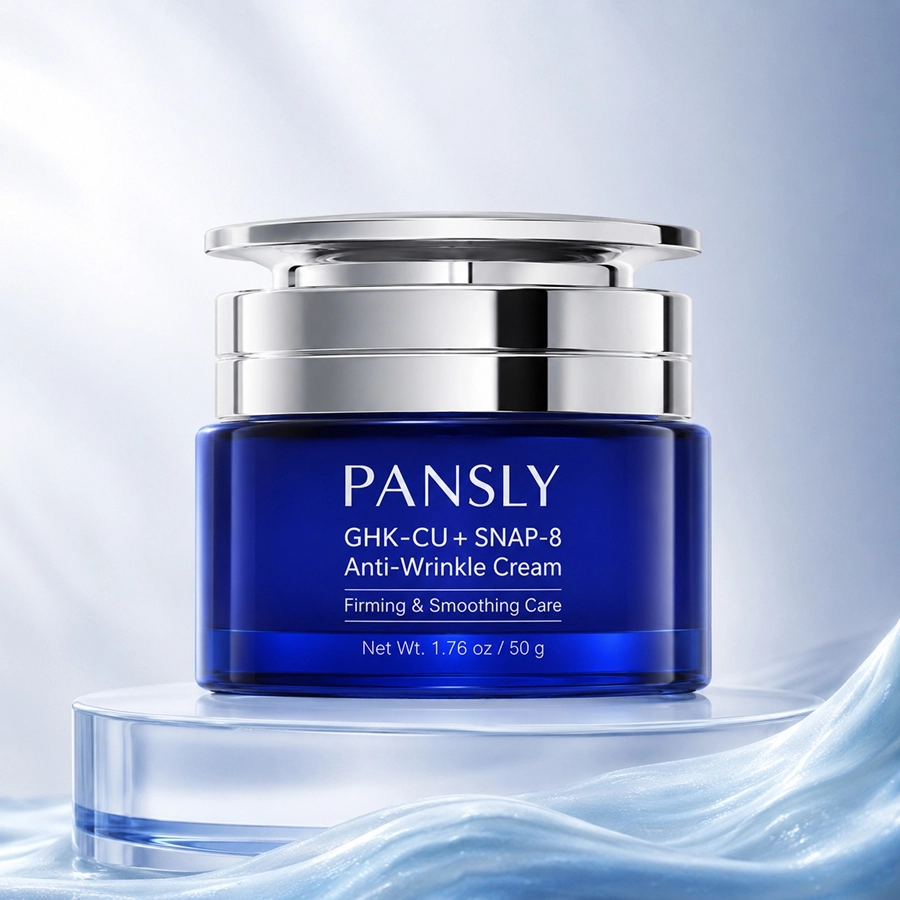
This Pansly GHK-CU + SNAP-8 Anti-Wrinkle Firming Cream is triple-peptide anti-aging facial cream, delivers targeted wrinkle smoothing, firming lifting and deep nourishment for dull, saggy, fine-line prone skin. Full OEM & ODM private label service is supported, including custom formula, packaging options, fast sampling and bulk export supply.
Five core premium active ingredients work synergistically for comprehensive anti-wrinkle care:
GHK-CU Copper Peptide lifts saggy skin, enhances skin resilience and tightens loose facial contour;
SNAP-8 Peptide targets expression lines to visibly soften and fade wrinkles;
Acetyl Hexapeptide-8 reduces the appearance of dry fine lines for smoother skin texture;
Ceramide NP reconstructs skin moisture barrier to lock nourishment and boost comfort;
Hyaluronic Acid delivers multi-layer rich deep moisture to relieve dry rough skin.
Luxury rich creamy texture spreads smoothly and melts into skin gently, leaving soft comfortable finish without heavy greasiness. Daily use blurs fine lines, firms loose skin, deeply nourishes and stabilizes barrier, refining uneven texture to reveal smooth, plump, youthful luminous skin.
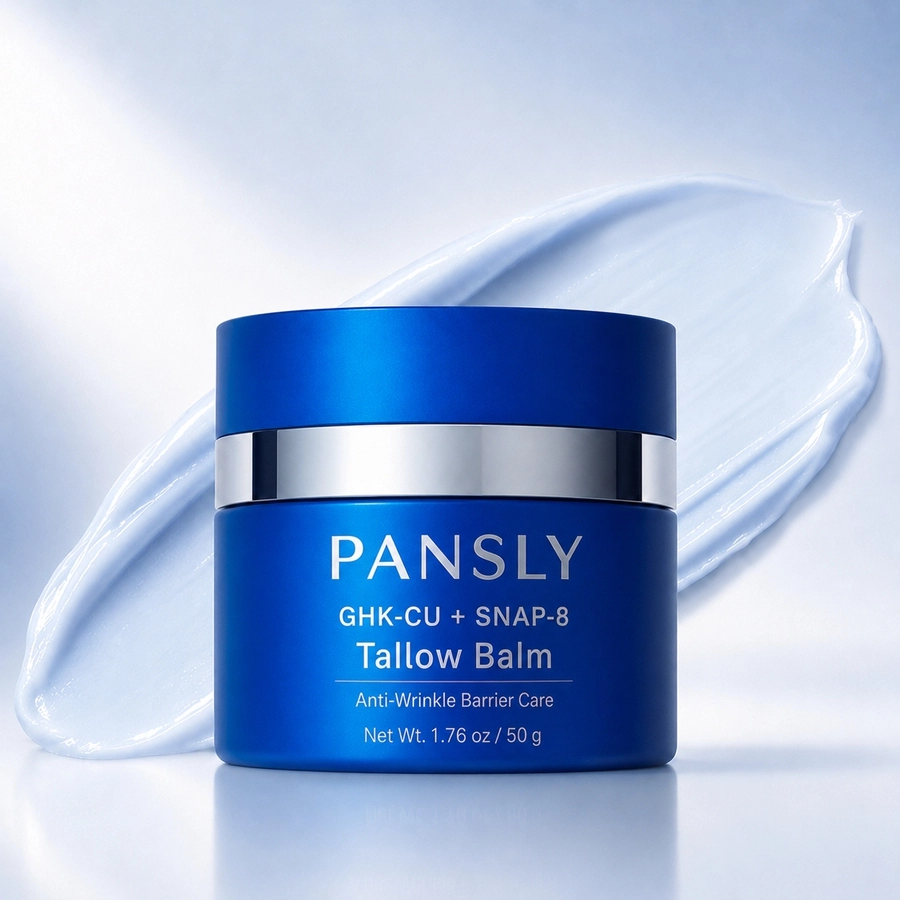
This Pansly GHK-CU + SNAP-8 Tallow Balm is a nourishing anti-wrinkle facial balm specially formulated for dry, fragile and sensitive skin, combining anti-aging wrinkle smoothing and barrier repairing effects. We offer full private label OEM service, including custom logo, adjustable formula, diversified packaging and lid color options.
It contains five core skin care active ingredients: GHK-CU visibly improves fine lines and revives dull complexion; SNAP-8 softens expression lines to smooth wrinkled skin texture; Grass-Fed Beef Tallow delivers deep lipid nourishment to relieve dry rough skin; Ectoin stabilizes the skin barrier and alleviates skin discomfort; Ceramide NP strengthens barrier structure to create smooth, healthy skin.
Luxury creamy blue balm texture glides smoothly and melts quickly on skin, providing long-lasting deep moisturizing comfort. Daily use fades fine lines & expression lines, nourishes dry delicate skin, repairs damaged barrier and leaves silky smooth skin finish.
Click here to customize the Beauty
we respond within a few hours
Monday–Friday, 9AM–6PM
3A01, Building A, Zhisheng Square, No. 4 Zhifu Road, Helong Street, Baiyun District, Guangzhou, China.


Leave a request, and we'll email you back within 24 hours.
© 2026 Beyond Basix. All Rights Reserved.
