
Hydrogel vs Bio-Cellulose: Choosing the Right Material for PDRN NAD+ Eye Patches
- Material Science Behind Advanced Under-Eye Patch Development
- How hydrogel supports formulation flexibility
- How bio-cellulose changes contact and positioning
- What PDRN and NAD+ mean for the formula
- Hydrogel and Bio-Cellulose Comparison for Procurement Decisions
- Performance variables that affect consumer experience
- Commercial and manufacturing trade-offs
- How to select the right format by project objective
- Why a One-Stop OEM/ODM Partner Improves Launch Control
- Integrated development from concept to finished pouch
- Quality systems, documentation, and project risk management
- Expanding beyond eye care
- Implementation Checklist for a Reliable Eye-Patch Launch
- Technical validation before commercial approval
- Commercial readiness and supplier scorecard
- Frequently Asked Questions
For brands developing pdrn nad+ eye patches, the material decision is not simply a choice between two fashionable sheet technologies. It affects active-ingredient protection, adhesion, serum delivery, user comfort, packaging design, production yield, regulatory positioning, and unit economics. Hydrogel is usually selected for its cooling sensory profile, adjustable thickness, high liquid loading, and efficient large-scale manufacturing. Bio-cellulose is often chosen for its close facial conformity, wet strength, breathable-feeling contact, and High Quality natural-material story. Neither substrate is universally superior. The appropriate option depends on the PDRN source and grade, NAD+ formulation stability, target wear time, intended claims, climate, retail price, and the supplier’s ability to validate the finished product.
Material Science Behind Advanced Under-Eye Patch Development
How hydrogel supports formulation flexibility
Hydrogel eye masks are three-dimensional polymer networks that retain a water-rich serum phase. Depending on the polymer system, they may be manufactured as clear, translucent, or colored patches with different thicknesses, elasticity, and dissolution behavior. A well-designed hydrogel can provide an immediate cooling sensation, smooth application, and sufficient adhesion for short treatment periods. These properties are commercially useful for quick-care products positioned around hydration, refreshed appearance, and temporary smoothing.
For project owners, the principal advantage is formulation and process flexibility. Hydrogel composition can be adjusted to influence tack, softness, wet weight, release behavior, and resistance to tearing during application. It can also support different patch geometries, including crescent, contoured, and asymmetric designs. However, high water activity and a nutrient-rich serum environment require robust preservation, filling hygiene, packaging integrity, and microbial testing. Suppliers should not assume that a visually attractive gel automatically protects sensitive ingredients or remains stable throughout its declared shelf life.
How bio-cellulose changes contact and positioning
Bio-cellulose is a fine cellulose-based membrane produced through microbial fermentation and processed into a hydrated sheet. Its dense fiber network can conform closely to the skin around the eye, helping minimize lifting at the inner and outer corners. The material is commonly associated with a thin, second-skin sensation and High Quality facial-mask positioning. Its wet strength can also support longer wear than fragile paper-based substrates, although actual performance depends on thickness, serum composition, cut pattern, and packaging.
Bio-cellulose should be evaluated as a complete delivery system rather than as a standalone claim. The membrane can retain a substantial amount of liquid, but this does not prove superior delivery of PDRN, NAD+, or any other active. Release is influenced by molecular size, solvent system, viscosity, skin contact, occlusion, pH, and the chemical compatibility of the formula. Procurement teams should request finished-product performance data instead of relying on substrate descriptions alone.
What PDRN and NAD+ mean for the formula
PDRN generally refers to polydeoxyribonucleotide materials, frequently described in cosmetic marketing as DNA-derived or nucleotide-based ingredients. The source, purification method, molecular-weight distribution, specification, and intended use must be documented. NAD+, or nicotinamide adenine dinucleotide, is a naturally occurring coenzyme involved in cellular redox reactions, but a cosmetic product must be assessed according to the permitted claims and applicable rules in each target market. Buyers should distinguish ingredient identity from clinical outcome language and avoid presenting a topical cosmetic patch as a drug or medical treatment without the required authorization.
Ingredient compatibility requires more attention than the substrate label. Development teams should assess pH, ionic strength, chelating agents, antioxidants, preservatives, fragrance components, oxygen exposure, light sensitivity, and heat history. A supplier should compare the active-containing formula with a placebo or base formula and conduct accelerated and real-time stability testing. The U.S. FDA guidance on cosmetic ingredients is a useful starting point for understanding that ingredient safety and labeling responsibilities remain with the responsible business operator.
Hydrogel and Bio-Cellulose Comparison for Procurement Decisions
Performance variables that affect consumer experience
Hydrogel tends to offer a cool, cushion-like feel and can be engineered for a thicker, more visible treatment format. Bio-cellulose generally offers closer anatomical contact and a thinner, highly conformable profile. For consumers who move during a 15-to-30-minute routine, adhesion at the curved orbital area is important. For High Quality spa or overnight-inspired positioning, visual delicacy and close contact may carry more value than a thick gel appearance.
Neither material should be judged only by initial adhesion. Buyers should examine edge lift after application, serum migration, tearing during removal, residue, eye irritation risk, and the ease of opening the pouch. A patch that adheres strongly but leaves excessive residue may create a poor experience, while a very wet patch can slide and compromise positioning. Packaging orientation, protective liners, notch design, and liquid distribution also influence application quality.
Commercial and manufacturing trade-offs
Hydrogel formats are often attractive for high-volume programs because the production route can be standardized around molding, casting, cutting, and pouch filling. They may provide greater freedom in color, thickness, shape, and visual differentiation. Bio-cellulose programs can support High Quality price architecture, but the substrate, hydration state, handling requirements, protective layers, and filling process may increase material and operational complexity.
Cost comparisons must include more than the substrate purchase price. A realistic landed-cost model includes active ingredients, serum fill weight, pouch film, protective mesh, labor, line speed, rejects, microbiological controls, testing, freight, carton configuration, and minimum order quantity. A lower-cost patch can become less profitable if leakage, drying, tearing, or inconsistent cutting produces high complaint and replacement rates.
| Evaluation factor | Hydrogel | Bio-cellulose | Procurement implication |
|---|---|---|---|
| Contact profile | Soft, flexible, cooling, thickness can be adjusted | Thin, closely conforming, second-skin positioning | Match the texture to wear time and brand tier |
| Shape flexibility | Broad freedom in thickness, color, and geometry | Fine, conformable shapes with substrate-handling constraints | Approve pilot tooling before mass production |
| Serum retention | High water retention within a polymer network | High hydration and liquid-holding capacity in a cellulose membrane | Validate leakage, release, and pouch fill together |
| Key process concern | Preservation, gel uniformity, cutting, and filling | Membrane integrity, protective layers, hydration, and handling | Audit line controls and finished-product inspection |
| High Quality positioning | Cooling treatment and colorful or transparent visual appeal | Biocellulose and close-contact second-skin story | Align claims with substantiated material facts |
| Regulatory consideration | Cosmetic classification, ingredient compliance, labeling, safety, and claims depend on the destination market | Obtain market-specific regulatory review before launch | |
The table provides a development framework, not a universal ranking. For quality-system alignment, buyers can review the principles of ISO 22716 cosmetics good manufacturing practices. Microbiological specifications and testing should be defined for the product category and market rather than copied from an unrelated mask. The WHO guidance on quality control methods for cosmetics also reinforces the importance of documented testing and controlled manufacturing practices.
How to select the right format by project objective
Hydrogel is a logical starting point when the brief emphasizes cooling sensation, accessible High Quality pricing, strong visual differentiation, high-volume output, or a short treatment ritual. Bio-cellulose is often better suited to a high-end launch where close fit, material storytelling, and a refined facial-treatment experience justify a higher target price. A hybrid strategy may also be appropriate: use one material for a mass-market SKU and another for a professional, giftable, or luxury line while maintaining a consistent active concept.
Before approving the purchase order, buyers should request a technical dossier covering the INCI list, active specifications, formula pH, preservative system, compatibility data, stability protocol, microbial results, patch dimensions, serum weight, packaging specification, and batch-release criteria. Claims should be written after reviewing evidence. Statements such as “hydrates,” “refreshes the look of tired eyes,” or “supports a smoother-looking appearance” are materially different from drug-like regeneration or repair claims.
Why a One-Stop OEM/ODM Partner Improves Launch Control
Integrated development from concept to finished pouch
A One-Stop OEM/ODM for Skincare can reduce handoff risk by coordinating ingredient sourcing, formula development, substrate selection, artwork, packaging, filling, testing, and production scheduling through one accountable team. This is especially important for nucleotide- and coenzyme-positioned eye treatments because an active formula may perform differently in a hydrogel and a bio-cellulose carrier. The supplier should be able to produce laboratory samples, pilot batches, packaging compatibility samples, and pre-production approvals before scale-up.
Beyond Basix supports this integrated model through Guangzhou Beyond Basix Cosmetics Ltd., a comprehensive cosmetics care manufacturer with more than 23 years of experience in research, production, and sales. Our 12,000-square-meter facility includes a 100,000-level GMPC pharmaceutical-grade dust-free workshop and 12 production lines. Equipment imported from Germany, the United States, and other regions supports controlled production and repeatable manufacturing for customized eye-care programs.
Quality systems, documentation, and project risk management
For international buyers, supplier qualification should cover more than a certificate list. It should include batch traceability, incoming-material controls, water-system management, environmental monitoring, in-process inspection, finished-product release, complaint handling, and change-control procedures. Beyond Basix operates with certifications and documentation including ISO 9001, CE, MSDS, GMP, HALAL, and other applicable qualifications. These credentials should be matched to the specific product, facility, destination market, and certification scope during due diligence.
Our engineering and manufacturing teams can help project owners compare gel and bio-cellulose constructions according to target cost, sensory profile, active concept, packaging format, and launch volume. The practical objective is not to oversell one material; it is to identify the construction that can be manufactured consistently, tested appropriately, labeled responsibly, and delivered at a commercially viable cost. This approach helps reduce late-stage reformulation, packaging leakage, and claims-related rework.
Expanding beyond eye care
Beyond Basix develops a broader portfolio across Skincare Products, Hair Care Products, Eye Care Products, and Body Care Products. This range allows brand owners and distributors to build coordinated collections rather than treating an eye patch as an isolated SKU. A PDRN-inspired eye treatment can be developed alongside facial serums, sheet masks, creams, scalp products, body treatments, or cleansing formats, subject to ingredient compliance and claim substantiation in each market.
Our four major brands—LANTHOME, PANSLY, FIRSTSUN, and SAUVASINE—reflect experience in developing skincare products with effective ingredients over 12 years. For private-label and customized projects, the value of a manufacturing partner is measured through responsiveness, sample accuracy, quality consistency, transparent communication, and the ability to support future extensions. Buyers should therefore assess both the initial quotation and the supplier’s capacity to support repeat orders, market expansion, and SKU optimization.
Implementation Checklist for a Reliable Eye-Patch Launch
Technical validation before commercial approval
A disciplined development gate should begin with a written product brief. It should define target consumer, market, intended claims, patch shape, wear time, fragrance policy, active concentration, serum weight, packaging format, price architecture, and annual demand. Next, the development team should compare at least one hydrogel and one bio-cellulose prototype where the business case is uncertain. Sensory scoring should cover adhesion, cooling, slip, residue, tearing, removal, and perceived comfort.
Laboratory work should include appearance, odor, pH, viscosity where applicable, net content, microbial limits, preservative effectiveness when relevant, active assay or identity testing, package seal integrity, and stability under defined conditions. The FDA information on cosmetic product testing provides useful context for safety and product assessment, although each destination market may impose additional requirements. Stability should be performed in the final container because pouch film, oxygen transmission, light exposure, and substrate contact can affect the formula.
Commercial readiness and supplier scorecard
A supplier scorecard should evaluate technical capability, facility hygiene, certifications, quality personnel, sample lead time, minimum order quantity, tooling charges, production capacity, export experience, documentation, and corrective-action responsiveness. Buyers should also confirm whether the quoted price includes the patch, serum, pouch, printing, protective liner, carton, testing, and delivery terms. Clear ownership of artwork approval and regulatory review prevents avoidable delays.
The strongest launch decision balances consumer experience with operational certainty. Hydrogel may win on scalability and cost discipline; bio-cellulose may win on conformity and High Quality storytelling. The final selection should be supported by comparative samples, stability evidence, packaging validation, claim review, and a documented manufacturing control plan. That process creates a more defensible product proposition than selecting a substrate solely because it is trending in the market.
Frequently Asked Questions
Is hydrogel or bio-cellulose better for PDRN and NAD+ eye treatments?
Neither material is universally superior. Hydrogel is often suitable for cooling sensation, adjustable thickness, visual differentiation, and scalable cost control, while bio-cellulose is often selected for close conformity, wet strength, and premium positioning. The decision should be based on formula compatibility, wear time, claims, packaging, target price, and stability data.
Can bio-cellulose improve the delivery of PDRN or NAD+?
Bio-cellulose can provide close skin contact and retain a hydrated serum, but the substrate alone does not prove superior active delivery. Release depends on molecular characteristics, pH, viscosity, solvent system, occlusion, contact time, and the finished formula. Comparative finished-product testing is required.
What stability tests should buyers request for active eye patches?
Buyers should request appearance, odor, pH, viscosity where applicable, net content, microbiological testing, preservative effectiveness when relevant, active assay or identity testing, package seal integrity, and real-time and accelerated stability data in the final pouch. Formula-substrate and packaging compatibility should also be assessed.
Are PDRN and NAD+ eye patches regulated as cosmetics in every market?
Classification and permitted claims vary by destination market. Ingredient identity, safety documentation, labeling, and claim wording must be reviewed for each jurisdiction. Cosmetic brands should avoid drug-like regeneration, repair, or treatment claims unless the product has the required authorization.
What information should an OEM/ODM supplier provide before mass production?
A qualified supplier should provide the INCI list, active specifications, formula pH, preservative information, stability protocol, microbial results, patch dimensions, serum weight, packaging specifications, batch-release criteria, production lead time, minimum order quantity, and relevant certification or quality-system documentation.
Why use one supplier for formula, patch material, and packaging?
An integrated supplier can coordinate active formulation, substrate selection, filling, pouch compatibility, testing, artwork, and production scheduling. This reduces handoff risk and helps identify problems such as leakage, drying, tearing, inconsistent serum distribution, or late-stage reformulation before commercial scale-up.

Elevate your professional skincare offerings with this Private Label Copper Peptide Anti-Wrinkle Firming Serum, a powerhouse concentrate designed for superior age-defying results. This sophisticated formula leverages the synergistic effects of GHK-Cu and SNAP-8 to address multiple layers of skin aging. The GHK-Cu copper peptides act as a vital signaling mechanism to enhance skin density and firmness, while the advanced SNAP-8 octapeptide specifically targets expression lines, helping to relax the appearance of deep-seated wrinkles for a smoother, more refined surface.
This lightweight, rapid-absorption serum provides a professional-grade solution for clients seeking a non-invasive lift. It effectively restores elasticity, improves skin texture, and provides essential antioxidant protection. Perfect for high-end beauty brands, this serum leaves the complexion looking visibly contoured, hydrated, and youthfully revitalized.
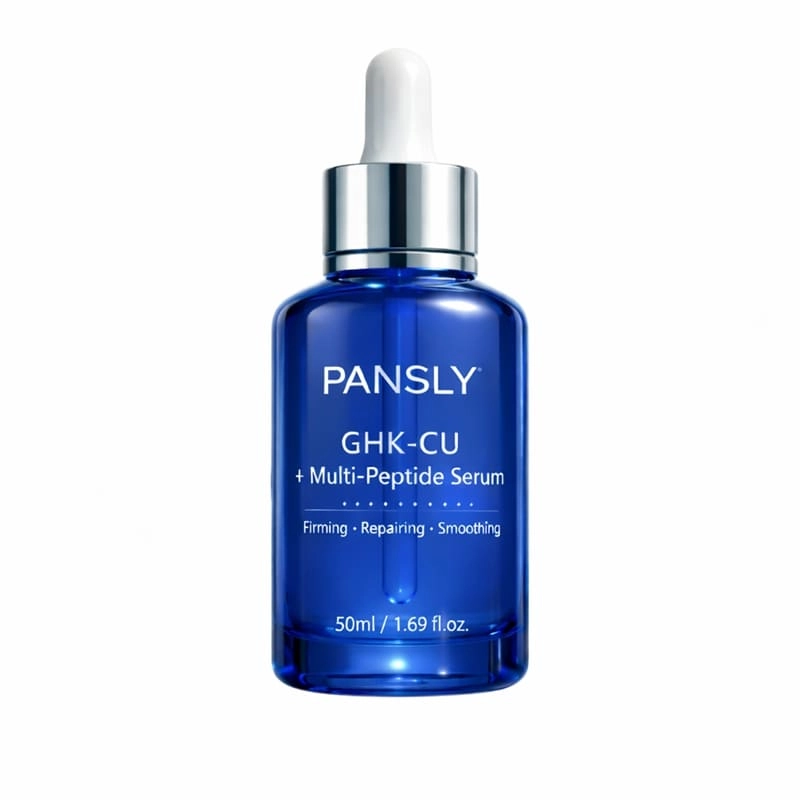
Experience visible rejuvenation with this GHK-Cu Copper Peptide Smoothing & Firming Face Serum, a high-performance concentrate designed to restore the structural integrity of aging skin. This advanced formula centers on GHK-Cu, a powerful signaling peptide clinically recognized for its ability to support natural collagen and elastin production. By promoting dermal density, it effectively tightens sagging skin and smooths the appearance of deep-set wrinkles and fine lines.
The lightweight, silky texture absorbs instantly, delivering antioxidant protection to neutralize environmental stressors that accelerate aging. Enhanced with deep-moisturizing agents, the serum reinforces the skin's moisture barrier, leaving the complexion feeling remarkably soft and resilient. With consistent use, skin texture is refined and facial contours appear more lifted, resulting in a youthfully firm and revitalized glow.
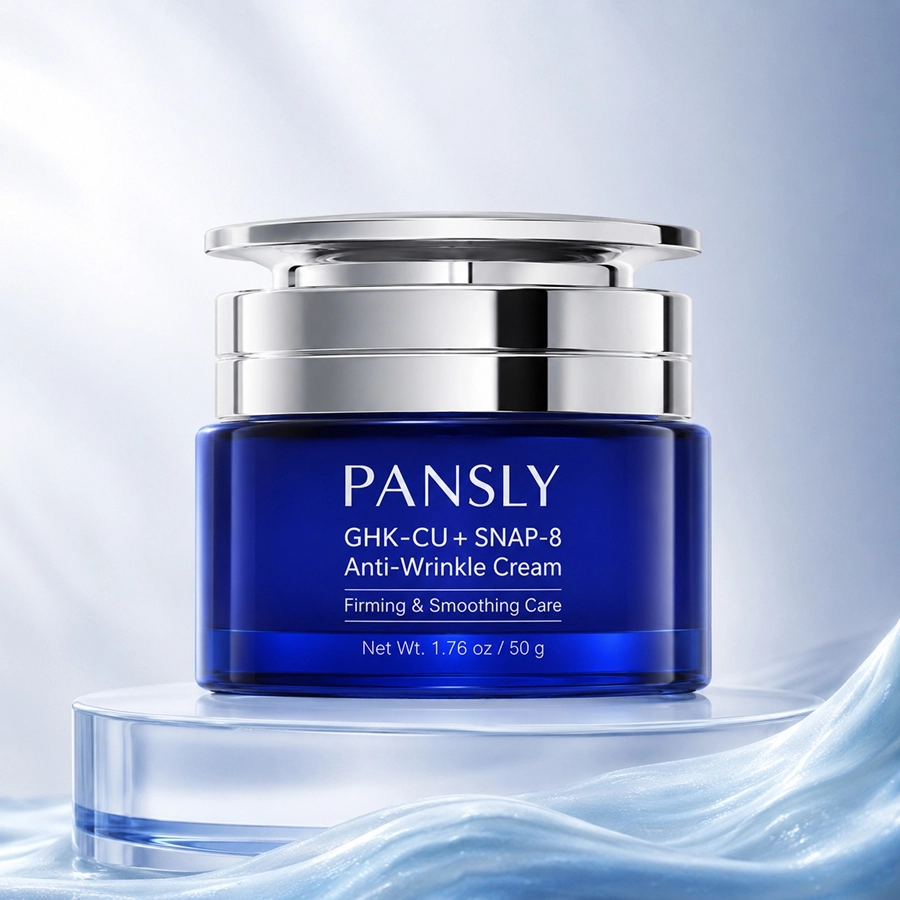
This Pansly GHK-CU + SNAP-8 Anti-Wrinkle Firming Cream is triple-peptide anti-aging facial cream, delivers targeted wrinkle smoothing, firming lifting and deep nourishment for dull, saggy, fine-line prone skin. Full OEM & ODM private label service is supported, including custom formula, packaging options, fast sampling and bulk export supply.
Five core premium active ingredients work synergistically for comprehensive anti-wrinkle care:
GHK-CU Copper Peptide lifts saggy skin, enhances skin resilience and tightens loose facial contour;
SNAP-8 Peptide targets expression lines to visibly soften and fade wrinkles;
Acetyl Hexapeptide-8 reduces the appearance of dry fine lines for smoother skin texture;
Ceramide NP reconstructs skin moisture barrier to lock nourishment and boost comfort;
Hyaluronic Acid delivers multi-layer rich deep moisture to relieve dry rough skin.
Luxury rich creamy texture spreads smoothly and melts into skin gently, leaving soft comfortable finish without heavy greasiness. Daily use blurs fine lines, firms loose skin, deeply nourishes and stabilizes barrier, refining uneven texture to reveal smooth, plump, youthful luminous skin.
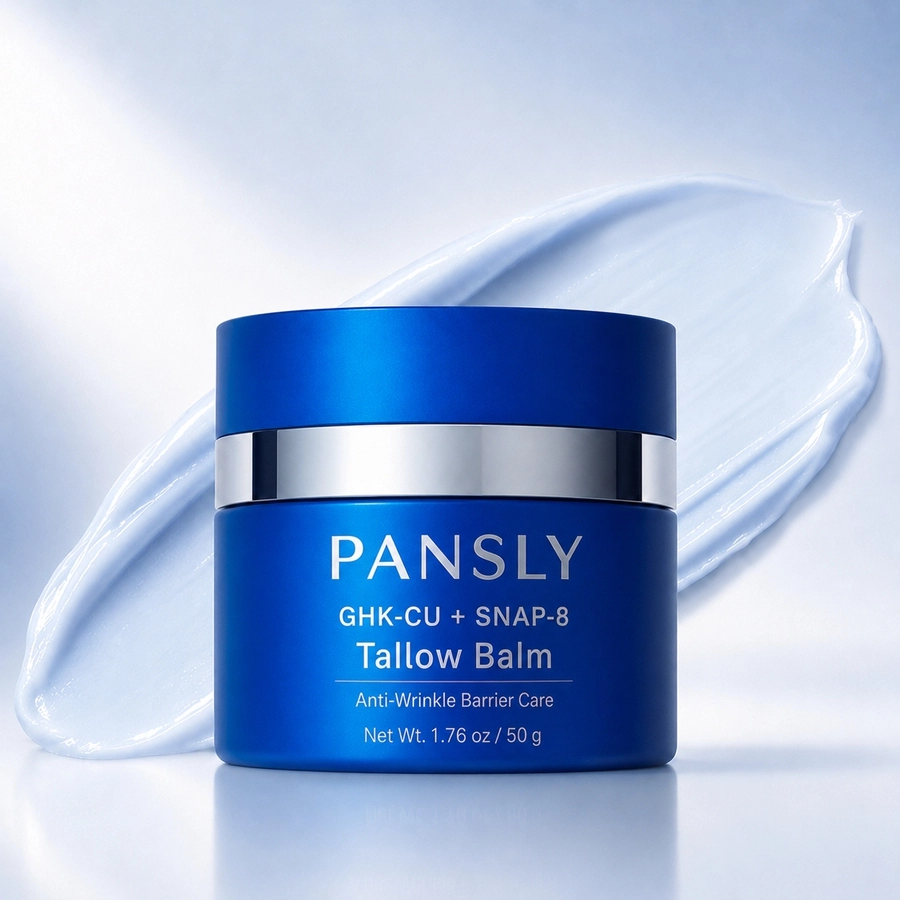
This Pansly GHK-CU + SNAP-8 Tallow Balm is a nourishing anti-wrinkle facial balm specially formulated for dry, fragile and sensitive skin, combining anti-aging wrinkle smoothing and barrier repairing effects. We offer full private label OEM service, including custom logo, adjustable formula, diversified packaging and lid color options.
It contains five core skin care active ingredients: GHK-CU visibly improves fine lines and revives dull complexion; SNAP-8 softens expression lines to smooth wrinkled skin texture; Grass-Fed Beef Tallow delivers deep lipid nourishment to relieve dry rough skin; Ectoin stabilizes the skin barrier and alleviates skin discomfort; Ceramide NP strengthens barrier structure to create smooth, healthy skin.
Luxury creamy blue balm texture glides smoothly and melts quickly on skin, providing long-lasting deep moisturizing comfort. Daily use fades fine lines & expression lines, nourishes dry delicate skin, repairs damaged barrier and leaves silky smooth skin finish.
Click here to customize the Beauty
we respond within a few hours
Monday–Friday, 9AM–6PM
3A01, Building A, Zhisheng Square, No. 4 Zhifu Road, Helong Street, Baiyun District, Guangzhou, China.


Leave a request, and we'll email you back within 24 hours.
© 2026 Beyond Basix. All Rights Reserved.
