Kids Bubble Bath Bombs OEM vs ODM: Which Model Fits Your Brand?

- Choosing the Right Private-Label Bath Fizzer Development Model
- What OEM means for children’s bath products
- What ODM means for children’s bath products
- OEM versus ODM at a glance
- Safety, Compliance, and Commercial Requirements
- Child-focused formulation requires a stricter risk review
- Documentation should be agreed before purchase orders
- Packaging and claims influence product risk
- How Buyers Should Compare Suppliers and Total Project Cost
- Evaluate technical capability rather than catalog breadth
- Calculate the complete cost of ownership
- Use a gated approval process
- Why Beyond Basix Can Support a Broader Care Portfolio
- Integrated manufacturing for coordinated product development
- Technical depth across skincare and personal care
- Quality systems and partnership-oriented execution
- Frequently Asked Questions
For brands developing kids bubble bath bombs, the choice between OEM and ODM determines who owns the formula, how much customization is available, how quickly the product can reach market, and which party carries development responsibility. OEM is generally suitable when a brand has a defined formulation, fragrance direction, packaging system, or proprietary concept; ODM is often more efficient when the buyer needs a tested product platform that can be customized with selected colors, scents, shapes, ingredients, and artwork. The correct model depends on target-market regulations, safety expectations, forecast volume, budget, intellectual-property requirements, and the supplier’s ability to manage formulation, testing, production, packaging, and documentation as one coordinated program.
Choosing the Right Private-Label Bath Fizzer Development Model
What OEM means for children’s bath products
OEM, or original equipment manufacturing, normally begins with a buyer-owned specification. The brand may provide a formula, prototype, laboratory sample, packaging design, ingredient list, fragrance brief, or product standard that the manufacturer converts into a stable and scalable commercial batch. The supplier’s responsibilities can include raw-material sourcing, process engineering, filling, molding, wrapping, carton assembly, inspection, and shipment preparation.
This model gives project owners stronger control over differentiation. A brand can specify a particular effervescent profile, foam level, dissolution time, skin-feel objective, scent family, visual effect, or ingredient story. It is especially appropriate for companies with an established R&D department, an existing hero product, or a clear intellectual-property strategy. However, the buyer must be prepared to provide complete technical documentation and participate in formula troubleshooting. A laboratory prototype may behave differently when exposed to industrial humidity, compression forces, high-speed packing, or extended storage.
What ODM means for children’s bath products
ODM, or original design manufacturing, uses the manufacturer’s existing product architecture, technical know-how, and development resources as the starting point. The buyer selects a base concept and customizes commercial elements such as fragrance, color, shape, packaging format, claims, and market positioning. The manufacturer typically manages more of the formulation adaptation, pilot production, stability review, and production transfer.
ODM can reduce development complexity for distributors, retailers, emerging brands, and investors testing a new category. It may also make smaller launches more practical because the supplier has already solved many basic processing challenges. The trade-off is that the same or similar base technology may be available to multiple customers unless exclusivity is negotiated contractually. Buyers should therefore clarify formula ownership, territorial rights, channel protection, artwork ownership, and whether the supplier can sell comparable products to competitors.
OEM versus ODM at a glance
| Decision factor | OEM model | ODM model | Procurement implication |
|---|---|---|---|
| Starting point | Buyer specification or proprietary formula | Supplier platform or existing concept | OEM requires a more complete technical brief |
| Customization | Usually highest | Usually moderate to high within platform limits | Confirm which elements are genuinely exclusive |
| Development responsibility | Shared, with greater buyer input | Supplier-led with buyer approval | Define approval gates and change-control rules |
| Launch speed | Often slower because of new development | Often faster when a suitable base exists | Validate testing and artwork lead times before committing |
| Initial investment | Potentially higher for formulation and tooling | Potentially lower for concept development | Compare total landed cost, not only unit price |
| Brand differentiation | Strong potential for proprietary positioning | Fast market entry with selected differentiation | Use packaging, claims, sensory design, and channel strategy carefully |
Safety, Compliance, and Commercial Requirements
Child-focused formulation requires a stricter risk review
A bath product intended for children must be evaluated for more than visual appeal. The project brief should address accidental ingestion risk, eye contact, fragrance sensitivity, colorant suitability, allergen disclosure, residue, water quality interaction, and appropriate use instructions. A fizzing product also requires control of moisture exposure because premature activation can affect weight, texture, performance, and microbial risk.
Regulatory classification varies by market and by product claims. A cosmetic claim such as cleansing, fragrancing, or skin conditioning may be treated differently from a therapeutic claim related to eczema, infection, pain, or disease. Buyers should review the relevant authority before approving artwork or advertising. The U.S. Food and Drug Administration cosmetics guidance provides an important reference for businesses selling personal-care products in the United States, while the European Union Cosmetics Regulation sets requirements for products placed on the EU market.
Documentation should be agreed before purchase orders
A reliable supplier should be able to explain which documents are available for the formula, raw materials, packaging, finished goods, and manufacturing site. Depending on the destination market, buyers may need an ingredient declaration using the required nomenclature, safety data documentation, certificate of analysis, microbiological results, stability information, batch records, allergen information, product safety assessment, and supporting evidence for marketing claims.
Quality-system expectations should also be defined. ISO 9001 describes a quality management system framework, while cosmetic good manufacturing practice is commonly associated with ISO 22716. These references do not replace destination-market legal review, but they help buyers assess whether a supplier operates with controlled procedures, traceability, documented corrective action, and consistent release standards.
Packaging and claims influence product risk
Packaging for a children’s bath item must balance shelf impact with practical protection. Individual wrapping, moisture barriers, tamper evidence, carton strength, storage conditions, and transport exposure can all affect product performance. Bright colors, cartoon characters, collectible shapes, and surprise effects may improve engagement, but they should not encourage unsafe handling or imply that the product is edible.
Claims such as natural, hypoallergenic, tear-free, dermatologically tested, sensitive-skin friendly, or free from specific ingredients require substantiation and careful wording. Buyers should request a claim-support matrix before finalizing the label. The U.S. Consumer Product Safety Commission business guidance is a useful reference when product presentation, packaging, or accessories may create consumer-product safety considerations.
How Buyers Should Compare Suppliers and Total Project Cost
Evaluate technical capability rather than catalog breadth
A supplier may display dozens of colorful bath shapes but still lack the engineering capability required for a stable commercial program. During qualification, buyers should ask about moisture control, powder blending, compression or molding parameters, fragrance loading, drying conditions, in-process weight checks, packaging-room controls, and finished-product sampling. The supplier should explain how a laboratory sample becomes a repeatable production specification.
For an OEM project, confirm whether the factory can work with buyer-supplied raw materials, confidential formulas, restricted fragrance houses, or custom molds. For an ODM project, ask how much of the base formula can be changed without restarting stability or safety work. These questions reveal whether the supplier offers genuine development support or simply resells standard stock.
Calculate the complete cost of ownership
Unit quotation is only one part of the commercial decision. The budget may include formula development, sample rounds, mold charges, testing, regulatory review, packaging plates, printed components, assembly, warehousing, quality inspections, freight, tariffs, rejected goods, and inventory carrying costs. A lower unit price can become expensive if high minimum order quantities leave the brand with slow-moving stock.
Buyers should request a stage-based quotation that separates one-time charges from recurring costs. The commercial proposal should also state minimum order quantities by SKU, lead time for repeat orders, payment terms, acceptable tolerance, defect handling, forecast requirements, and the process for approving substitutions. This structure improves cash-flow planning and prevents disagreements after production begins.
Use a gated approval process
A disciplined launch normally moves through concept approval, formula or base selection, laboratory sampling, packaging compatibility review, safety and stability testing, pilot production, artwork approval, pre-production inspection, mass production, final release, and shipment. Each gate should have a named decision-maker and written acceptance criteria.
For seasonal products, procurement teams should build additional time for fragrance sourcing, custom tooling, regulatory review, and ocean or air freight. For retail programs, the supplier should be able to support barcode, carton marking, pallet configuration, and retailer-specific compliance requirements. Clear gates reduce the risk of approving a visually attractive sample that cannot be manufactured consistently.
Why Beyond Basix Can Support a Broader Care Portfolio
Integrated manufacturing for coordinated product development
Beyond Basix brings more than 23 years of experience in cosmetics research, production, and sales through Guangzhou Beyond Basix Cosmetics Ltd. Our 12,000-square-meter facility includes a 100,000-level GMPC pharmaceutical-grade dust-free workshop and 12 production lines. Production equipment imported from Germany, the United States, and other regions supports controlled manufacturing across multiple personal-care formats.
For buyers comparing an OEM or ODM route, this integrated structure can simplify communication between product development, sourcing, quality control, packaging, and production planning. A children’s bath program can be managed as part of a wider body-care portfolio rather than as an isolated seasonal SKU. Our manufacturing process is designed to support project requirements from concept discussion through sample evaluation, production, and delivery coordination.
Technical depth across skincare and personal care
Our team has focused on skincare development with effective ingredients for 12 years, while our broader portfolio includes Skincare Products, Hair Care Products, Eye Care Products, and Body Care Products. This category breadth is valuable for brands planning coordinated launches, gift sets, bath-and-body collections, hotel amenities, retail programs, or private-label personal-care lines.
Beyond Basix operates four brands—LANTHOME, PANSLY, FIRSTSUN, and SAUVASINE—which reflects continuing activity in the consumer-care sector. Buyers can use our capabilities to assess whether a project is better suited to a customized OEM specification or an ODM platform adapted to a defined market position. Our team can also help align texture, fragrance, packaging hierarchy, and product storytelling across multiple categories.
Quality systems and partnership-oriented execution
Beyond Basix holds certifications and documentation including ISO 9001, CE, MSDS, GMP, and HALAL, subject to the applicability of each document to the relevant product and market. These credentials should be reviewed against the buyer’s destination-country requirements and the exact finished goods being ordered. Our quality approach emphasizes controlled production, documentation, product consistency, and communication throughout the project lifecycle.
Whether the requirement is a distinctive molded bath product, a scalable body-care range, or a broader One-Stop OEM/ODM for Skincare program, our objective is to help partners balance speed, quality, compliance, and commercial viability. Buyers should provide a clear brief covering target users, market, claims, price positioning, forecast, packaging, and launch timing so that the appropriate development model can be recommended from the beginning.
Contact Beyond Basix to discuss a compliant OEM or ODM bath-and-body program and explore our Skincare Products, Hair Care Products, Eye Care Products, and Body Care Products for your next private-label launch.
Frequently Asked Questions
Is OEM or ODM better for a new children’s bath product brand?
ODM is often more practical for a new brand that needs a tested product platform, faster development, and lower initial complexity. OEM may be better when the brand already owns a formula, prototype, or highly specific product concept.
What documents should buyers request from a bath product manufacturer?
Depending on the destination market, buyers may need an ingredient declaration, safety data documentation, certificate of analysis, microbiological results, stability information, batch records, allergen information, product safety assessment, and evidence supporting marketing claims.
What should be checked before approving a children’s bath bomb formula?
The review should address accidental ingestion risk, eye contact, fragrance sensitivity, colorant suitability, allergen disclosure, residue, water interaction, moisture exposure, microbial risk, product performance, and appropriate use instructions.
How can buyers compare the real cost of OEM and ODM?
Buyers should compare development, sampling, testing, molds, packaging plates, assembly, minimum order quantities, warehousing, freight, tariffs, quality inspections, and inventory risk in addition to the quoted unit price.
Can a supplier customize an ODM bath product?
Yes, ODM programs commonly allow customization of fragrance, color, shape, packaging, claims, and positioning within the limits of the supplier’s product platform. Buyers should confirm which changes require additional testing or a new development cycle.
Why are moisture control and packaging important for effervescent bath products?
Moisture can trigger premature activation and change the product’s weight, texture, performance, and microbial risk. Individual wrapping, moisture barriers, storage controls, and suitable transport packaging help preserve product quality.

Elevate your professional skincare offerings with this Private Label Copper Peptide Anti-Wrinkle Firming Serum, a powerhouse concentrate designed for superior age-defying results. This sophisticated formula leverages the synergistic effects of GHK-Cu and SNAP-8 to address multiple layers of skin aging. The GHK-Cu copper peptides act as a vital signaling mechanism to enhance skin density and firmness, while the advanced SNAP-8 octapeptide specifically targets expression lines, helping to relax the appearance of deep-seated wrinkles for a smoother, more refined surface.
This lightweight, rapid-absorption serum provides a professional-grade solution for clients seeking a non-invasive lift. It effectively restores elasticity, improves skin texture, and provides essential antioxidant protection. Perfect for high-end beauty brands, this serum leaves the complexion looking visibly contoured, hydrated, and youthfully revitalized.
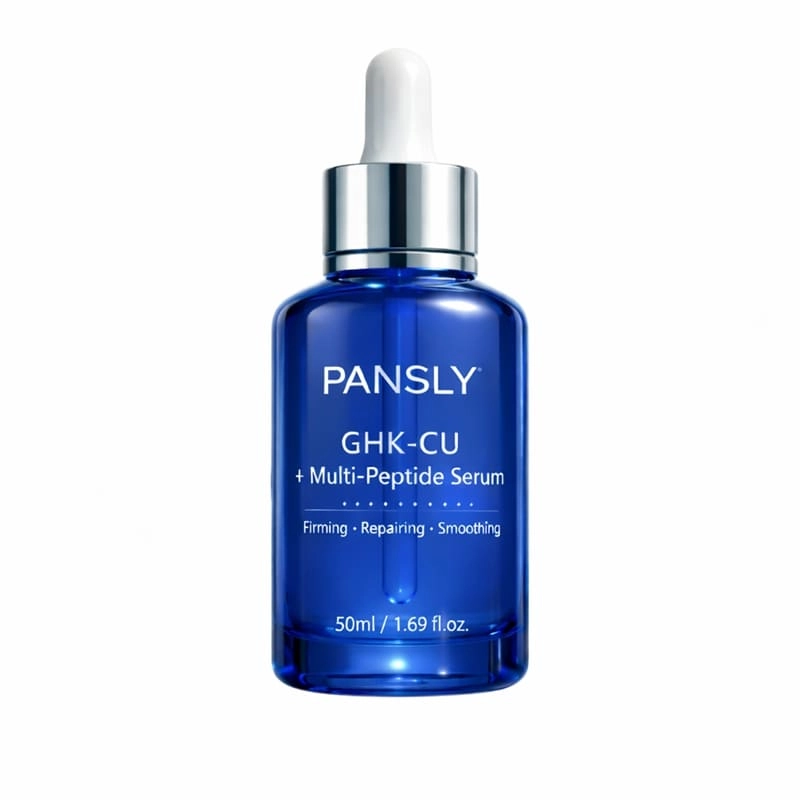
Experience visible rejuvenation with this GHK-Cu Copper Peptide Smoothing & Firming Face Serum, a high-performance concentrate designed to restore the structural integrity of aging skin. This advanced formula centers on GHK-Cu, a powerful signaling peptide clinically recognized for its ability to support natural collagen and elastin production. By promoting dermal density, it effectively tightens sagging skin and smooths the appearance of deep-set wrinkles and fine lines.
The lightweight, silky texture absorbs instantly, delivering antioxidant protection to neutralize environmental stressors that accelerate aging. Enhanced with deep-moisturizing agents, the serum reinforces the skin's moisture barrier, leaving the complexion feeling remarkably soft and resilient. With consistent use, skin texture is refined and facial contours appear more lifted, resulting in a youthfully firm and revitalized glow.
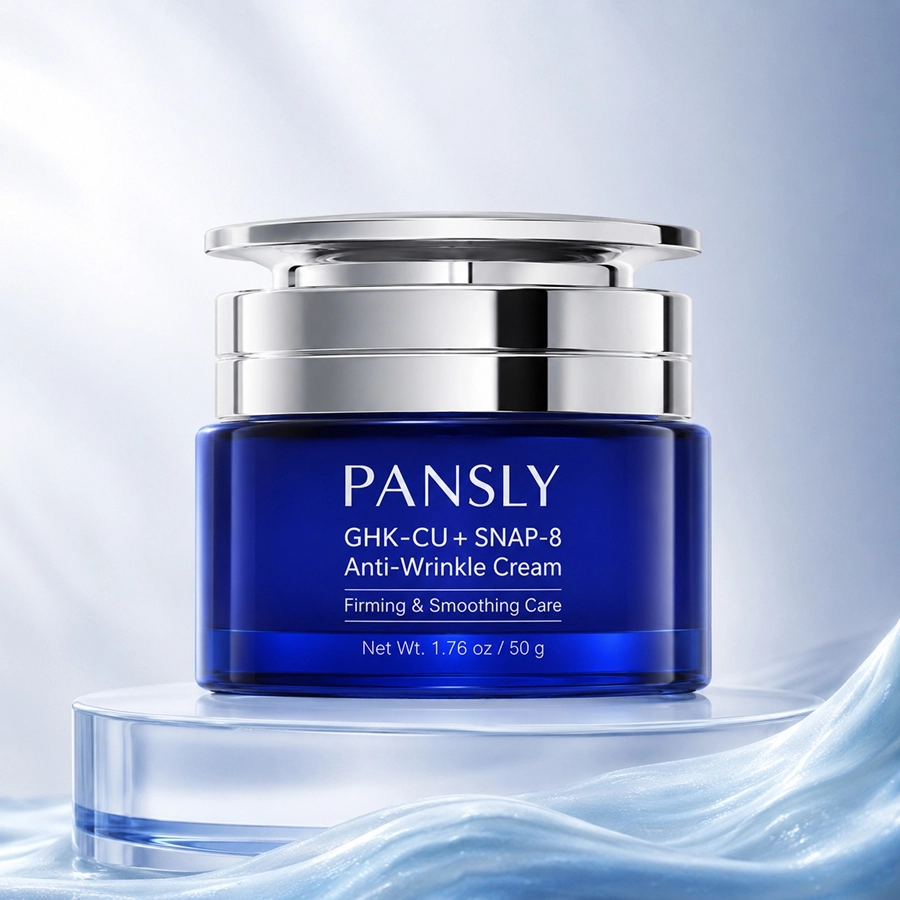
This Pansly GHK-CU + SNAP-8 Anti-Wrinkle Firming Cream is triple-peptide anti-aging facial cream, delivers targeted wrinkle smoothing, firming lifting and deep nourishment for dull, saggy, fine-line prone skin. Full OEM & ODM private label service is supported, including custom formula, packaging options, fast sampling and bulk export supply.
Five core premium active ingredients work synergistically for comprehensive anti-wrinkle care:
GHK-CU Copper Peptide lifts saggy skin, enhances skin resilience and tightens loose facial contour;
SNAP-8 Peptide targets expression lines to visibly soften and fade wrinkles;
Acetyl Hexapeptide-8 reduces the appearance of dry fine lines for smoother skin texture;
Ceramide NP reconstructs skin moisture barrier to lock nourishment and boost comfort;
Hyaluronic Acid delivers multi-layer rich deep moisture to relieve dry rough skin.
Luxury rich creamy texture spreads smoothly and melts into skin gently, leaving soft comfortable finish without heavy greasiness. Daily use blurs fine lines, firms loose skin, deeply nourishes and stabilizes barrier, refining uneven texture to reveal smooth, plump, youthful luminous skin.
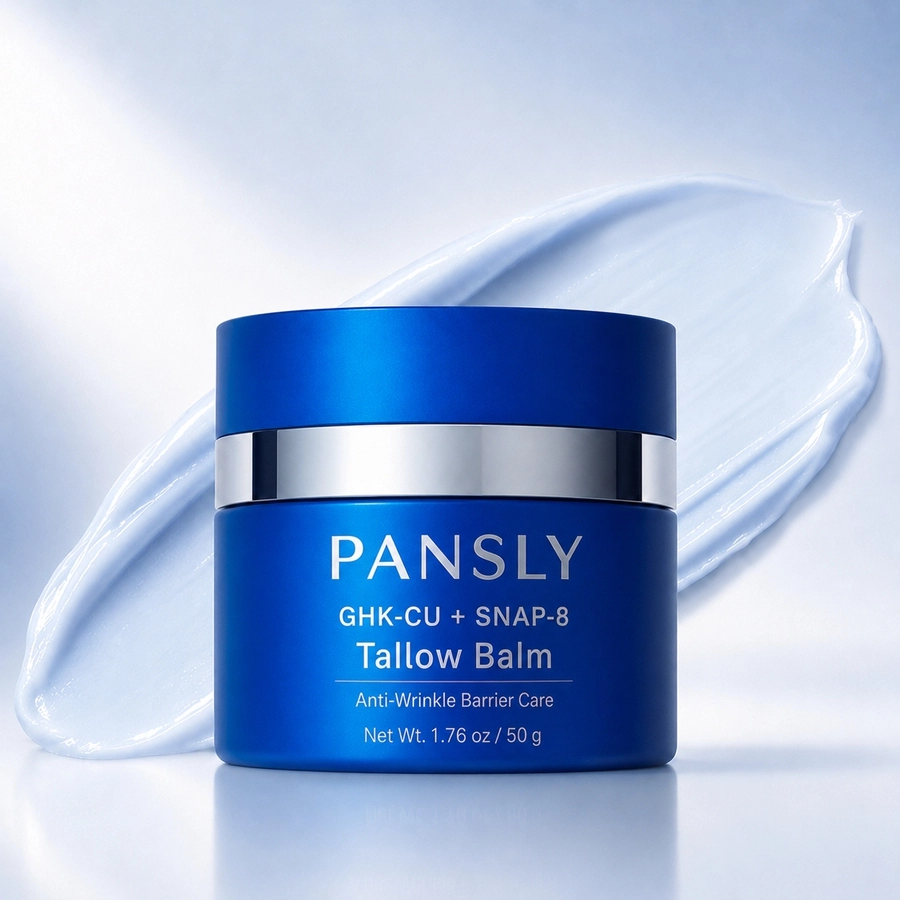
This Pansly GHK-CU + SNAP-8 Tallow Balm is a nourishing anti-wrinkle facial balm specially formulated for dry, fragile and sensitive skin, combining anti-aging wrinkle smoothing and barrier repairing effects. We offer full private label OEM service, including custom logo, adjustable formula, diversified packaging and lid color options.
It contains five core skin care active ingredients: GHK-CU visibly improves fine lines and revives dull complexion; SNAP-8 softens expression lines to smooth wrinkled skin texture; Grass-Fed Beef Tallow delivers deep lipid nourishment to relieve dry rough skin; Ectoin stabilizes the skin barrier and alleviates skin discomfort; Ceramide NP strengthens barrier structure to create smooth, healthy skin.
Luxury creamy blue balm texture glides smoothly and melts quickly on skin, providing long-lasting deep moisturizing comfort. Daily use fades fine lines & expression lines, nourishes dry delicate skin, repairs damaged barrier and leaves silky smooth skin finish.
Click here to customize the Beauty
we respond within a few hours
Monday–Friday, 9AM–6PM
3A01, Building A, Zhisheng Square, No. 4 Zhifu Road, Helong Street, Baiyun District, Guangzhou, China.


Leave a request, and we'll email you back within 24 hours.
© 2026 Beyond Basix. All Rights Reserved.