
The latest trends for anti wrinkle face serum | Beyond Basix Ultimate Insights
- Regional market context and macro drivers shaping supply
- Economic and demographic tailwinds
- Channel evolution: omnichannel and regulatory divergence
- Capital and procurement cycles for OEM/ODM partnerships
- Formulation and ingredient innovation
- From single actives to synergistic complexes
- Delivery systems and stability engineering
- Sustainable and regulatory-friendly actives
- Manufacturing, quality systems, and supply chain resilience
- Scale meets compliance
- Flexible packaging and personalization at scale
- Supply chain risk management
- Commercial strategies and buyer guidance for 2026 and beyond
- Claims architecture and evidence hierarchy
- Market positioning: micro-segmentation wins
- Pricing, margin, and speed-to-market trade-offs
- Strategic procurement checklist for B2B buyers
- Technical and regulatory due diligence
- Operational KPIs and pilot metrics
- Collaborative roadmap and IP protection
- FAQ
- What active ingredients are dominating anti wrinkle face serum formulations in 2026?
- How should B2B buyers evaluate an OEM/ODM for anti wrinkle face serum production?
- Are there packaging innovations that materially affect efficacy for anti wrinkle face serum?
- What regulatory pitfalls should brands watch when launching an anti wrinkle face serum internationally?
- How can brands prove efficacy for anti wrinkle face serum without full-scale clinical trials?
- What supply chain strategies mitigate scarcity of High Quality actives like peptides?
- FAQ Main Title
Anti wrinkle face serum demand is shifting from single-ingredient marketing to multi-modal, evidence-driven formulations that combine peptides, stabilized retinoids, hyaluronic acid scaffolds, and microbiome-friendly delivery systems; this report synthesizes macroeconomic drivers, ingredient science, manufacturing readiness, and buyer-facing go-to-market tactics to help OEM/ODM partners and B2B buyers de-risk sourcing, shorten time-to-market, and capture High Quality margins in regional and global channels.
Regional market context and macro drivers shaping supply
Economic and demographic tailwinds
Population ageing, rising middle-class spending in Asia-Pacific, and increased male grooming penetration are structural drivers expanding demand for anti wrinkle face serum portfolios. While consumers historically bought single-function wrinkle reduction products, the contemporary shopper seeks hybrid anti-aging serums that deliver visible wrinkle reduction, skin density improvement, and hydration—forcing brands to brief OEM/ODM partners for multi-benefit formulations that are scalable.
Channel evolution: omnichannel and regulatory divergence
Retail migration to DTC, social commerce, and clinic-dispensed cosmeceuticals means buyers require flexible packaging, serial-numbered traceability, and variable batch sizes from manufacturers. Regulatory divergence across markets (cosmetic vs. OTC/drug classification for active retinoids or peptides) increases compliance complexity for anti wrinkle face serum product lines and elevates the importance of GMP and ISO-aligned manufacturing protocols.
Capital and procurement cycles for OEM/ODM partnerships
Buyers now evaluate partners on capital intensity (automation, filling lines), quality certifications, and the ability to manage SKU proliferation. Guangzhou Beyond Basix Cosmetics Ltd., with a 12,000-square-meter facility, 100,000-level GMPC dust-free workshop, and 12 production lines, exemplifies the scale buyers need to deliver multiple anti wrinkle face serum SKUs across channels without compromising lead times or regulatory traceability.
Formulation and ingredient innovation
From single actives to synergistic complexes
The anti wrinkle face serum category has moved beyond solo actives like retinol toward layered actives: low-irritation retinoid derivatives combined with signal peptides, stabilized vitamin C derivatives, and multi-weight hyaluronic acids for both immediate plumping and long-term collagen stimulation. Buyers should brief formulators on evidence thresholds—clinical end-points such as wrinkle depth reduction, skin elasticity metrics, and TEWL improvement—rather than vague “anti-aging” claims.
Delivery systems and stability engineering
Encapsulation, liposomal carriers, and controlled-release microspheres are increasingly standard for High Quality anti wrinkle face serum products to improve skin penetration and reduce irritancy. This elevates manufacturing requirements: low-shear mixing, controlled-temperature emulsification, and clean-room encapsulation capabilities to ensure batch-to-batch uniformity and extended shelf stability without heavy use of preservatives.
Sustainable and regulatory-friendly actives
Green chemistry and traceable sourcing matter for brand shelf appeal: bio-identical peptides produced via fermentation, plant-derived squalane, and biodegradable delivery matrices are trending. For buyers, specifying certified raw-material pedigrees and supplier audit trails will reduce claim risk and facilitate cross-border registration.
Manufacturing, quality systems, and supply chain resilience
Scale meets compliance
To produce high-quality anti wrinkle face serum at scale, OEM/ODM facilities must demonstrate GMP-grade clean rooms, validated process controls, and third-party certifications. Certification alignment with ISO 9001 and pharmaceutical-grade practices reduces buyer regulatory friction and positions products for High Quality channels such as dermatology clinics and regulated marketplaces.
Flexible packaging and personalization at scale
Demand for airless pumps, dropper dosing, and recyclable barrier materials is growing. Buyers should prioritize partners offering modular packaging platforms that allow both clinical-style amber glass and lightweight recyclable options, minimizing tooling lead time while enabling batch personalization for influencer or clinic co-branded campaigns.
Supply chain risk management
Raw-material concentration—such as limited suppliers for specific peptides or stabilized vitamin C—creates single points of failure. A robust procurement strategy for anti wrinkle face serum should include dual-sourcing, safety-stock policies calibrated to SKU velocity, and supplier quality agreements that codify testing for identity, potency, and impurity profiles.
Commercial strategies and buyer guidance for 2026 and beyond
Claims architecture and evidence hierarchy
Regulatory bodies increasingly scrutinize anti-aging claims. Buyers should adopt a claims ladder: cosmetic (hydration, smoothing) → cosmeceutical (collagen-supporting) → drug/OTC (clinically validated retinoid indication) with corresponding substantiation levels. Investment in small-scale clinicals (instrumental proof such as PRIMOS or cutometer data) can unlock clinic channels and justify High Quality pricing.
Market positioning: micro-segmentation wins
Successful anti wrinkle face serum launches are narrow and deep: targeting menopausal skin, post-procedure recovery, or oxidative-stress urban skin. Customize textures and active concentration ranges for each segment, and use the OEM/ODM to produce pilot runs that validate conversion before scaling to full-channel distribution.
Pricing, margin, and speed-to-market trade-offs
Buyers must balance ingredient costs (peptides and stabilized retinoids command High Quality pricing) with launch velocity. Tiered formulations—core, performance, and clinical—allow brands to occupy multiple price points while leveraging shared supply lines and minimizing separate tooling or certification costs.
| Attribute | Historical (2015–2022) | Near-future (2026–2030) |
|---|---|---|
| Ingredient focus | Single actives (retinol, HA) | Multi-modal complexes (peptide-retinoid-HA matrices) |
| Delivery tech | Standard emulsions, low encapsulation | Advanced encapsulation, liposomes, microdelivery systems |
| Quality & compliance | Basic cosmetic GMP | Pharmaceutical-grade cleanliness, ISO/GMP harmonization |
| Packaging | Glass droppers, jars | Airless, recyclable barriers, serialized traceability |
| Go-to-market | Mass retail, department stores | DTC, clinics, subscription and personalization |
Strategic procurement checklist for B2B buyers
Technical and regulatory due diligence
Require certificates of analysis, stability studies, and manufacturing batch records for anti wrinkle face serum prototypes. Validate a partner’s ability to segregate actives that could trigger drug-classification in some markets, and confirm access to regulatory dossiers that support cross-border claims.
Operational KPIs and pilot metrics
Set clear KPIs for pilot runs: % active potency retention at month 3, microbial limits, fill-weight variance, and shelf-life testing. Use small-batch pilots to measure consumer acceptance for texture, fragrance, and efficacy before scaling volumes.
Collaborative roadmap and IP protection
Establish transparent product roadmaps with your OEM/ODM partner for compound upgrades and expiration windows for exclusive formulations. Protect unique combinations and process know-how through clear NDAs and IP clauses while enabling co-development that accelerates anti wrinkle face serum innovation.
FAQ
What active ingredients are dominating anti wrinkle face serum formulations in 2026?
Peptides paired with low-irritation retinoid derivatives, multi-weight hyaluronic acids, stabilized vitamin C derivatives, and barrier-supporting lipids are the dominant combination; formulators are combining signal peptides for collagen synthesis with humectants and barrier actives to deliver visible wrinkle reduction with reduced irritation.
How should B2B buyers evaluate an OEM/ODM for anti wrinkle face serum production?
Assess manufacturing certifications (GMP, ISO 9001), clean-room class levels, encapsulation and low-shear mixing capabilities, historical batch-release data, and the supplier’s ability to provide clinical or instrumental efficacy data—these factors reduce regulatory and market launch risk.
Are there packaging innovations that materially affect efficacy for anti wrinkle face serum?
Yes; airless pumps, opaque barrier systems, and single-dose ampoules preserve labile actives such as retinoids and vitamin C derivatives. Packaging that reduces oxygen and light exposure extends shelf life and helps maintain clinical claim substantiation.
What regulatory pitfalls should brands watch when launching an anti wrinkle face serum internationally?
Be cautious about ingredient classifications: retinoids and strong peptides may be considered drug actives in some jurisdictions. Ensure ingredient concentration thresholds, labeling, and claims align with local cosmetic or medicinal regulations and that dossiers are prepared for cross-border compliance.
How can brands prove efficacy for anti wrinkle face serum without full-scale clinical trials?
Instrumental testing (profilometry, cutometer, corneometer) on smaller cohorts, validated stability studies, in vitro biomarker data, and consumer use studies with photographic evidence can build a credible evidence package that supports hierarchy-appropriate claims while managing cost.
What supply chain strategies mitigate scarcity of High Quality actives like peptides?
Dual-sourcing, long-term supplier agreements, inventory buffer strategies, and exploring bio-fermentation alternatives for peptide production reduce single-supplier risk; contractual penalties and shared forecasting also improve supplier responsiveness for anti wrinkle face serum production.
Contact Beyond Basix to design and scale clinically credible, regulation-ready anti wrinkle face serum formulations with proven manufacturing and certification capacity.
References: Skin care overview - Wikipedia, U.S. FDA - Cosmetics, ISO 22716 - Cosmetics GMP
FAQ Main Title
What active ingredients are dominating anti wrinkle face serum formulations in 2026?
Peptides paired with low-irritation retinoid derivatives, multi-weight hyaluronic acids, stabilized vitamin C derivatives, and barrier-supporting lipids are the dominant combination; formulators are combining signal peptides for collagen synthesis with humectants and barrier actives to deliver visible wrinkle reduction with reduced irritation.
How should B2B buyers evaluate an OEM/ODM for anti wrinkle face serum production?
Assess manufacturing certifications (GMP, ISO 9001), clean-room class levels, encapsulation and low-shear mixing capabilities, historical batch-release data, and the supplier’s ability to provide clinical or instrumental efficacy data—these factors reduce regulatory and market launch risk.
Are there packaging innovations that materially affect efficacy for anti wrinkle face serum?
Yes; airless pumps, opaque barrier systems, and single-dose ampoules preserve labile actives such as retinoids and vitamin C derivatives. Packaging that reduces oxygen and light exposure extends shelf life and helps maintain clinical claim substantiation.
What regulatory pitfalls should brands watch when launching an anti wrinkle face serum internationally?
Be cautious about ingredient classifications: retinoids and strong peptides may be considered drug actives in some jurisdictions. Ensure ingredient concentration thresholds, labeling, and claims align with local cosmetic or medicinal regulations and that dossiers are prepared for cross-border compliance.
How can brands prove efficacy for anti wrinkle face serum without full-scale clinical trials?
Instrumental testing (profilometry, cutometer, corneometer) on smaller cohorts, validated stability studies, in vitro biomarker data, and consumer use studies with photographic evidence can build a credible evidence package that supports hierarchy-appropriate claims while managing cost.
What supply chain strategies mitigate scarcity of premium actives like peptides?
Dual-sourcing, long-term supplier agreements, inventory buffer strategies, and exploring bio-fermentation alternatives for peptide production reduce single-supplier risk; contractual penalties and shared forecasting also improve supplier responsiveness for anti wrinkle face serum production.

Elevate your professional skincare offerings with this Private Label Copper Peptide Anti-Wrinkle Firming Serum, a powerhouse concentrate designed for superior age-defying results. This sophisticated formula leverages the synergistic effects of GHK-Cu and SNAP-8 to address multiple layers of skin aging. The GHK-Cu copper peptides act as a vital signaling mechanism to enhance skin density and firmness, while the advanced SNAP-8 octapeptide specifically targets expression lines, helping to relax the appearance of deep-seated wrinkles for a smoother, more refined surface.
This lightweight, rapid-absorption serum provides a professional-grade solution for clients seeking a non-invasive lift. It effectively restores elasticity, improves skin texture, and provides essential antioxidant protection. Perfect for high-end beauty brands, this serum leaves the complexion looking visibly contoured, hydrated, and youthfully revitalized.
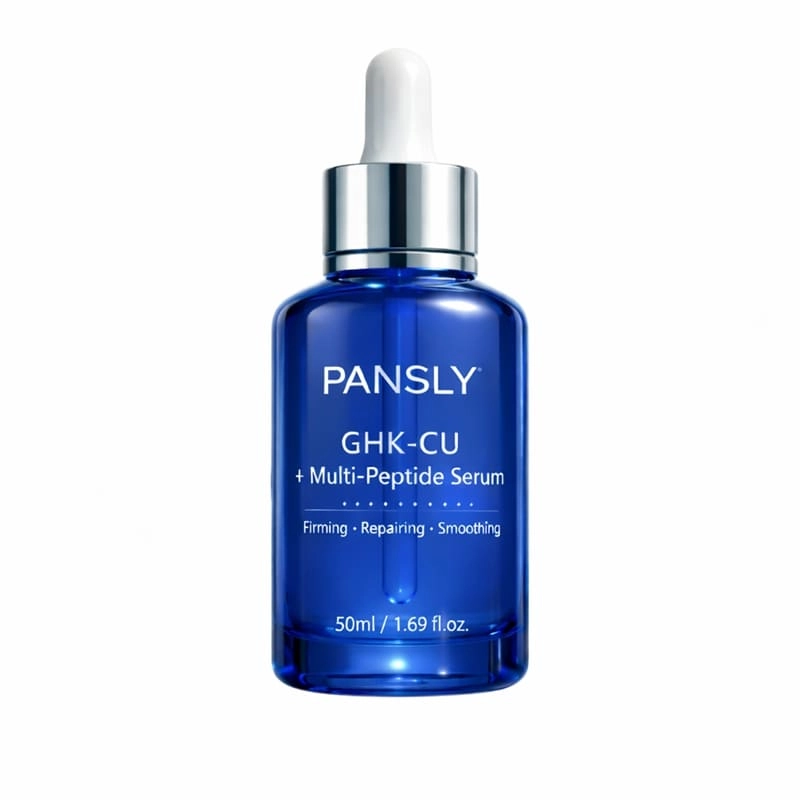
Experience visible rejuvenation with this GHK-Cu Copper Peptide Smoothing & Firming Face Serum, a high-performance concentrate designed to restore the structural integrity of aging skin. This advanced formula centers on GHK-Cu, a powerful signaling peptide clinically recognized for its ability to support natural collagen and elastin production. By promoting dermal density, it effectively tightens sagging skin and smooths the appearance of deep-set wrinkles and fine lines.
The lightweight, silky texture absorbs instantly, delivering antioxidant protection to neutralize environmental stressors that accelerate aging. Enhanced with deep-moisturizing agents, the serum reinforces the skin's moisture barrier, leaving the complexion feeling remarkably soft and resilient. With consistent use, skin texture is refined and facial contours appear more lifted, resulting in a youthfully firm and revitalized glow.
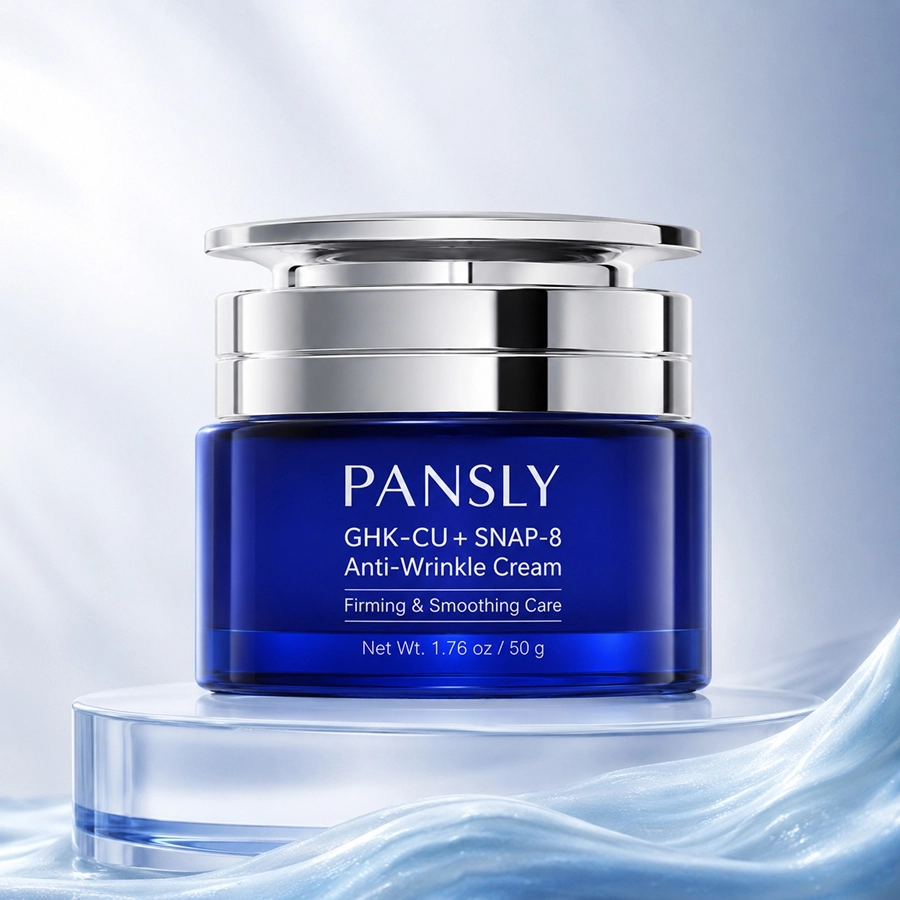
This Pansly GHK-CU + SNAP-8 Anti-Wrinkle Firming Cream is triple-peptide anti-aging facial cream, delivers targeted wrinkle smoothing, firming lifting and deep nourishment for dull, saggy, fine-line prone skin. Full OEM & ODM private label service is supported, including custom formula, packaging options, fast sampling and bulk export supply.
Five core premium active ingredients work synergistically for comprehensive anti-wrinkle care:
GHK-CU Copper Peptide lifts saggy skin, enhances skin resilience and tightens loose facial contour;
SNAP-8 Peptide targets expression lines to visibly soften and fade wrinkles;
Acetyl Hexapeptide-8 reduces the appearance of dry fine lines for smoother skin texture;
Ceramide NP reconstructs skin moisture barrier to lock nourishment and boost comfort;
Hyaluronic Acid delivers multi-layer rich deep moisture to relieve dry rough skin.
Luxury rich creamy texture spreads smoothly and melts into skin gently, leaving soft comfortable finish without heavy greasiness. Daily use blurs fine lines, firms loose skin, deeply nourishes and stabilizes barrier, refining uneven texture to reveal smooth, plump, youthful luminous skin.
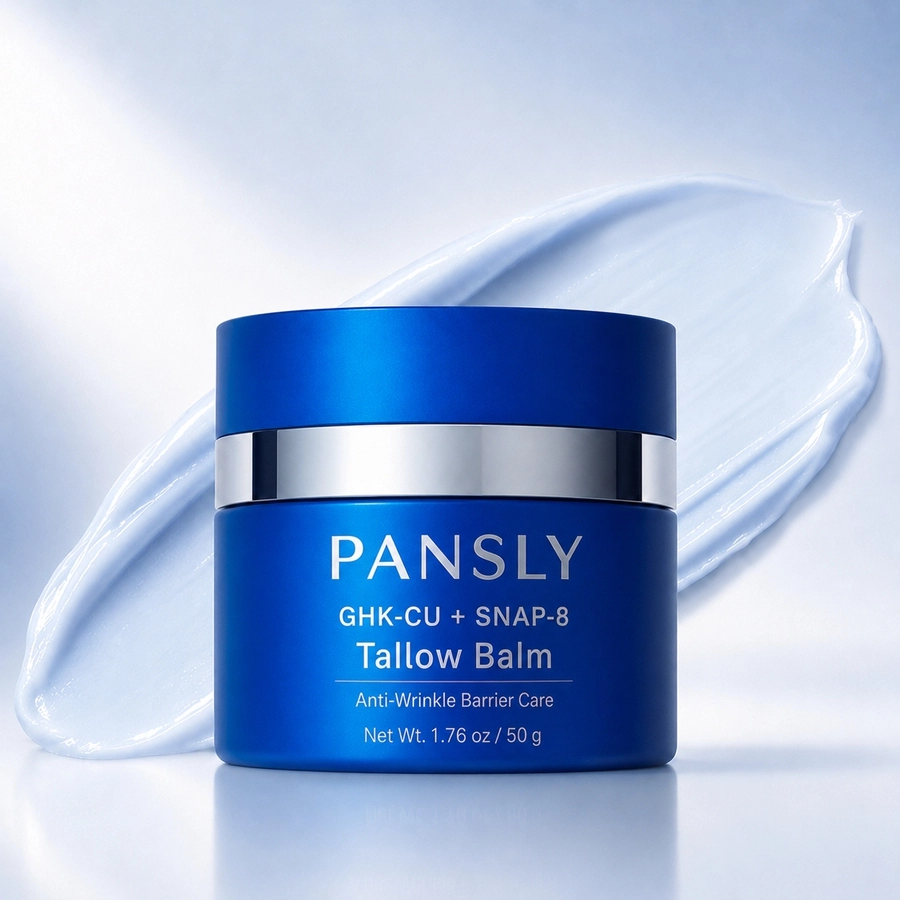
This Pansly GHK-CU + SNAP-8 Tallow Balm is a nourishing anti-wrinkle facial balm specially formulated for dry, fragile and sensitive skin, combining anti-aging wrinkle smoothing and barrier repairing effects. We offer full private label OEM service, including custom logo, adjustable formula, diversified packaging and lid color options.
It contains five core skin care active ingredients: GHK-CU visibly improves fine lines and revives dull complexion; SNAP-8 softens expression lines to smooth wrinkled skin texture; Grass-Fed Beef Tallow delivers deep lipid nourishment to relieve dry rough skin; Ectoin stabilizes the skin barrier and alleviates skin discomfort; Ceramide NP strengthens barrier structure to create smooth, healthy skin.
Luxury creamy blue balm texture glides smoothly and melts quickly on skin, providing long-lasting deep moisturizing comfort. Daily use fades fine lines & expression lines, nourishes dry delicate skin, repairs damaged barrier and leaves silky smooth skin finish.
Click here to customize the Beauty
we respond within a few hours
Monday–Friday, 9AM–6PM
3A01, Building A, Zhisheng Square, No. 4 Zhifu Road, Helong Street, Baiyun District, Guangzhou, China.


Leave a request, and we'll email you back within 24 hours.
© 2026 Beyond Basix. All Rights Reserved.
