MOQ, Pricing & Lead Time Benchmarks for Bulk Anti-Wrinkle Eye Cream
- Periocular Product Sourcing Benchmarks and Buyer Criteria
- Minimum order quantity tiers and commercial thresholds
- How procurement teams evaluate unit-cost drivers
- Typical production lead-time milestones and planning windows
- Pricing Architecture, Packaging Impact & Contract Models
- Ingredient and manufacturing cost breakdown
- Packaging selection: durability, aesthetics and cost trade-offs
- Commercial terms: FOB vs. DDP and volume discounts
- Quality Assurance, Regulatory Compliance & Risk Mitigation
- Essential certificates and third-party standards
- Stability testing, microbial limits and shelf-life validation
- Inspection regimes and shipment validation
- How One-Stop OEM/ODM Partnerships Reduce Time-to-Market
- Integrated services and formulation acceleration
- Cost containment through vertical integration
- Case for partnering with an experienced contract manufacturer
- Why Beyond Basix Strengthens Your Periocular Product Strategy
- Manufacturing scale and pharmaceutical-grade facilities
- Formulation expertise and brand acceleration
- Certifications, compliance and global market access
- Product breadth: Skincare, Hair Care, Eye Care and Body Care
- Frequently Asked Questions
- What is a realistic MOQ for a private-label periocular repair formula?
- How can buyers lower the required minimum order quantity?
- What are the main factors that move a unit into the High Quality pricing band?
- How long does full regulatory-ready production usually take for a custom formulation?
- Which certifications should brand owners insist upon when selecting an OEM/ODM?
- Are consumer samples and stability data included in standard quotes?
- What payment terms and incoterms are industry-standard?
Quick procurement summary: This guide delivers actionable MOQ tiers, verified pricing bands, and standard production timelines for bulk periocular rejuvenation formulations (commonly marketed as anti-wrinkle eye cream), plus a compliance checklist and supplier-selection matrix tailored for brand owners, distributors, and private-label operators seeking one-stop OEM/ODM partners with pharmaceutical-level manufacturing controls.
Periocular Product Sourcing Benchmarks and Buyer Criteria
Minimum order quantity tiers and commercial thresholds
Most manufacturers segment purchase minimums by formula complexity and packaging. Off-the-shelf hydrating under-eye lotions with standard preservatives usually start at lower volume thresholds (commonly 500–2,000 units). Semi-custom actives (peptides, stabilized vitamin A derivatives) typically move to medium MOQs of 2,000–5,000 units. Fully bespoke serums, licensed ingredient blends, or specialized airless dispensers commonly require 5,000 units or more due to tooling and validation costs. Buyers should map product tier to channel margin expectations—High Quality retail lists require higher per-unit margins which justify larger runs and longer amortization of tooling.
How procurement teams evaluate unit-cost drivers
Key cost levers include active ingredient concentration and sourcing (e.g., palmitoyl pentapeptide vs. novel peptides), packaging type (jar vs. airless pump), regulatory scope (global vs. single-market registration), and post-fill testing. Simple polyethylene jars and bulk glycerin-heavy formulations drive raw-material costs down, while stabilized peptide blends, microencapsulated retinol alternatives, or preservative-free systems increase COGS dramatically. Buyers should request an ingredient-level costing sheet and factor in fill-finish losses, secondary packaging, and duty/tariff scenarios.
Typical production lead-time milestones and planning windows
Lead times follow three phases: development, validation, and production. Stock formula orders: 15–30 calendar days from purchase order to shipment. Custom formulation and claim development: 45–90 days including lab trials and small-batch samples. Full launch with stability testing and regulatory dossiers: 90–180+ days depending on testing scope and certification needs. Contingencies such as raw-material backorders, seasonal demand peaks, and third-party testing capacity should be incorporated into procurement calendars to avoid stockouts.
Pricing Architecture, Packaging Impact & Contract Models
Ingredient and manufacturing cost breakdown
Unit price is a composite of raw materials (active molecules, emulsifiers), packaging components (cap, pump, glass vs. PET), labor and machine run time, QA/QC, and overhead. For example, a 15ml periorbital repairing formulation with mid-range actives and a standard jar often falls in a mid-tier price band, while the same formula in an ultra-low-dispense airless pump with metalized finishing will move to High Quality pricing. Buyers should request BOM (bill of materials) transparency to identify high-impact cost contributors and negotiate substitute components that preserve performance while lowering unit cost.
Packaging selection: durability, aesthetics and cost trade-offs
Packaging choices influence both consumer perception and supply-chain complexity. Jars are low-cost but present oxidative/stability challenges for actives; tubes and airless dispensers protect integrity and justify higher retail price points. Secondary packaging—printed cartons, tamper seals, and labeling—adds both cost and lead time. Confirm supplier capabilities for in-line labeling, shrink-wrapping, and serialization if market regulations require batch traceability.
Commercial terms: FOB vs. DDP and volume discounts
Pricing models frequently presented: EXW (Ex-Works), FOB (Free On Board), CIF, and DDP (Delivered Duty Paid). Each term shifts responsibility for freight, customs, and insurance. Volume discounts often follow graduated bands—e.g., 1–2K, 2–5K, 5–10K—so structuring purchases across multiple SKUs or consolidating launches can secure more favorable per-unit pricing. Negotiate payment milestones aligned to sample approval, batch release, and shipment to mitigate supplier risk and align cashflow.
Quality Assurance, Regulatory Compliance & Risk Mitigation
Essential certificates and third-party standards
Reliable suppliers should provide ISO-based quality management evidence and manufacturing certifications. Refer to industry definitions and consult the U.S. Food and Drug Administration cosmetics guidance for labeling and safety obligations in the United States. For system-level quality management, ISO 9001 demonstrates process control—see ISO 9001 details. GMP-compliant workshops and material safety data sheets (MSDS) are minimum documentary prerequisites for export-grade skincare.
Stability testing, microbial limits and shelf-life validation
Periocular formulations demand accelerated and real-time stability testing to confirm preservative efficacy, viscosity stability, pH drift, and active potency. Typical protocol: 3-month accelerated profiles and 12–24 month real-time data to support shelf-life claims. Microbial limit tests, preservative challenge tests, and extractables/leachables for packaging must be executed and documented. Buyers should specify test acceptance criteria and confirm retest intervals as part of the contract.
Inspection regimes and shipment validation
Pre-shipment inspections (PSI), in-line process checks, and certificate-of-analysis (CoA) deliveries protect buyers. Consider third-party laboratory verification for first production lots. Include sampling rules for retained samples (e.g., two production batches held for two years) and define warranty/recall terms to transfer performance risk appropriately.
| Benchmark | Simplified Hydrating Formula | Peptide/Retinoid Enhanced Formula | High-Precision Airless/Filled High Quality |
|---|---|---|---|
| Typical MOQ (units) | 500–2,000 | 2,000–5,000 | 5,000+ |
| Indicative FOB Unit Price (per 15ml) | US$0.80–US$2.50 | US$2.50–US$7.50 | US$7.50–US$20.00+ |
| Lead Time (PO to shipment) | 15–30 days | 45–90 days | 90–180+ days |
| Key Cost Drivers | Basic actives, jar packaging | Specialist actives, stability work | Custom tooling, advanced dispensers |
How One-Stop OEM/ODM Partnerships Reduce Time-to-Market
Integrated services and formulation acceleration
A true one-stop partner bundles R&D, stability labs, filling lines, packaging sourcing, and regulatory support. This reduces handoff friction and compresses development cycles. Buyers benefit from consolidated vendor management, faster iteration on prototypes, and clearer traceability across the value chain, which is particularly valuable for periorbital products that demand higher scrutiny for safety and efficacy.
Cost containment through vertical integration
Vertically integrated manufacturers offer better negotiation power on raw materials and packaging, which directly reduces cost-per-unit at scale. Consolidated QC further reduces duplicate testing and speeds up batch release. For launch planning, align SKU architecture (e.g., limited SKU colorways, standardized pack sizes) to capture these economies.
Case for partnering with an experienced contract manufacturer
Buyers should prioritize suppliers with transparent testing records, documented batch traceability, and a portfolio of successful private-label launches. Supplier audits, sample-approval workflows, and a clear escalation path for nonconformances form the backbone of a reliable supply partnership and reduce commercial risk.
Why Beyond Basix Strengthens Your Periocular Product Strategy
Manufacturing scale and pharmaceutical-grade facilities
Our manufacturing capability at Guangzhou Beyond Basix Cosmetics Ltd. provides procurement teams a secure supply base. We operate a 12,000-square-meter facility with a 100,000-level GMPC pharmaceutical-grade dust-free workshop and 12 production lines, supported by advanced machinery imported from Germany and the United States. This setup reduces contamination risk, shortens lead times for validated fills, and supports both small-batch launches and high-volume retail programs.
Formulation expertise and brand acceleration
Our team has focused on developing clinically effective skincare actives for 12 years, enabling faster prototype cycles and more predictable stability outcomes. We operate four principal brands—LANTHOME, PANSLY, FIRSTSUN, and SAUVASINE—and leverage cross-brand learnings to optimize actives, delivery systems, and consumer-facing claims without exposing proprietary blends.
Certifications, compliance and global market access
Beyond Basix is certified with ISO 9001, CE, MSDS, GMP, and HALAL among other credentials, which supports smoother market entry for global distributors. Buyers benefit from documented quality systems and the ability to meet retailer and regulatory demands in major export markets. For regulatory guidance, refer to standard-setting authorities such as the FDA and manufacturing frameworks exemplified by ISO 9001.
Product breadth: Skincare, Hair Care, Eye Care and Body Care
Our product portfolio spans Skincare Products, Hair Care Products, Eye Care Products, and Body Care Products, enabling brand owners to consolidate suppliers across categories and streamline procurement. This cross-category capability reduces vendor count and yields better pricing leverage on packaging and ingredient purchases.
Frequently Asked Questions
What is a realistic MOQ for a private-label periocular repair formula?
Realistic minimums depend on formula and packaging: stock hydrating variants often start at 500–2,000 units; custom active blends and specialized dispensers normally require 2,000–5,000 units or more due to tooling and validation.
How can buyers lower the required minimum order quantity?
Strategies include selecting stock formulations, simplifying packaging, grouping multiple SKUs into larger consolidated orders, or agreeing to higher per-unit pricing for smaller initial runs to offset supplier setup costs.
What are the main factors that move a unit into the High Quality pricing band?
High Quality costs arise from high-cost actives (peptides, biosynthetic molecules), advanced protective packaging (airless pumps, amber glass), additional clinical testing, and bespoke secondary packaging or serialization requirements.
How long does full regulatory-ready production usually take for a custom formulation?
From initial R&D to regulatory-ready production, expect 90–180+ days depending on testing scope, preservative challenge results, and any market-specific registration steps that add verification time.
Which certifications should brand owners insist upon when selecting an OEM/ODM?
Insist on GMP (manufacturing hygiene), ISO 9001 (quality management), CoA for raw materials, MSDS, and any market-specific compliance such as HALAL or CE if targeting those markets.
Are consumer samples and stability data included in standard quotes?
Most suppliers include a basic sample and initial stability snapshot; extended stability data, challenge testing, and third-party lab verification are commonly scoped as additional line items and should be defined in the quote.
What payment terms and incoterms are industry-standard?
Common commercial structures include 30–50% deposit with order confirmation, balance at batch release, and incoterms such as FOB or EXW; DDP can be arranged but typically increases supplier pricing due to logistics handling.
Contact Beyond Basix to request sample kits, MOQ proposals, or a tailored production timeline for eye-focused rejuvenation formulations.

Elevate your professional skincare offerings with this Private Label Copper Peptide Anti-Wrinkle Firming Serum, a powerhouse concentrate designed for superior age-defying results. This sophisticated formula leverages the synergistic effects of GHK-Cu and SNAP-8 to address multiple layers of skin aging. The GHK-Cu copper peptides act as a vital signaling mechanism to enhance skin density and firmness, while the advanced SNAP-8 octapeptide specifically targets expression lines, helping to relax the appearance of deep-seated wrinkles for a smoother, more refined surface.
This lightweight, rapid-absorption serum provides a professional-grade solution for clients seeking a non-invasive lift. It effectively restores elasticity, improves skin texture, and provides essential antioxidant protection. Perfect for high-end beauty brands, this serum leaves the complexion looking visibly contoured, hydrated, and youthfully revitalized.
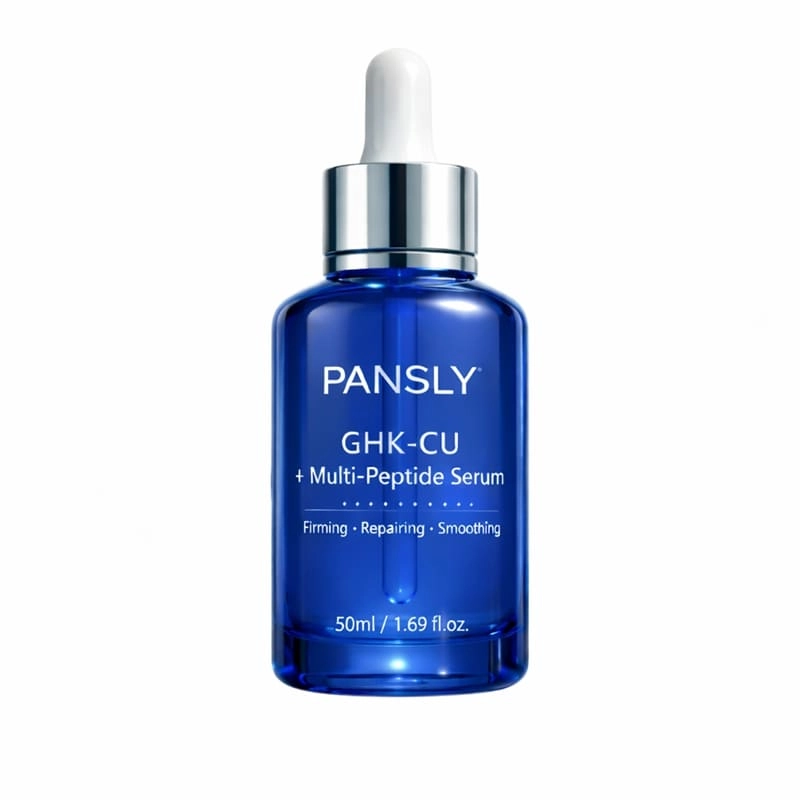
Experience visible rejuvenation with this GHK-Cu Copper Peptide Smoothing & Firming Face Serum, a high-performance concentrate designed to restore the structural integrity of aging skin. This advanced formula centers on GHK-Cu, a powerful signaling peptide clinically recognized for its ability to support natural collagen and elastin production. By promoting dermal density, it effectively tightens sagging skin and smooths the appearance of deep-set wrinkles and fine lines.
The lightweight, silky texture absorbs instantly, delivering antioxidant protection to neutralize environmental stressors that accelerate aging. Enhanced with deep-moisturizing agents, the serum reinforces the skin's moisture barrier, leaving the complexion feeling remarkably soft and resilient. With consistent use, skin texture is refined and facial contours appear more lifted, resulting in a youthfully firm and revitalized glow.
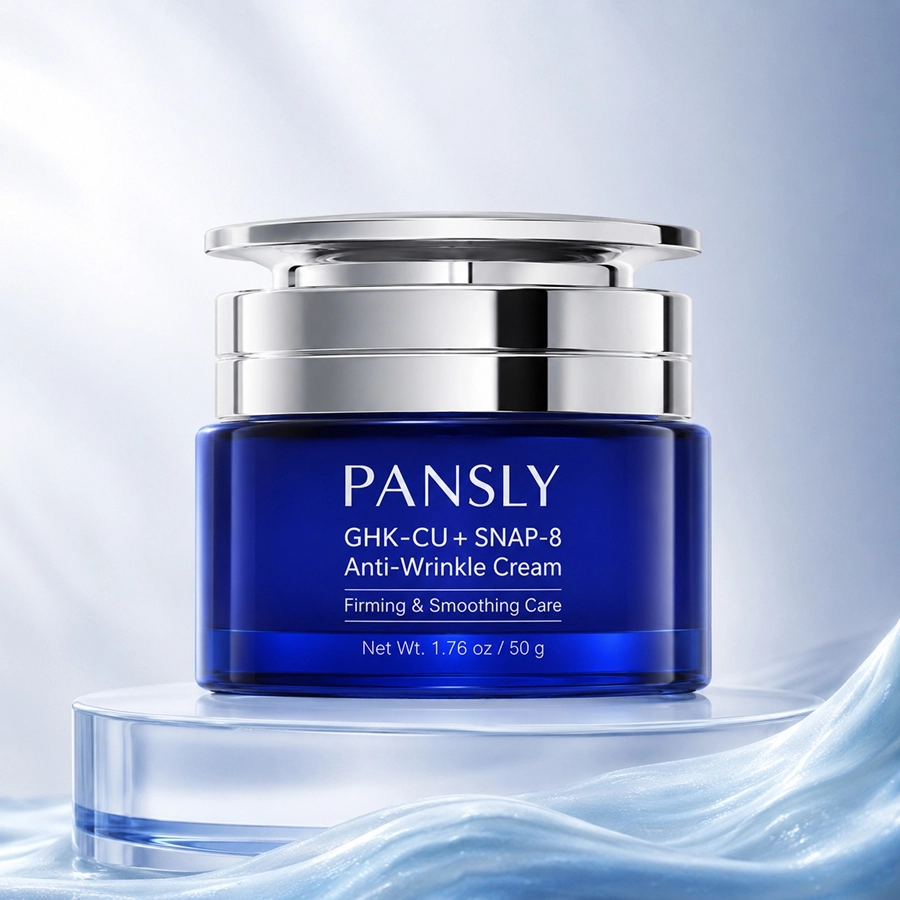
This Pansly GHK-CU + SNAP-8 Anti-Wrinkle Firming Cream is triple-peptide anti-aging facial cream, delivers targeted wrinkle smoothing, firming lifting and deep nourishment for dull, saggy, fine-line prone skin. Full OEM & ODM private label service is supported, including custom formula, packaging options, fast sampling and bulk export supply.
Five core premium active ingredients work synergistically for comprehensive anti-wrinkle care:
GHK-CU Copper Peptide lifts saggy skin, enhances skin resilience and tightens loose facial contour;
SNAP-8 Peptide targets expression lines to visibly soften and fade wrinkles;
Acetyl Hexapeptide-8 reduces the appearance of dry fine lines for smoother skin texture;
Ceramide NP reconstructs skin moisture barrier to lock nourishment and boost comfort;
Hyaluronic Acid delivers multi-layer rich deep moisture to relieve dry rough skin.
Luxury rich creamy texture spreads smoothly and melts into skin gently, leaving soft comfortable finish without heavy greasiness. Daily use blurs fine lines, firms loose skin, deeply nourishes and stabilizes barrier, refining uneven texture to reveal smooth, plump, youthful luminous skin.
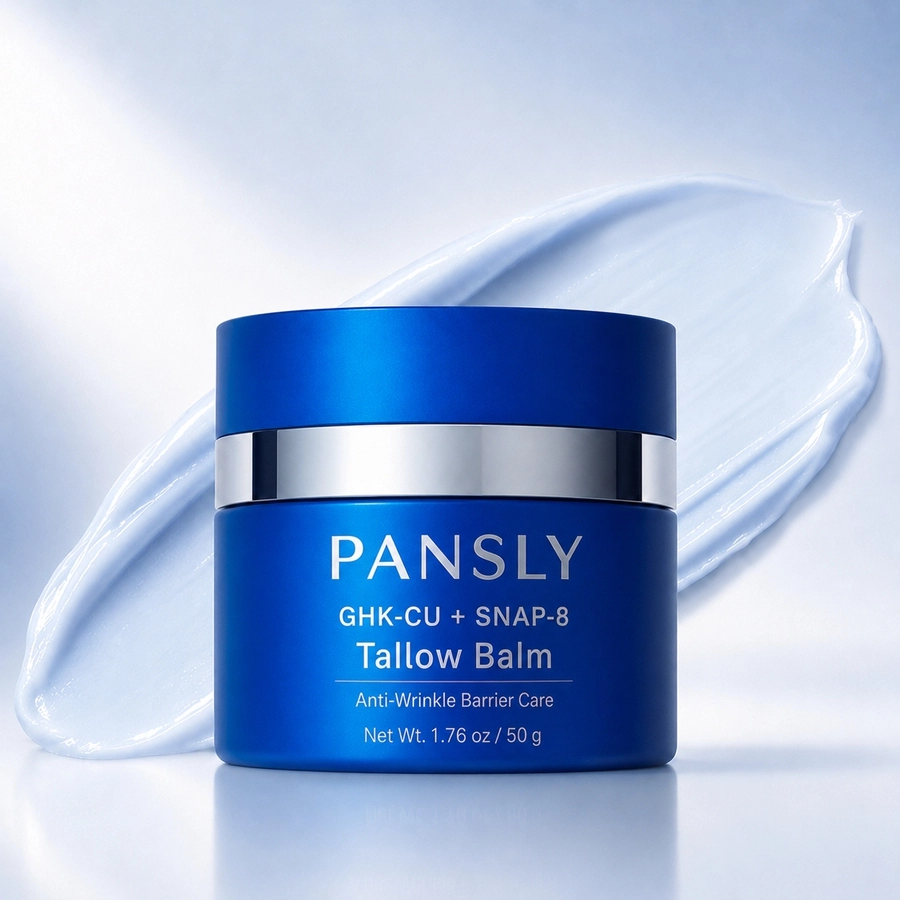
This Pansly GHK-CU + SNAP-8 Tallow Balm is a nourishing anti-wrinkle facial balm specially formulated for dry, fragile and sensitive skin, combining anti-aging wrinkle smoothing and barrier repairing effects. We offer full private label OEM service, including custom logo, adjustable formula, diversified packaging and lid color options.
It contains five core skin care active ingredients: GHK-CU visibly improves fine lines and revives dull complexion; SNAP-8 softens expression lines to smooth wrinkled skin texture; Grass-Fed Beef Tallow delivers deep lipid nourishment to relieve dry rough skin; Ectoin stabilizes the skin barrier and alleviates skin discomfort; Ceramide NP strengthens barrier structure to create smooth, healthy skin.
Luxury creamy blue balm texture glides smoothly and melts quickly on skin, providing long-lasting deep moisturizing comfort. Daily use fades fine lines & expression lines, nourishes dry delicate skin, repairs damaged barrier and leaves silky smooth skin finish.
Click here to customize the Beauty
we respond within a few hours
Monday–Friday, 9AM–6PM
3A01, Building A, Zhisheng Square, No. 4 Zhifu Road, Helong Street, Baiyun District, Guangzhou, China.


Leave a request, and we'll email you back within 24 hours.
© 2026 Beyond Basix. All Rights Reserved.