Why PDRN and Centella Are a Strong Pairing for Sensitive-Skin Serums
- Biotech-botanical synergy for reactive dermis and barrier restoration
- Molecular pathways: regeneration plus anti-inflammatory modulation
- Clinical endpoints and measurable outcomes for product claims
- Minimizing irritation risk through complementary mechanisms
- Formulation and production: ensuring stability, efficacy, and gentle performance
- Compatibility, pH windows, and solubility considerations
- Preservation strategies and microbiological control for sensitive formulations
- Delivery systems and sensory optimization for high-adoption rates
- Procurement, regulatory strategy, and quality assurance for OEM/ODM collaborations
- Sourcing raw materials: traceability and supplier qualification
- Certifications, claims substantiation, and compliance checkpoints
- Testing protocols and batch release criteria
- Data-driven comparison: regenerative nucleotide vs. botanical actives vs. combined formulations
- Why partner with a one-stop OEM/ODM like Beyond Basix for calming regenerative serums
- Facility scale, cleanroom standards, and production flexibility
- Quality systems, certifications, and testing capacity
- R&D, formulation support, and product range
- Supply continuity and partner-oriented commercial terms
- Evidence and regulatory resources
- Authoritative sources for safety and ingredient data
- Action checklist for buyers evaluating calming serum suppliers
- Frequently Asked Questions
High-value sensitive-skin serums that blend regenerative nucleotides and botanical anti-inflammatories deliver measurable reductions in reactivity while supporting barrier repair—this guide explains the biochemical rationale, formulation controls, sourcing and testing protocols, and manufacturing best practices required by brand owners and OEM/ODM partners to commercialize a clinically credible calming serum combining PDRN and Centella-derived actives with low irritation risk.
Biotech-botanical synergy for reactive dermis and barrier restoration
Molecular pathways: regeneration plus anti-inflammatory modulation
PDRN, a polydeoxyribonucleotide-derived bioactive, acts on tissue repair via adenosine A2A receptor signaling and nucleotide salvage pathways to enhance fibroblast proliferation and collagen synthesis; pairing that activity with the triterpenoids and asiaticoside fractions in Centella asiatica provides complementary suppression of pro-inflammatory mediators and oxidative stress—together they target both structural repair and symptomatic erythema reduction. For buyers, prioritizing raw material certificates that include assay data for molecular markers (e.g., A2A agonist equivalency for PDRN and asiaticoside percentage for Centella) reduces downstream claim risk and accelerates regulatory review.
Clinical endpoints and measurable outcomes for product claims
Brands positioning a restorative calming serum should define primary endpoints to satisfy B2B customers: transepidermal water loss (TEWL) reduction, validated erythema scoring (e.g., Mexameter), subjective irritation indexing, and non-invasive collagen density imaging. Suppliers should provide third-party clinical or biophysical test reports corresponding to these endpoints; this helps formulators calibrate active loadings and determine whether in-use concentrations require preservative efficacy testing or additional safety panels such as repeated insult patch testing (RIPT).
Minimizing irritation risk through complementary mechanisms
The combination reduces irritation probability because PDRN promotes repair without the pro-inflammatory signaling sometimes seen with peptide stimulators, while Centella components downregulate NF-kB pathways and reduce histamine-driven responses. Procurement guidance: request stability and irritation matrices from manufacturers documenting concentration-dependent responses, and specify acceptance criteria (e.g., no statistical increase in erythema vs. placebo in n≥30 panel) before approving a finished product SKU.
Formulation and production: ensuring stability, efficacy, and gentle performance
Compatibility, pH windows, and solubility considerations
PDRN oligonucleotides are hydrophilic and perform optimally in neutral-to-slightly acidic pH ranges where enzymatic degradation is minimized; Centella extracts can be water-soluble or alcohol-soluble depending on fractionation. Formulators must reconcile solvent systems to avoid denaturing nucleotides—common approaches include aqueous glycerin bases, low levels of PEG solvents, or encapsulation in liposomal carriers to maintain molecular integrity. Specification sheets should list pH stability ranges, recommended solvent matrices, and forced-degradation data to inform packaging choices.
Preservation strategies and microbiological control for sensitive formulations
Sensitive-skin serums typically avoid high levels of alcohol and harsh surfactants; this constrains preservative choices. Manufacturers should provide validated preservative efficacy test (PET) reports compliant with ISO or pharmacopeial standards and supply microbial limits certificates for bulk and finished goods. For OEM/ODM processes, aseptic filling in a certified cleanroom (e.g., GMP-compliant 100,000-level) and in-line microbial monitoring are essential to maintain low bioburden without irritating additives.
Delivery systems and sensory optimization for high-adoption rates
Delivery formats—lightweight serums, ampoules, or gel emulsions—impact consumer adoption and compatibility with other routines. Encapsulation techniques such as liposomes or nanoemulsions improve dermal penetration of both nucleotide fragments and Centella actives while smoothing sensory profiles. Buyers should request sample batches across packaging formats to evaluate in-panel sensory testing and stability under accelerated and real-world storage conditions.
Procurement, regulatory strategy, and quality assurance for OEM/ODM collaborations
Sourcing raw materials: traceability and supplier qualification
Reliable supply of PDRN and standardized Centella fractions requires supplier audits, COA verification, and DNA or chromatographic authentication. Procurement teams should require a supplier quality agreement (SQA) that covers chain-of-custody, heavy-metal testing, residual solvent limits, and batch-level certificates of analysis. For botanicals, request botanical identification reports and pesticide screening; for PDRN, confirm the origin (e.g., salmon-derived or synthetic) and provide viral and endotoxin testing as applicable.
Certifications, claims substantiation, and compliance checkpoints
Cosmetics markets differ by jurisdiction: the U.S. FDA regulates labeling and safety surveillance but does not pre-approve cosmetics, while quality management for manufacturing is assessed against standards such as ISO 9001. For clinical claims beyond cosmetic structure/function, consult medical regulatory pathways. Brands should expect their OEM/ODM partner to supply GMP audit trails, finished-product COAs, and testing aligned with international norms (e.g., preservative efficacy, heavy metals, and stability assays).
Testing protocols and batch release criteria
Establishing clear release criteria accelerates time-to-market: set thresholds for microbial limits, pH stability, viscosity range, assay potency (active content), and packaging integrity. Consider including challenge test protocols like RIPT or 48–72 hour human repeat-insult patch testing when promoting hypoallergenic positioning. Reputable manufacturers will provide historical batch variability data to support shelf-life claims and minimize product recalls.
Data-driven comparison: regenerative nucleotide vs. botanical actives vs. combined formulations
| Attribute | PDRN (nucleotide biologic) | Centella fractions (botanical) | Combined serum |
|---|---|---|---|
| Primary mechanism | Repair via A2A receptor signaling and nucleic acid salvage | Anti-inflammatory, extracellular matrix modulation (asiaticoside, madecassoside) | Synergistic repair + calming, reduced inflammatory sequelae |
| Typical formulation concentration | 0.5–5% (varies by purity and clinical data) | 0.5–3% for standardized extracts (higher for raw hydrosols) | Optimized blends often keep each active within non-irritating ranges |
| Stability factors | Susceptible to nuclease degradation; pH and temperature sensitive | Stable across wider pH; some fractions oxidize if unprotected | Requires matched vehicle and antioxidant or encapsulation strategies |
| Sourcing complexity | Higher—biotech or animal-derived sourcing with testing needs | Moderate—botanical variability demands standardization | Combined—both supply chains must be qualified and harmonized |
| Regulatory & safety testing | Extensive batch-level safety and endotoxin assays recommended | Pesticide and heavy-metal screening required | Full panel testing plus human-safety data advisable for hypoallergenic claims |
Why partner with a one-stop OEM/ODM like Beyond Basix for calming regenerative serums
Facility scale, cleanroom standards, and production flexibility
Beyond Basix provides contract manufacturing in a 12,000-square-meter facility with a 100,000-level GMPC pharmaceutical-grade dust-free workshop and 12 production lines capable of handling water-based serums, ampoule fills, and delicate aseptic processes; this scale supports both pilot batches for clinical testing and full-scale commercial runs. For buyers, leveraging a partner with integrated production lines reduces lead times and simplifies supplier management.
Quality systems, certifications, and testing capacity
Our operations are certified with ISO 9001 and GMP-compliant workflows, and we maintain product-level documentation (COAs, stability data, and PET results) to support cross-border distribution. Regulatory-conscious customers benefit from coordinated dossiers that reference international quality frameworks and testing outcomes to expedite market entry across jurisdictions.
R&D, formulation support, and product range
With over 23 years of experience and a 12-year focus on active-driven skincare development, our formulation teams develop targeted serums, as well as complementary Skincare Products, Hair Care Products, Eye Care Products, and Body Care Products for multi-touchpoint regimens. We offer custom encapsulation, low-irritant vehicle design, and clinical testing coordination so that brands can substantiate calming and barrier-restorative claims with reproducible manufacturing processes.
Supply continuity and partner-oriented commercial terms
Beyond Basix maintains multi-sourced raw material relationships and robust quality agreements to mitigate single-point failures in supply chains. For B2B partners, this translates to reliable batch-to-batch quality, predictable MOQ scalability, and transparent pricing structures that support margin planning and retailer negotiations.
Evidence and regulatory resources
Authoritative sources for safety and ingredient data
For botanical identification and traditional usage context, refer to Centella asiatica — Wikipedia. Regulatory guidance for cosmetic safety and labeling can be found at the U.S. Food and Drug Administration: FDA Cosmetics. Quality management frameworks useful to OEM/ODM contracting are explained at ISO 9001. For peer-reviewed literature and clinical studies on polydeoxyribonucleotide applications, search PubMed for polydeoxyribonucleotide at PubMed.
Action checklist for buyers evaluating calming serum suppliers
Require supplier-provided test packs including: raw-material COAs, stability under defined storage conditions, preservative efficacy reports, clinical endpoints aligned with marketing claims, and an SQA detailing traceability and recall procedures. Ensure packaging compatibility tests and shelf-life challenge data are included in the technical file before signing a commercial agreement.
Frequently Asked Questions
What are the main benefits of combining PDRN with Centella asiatica in a soothing serum?
The combination pairs regenerative signaling from PDRN (enhancing fibroblast activity and collagen synthesis) with Centella's anti-inflammatory triterpenoids, delivering both structural repair and symptomatic calming; this dual action reduces erythema and supports barrier restoration when formulated at clinically validated concentrations.
What formulation challenges should brand owners expect when developing a nucleotide-botanical serum?
Key challenges include solvent compatibility (PDRN is hydrophilic while Centella fractions vary), pH and temperature sensitivity of nucleotides, preservative selection for alcohol-free vehicles, and packaging that protects labile actives; requesting forced-degradation studies and stability matrices from manufacturers mitigates these risks.
Which tests are essential before commercializing a low-irritant calming serum?
Essential tests include preservative efficacy testing (PET), microbial limit testing, stability under accelerated and real-world conditions, assay potency for actives, and human safety panels such as repeated insult patch testing or small-scale clinical endpoints (TEWL, erythema scoring) to support hypoallergenic or calming claims.
How should procurement teams qualify suppliers of PDRN and Centella extracts?
Procurement should require supplier quality agreements, batch-level certificates of analysis, botanical identification and pesticide screening for Centella, and viral/endotoxin testing for PDRN sources; audits and COA traceability are critical to prevent supply and compliance failures.
Why choose an integrated OEM/ODM partner for producing sensitive-skin serums?
An integrated OEM/ODM partner provides controlled cleanroom production, validated quality systems, in-house formulation and stability testing, and supply-chain management—reducing lead times, ensuring batch consistency, and consolidating technical responsibilities which simplifies regulatory readiness and commercial scaling.

Elevate your professional skincare offerings with this Private Label Copper Peptide Anti-Wrinkle Firming Serum, a powerhouse concentrate designed for superior age-defying results. This sophisticated formula leverages the synergistic effects of GHK-Cu and SNAP-8 to address multiple layers of skin aging. The GHK-Cu copper peptides act as a vital signaling mechanism to enhance skin density and firmness, while the advanced SNAP-8 octapeptide specifically targets expression lines, helping to relax the appearance of deep-seated wrinkles for a smoother, more refined surface.
This lightweight, rapid-absorption serum provides a professional-grade solution for clients seeking a non-invasive lift. It effectively restores elasticity, improves skin texture, and provides essential antioxidant protection. Perfect for high-end beauty brands, this serum leaves the complexion looking visibly contoured, hydrated, and youthfully revitalized.
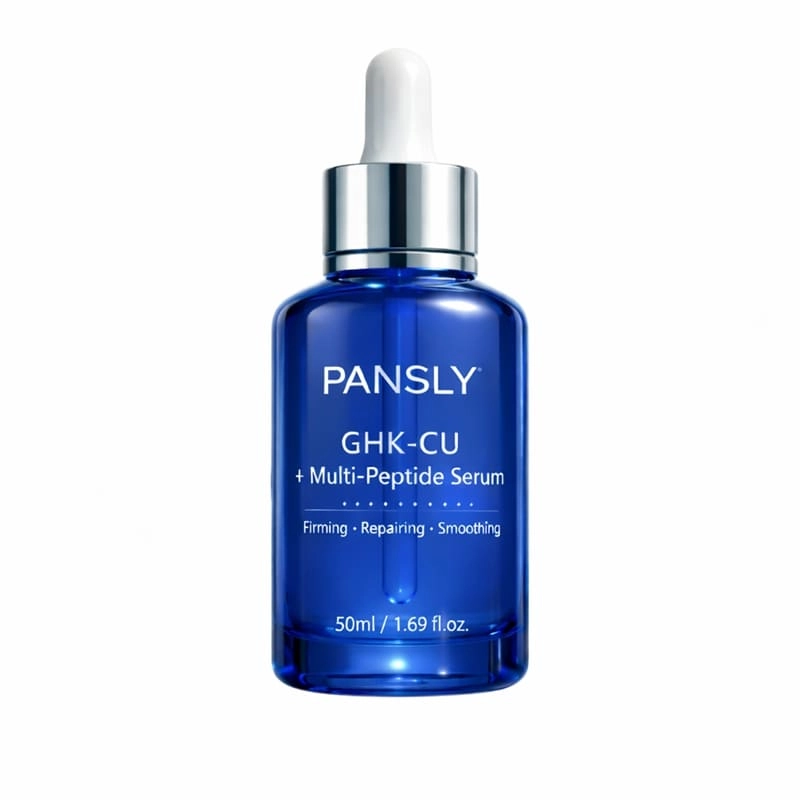
Experience visible rejuvenation with this GHK-Cu Copper Peptide Smoothing & Firming Face Serum, a high-performance concentrate designed to restore the structural integrity of aging skin. This advanced formula centers on GHK-Cu, a powerful signaling peptide clinically recognized for its ability to support natural collagen and elastin production. By promoting dermal density, it effectively tightens sagging skin and smooths the appearance of deep-set wrinkles and fine lines.
The lightweight, silky texture absorbs instantly, delivering antioxidant protection to neutralize environmental stressors that accelerate aging. Enhanced with deep-moisturizing agents, the serum reinforces the skin's moisture barrier, leaving the complexion feeling remarkably soft and resilient. With consistent use, skin texture is refined and facial contours appear more lifted, resulting in a youthfully firm and revitalized glow.
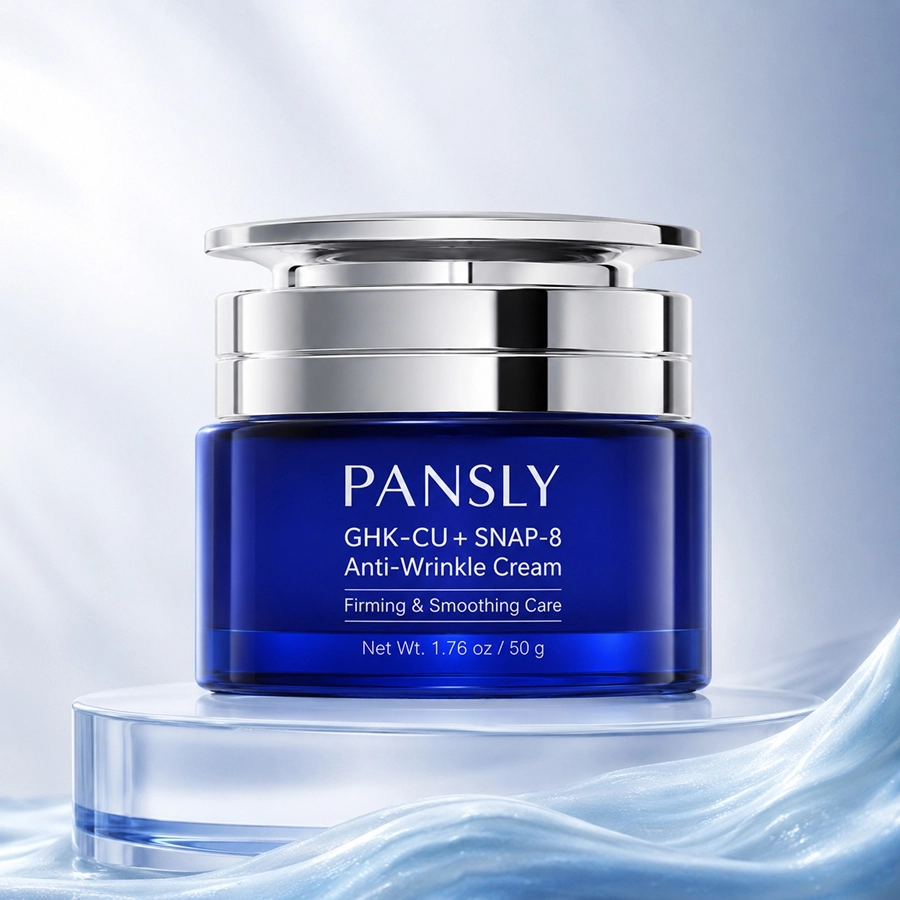
This Pansly GHK-CU + SNAP-8 Anti-Wrinkle Firming Cream is triple-peptide anti-aging facial cream, delivers targeted wrinkle smoothing, firming lifting and deep nourishment for dull, saggy, fine-line prone skin. Full OEM & ODM private label service is supported, including custom formula, packaging options, fast sampling and bulk export supply.
Five core premium active ingredients work synergistically for comprehensive anti-wrinkle care:
GHK-CU Copper Peptide lifts saggy skin, enhances skin resilience and tightens loose facial contour;
SNAP-8 Peptide targets expression lines to visibly soften and fade wrinkles;
Acetyl Hexapeptide-8 reduces the appearance of dry fine lines for smoother skin texture;
Ceramide NP reconstructs skin moisture barrier to lock nourishment and boost comfort;
Hyaluronic Acid delivers multi-layer rich deep moisture to relieve dry rough skin.
Luxury rich creamy texture spreads smoothly and melts into skin gently, leaving soft comfortable finish without heavy greasiness. Daily use blurs fine lines, firms loose skin, deeply nourishes and stabilizes barrier, refining uneven texture to reveal smooth, plump, youthful luminous skin.
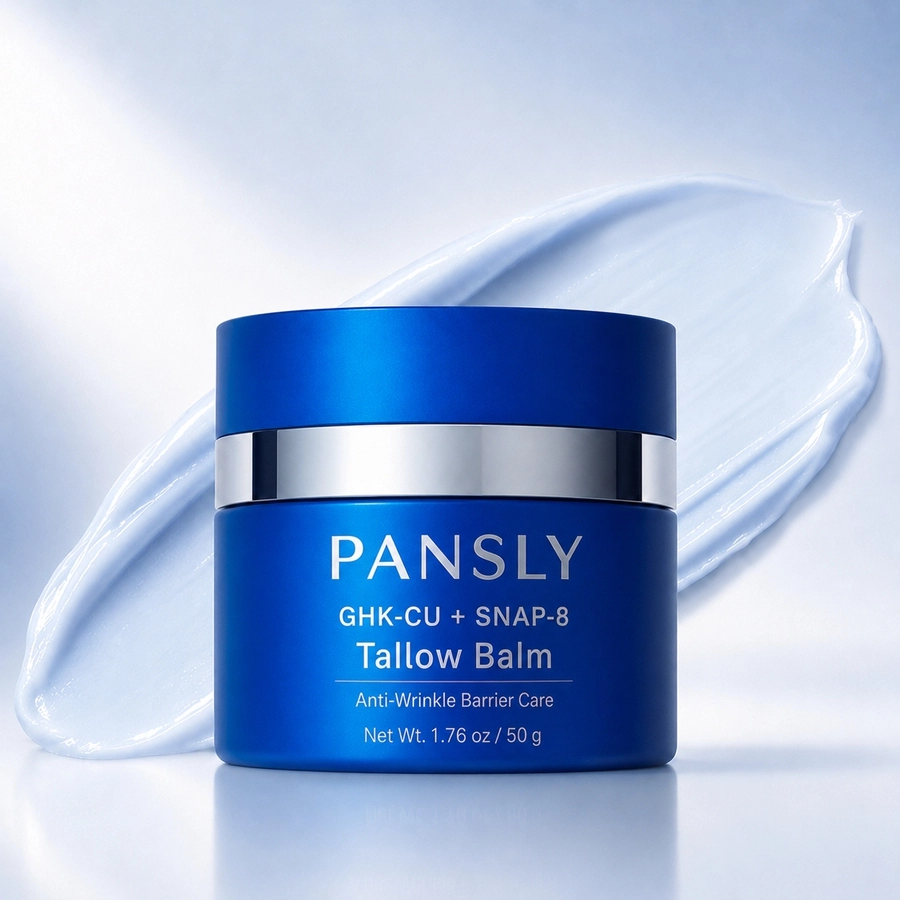
This Pansly GHK-CU + SNAP-8 Tallow Balm is a nourishing anti-wrinkle facial balm specially formulated for dry, fragile and sensitive skin, combining anti-aging wrinkle smoothing and barrier repairing effects. We offer full private label OEM service, including custom logo, adjustable formula, diversified packaging and lid color options.
It contains five core skin care active ingredients: GHK-CU visibly improves fine lines and revives dull complexion; SNAP-8 softens expression lines to smooth wrinkled skin texture; Grass-Fed Beef Tallow delivers deep lipid nourishment to relieve dry rough skin; Ectoin stabilizes the skin barrier and alleviates skin discomfort; Ceramide NP strengthens barrier structure to create smooth, healthy skin.
Luxury creamy blue balm texture glides smoothly and melts quickly on skin, providing long-lasting deep moisturizing comfort. Daily use fades fine lines & expression lines, nourishes dry delicate skin, repairs damaged barrier and leaves silky smooth skin finish.
Click here to customize the Beauty
we respond within a few hours
Monday–Friday, 9AM–6PM
3A01, Building A, Zhisheng Square, No. 4 Zhifu Road, Helong Street, Baiyun District, Guangzhou, China.


Leave a request, and we'll email you back within 24 hours.
© 2026 Beyond Basix. All Rights Reserved.