
What Makes a PDRN Centella Soothing Serum Stand Out in Clinical Skincare?
- Why This Barrier-Focused Recovery Serum Is Gaining Attention
- PDRN contributes a differentiated ingredient story
- Centella asiatica adds botanical calming and barrier relevance
- The formula must be soothing in use, not only attractive on paper
- What Clinical Skincare Buyers Should Evaluate Before Approval
- Raw-material quality and formula architecture
- Manufacturing controls and evidence packages
- Packaging and the economics of scale
- How Beyond Basix Supports One-Stop OEM/ODM for Skincare Projects
- Integrated development from concept to finished batch
- Facility capacity and documented quality systems
- Broader category capability for portfolio expansion
- Frequently Asked Questions
- What is the main appeal of combining PDRN with Centella asiatica?
- Can a PDRN and Centella serum be marketed as a medical repair product?
- What documents should a buyer request from the OEM/ODM supplier?
- Which packaging is suitable for a sensitive-skin serum?
- How can buyers compare suppliers beyond the quoted unit price?
- Can the same manufacturer develop related personal-care products?
A PDRN Centella soothing serum is positioned at the intersection of ingredient-led skincare, post-procedure comfort, and barrier-focused daily care. The concept typically combines polydeoxyribonucleotide, commonly abbreviated as PDRN, with Centella asiatica fractions, humectants, film-formers, and calming agents. For clinical skincare buyers, the differentiator is not simply the presence of two popular ingredients. The real value lies in whether the formula delivers a stable, elegant, low-irritation experience while the manufacturer can document raw-material identity, safety, quality, and repeatable production. Buyers should also distinguish cosmetic skin-conditioning claims from medical or therapeutic claims, following guidance from the U.S. Food and Drug Administration on cosmetic claims.
Why This Barrier-Focused Recovery Serum Is Gaining Attention
PDRN contributes a differentiated ingredient story
PDRN is a mixture of deoxyribonucleotide fragments that is generally discussed in connection with skin-conditioning and regenerative research. In a cosmetic product, its commercial significance comes from traceable sourcing, controlled purification, appropriate molecular specifications, and compatibility with the finished formula. The term alone does not guarantee a defined performance profile. A buyer should request the ingredient specification, certificate of analysis, origin statement, allergen information where applicable, microbiological limits, heavy-metal limits, and evidence that the material remains stable throughout the product’s intended shelf life.
Ingredient terminology also requires careful communication. A cosmetic serum may support a moisturized, comfortable, and visibly smoother skin appearance, but it should not be marketed as treating wounds, disease, inflammation, or a medical condition without the relevant authorization. For technical teams, this distinction affects product naming, packaging copy, influencer scripts, distributor training, and market-entry review. A disciplined claims framework protects both brand equity and channel relationships.
Centella asiatica adds botanical calming and barrier relevance
Centella asiatica is a familiar botanical in sensitive-skin and barrier-care positioning. Extracts may contain triterpenes such as asiaticoside, madecassoside, asiatic acid, and madecassic acid, although the composition depends on the plant material, extraction method, solvent system, and standardization approach. Buyers should avoid treating “Centella extract” as a uniform commodity. A reliable supplier can clarify the extract ratio, marker compounds, botanical authentication, residual solvent controls, color variation, odor profile, and storage requirements.
For a finished emulsion or aqueous gel, Centella must also be evaluated for its effect on color, odor, viscosity, preservative demand, and long-term stability. A formula that performs well in a laboratory beaker may change after heat exposure, transport vibration, or repeated consumer opening. Standardized botanical input and a controlled filling process therefore matter as much as the ingredient label.
The formula must be soothing in use, not only attractive on paper
Clinical skincare consumers often expect a serum to spread quickly, absorb without excessive tack, layer under sunscreen, and remain comfortable on reactive-feeling skin. Formulators may combine PDRN and Centella with glycerin, betaine, panthenol, ectoin, sodium hyaluronate, allantoin, or carefully selected polymers. The selection should be based on skin feel, compatibility, claim strategy, and target-market requirements rather than an indiscriminate “more actives” approach.
A low-fragrance or fragrance-free option can improve suitability for sensitive-skin positioning, although fragrance policy should be confirmed according to the brand’s audience and destination-market rules. The finished product should be assessed through pH testing, accelerated and real-time stability, centrifuge or emulsion stress testing when relevant, preservative efficacy testing, packaging compatibility, and repeated-use simulation. These controls turn a popular ingredient combination into a dependable commercial product.
What Clinical Skincare Buyers Should Evaluate Before Approval
Raw-material quality and formula architecture
Procurement teams should begin with a technical brief that defines the intended skin type, dosage form, target texture, pack size, market, claim boundaries, and cost ceiling. The brief should identify whether the product is a watery essence, gel serum, milky serum, or richer barrier concentrate. Each architecture creates different requirements for solubilization, viscosity control, filling accuracy, and packaging.
PDRN quality documentation should be reviewed alongside Centella documentation rather than after the sample is approved. Important checkpoints include identity testing, assay or marker information, microbial specifications, batch number traceability, country of origin, storage conditions, and retest or expiry policy. For sensitive-skin products, the full formula should be screened for unnecessary irritants, incompatible actives, and preservative interactions. The objective is a balanced formula with predictable performance, not a crowded ingredient list.
Manufacturing controls and evidence packages
Good manufacturing practice is a practical procurement issue because it connects facility hygiene, process control, personnel training, documentation, and release decisions. Buyers can review whether the supplier maintains controlled areas, validated cleaning procedures, calibrated equipment, raw-material quarantine, environmental monitoring, deviation management, and finished-batch records. The ISO 9001 quality management framework provides a useful reference for process consistency and continual improvement, while cosmetic GMP expectations should be assessed against the destination market.
Before commercial approval, project owners should request a sample approval record, product specification, safety information, stability summary, microbiological report, packaging compatibility result, and proposed certificate of analysis. Depending on the market and product claims, the dossier may also require an ingredient list using accepted nomenclature, product information file support, safety assessment input, or notification documentation. The World Health Organization guidance on quality risk management illustrates why hazards, controls, and verification should be evaluated systematically rather than informally.
Packaging and the economics of scale
Airless pumps, opaque bottles, and well-designed droppers can help protect a sensitive formula from repeated exposure to air, light, and consumer handling. Packaging selection should be tested with the actual serum, because elastomers, springs, adhesives, and plastic components can affect odor, color, viscosity, or preservative performance. A High Quality clinical image is valuable, but functional protection and filling reliability should lead the decision.
Commercial economics also extend beyond unit price. Buyers should compare minimum order quantity, formula development fees, sampling rounds, tooling, packaging lead time, testing charges, shipping configuration, and rework policy. A slightly higher ex-factory price may generate better ROI if it reduces leakage, rejects, customer complaints, or launch delays. A supplier capable of coordinating formula, packaging, testing, production, and documentation can simplify the project and reduce the number of handoffs.
| Evaluation area | Basic supplier approach | Clinical-oriented supplier approach | Buyer verification |
|---|---|---|---|
| PDRN input | Ingredient name supplied without detailed specifications | Defined origin, specification, traceability, and batch documentation | Request COA, specification, origin, storage, and identity information |
| Centella extract | Botanical listed without marker information | Extraction method and relevant standardization details disclosed | Review botanical authentication, marker compounds, and microbial limits |
| Formula validation | Basic appearance and short sample observation | Stability, microbiology, preservative efficacy, and compatibility assessment | Review test methods, conditions, acceptance criteria, and reports |
| Claims | Broad repair or medical language used without substantiation | Cosmetic, evidence-aligned wording reviewed for target markets | Map every claim to evidence and applicable regulations |
| Scale-up | Laboratory formula transferred with limited process detail | Pilot batching, process parameters, filling controls, and release criteria | Assess batch records, MOQ, lead time, and change-control process |
The table represents a procurement framework rather than a claim that one supplier or formula is automatically superior. It helps buyers compare the depth of quality systems behind a calming serum. For substantiation planning, teams can also consult peer-reviewed research databases such as PubMed and check cosmetic ingredient or product requirements in the relevant jurisdiction. Evidence should support the exact ingredient, concentration, product format, and consumer-facing wording.
How Beyond Basix Supports One-Stop OEM/ODM for Skincare Projects
Integrated development from concept to finished batch
Beyond Basix is Guangzhou Beyond Basix Cosmetics Ltd., a comprehensive cosmetics care manufacturer with more than 23 years of experience in research, production, and sales. Our team supports brand owners, distributors, investors, and project operators who need a coordinated route from market concept to commercial manufacturing. For a PDRN and Centella serum, this can include product positioning, formula selection, sample refinement, texture adjustment, packaging coordination, testing support, and production planning.
Our technical approach focuses on effective-ingredient skincare development and has included 12 years of dedicated attention to products built around functional ingredients. We assess the relationship between active materials, base composition, packaging, manufacturing parameters, and claim strategy. This integrated process helps reduce avoidable delays caused by incompatible packaging, unstable botanical inputs, or formula changes introduced too late in the project.
Facility capacity and documented quality systems
Our 12,000-square-meter facility includes a 100,000-level GMPC pharmaceutical-grade dust-free workshop and 12 production lines. The site is equipped with advanced machinery imported from Germany, the United States, and other regions. This infrastructure supports controlled manufacturing, filling flexibility, and the capacity to manage different formats and order volumes while maintaining defined process requirements.
Beyond Basix holds certifications and documentation including ISO 9001, CE, MSDS, GMP, HALAL, and more, according to product and market requirements. Certifications should always be matched to the specific facility, product category, and destination-market obligation; nevertheless, a documented management system gives buyers a stronger basis for supplier qualification. Our process emphasizes raw-material control, in-process checks, finished-product inspection, batch traceability, and coordinated quality communication.
Broader category capability for portfolio expansion
A one-stop partner can create value beyond one hero serum. Beyond Basix develops and manufactures Skincare Products, Hair Care Products, Eye Care Products, and Body Care Products. This broader capability allows a brand to build a coherent clinical-inspired assortment, such as a calming facial serum supported by an eye-care gel, body lotion, scalp treatment, or cleansing product with complementary positioning.
We also operate four major brands—LANTHOME, PANSLY, FIRSTSUN, and SAUVASINE—which contributes to our understanding of product presentation, category planning, and consumer-facing execution. For B2B customers, the commercial benefit is a more coordinated development pathway: fewer supplier interfaces, clearer project ownership, and a better opportunity to align texture, fragrance policy, packaging language, and visual identity across a product range.
Our objective is to offer dependable products, responsive service, and competitive pricing while growing together with partners. Buyers considering a clinical skincare launch should still complete their own audits, documentation review, market compliance checks, and product testing. Beyond Basix provides the manufacturing platform and technical coordination required to make those decisions more efficient and commercially actionable.
Frequently Asked Questions
What is the main appeal of combining PDRN with Centella asiatica?
The combination creates a differentiated barrier-care and soothing story: PDRN supplies a specialized skin-conditioning ingredient narrative, while Centella asiatica contributes botanical familiarity and sensitive-skin relevance. Final performance depends on formula design, ingredient quality, concentration, stability, and compliant claims.
Can a PDRN and Centella serum be marketed as a medical repair product?
Not automatically. A cosmetic product should use claims supported by appropriate evidence and applicable regulations, such as helping skin feel moisturized, comfortable, or visibly smoother. Medical, therapeutic, wound-healing, or disease-treatment claims may change the product’s regulatory classification.
What documents should a buyer request from the OEM/ODM supplier?
Typical documents include the product specification, ingredient list, certificates of analysis, safety information, microbiological results, stability data, preservative efficacy results when applicable, packaging compatibility information, batch traceability records, and market-specific compliance support.
Which packaging is suitable for a sensitive-skin serum?
Airless pumps, opaque containers, and compatible droppers may be considered depending on the formula’s sensitivity to air, light, and contamination. The actual package should be tested with the finished product for leakage, dispensing performance, compatibility, odor transfer, color change, and stability.
How can buyers compare suppliers beyond the quoted unit price?
Buyers should compare formula development capability, testing scope, MOQ, lead time, packaging coordination, change control, documentation quality, manufacturing capacity, certifications, communication speed, and complaint-handling procedures. Total project cost and launch risk are more meaningful than unit price alone.
Can the same manufacturer develop related personal-care products?
Yes, a qualified full-service cosmetics manufacturer may support adjacent categories. Beyond Basix provides Skincare Products, Hair Care Products, Eye Care Products, and Body Care Products, allowing buyers to coordinate a broader portfolio through one manufacturing partner.
Contact Beyond Basix to discuss a compliant PDRN-and-Centella serum concept or explore our full range of skincare, hair care, eye care, and body care products.

Elevate your professional skincare offerings with this Private Label Copper Peptide Anti-Wrinkle Firming Serum, a powerhouse concentrate designed for superior age-defying results. This sophisticated formula leverages the synergistic effects of GHK-Cu and SNAP-8 to address multiple layers of skin aging. The GHK-Cu copper peptides act as a vital signaling mechanism to enhance skin density and firmness, while the advanced SNAP-8 octapeptide specifically targets expression lines, helping to relax the appearance of deep-seated wrinkles for a smoother, more refined surface.
This lightweight, rapid-absorption serum provides a professional-grade solution for clients seeking a non-invasive lift. It effectively restores elasticity, improves skin texture, and provides essential antioxidant protection. Perfect for high-end beauty brands, this serum leaves the complexion looking visibly contoured, hydrated, and youthfully revitalized.
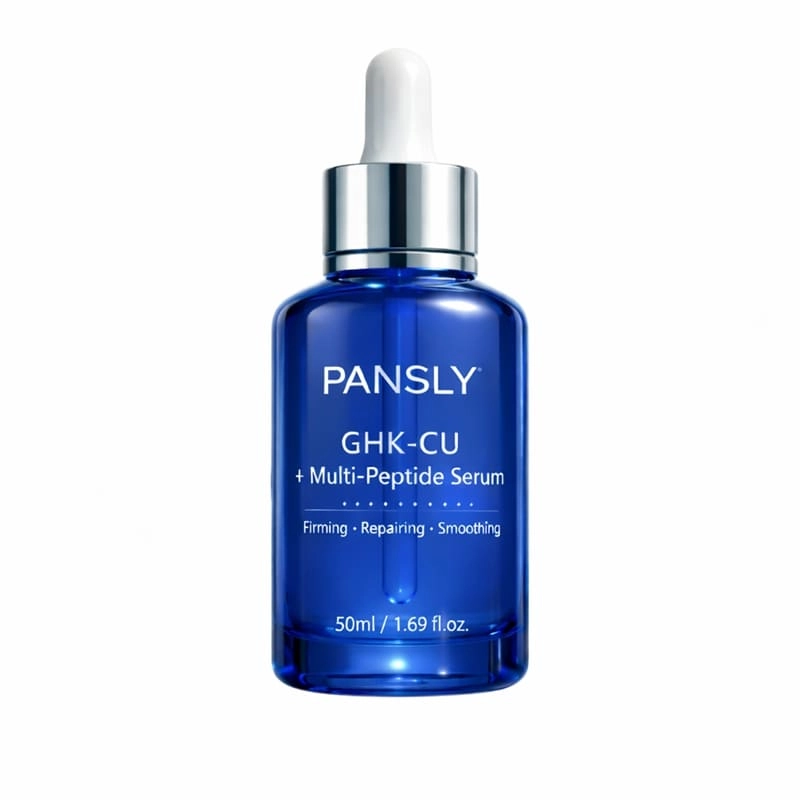
Experience visible rejuvenation with this GHK-Cu Copper Peptide Smoothing & Firming Face Serum, a high-performance concentrate designed to restore the structural integrity of aging skin. This advanced formula centers on GHK-Cu, a powerful signaling peptide clinically recognized for its ability to support natural collagen and elastin production. By promoting dermal density, it effectively tightens sagging skin and smooths the appearance of deep-set wrinkles and fine lines.
The lightweight, silky texture absorbs instantly, delivering antioxidant protection to neutralize environmental stressors that accelerate aging. Enhanced with deep-moisturizing agents, the serum reinforces the skin's moisture barrier, leaving the complexion feeling remarkably soft and resilient. With consistent use, skin texture is refined and facial contours appear more lifted, resulting in a youthfully firm and revitalized glow.
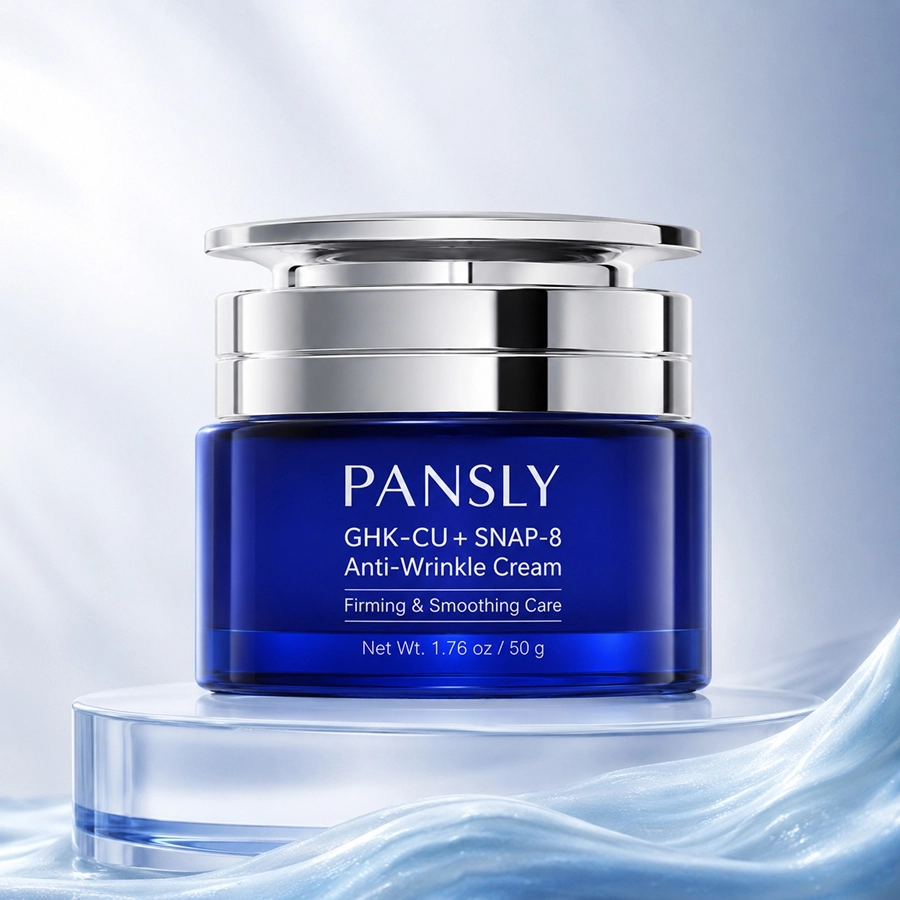
This Pansly GHK-CU + SNAP-8 Anti-Wrinkle Firming Cream is triple-peptide anti-aging facial cream, delivers targeted wrinkle smoothing, firming lifting and deep nourishment for dull, saggy, fine-line prone skin. Full OEM & ODM private label service is supported, including custom formula, packaging options, fast sampling and bulk export supply.
Five core premium active ingredients work synergistically for comprehensive anti-wrinkle care:
GHK-CU Copper Peptide lifts saggy skin, enhances skin resilience and tightens loose facial contour;
SNAP-8 Peptide targets expression lines to visibly soften and fade wrinkles;
Acetyl Hexapeptide-8 reduces the appearance of dry fine lines for smoother skin texture;
Ceramide NP reconstructs skin moisture barrier to lock nourishment and boost comfort;
Hyaluronic Acid delivers multi-layer rich deep moisture to relieve dry rough skin.
Luxury rich creamy texture spreads smoothly and melts into skin gently, leaving soft comfortable finish without heavy greasiness. Daily use blurs fine lines, firms loose skin, deeply nourishes and stabilizes barrier, refining uneven texture to reveal smooth, plump, youthful luminous skin.
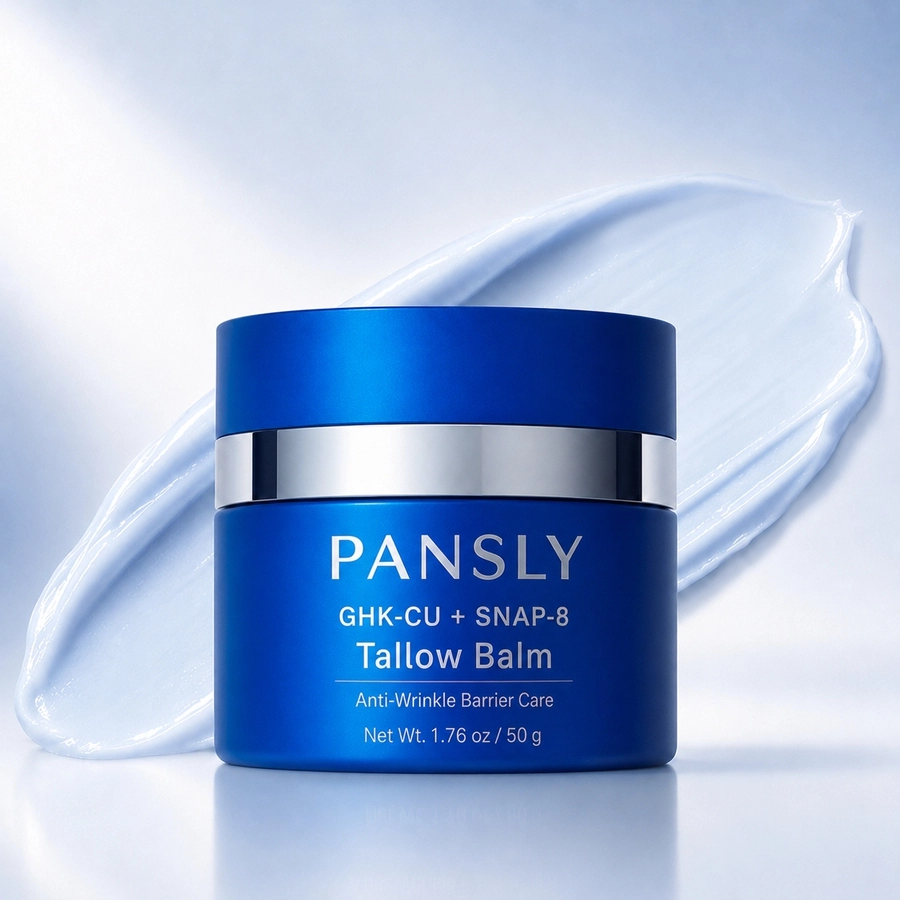
This Pansly GHK-CU + SNAP-8 Tallow Balm is a nourishing anti-wrinkle facial balm specially formulated for dry, fragile and sensitive skin, combining anti-aging wrinkle smoothing and barrier repairing effects. We offer full private label OEM service, including custom logo, adjustable formula, diversified packaging and lid color options.
It contains five core skin care active ingredients: GHK-CU visibly improves fine lines and revives dull complexion; SNAP-8 softens expression lines to smooth wrinkled skin texture; Grass-Fed Beef Tallow delivers deep lipid nourishment to relieve dry rough skin; Ectoin stabilizes the skin barrier and alleviates skin discomfort; Ceramide NP strengthens barrier structure to create smooth, healthy skin.
Luxury creamy blue balm texture glides smoothly and melts quickly on skin, providing long-lasting deep moisturizing comfort. Daily use fades fine lines & expression lines, nourishes dry delicate skin, repairs damaged barrier and leaves silky smooth skin finish.
Click here to customize the Beauty
we respond within a few hours
Monday–Friday, 9AM–6PM
3A01, Building A, Zhisheng Square, No. 4 Zhifu Road, Helong Street, Baiyun District, Guangzhou, China.


Leave a request, and we'll email you back within 24 hours.
© 2026 Beyond Basix. All Rights Reserved.
