
PDRN Centella Soothing Serum for Post-Treatment and Barrier-Focused Skincare
- Barrier-Supportive Serum Design for Sensitive and Post-Treatment Routines
- Why Centella asiatica is commercially relevant
- Understanding the PDRN and polynucleotide positioning
- Post-treatment positioning without overclaiming
- Procurement and Quality Control for a Calming Facial Serum
- Formulation checkpoints that affect commercial success
- Packaging selection and user experience
- Traditional development versus a structured OEM/ODM process
- How Beyond Basix Supports Scalable Private-Label Skincare
- Integrated manufacturing resources for serum programs
- Quality systems and documentation for international buyers
- Beyond facial serums: a broader product portfolio
- Commercial planning and buyer ROI
- Frequently Asked Questions
- Is a PDRN Centella serum suitable for every post-treatment routine?
- What documents should a buyer request from the manufacturer?
- How can a buyer assess the quality of the PDRN ingredient?
- Which packaging is usually considered for a sensitive-skin serum?
- Can an OEM/ODM supplier develop a complete barrier-care product line?
A PDRN Centella soothing serum is positioned at the intersection of post-treatment care, sensitive-skin management, and barrier-focused skincare. The category typically combines a PDRN or polynucleotide-inspired ingredient concept with Centella asiatica extracts, madecassoside, asiaticoside, panthenol, glycerin, beta-glucan, allantoin, ceramides, or other skin-conditioning materials. For brand owners, the commercial opportunity is clear: consumers increasingly seek lightweight products that help reduce the feeling of dryness, tightness, and visible discomfort after intensive beauty routines. However, a successful product requires disciplined formulation, responsible communication, and manufacturing controls rather than a fashionable ingredient label alone.
In cosmetic development, “soothing,” “hydrating,” “comforting,” and “barrier-supportive” are generally more appropriate positioning directions than medical or therapeutic promises. The U.S. Food and Drug Administration guidance on cosmetic and drug claims explains that intended use and marketing language can affect regulatory classification. Buyers should therefore align product claims with the destination market, ingredient documentation, safety assessment, and final packaging copy before commercialization.
Barrier-Supportive Serum Design for Sensitive and Post-Treatment Routines
Why Centella asiatica is commercially relevant
Centella asiatica is widely recognized in cosmetic formulation for its association with skin-conditioning and calming routines. Its key triterpenes, including madecassoside, asiaticoside, asiatic acid, and madecassic acid, can provide a strong storytelling platform for redness-prone, dry, or sensitized-looking skin. The commercial value depends on extract standardization, solvent system, concentration, odor, color, and compatibility with the rest of the formula. A supplier should disclose the botanical source, extraction method, specification range, and available quality documents rather than relying only on the common name printed on a sample label.
For a private-label project, Centella can be paired with humectants such as glycerin, betaine, sodium hyaluronate, or ectoin to improve the immediate hydration experience. Panthenol and beta-glucan can support a comfort-oriented narrative, while ceramides, cholesterol, and fatty acids may be considered when a richer barrier-replenishing texture is required. The final selection should reflect the intended skin type, climate, price tier, packaging format, and target channel. A watery essence, gel serum, and emulsion-serum each require different rheology and preservation strategies.
Understanding the PDRN and polynucleotide positioning
PDRN is commonly described in the market as a purified DNA-fragment or polynucleotide-related cosmetic ingredient. Its source, molecular profile, purification process, INCI naming, permitted use, and supporting documentation must be reviewed for each jurisdiction. Cosmetic buyers should avoid assuming that an ingredient’s clinical or medical associations automatically transfer to an over-the-counter cosmetic product. The National Library of Medicine record on PDRN-related research illustrates why technical evidence must be interpreted in context: research settings, delivery methods, concentrations, and regulatory categories may differ substantially from a cosmetic serum.
From a formulation perspective, the PDRN concept should be assessed for solubility, heat sensitivity, pH tolerance, interaction with electrolytes, and compatibility with preservatives. A manufacturer may recommend adding the active during a controlled cool-down stage to reduce unnecessary thermal exposure. Buyers should also request raw-material specifications, origin statements, microbial limits, heavy-metal controls, allergen information where relevant, and a certificate of analysis for each production lot.
Post-treatment positioning without overclaiming
Post-treatment skincare is a demanding segment because users may apply products when the skin feels unusually dry, warm, tight, or reactive. A suitable cosmetic serum should prioritize a low-irritation sensory profile, minimal unnecessary fragrance, a well-controlled pH, smooth spreadability, and an easy-to-layer finish. Product directions should clarify that the formula is intended for cosmetic use and should not be applied to open wounds or areas where a healthcare professional has advised otherwise.
For buyers, the most useful product brief includes the target procedure context, expected application timing, skin sensitivity profile, desired claims, market, packaging size, and price target. This information enables the OEM/ODM laboratory to select appropriate ingredients and testing routes. It also reduces late-stage reformulation caused by conflicts between a “minimalist” claim, a complex active system, and a demanding shelf-life requirement.
Procurement and Quality Control for a Calming Facial Serum
Formulation checkpoints that affect commercial success
A technically attractive formula can still fail in production if its viscosity changes during filling, the pump cannot draw the product consistently, or the active causes color and odor variation. Buyers should evaluate appearance, odor, pH, viscosity, density, spreadability, centrifuge behavior, freeze-thaw performance, accelerated stability, and preservative effectiveness. The ISO 22716 cosmetics good manufacturing practices standard provides a recognized framework for production, control, storage, and shipment of cosmetic products.
Preservation is particularly important in water-based soothing serums. A formula with botanical extracts, polysaccharides, and multiple active ingredients may create a favorable environment for microbial growth or may challenge the preservative system. A reliable supplier should conduct appropriate microbial testing and, where applicable, preservative efficacy testing using a validated laboratory method. The project owner should receive defined acceptance criteria, test methods, retain-sample procedures, and deviation-handling processes.
Packaging selection and user experience
Airless pumps, treatment pumps, droppers, and single-dose formats each provide different benefits. Airless systems can help reduce repeated exposure to air and fingers, while droppers support a High Quality visual identity but may introduce more handling and dosing variability. Packaging compatibility testing should examine leakage, stress cracking, discoloration, pump functionality, formula adsorption, label adhesion, and interaction between the formula and primary container.
For a post-treatment-oriented product, dispensing control is part of the safety and usability proposition. A pump that delivers a consistent dose can support clear instructions such as applying two to three pumps to clean skin, subject to the final product design. Packaging claims should not imply sterility unless the product is manufactured and validated under the requirements applicable to such a claim. The World Health Organization quality assurance guidance also reinforces the importance of controlled processes and documented quality systems, even though specific requirements depend on the product category and market.
Traditional development versus a structured OEM/ODM process
| Development area | Traditional fragmented sourcing | Structured one-stop OEM/ODM approach | Buyer benefit |
|---|---|---|---|
| Formula development | Separate laboratory, raw-material and filling coordination | Centralized formulation, sampling and production communication | Fewer handoff errors and clearer accountability |
| Quality documentation | Documents may arrive from multiple parties in inconsistent formats | Defined specification, batch records and testing package | More efficient regulatory and procurement review |
| Packaging compatibility | Brand owner coordinates packaging and formula suppliers independently | Formula, component and filling checks managed within one project workflow | Lower risk of leakage, dosing and stability issues |
| Scale-up | Pilot formula may not transfer smoothly to mass production | Process parameters are reviewed before commercial batching | Better consistency between samples and finished goods |
| Portfolio expansion | New categories require new supplier searches | Related skincare, hair care, eye care and body care capabilities | More efficient multi-product brand development |
The comparison reflects operational differences in supplier models rather than a guarantee of performance from any individual manufacturer. Buyers should verify the actual scope of a supplier’s quality system, facility, testing capability, minimum order quantity, lead time, and export documentation during due diligence.
How Beyond Basix Supports Scalable Private-Label Skincare
Integrated manufacturing resources for serum programs
Beyond Basix is the brand and manufacturing partner of Guangzhou Beyond Basix Cosmetics Ltd., a comprehensive cosmetics care manufacturer with more than 23 years of experience in research, production, and sales. Our 12,000-square-meter facility includes a 100,000-level GMPC pharmaceutical-grade dust-free workshop and 12 production lines. Advanced machinery imported from Germany, the United States, and other regions supports controlled processing, filling, and packaging for different project requirements.
Our team has focused on effective-ingredient skincare development for 12 years. For a Centella and PDRN-inspired calming serum, this experience supports the practical stages that buyers need: formula concept development, sample adjustment, texture refinement, packaging matching, production planning, and quality documentation. The objective is not simply to supply a popular active, but to create a commercially viable product with a coherent formula, claim strategy, sensory profile, and cost structure.
Quality systems and documentation for international buyers
Beyond Basix maintains certifications and documents including ISO 9001, CE, MSDS, GMP, HALAL, and other relevant qualifications according to product and market requirements. These credentials should be reviewed against the specific project scope and destination-market expectations. Our manufacturing process emphasizes raw-material control, production hygiene, batch traceability, in-process checks, finished-product inspection, and communication of quality requirements to project owners.
For procurement teams, this structure can simplify supplier evaluation. A practical technical file may include the ingredient list, specifications, certificate of analysis, safety information, stability results, microbial results, packaging details, production records, and artwork review points. The exact document package depends on the destination country and product claims, but early organization helps reduce launch delays and unexpected compliance costs.
Beyond facial serums: a broader product portfolio
Beyond Basix supports development across Skincare Products, Hair Care Products, Eye Care Products, and Body Care Products. This broader capability is useful for brand owners planning a barrier-care collection rather than a single hero SKU. A serum can be coordinated with a gentle cleanser, facial cream, eye treatment, body lotion, scalp product, or aftercare mask while maintaining consistent positioning and packaging architecture.
We operate four major brands—LANTHOME, PANSLY, FIRSTSUN, and SAUVASINE—which reflects our continuing focus on consumer-facing cosmetics and product development. For distributors and investors, a one-stop OEM/ODM relationship can reduce the complexity of managing separate laboratories, filling plants, packaging vendors, and category suppliers. Our team works with partners to balance formula performance, target pricing, minimum order quantity, delivery planning, and market-specific documentation.
Commercial planning and buyer ROI
Return on investment in a calming serum depends on repeat purchase, claims credibility, defect reduction, inventory efficiency, and speed to market. Buyers should compare suppliers using total project cost rather than unit price alone. Important variables include sample iterations, testing fees, packaging tooling, artwork revisions, component minimums, freight configuration, quality claims, and the cost of managing nonconforming goods.
Beyond Basix is committed to offering competitive products, services, and prices while building long-term cooperation with partners. Our role is to help project owners move from a market insight—such as demand for sensitive-skin and post-treatment routines—to a manufacturable, documented, and scalable product. Commercial claims remain subject to the final formula, evidence, and regulatory review, but a disciplined development process gives buyers a stronger foundation for sustainable growth.
Frequently Asked Questions
Is a PDRN Centella serum suitable for every post-treatment routine?
No. Suitability depends on the treatment, skin condition, professional advice, formula composition, and local product instructions. A cosmetic serum should not be positioned for open wounds or as a substitute for medical care.
What documents should a buyer request from the manufacturer?
Buyers should request an ingredient list, raw-material specifications, certificates of analysis, safety information, stability and microbial testing where applicable, packaging details, batch traceability information, and market-specific compliance documents.
How can a buyer assess the quality of the PDRN ingredient?
The buyer should review the ingredient’s INCI name, source, purification method, specification range, molecular or compositional information where available, microbial limits, heavy-metal controls, certificate of analysis, and compatibility with the intended market.
Which packaging is usually considered for a sensitive-skin serum?
Airless pumps, treatment pumps, droppers, and single-dose packaging may all be considered. The choice should reflect formula viscosity, dosing needs, contamination control, brand positioning, compatibility results, and target cost.
Can an OEM/ODM supplier develop a complete barrier-care product line?
Yes, a capable supplier may coordinate facial skincare with hair care, eye care, and body care products. Buyers should confirm the manufacturer’s actual category expertise, formulation resources, production lines, quality system, minimum order quantities, and export support.
Contact Beyond Basix to discuss a customized soothing serum or view our Skincare Products, Hair Care Products, Eye Care Products, and Body Care Products for your next OEM/ODM project.

Elevate your professional skincare offerings with this Private Label Copper Peptide Anti-Wrinkle Firming Serum, a powerhouse concentrate designed for superior age-defying results. This sophisticated formula leverages the synergistic effects of GHK-Cu and SNAP-8 to address multiple layers of skin aging. The GHK-Cu copper peptides act as a vital signaling mechanism to enhance skin density and firmness, while the advanced SNAP-8 octapeptide specifically targets expression lines, helping to relax the appearance of deep-seated wrinkles for a smoother, more refined surface.
This lightweight, rapid-absorption serum provides a professional-grade solution for clients seeking a non-invasive lift. It effectively restores elasticity, improves skin texture, and provides essential antioxidant protection. Perfect for high-end beauty brands, this serum leaves the complexion looking visibly contoured, hydrated, and youthfully revitalized.
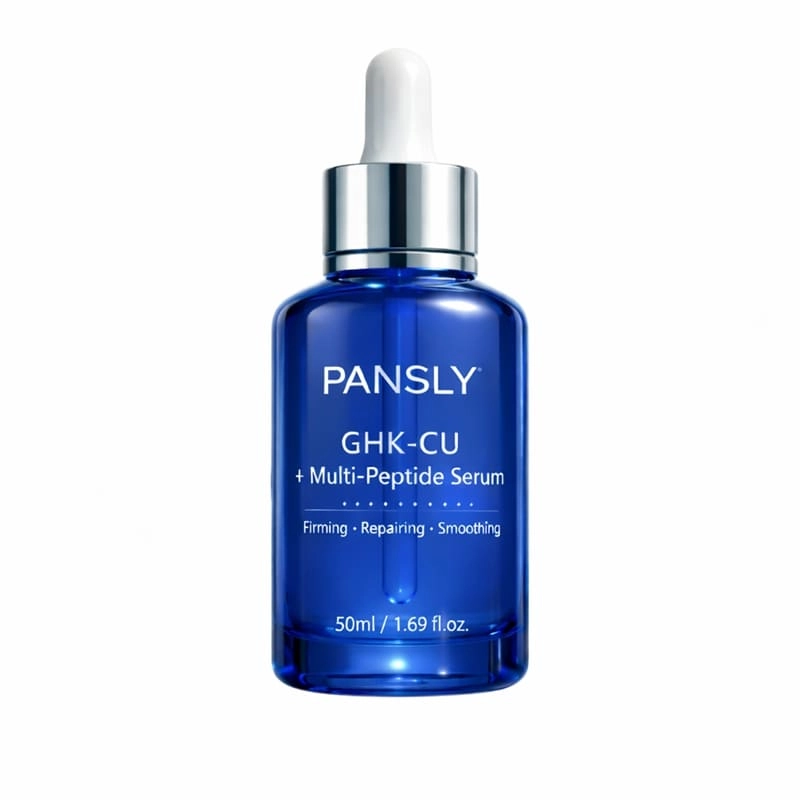
Experience visible rejuvenation with this GHK-Cu Copper Peptide Smoothing & Firming Face Serum, a high-performance concentrate designed to restore the structural integrity of aging skin. This advanced formula centers on GHK-Cu, a powerful signaling peptide clinically recognized for its ability to support natural collagen and elastin production. By promoting dermal density, it effectively tightens sagging skin and smooths the appearance of deep-set wrinkles and fine lines.
The lightweight, silky texture absorbs instantly, delivering antioxidant protection to neutralize environmental stressors that accelerate aging. Enhanced with deep-moisturizing agents, the serum reinforces the skin's moisture barrier, leaving the complexion feeling remarkably soft and resilient. With consistent use, skin texture is refined and facial contours appear more lifted, resulting in a youthfully firm and revitalized glow.
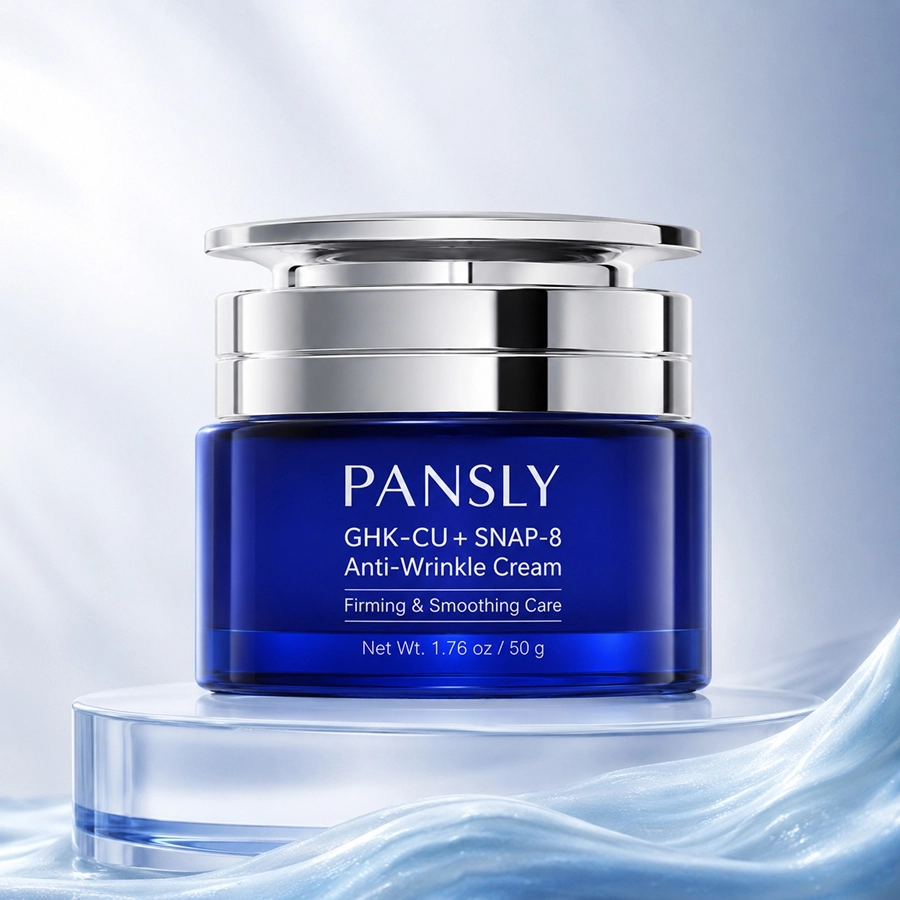
This Pansly GHK-CU + SNAP-8 Anti-Wrinkle Firming Cream is triple-peptide anti-aging facial cream, delivers targeted wrinkle smoothing, firming lifting and deep nourishment for dull, saggy, fine-line prone skin. Full OEM & ODM private label service is supported, including custom formula, packaging options, fast sampling and bulk export supply.
Five core premium active ingredients work synergistically for comprehensive anti-wrinkle care:
GHK-CU Copper Peptide lifts saggy skin, enhances skin resilience and tightens loose facial contour;
SNAP-8 Peptide targets expression lines to visibly soften and fade wrinkles;
Acetyl Hexapeptide-8 reduces the appearance of dry fine lines for smoother skin texture;
Ceramide NP reconstructs skin moisture barrier to lock nourishment and boost comfort;
Hyaluronic Acid delivers multi-layer rich deep moisture to relieve dry rough skin.
Luxury rich creamy texture spreads smoothly and melts into skin gently, leaving soft comfortable finish without heavy greasiness. Daily use blurs fine lines, firms loose skin, deeply nourishes and stabilizes barrier, refining uneven texture to reveal smooth, plump, youthful luminous skin.
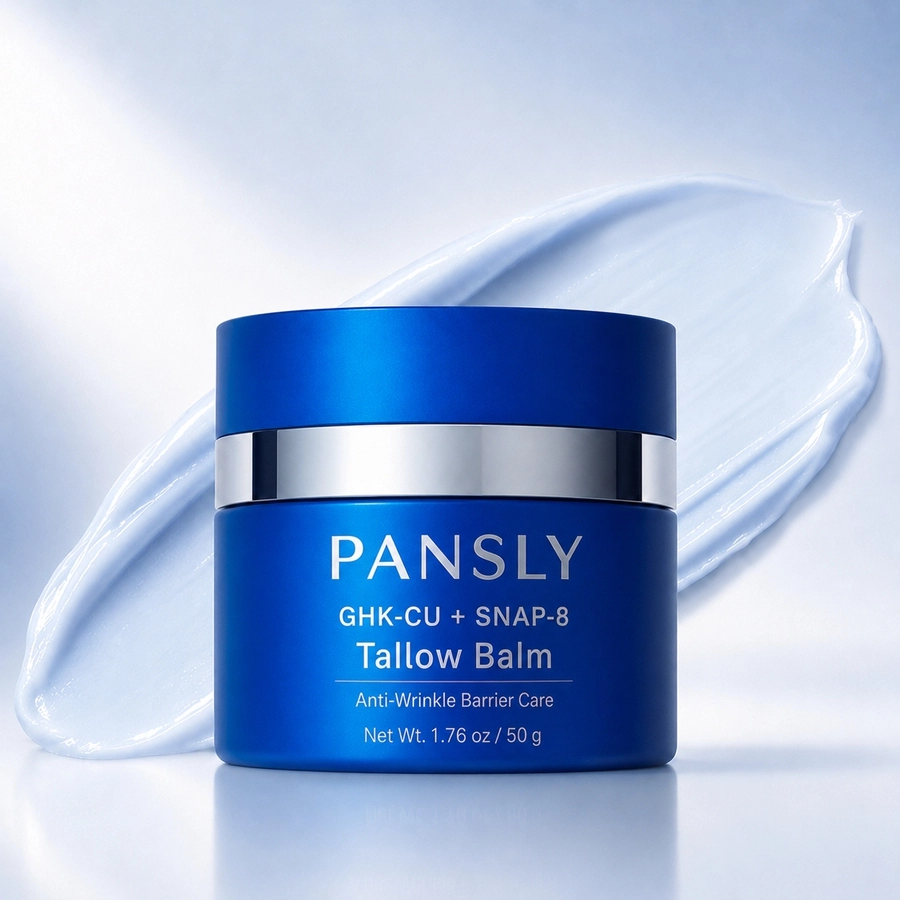
This Pansly GHK-CU + SNAP-8 Tallow Balm is a nourishing anti-wrinkle facial balm specially formulated for dry, fragile and sensitive skin, combining anti-aging wrinkle smoothing and barrier repairing effects. We offer full private label OEM service, including custom logo, adjustable formula, diversified packaging and lid color options.
It contains five core skin care active ingredients: GHK-CU visibly improves fine lines and revives dull complexion; SNAP-8 softens expression lines to smooth wrinkled skin texture; Grass-Fed Beef Tallow delivers deep lipid nourishment to relieve dry rough skin; Ectoin stabilizes the skin barrier and alleviates skin discomfort; Ceramide NP strengthens barrier structure to create smooth, healthy skin.
Luxury creamy blue balm texture glides smoothly and melts quickly on skin, providing long-lasting deep moisturizing comfort. Daily use fades fine lines & expression lines, nourishes dry delicate skin, repairs damaged barrier and leaves silky smooth skin finish.
Click here to customize the Beauty
we respond within a few hours
Monday–Friday, 9AM–6PM
3A01, Building A, Zhisheng Square, No. 4 Zhifu Road, Helong Street, Baiyun District, Guangzhou, China.


Leave a request, and we'll email you back within 24 hours.
© 2026 Beyond Basix. All Rights Reserved.
