
The latest trends for pdrn eye patches | Beyond Basix Ultimate Insights
- Regional Macroeconomic and Regulatory Drivers
- Manufacturing infrastructure and OEM/ODM scale
- Regulatory pathways and safety standards
- Trade and ingredient sourcing dynamics
- Ingredient & Formulation Innovations in Eye Care
- Polynucleotide (PDRN) technology and delivery systems
- Advanced hydrogel matrices and sustained release
- Combination actives: peptides, growth factors, and PDRN synergy
- Supply Chain, Quality, and Commercialization Strategies
- Scale-up and GMP/compliance
- Packaging, sustainability, and consumer expectations
- Channel strategies: professional vs mass-market
- Market Trajectory and Competitive Landscape
- Market adoption rates and target demographics
- OEM/ODM positioning and white-label demand
- Pricing, margins, and procurement timelines
- FAQ Main Title
Beyond Basix presents a concise enterprise-grade view on pdrn eye patches that synthesizes the latest formulation science, regulatory pressure points, and OEM/ODM scale considerations—so brand owners and procurement teams can de-risk launch timelines, evaluate polynucleotide delivery options, and align margin models to 2026 market realities.
Regional Macroeconomic and Regulatory Drivers
Manufacturing infrastructure and OEM/ODM scale
Capacity and proximity matter for pdrn eye patches because polynucleotide-based products require cold-chain-aware ingredient sourcing, sterile handling, and validated filling lines for hydrogel matrices. Guangzhou Beyond Basix Cosmetics Ltd. operates a 12,000-square-meter production campus with a 100,000-level GMPC pharmaceutical-grade dust-free workshop and 12 production lines—assets that materially shorten OEM lead times compared to smaller contract manufacturers and reduce compliance risk when scaling polynucleotide eye patches from clinical samples to retail SKUs.
Regulatory pathways and safety standards
Regulatory frameworks for topical cosmetic devices and cosmeceuticals diverge across jurisdictions. The EU cosmetics regulation emphasizes safety dossiers and restricted substances; the US FDA regulates cosmetics under a different rubric focused on adulteration and misbranding. For manufacturers and brand owners evaluating pdrn eye patches, aligning testing (stability, preservative efficacy, skin irritation) with FDA cosmetic guidance and Good Manufacturing Practices such as ISO 22716 is essential to ensure multi-region market access.
Trade and ingredient sourcing dynamics
Global supply chains for polynucleotide precursors and hydrogel polymers tightened in the late 2010s and recovered with diversification in 2022–2024. Buyers should expect tighter lead times for high-purity PDRN (polydeoxyribonucleotide) raw materials during demand spikes; establishing strategic supplier agreements and holding validated secondary suppliers is now standard procurement practice for reliable pdrn eye patches production.
Ingredient & Formulation Innovations in Eye Care
Polynucleotide (PDRN) technology and delivery systems
PDRN acts as a regenerative stimulus through adenosine A2A receptor interactions and extracellular matrix modulation—attributes that have driven interest in topical and peri-ocular delivery. Successful pdrn eye patches hinge on maintaining polynucleotide integrity during formulation and delivery; optimized pH, chelator selection, and enzyme-inhibiting excipients are standard to preserve activity through shelf life and upon application.
Advanced hydrogel matrices and sustained release
Hydrogel innovations—crosslinked, biomimetic matrices and layered adhesive hydrogels—are the leading vectors for sustained polynucleotide delivery under the eye. PDRN hydrogel eye patches that use semi-occlusive, low-irritation adhesives achieve longer contact time and improved percutaneous transfer, addressing a core buyer concern: measurable efficacy in a single-use format.
Combination actives: peptides, growth factors, and PDRN synergy
Formulators increasingly pair pdrn eye patches with complementary actives—short peptides for collagen signaling, stabilized growth-factor mimetics, and antioxidant encapsulates—to achieve synergistic outcomes. For OEM/ODM partners, compatibility testing (chemical, physical, and microbiological) between PDRN and co-actives is a non-negotiable step in the product development lifecycle to avoid potency loss or instability.
Supply Chain, Quality, and Commercialization Strategies
Scale-up and GMP/compliance
Scale-up of pdrn eye patches is not purely volumetric: it requires validated aseptic processes, environmental monitoring, and real-time batch release analytics. Beyond Basix’s ISO, GMP, and CE certifications and its pharmacy-grade workshops enable quicker technology transfer from lab to production while maintaining batch traceability for polynucleotide-containing products.
Packaging, sustainability, and consumer expectations
Packaging for pdrn eye patches increasingly balances barrier protection (to preserve polynucleotide stability) with sustainability goals. Innovations such as recyclable foil laminates with secondary barrier inserts and minimal single-use plastics are becoming procurement priorities without compromising sterility and shelf life, which are crucial for High Quality pdrn eye patches positioned in professional channels.
Channel strategies: professional vs mass-market
Market segmentation for pdrn eye patches separates professional-use formats (clinics and dermatologists) from consumer retail. Professional channels prioritize higher-concentration PDRN formulations and robust clinical dossiers; mass-market channels favor convenience, lower-cost hydrogel patches, and strong claims substantiation. OEM/ODM partners must be prepared to produce both regulated professional SKUs and consumer-friendly variants using the same manufacturing backbone.
Market Trajectory and Competitive Landscape
Market adoption rates and target demographics
Adoption is fastest among consumers seeking evidence-led anti-aging interventions near the eye—millennials through older Gen X purchasers in urban markets—and among clinics offering adjunctive aesthetic services. Demand for pdrn eye patches is rising where regenerative ingredients have clinical validation, but differentiation requires robust clinical endpoints: reduction in periorbital fine lines, improved skin elasticity, and patient-reported outcome measures.
OEM/ODM positioning and white-label demand
Brands seek one-stop OEM/ODM partners that can supply formulation innovation, stability testing, contract packaging, and regulatory support for labeling claims. Beyond Basix’s full-service model—from R&D to 12 production lines—positions it as a regional leader for partners requiring rapid market entry and multi-SKU rollouts of pdrn eye patches.
Pricing, margins, and procurement timelines
High-purity PDRN raises COGS relative to basic hydrogel eye patches, but High Quality pricing is attainable when supported by clinical endpoints and professional endorsements. Typical OEM lead times for validated formulations are 8–14 weeks from contract signature to pilot run for established formulas, with longer windows for novel polynucleotide blends requiring additional stability and compatibility studies.
| Metric | Historical (2016–2021) | Current (2024) | Near-Future Projection (2026) |
|---|---|---|---|
| Demand drivers | Clinical curiosity, limited consumer awareness | Clinical studies + influencer adoption | Broader consumer adoption via clinic-to-retail channels |
| Typical formulations | Simple PDRN serums or gels | PDRN hydrogel eye patches with combined peptides | Layered sustained-release hydrogels and higher-concentration options |
| Regulatory complexity | Low-to-moderate (early-stage) | Moderate (region-specific safety dossiers) | Higher (standardized testing expectations and labeling scrutiny) |
| OEM lead time (validated SKU) | 10–20 weeks | 8–14 weeks | 6–12 weeks with strategic supplier agreements |
| Buyer focus | Proof-of-concept | Clinical efficacy and brand story | Scalability, sustainability, and multi-region compliance |
For procurement teams: require detailed CMC (chemistry, manufacturing, and controls) documentation for PDRN raw materials, validated stability data for the target retail climates, and contracts that include secondary supplier clauses for critical polynucleotide ingredients to mitigate supply shocks.
Key references and resources for regulatory and scientific context include the FDA cosmetic overview for market requirements (FDA Cosmetics), ISO guidance on cosmetic GMP (ISO 22716), the European regulatory framework for cosmetics (EU Cosmetics Regulation), and foundational polymer delivery science as it pertains to hydrogels (Hydrogel Overview).
Operational checklist for B2B buyers evaluating partners for pdrn eye patches: verify laboratory batch certificates for PDRN purity, review environmental monitoring logs for the filling suite, confirm packaging barrier performance for the intended markets, and contract clinical or consumer studies that match intended claims.
Beyond Basix combines 23 years of sector expertise, in-house R&D focused on active ingredients, and a multi-brand operating history—LANTHOME, PANSLY, FIRSTSUN, and SAUVASINE—making it a pragmatic partner for brands seeking reliable manufacture of High Quality pdrn eye patches at scale.
Contact Beyond Basix today to discuss custom OEM/ODM pdrn eye patches solutions and scaled manufacturing timelines.
FAQ Main Title
What are pdrn eye patches and how do they work?
PDRN eye patches are topical, periorbital treatments formulated with polydeoxyribonucleotide (PDRN) designed to support tissue repair and improve periorbital skin quality through extracellular matrix modulation and receptor-mediated pathways when delivered effectively via hydrogel matrices.
How should a brand evaluate OEM/ODM partners for pdrn eye patches?
Brands should evaluate OEM partners based on GMP and ISO certifications, sterile filling capabilities, environmental monitoring, validated stability data for PDRN, supplier redundancy for polynucleotide raw materials, and the partner’s track record with clinical or consumer efficacy testing.
What formulation challenges are specific to PDRN in eye patches?
Key challenges include maintaining polynucleotide integrity (pH control, enzyme inhibition), ensuring compatibility with co-actives (peptides, antioxidants), and designing hydrogel matrices that provide sustained release while minimizing irritation in the delicate periorbital area.
What are realistic lead times and cost drivers when ordering PDRN eye patches?
Validated SKU lead times typically range from 8–14 weeks for manufacturers with established lines; major cost drivers are high-purity PDRN raw materials, aseptic/sterile handling requirements, barrier-grade packaging, and any required clinical testing supporting product claims.
How are regulatory requirements changing for polynucleotide-containing cosmetics?
Regulatory expectations are trending toward more rigorous safety dossiers and substantiation for functional claims; brand owners should align testing with regional authorities (e.g., FDA guidance, EU safety assessments) and follow recognized GMP standards (such as ISO 22716) to facilitate multi-region launch.

Elevate your professional skincare offerings with this Private Label Copper Peptide Anti-Wrinkle Firming Serum, a powerhouse concentrate designed for superior age-defying results. This sophisticated formula leverages the synergistic effects of GHK-Cu and SNAP-8 to address multiple layers of skin aging. The GHK-Cu copper peptides act as a vital signaling mechanism to enhance skin density and firmness, while the advanced SNAP-8 octapeptide specifically targets expression lines, helping to relax the appearance of deep-seated wrinkles for a smoother, more refined surface.
This lightweight, rapid-absorption serum provides a professional-grade solution for clients seeking a non-invasive lift. It effectively restores elasticity, improves skin texture, and provides essential antioxidant protection. Perfect for high-end beauty brands, this serum leaves the complexion looking visibly contoured, hydrated, and youthfully revitalized.
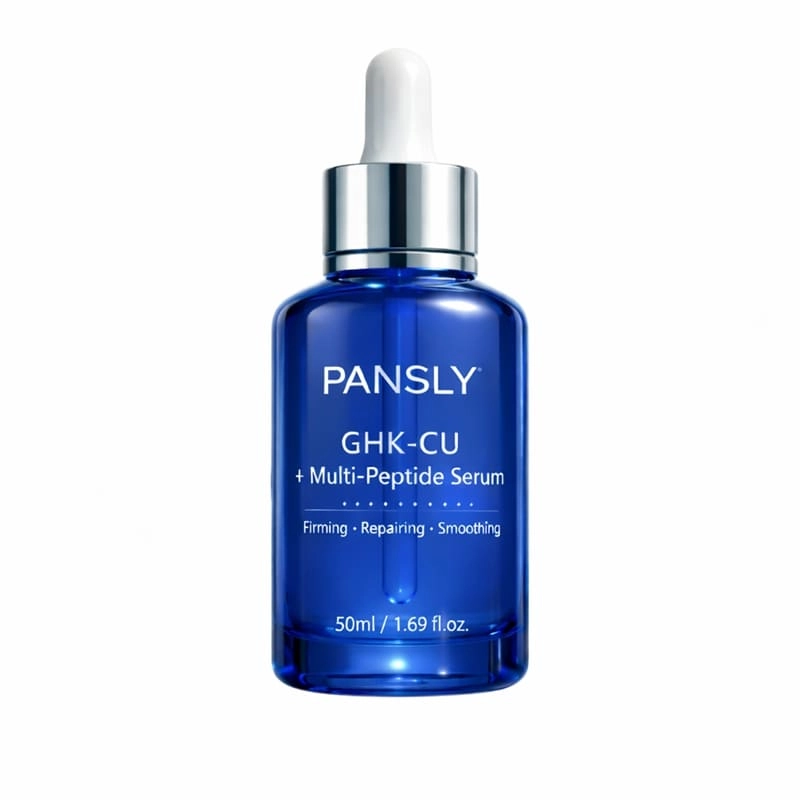
Experience visible rejuvenation with this GHK-Cu Copper Peptide Smoothing & Firming Face Serum, a high-performance concentrate designed to restore the structural integrity of aging skin. This advanced formula centers on GHK-Cu, a powerful signaling peptide clinically recognized for its ability to support natural collagen and elastin production. By promoting dermal density, it effectively tightens sagging skin and smooths the appearance of deep-set wrinkles and fine lines.
The lightweight, silky texture absorbs instantly, delivering antioxidant protection to neutralize environmental stressors that accelerate aging. Enhanced with deep-moisturizing agents, the serum reinforces the skin's moisture barrier, leaving the complexion feeling remarkably soft and resilient. With consistent use, skin texture is refined and facial contours appear more lifted, resulting in a youthfully firm and revitalized glow.
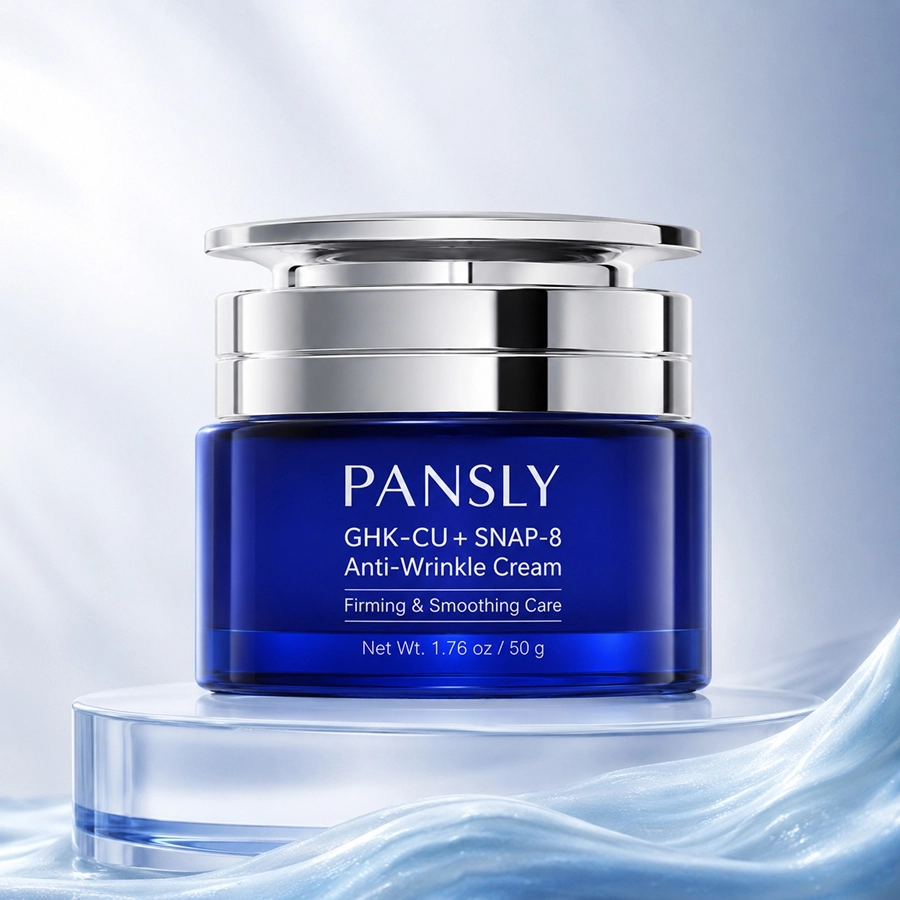
This Pansly GHK-CU + SNAP-8 Anti-Wrinkle Firming Cream is triple-peptide anti-aging facial cream, delivers targeted wrinkle smoothing, firming lifting and deep nourishment for dull, saggy, fine-line prone skin. Full OEM & ODM private label service is supported, including custom formula, packaging options, fast sampling and bulk export supply.
Five core premium active ingredients work synergistically for comprehensive anti-wrinkle care:
GHK-CU Copper Peptide lifts saggy skin, enhances skin resilience and tightens loose facial contour;
SNAP-8 Peptide targets expression lines to visibly soften and fade wrinkles;
Acetyl Hexapeptide-8 reduces the appearance of dry fine lines for smoother skin texture;
Ceramide NP reconstructs skin moisture barrier to lock nourishment and boost comfort;
Hyaluronic Acid delivers multi-layer rich deep moisture to relieve dry rough skin.
Luxury rich creamy texture spreads smoothly and melts into skin gently, leaving soft comfortable finish without heavy greasiness. Daily use blurs fine lines, firms loose skin, deeply nourishes and stabilizes barrier, refining uneven texture to reveal smooth, plump, youthful luminous skin.
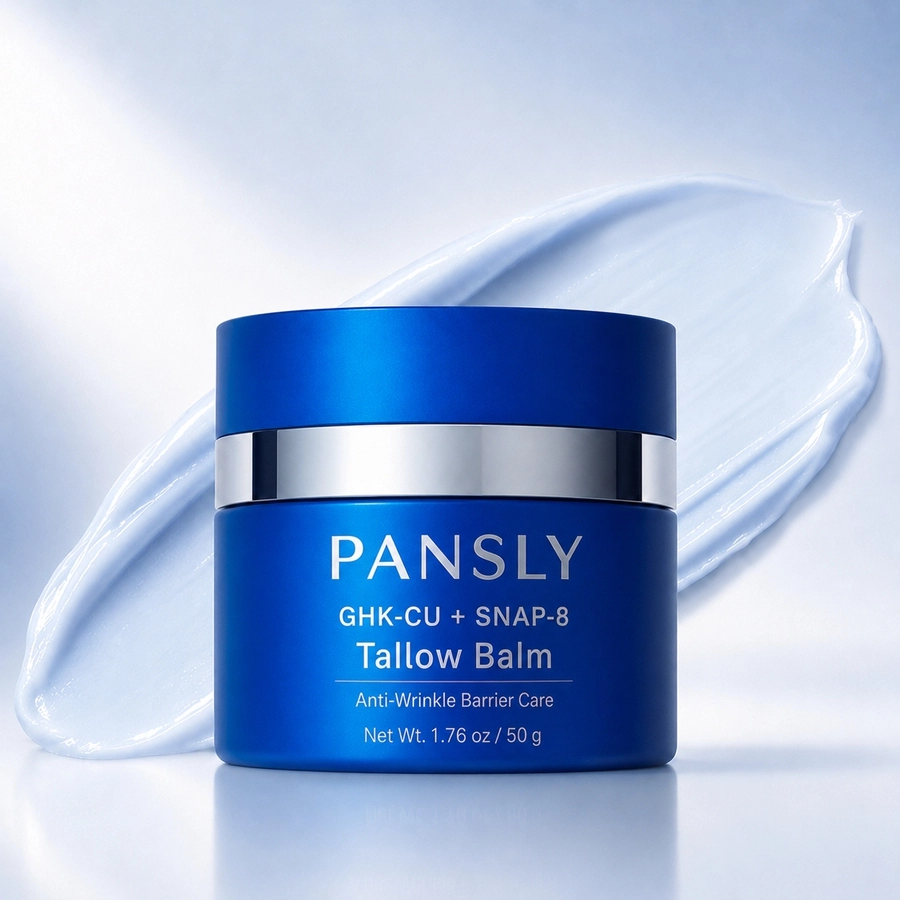
This Pansly GHK-CU + SNAP-8 Tallow Balm is a nourishing anti-wrinkle facial balm specially formulated for dry, fragile and sensitive skin, combining anti-aging wrinkle smoothing and barrier repairing effects. We offer full private label OEM service, including custom logo, adjustable formula, diversified packaging and lid color options.
It contains five core skin care active ingredients: GHK-CU visibly improves fine lines and revives dull complexion; SNAP-8 softens expression lines to smooth wrinkled skin texture; Grass-Fed Beef Tallow delivers deep lipid nourishment to relieve dry rough skin; Ectoin stabilizes the skin barrier and alleviates skin discomfort; Ceramide NP strengthens barrier structure to create smooth, healthy skin.
Luxury creamy blue balm texture glides smoothly and melts quickly on skin, providing long-lasting deep moisturizing comfort. Daily use fades fine lines & expression lines, nourishes dry delicate skin, repairs damaged barrier and leaves silky smooth skin finish.
Click here to customize the Beauty
we respond within a few hours
Monday–Friday, 9AM–6PM
3A01, Building A, Zhisheng Square, No. 4 Zhifu Road, Helong Street, Baiyun District, Guangzhou, China.


Leave a request, and we'll email you back within 24 hours.
© 2026 Beyond Basix. All Rights Reserved.
