
Dark Circles, Dryness or Fine Lines: How Should Brands Position PDRN Eye Patches?
- How Should Brands Define the Benefit Territory of Regenerative-Looking Eye Care?
- Start with the biology and appearance of the concern
- Use PDRN and NAD+ as a technology story, not a single promise
- Match the positioning to a commercially meaningful occasion
- How Can Buyers Convert Ingredient Interest into a Scalable Product Brief?
- Specify the formula beyond the hero ingredients
- Engineer the patch as a delivery and usability system
- Build an evidence ladder for each claim
- What Procurement and Regulatory Teams Should Validate Before Launch
- Check ingredient identity, documentation, and claim boundaries
- Audit the supplier’s process capability
- Calculate total project economics
- Why Beyond Basix Can Support a Full Eye-Patch Development Program
- Integrated manufacturing resources for multi-category brands
- Technical depth for effective-ingredient skincare
- Certifications, portfolio breadth, and partnership value
- Frequently Asked Questions
- Should a brand position a nucleotide eye patch primarily for dark circles?
- Are PDRN and NAD+ eye patches suitable for dry under-eye skin?
- What testing should buyers request before approving an OEM sample?
- Can a manufacturer provide private-label eye patches and custom development?
- What certifications are important when sourcing eye-area skincare internationally?
- How can a brand control the cost of an advanced eye-patch project?
PDRN and NAD+ eye patches should be positioned according to a clearly defined consumer concern rather than as a universal anti-aging product. Brands can build stronger product-market fit by separating dark-circle care, dehydration relief, and fine-line smoothing into distinct benefit narratives, while controlling ingredient claims, substrate performance, packaging stability, regulatory documentation, and clinical substantiation. A capable One-Stop OEM/ODM for Skincare partner can support formula development, hydrogel engineering, eye-area safety testing, packaging, compliance, and scalable production from concept to launch.
How Should Brands Define the Benefit Territory of Regenerative-Looking Eye Care?
Start with the biology and appearance of the concern
Dark circles, dryness, and fine lines are visible in the same small facial area, but they do not have the same causes. Periorbital darkness may be influenced by pigmentation, visible blood vessels, shadowing from facial structure, thin skin, or fatigue-related appearance. Dehydration is more closely associated with reduced surface water, a compromised-feeling barrier, and temporary tightness. Fine lines can become more noticeable when the stratum corneum is dry, while longer-term lines are associated with intrinsic aging, repeated facial movement, and environmental exposure.
This distinction matters for product positioning. A patch designed for a refreshed-looking eye area should not automatically promise correction of every form of dark circle. Buyers need a claims architecture that separates cosmetic appearance benefits from medical or biological claims. The FDA cosmetics labeling guidance explains why wording, intended use, and presentation can influence the regulatory classification of a product. Terms such as “helps reduce the appearance of” are generally more controllable than absolute language such as “repairs” or “eliminates.”
Use PDRN and NAD+ as a technology story, not a single promise
Polydeoxyribonucleotide, commonly abbreviated as PDRN, is an ingredient category associated with nucleotide-derived materials and research into tissue-supporting pathways. NAD+, or nicotinamide adenine dinucleotide, is a coenzyme involved in cellular redox reactions and energy metabolism. In a cosmetic eye patch, however, topical performance depends on more than ingredient recognition. Molecular stability, concentration, delivery vehicle, pH, preservative strategy, contact time, and the condition of the skin all influence the consumer experience.
For this reason, brands should avoid treating a PDRN and NAD+ hydrogel as a direct substitute for a clinical procedure. A more defensible narrative is “advanced nucleotide-inspired eye care for a smoother, fresher-looking eye contour,” supported by hydration, comfort, and appearance testing. Scientific background can be reviewed through peer-reviewed PDRN research indexed in PubMed, while the final cosmetic claim must still reflect the actual formula and evidence package.
Match the positioning to a commercially meaningful occasion
Eye patches are frequently purchased for visible, short-term occasions: morning depuffing routines, travel recovery, pre-makeup preparation, evening self-care, and High Quality gift sets. This creates an opportunity to position the same ingredient platform through different consumer entry points. A dark-circle concept can focus on a more awake-looking eye contour. A dryness concept can emphasize cushion, cooling sensation, and immediate comfort. A fine-line concept can communicate a smoother-looking surface after the patch is removed and with continued use, provided the brand has suitable testing.
For B2B buyers, the occasion also affects channel selection. A clinically styled anti-aging concept may suit dermatology-adjacent retail and High Quality e-commerce, whereas a bright, single-use format may perform better in travel, beauty subscription, and social commerce channels. Procurement teams should therefore define the target customer, retail price, repeat-purchase expectation, and usage occasion before approving the formula.
How Can Buyers Convert Ingredient Interest into a Scalable Product Brief?
Specify the formula beyond the hero ingredients
A complete brief should identify the desired hydration system, humectants, emollients, soothing agents, antioxidant support, fragrance policy, color requirements, and preservative approach. Hyaluronic acid, glycerin, betaine, panthenol, allantoin, and certain botanical extracts may support a hydration-led proposition, but the selection must be evaluated for compatibility with the nucleotide ingredients and the sensitive eye area. “Clean,” vegan, halal, fragrance-free, and dermatologically tested are not interchangeable claims; each requires a defined standard and documentation pathway.
The brief should also state whether the brand wants an instant sensory effect, a cumulative-use program, or both. A cooling sensation can come from the hydrogel, water content, storage recommendation, or selected sensory ingredients. Strong cooling is not automatically better because excessive stimulation may reduce comfort around the eyes. A reliable manufacturer should assess sting potential, adhesion, serum migration, tear-area tolerance, and removal behavior rather than evaluating only the ingredient list.
Engineer the patch as a delivery and usability system
The substrate determines how much essence is retained, how evenly the product contacts the skin, and whether the patch stays in place during use. Hydrogel, bio-cellulose, nonwoven, and other sheet formats offer different combinations of adhesion, serum loading, transparency, thickness, biodegradability, and cost. A High Quality eye contour product may require a thin, flexible patch with a contoured edge, while a mass-market SKU may prioritize efficient filling, stable stacking, and lower packaging cost.
Buyers should request measurable specifications, including patch dimensions, unit weight, essence fill weight, pH range, viscosity, microbial limits, storage conditions, and target shelf life. Packaging is equally important. Individual sachets can improve hygiene and dosing consistency, while jar formats may create a more luxurious presentation but require careful preservation and consumer-use instructions. Compatibility testing should confirm that the pouch, adhesive layer, ink, and formula do not create leakage, discoloration, or interaction during accelerated stability studies.
Build an evidence ladder for each claim
Not every launch requires a large clinical trial, but every important claim needs an appropriate level of support. A practical evidence ladder may include raw-material documentation, formula stability, microbiological testing, safety assessment, instrumental hydration measurements, consumer perception studies, and before-and-after photography under controlled conditions. The claim “immediately hydrates the eye area” requires different support from “visibly reduces the appearance of fine lines after four weeks.”
Manufacturers and project owners should agree on test design before production. The study population, application frequency, comparison method, environmental controls, evaluator training, and statistical reporting all affect credibility. The ISO 22716 good manufacturing practices framework is also relevant when buyers evaluate production controls for cosmetic products. A documented quality system does not replace claim substantiation, but it strengthens manufacturing reliability and audit readiness.
| Positioning route | Primary consumer concern | Recommended benefit language | Key development priorities | Commercial fit |
|---|---|---|---|---|
| Brightening and refreshed appearance | Dull-looking or tired eye contour | Helps the eye area look brighter and more awake | Comfort, hydration, optical appearance, controlled brightening support | Mass High Quality, travel, morning routines |
| Hydration and barrier comfort | Dryness, tightness, makeup creasing | Provides immediate moisture and a smoother-feeling surface | Humectant balance, essence retention, adhesion, sting testing | Daily skincare, sensitive-skin ranges |
| Fine-line smoothing | Dehydration lines and visible texture | Helps reduce the appearance of fine lines with regular use | Instrumental hydration, profilometry or validated imaging, use-period study | High Quality anti-aging, professional retail |
| Advanced nucleotide technology | Consumers seeking innovative ingredients | Powered by a PDRN and NAD+ ingredient system for a refreshed-looking contour | Ingredient identity, stability, compatibility, compliant communication | Tech-led e-commerce, prestige launches |
What Procurement and Regulatory Teams Should Validate Before Launch
Check ingredient identity, documentation, and claim boundaries
Ingredient naming must be consistent across the formula, specification sheet, artwork, product information file, and market-specific notification documents. Buyers should request certificates of analysis, safety data sheets where applicable, allergen information, origin statements, and a clear explanation of the PDRN source and processing method. If NAD+ is included, the supplier should clarify its grade, assay, stability profile, and recommended use level.
Global distribution adds complexity because cosmetic ingredient status and claim expectations vary by market. The European Commission CosIng database can help teams review ingredient information for the European market, but it should not be treated as blanket approval for a finished product or a specific marketing claim. Local regulatory review remains necessary for the destination market, label language, warnings, responsible-person obligations, and product notification process.
Audit the supplier’s process capability
A supplier evaluation should cover more than a factory tour and a sample kit. Buyers should assess raw-material receiving, weighing controls, water treatment, batch traceability, environmental monitoring, filling accuracy, seal integrity, quarantine release, deviation handling, complaint management, and retained-sample procedures. The factory’s production scale must also match the commercial plan. A supplier that can make laboratory samples but cannot maintain consistency across several million sachets creates launch and replenishment risk.
Quality agreements should define approval samples, change-control procedures, acceptable quality limits, testing responsibilities, lead times, packaging ownership, and actions for nonconforming goods. This is especially important for eye-area products because leakage, contamination, poor adhesion, or excessive serum migration can generate high complaint rates even when the formula itself is acceptable.
Calculate total project economics
Unit price is only one part of the cost structure. Project owners should model formula development, testing, molds, sachet artwork, translation, regulatory review, freight, minimum order quantity, inventory holding, and potential rework. A more expensive hydrogel can still create superior ROI if it improves perceived efficacy, reduces returns, supports a higher retail price, or increases repeat purchase. Conversely, an advanced ingredient story may fail commercially if the patch dries out, slips during use, or is packaged in a format that consumers find inconvenient.
Forecasting should include a pilot order before a full-scale commitment. Pilot production can validate filling speed, patch placement, sachet sealing, carton packing, shipping conditions, and the consumer unboxing experience. For international brands, transport simulation and stability checks under expected climate conditions are valuable safeguards against leakage and performance loss.
Why Beyond Basix Can Support a Full Eye-Patch Development Program
Integrated manufacturing resources for multi-category brands
Beyond Basix operates as Guangzhou Beyond Basix Cosmetics Ltd., a comprehensive cosmetics care manufacturer with more than 23 years of experience in research, production, and sales. Our 12,000-square-meter facility includes a 100,000-level GMPC pharmaceutical-grade dust-free workshop and 12 production lines. Advanced machinery imported from Germany, the United States, and other regions supports controlled manufacturing, efficient filling, and scalable output.
For brands developing a nucleotide-based eye contour product, our role can extend from concept definition and sample development to formula refinement, packaging coordination, production, and delivery. This One-Stop OEM/ODM for Skincare model reduces the number of handoffs between ingredient sourcing, laboratory teams, packaging vendors, quality personnel, and logistics operators. Fewer interfaces can improve timeline control and make responsibility clearer when the project requires revisions.
Technical depth for effective-ingredient skincare
Our team has focused on skincare products with effective ingredients for 12 years. That specialization supports the development of eye care formats where sensory performance and formula stability must work together. The project can be structured around a hydration-first patch, a brightening appearance concept, a fine-line smoothing program, or a differentiated PDRN and NAD+ platform, depending on the target market and permissible claims.
Development discussions can cover hydrogel or sheet selection, essence viscosity, patch contour, fragrance-free options, packaging format, color and finish, recommended application time, and evidence planning. The objective is not simply to add fashionable ingredients. It is to create a coherent product in which the ingredient narrative, user experience, packaging, claims, and production economics reinforce one another.
Certifications, portfolio breadth, and partnership value
Beyond Basix maintains certifications and documentation including ISO 9001, CE, MSDS, GMP, HALAL, and other market-relevant qualifications, subject to product and destination requirements. Buyers should verify the exact scope and validity of documents for each project, but an established quality and compliance framework provides a stronger foundation for international procurement.
Our portfolio extends beyond eye care. We support skincare products, hair care products, eye care products, and body care products, enabling brand owners to coordinate multiple categories through one manufacturing partner. Beyond Basix also operates four brands—LANTHOME, PANSLY, FIRSTSUN, and SAUVASINE—which reflects experience in developing and managing consumer-facing beauty concepts as well as contract manufacturing programs.
For investors, distributors, and established beauty companies, the commercial advantage is coordination. A single partner can help align formula development, packaging design, production capacity, quality documentation, and replenishment planning. That structure can be particularly useful when an eye-patch launch is intended to become part of a broader anti-aging, sensitive-skin, or professional skincare assortment.
Frequently Asked Questions
Should a brand position a nucleotide eye patch primarily for dark circles?
Only when the product evidence and formula support a compliant appearance claim. Because dark circles have multiple causes, brands should usually communicate a brighter, more rested-looking eye contour rather than promise universal correction.
Are PDRN and NAD+ eye patches suitable for dry under-eye skin?
They can be developed for a hydration-led proposition when the formula uses a suitable humectant and soothing system, provides comfortable contact, and passes eye-area safety and stability evaluations. The patch format and essence retention are as important as the hero ingredients.
What testing should buyers request before approving an OEM sample?
Buyers should request ingredient documentation, microbiological testing, stability data, packaging compatibility, seal integrity, safety assessment, and claim-support testing appropriate to the intended benefits. Hydration and fine-line claims should be linked to defined measurement methods and study conditions.
Can a manufacturer provide private-label eye patches and custom development?
A capable OEM/ODM partner can offer either a faster private-label route or a more customized program involving formula, patch material, packaging, fragrance policy, claims, and testing. The correct route depends on launch timing, differentiation requirements, minimum order quantity, and regulatory needs.
What certifications are important when sourcing eye-area skincare internationally?
Buyers should review the supplier’s quality-management and cosmetic manufacturing documentation, such as ISO 9001 and GMP-related records, together with product-specific safety, labeling, and market compliance documents. Certifications should be verified for current validity and relevant scope.
How can a brand control the cost of an advanced eye-patch project?
Cost control improves when the brand defines the target retail price, patch format, packaging quantity, minimum order, testing plan, and forecast early. Pilot production and packaging compatibility checks can reduce expensive rework, leakage, rejected batches, and delayed replenishment.

Elevate your professional skincare offerings with this Private Label Copper Peptide Anti-Wrinkle Firming Serum, a powerhouse concentrate designed for superior age-defying results. This sophisticated formula leverages the synergistic effects of GHK-Cu and SNAP-8 to address multiple layers of skin aging. The GHK-Cu copper peptides act as a vital signaling mechanism to enhance skin density and firmness, while the advanced SNAP-8 octapeptide specifically targets expression lines, helping to relax the appearance of deep-seated wrinkles for a smoother, more refined surface.
This lightweight, rapid-absorption serum provides a professional-grade solution for clients seeking a non-invasive lift. It effectively restores elasticity, improves skin texture, and provides essential antioxidant protection. Perfect for high-end beauty brands, this serum leaves the complexion looking visibly contoured, hydrated, and youthfully revitalized.
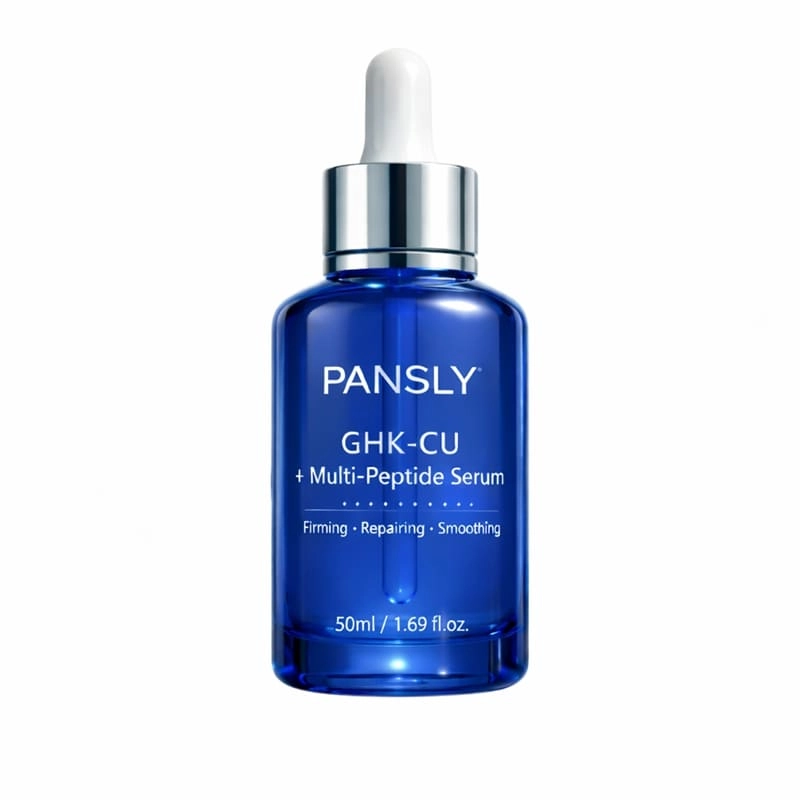
Experience visible rejuvenation with this GHK-Cu Copper Peptide Smoothing & Firming Face Serum, a high-performance concentrate designed to restore the structural integrity of aging skin. This advanced formula centers on GHK-Cu, a powerful signaling peptide clinically recognized for its ability to support natural collagen and elastin production. By promoting dermal density, it effectively tightens sagging skin and smooths the appearance of deep-set wrinkles and fine lines.
The lightweight, silky texture absorbs instantly, delivering antioxidant protection to neutralize environmental stressors that accelerate aging. Enhanced with deep-moisturizing agents, the serum reinforces the skin's moisture barrier, leaving the complexion feeling remarkably soft and resilient. With consistent use, skin texture is refined and facial contours appear more lifted, resulting in a youthfully firm and revitalized glow.
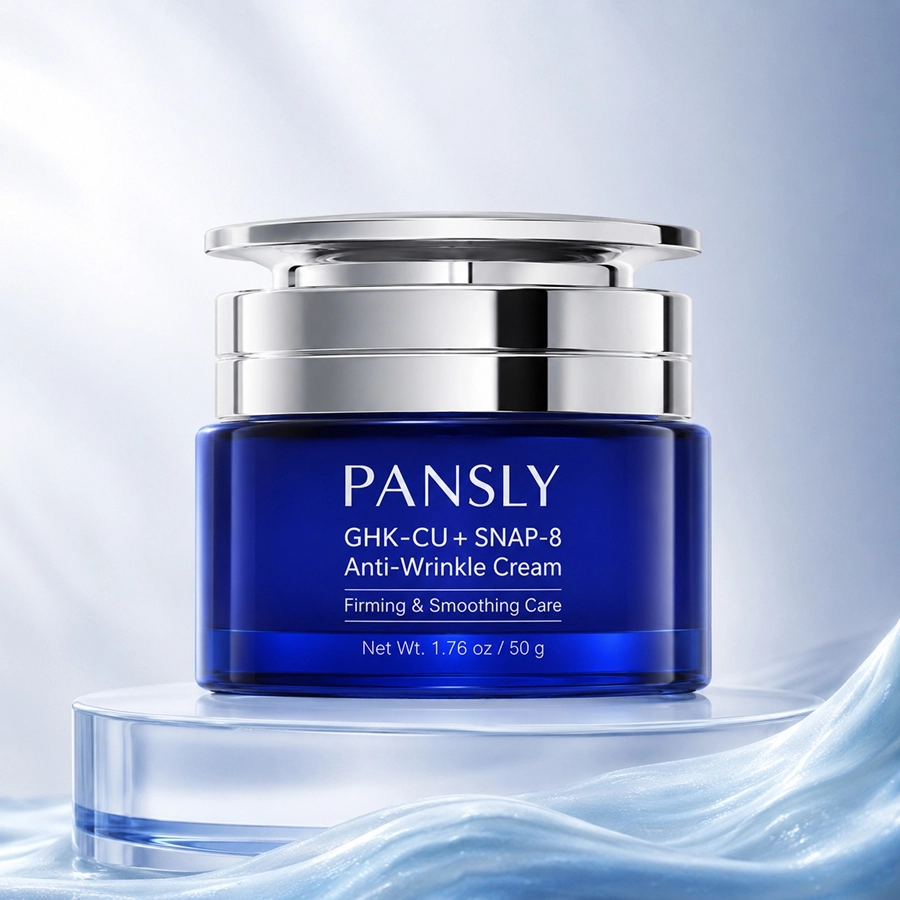
This Pansly GHK-CU + SNAP-8 Anti-Wrinkle Firming Cream is triple-peptide anti-aging facial cream, delivers targeted wrinkle smoothing, firming lifting and deep nourishment for dull, saggy, fine-line prone skin. Full OEM & ODM private label service is supported, including custom formula, packaging options, fast sampling and bulk export supply.
Five core premium active ingredients work synergistically for comprehensive anti-wrinkle care:
GHK-CU Copper Peptide lifts saggy skin, enhances skin resilience and tightens loose facial contour;
SNAP-8 Peptide targets expression lines to visibly soften and fade wrinkles;
Acetyl Hexapeptide-8 reduces the appearance of dry fine lines for smoother skin texture;
Ceramide NP reconstructs skin moisture barrier to lock nourishment and boost comfort;
Hyaluronic Acid delivers multi-layer rich deep moisture to relieve dry rough skin.
Luxury rich creamy texture spreads smoothly and melts into skin gently, leaving soft comfortable finish without heavy greasiness. Daily use blurs fine lines, firms loose skin, deeply nourishes and stabilizes barrier, refining uneven texture to reveal smooth, plump, youthful luminous skin.
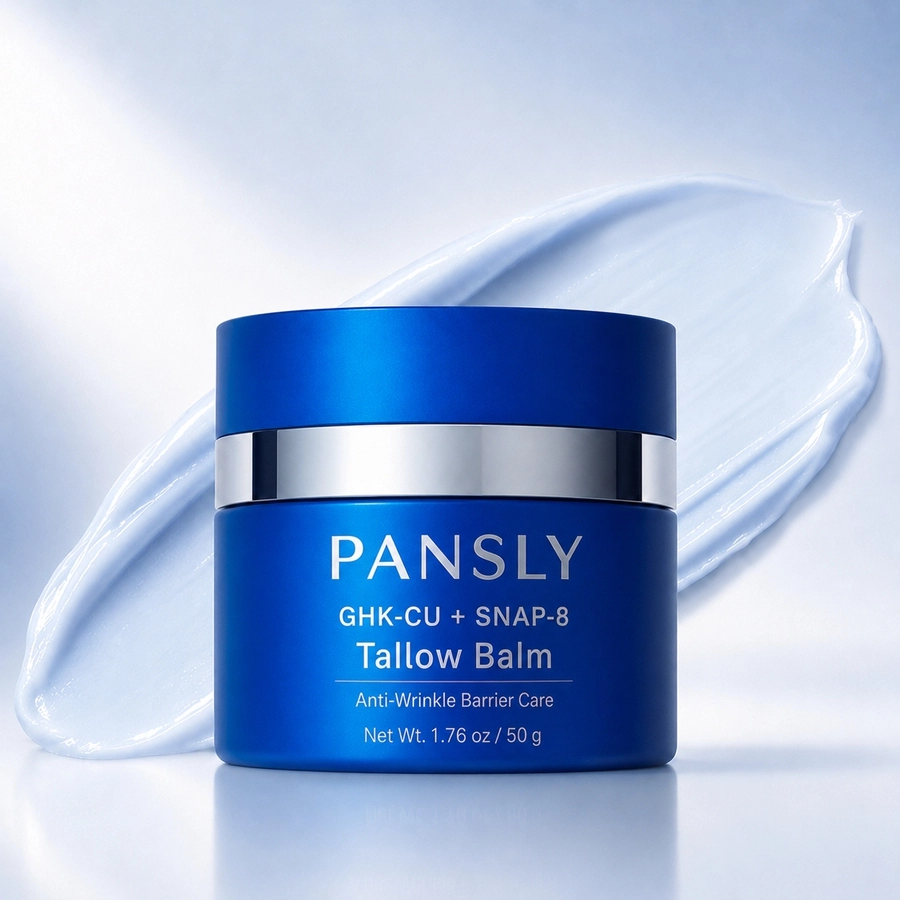
This Pansly GHK-CU + SNAP-8 Tallow Balm is a nourishing anti-wrinkle facial balm specially formulated for dry, fragile and sensitive skin, combining anti-aging wrinkle smoothing and barrier repairing effects. We offer full private label OEM service, including custom logo, adjustable formula, diversified packaging and lid color options.
It contains five core skin care active ingredients: GHK-CU visibly improves fine lines and revives dull complexion; SNAP-8 softens expression lines to smooth wrinkled skin texture; Grass-Fed Beef Tallow delivers deep lipid nourishment to relieve dry rough skin; Ectoin stabilizes the skin barrier and alleviates skin discomfort; Ceramide NP strengthens barrier structure to create smooth, healthy skin.
Luxury creamy blue balm texture glides smoothly and melts quickly on skin, providing long-lasting deep moisturizing comfort. Daily use fades fine lines & expression lines, nourishes dry delicate skin, repairs damaged barrier and leaves silky smooth skin finish.
Click here to customize the Beauty
we respond within a few hours
Monday–Friday, 9AM–6PM
3A01, Building A, Zhisheng Square, No. 4 Zhifu Road, Helong Street, Baiyun District, Guangzhou, China.


Leave a request, and we'll email you back within 24 hours.
© 2026 Beyond Basix. All Rights Reserved.
