
Peptide Skincare OEM/ODM: Sourcing High-Performance Peptides
- Advanced ingredient sourcing for clinical-grade peptide sequences
- Classification of functional short-chain agents
- Analytical specifications procurement teams must demand
- Supply-chain risk mapping and redundancy planning
- Formulation architecture and stability engineering for active peptides
- Delivery technologies and enhancement systems
- Compatibility with complementary actives and preservation systems
- Accelerated stability protocols and real-world shelf-life validation
- Regulatory conformity, analytical controls, and scale-up execution
- Analytical release testing and documentation
- Regulatory frameworks and safety substantiation
- Scale-up, tech transfer, and GMP production controls
- Commercial strategies: reducing time-to-market with an integrated OEM/ODM partner
- Value-chain integration and project management
- Cost modelling, MOQs and defensible pricing
- Multi-category capability: face, eye, body and hair platforms
- Why select a proven one-stop OEM/ODM for peptide-based product programs
- Technical competence and certified facilities
- Turnkey development, scale, and commercial support
- Operational differentiation and support for multi-channel distribution
- Partner profile: Guangzhou Beyond Basix Cosmetics Ltd.
- Facility scale and production credentials
- Research focus and brand operation
- End-to-end offerings across product categories
- Frequently Asked Questions
- What purity specifications should be required for active peptide sequences?
- How long does development and scale-up typically take for a peptide-containing topical SKU?
- What regulatory documentation is needed for international distribution?
- What are typical MOQ considerations for specialty actives?
- How should a buyer validate claims related to efficacy for peptide actives?
- Can peptide sequences be considered proprietary and how is IP protected?
High-performance peptide actives require a sourcing and manufacturing strategy that aligns analytical rigour, regulatory documentation, and scalable production to deliver consistent efficacy across facial, periorbital, body, and hair care SKUs; this guide synthesizes procurement-grade specifications, supply-chain models, formulation delivery options, and compliance checkpoints to enable brand owners and distributors to select an OEM/ODM partner capable of reducing technical risk and compressing time-to-market.
Advanced ingredient sourcing for clinical-grade peptide sequences
Classification of functional short-chain agents
Buyers should differentiate between synthetic oligopeptides, recombinant/fermentation-derived chains, and plant-derived peptide fractions. Synthetic solid-phase synthesized sequences commonly offer the highest purity (>95%) and precise sequence control, while biotechnological fermentation enables larger-scale production for long or modified sequences. Botanical hydrolysates provide lower-cost options but with substantial variability in composition and bioactivity profiles, requiring extensive lot-to-lot verification.
Analytical specifications procurement teams must demand
Procurement managers should require certificate of analysis (CoA) entries for sequence confirmation (MS/MS), purity (% by HPLC), endotoxin level (EU/mg), residual solvents (ICH Q3C), heavy metals, and water activity. Stability profiles under ICH Q1A conditions and forced-degradation data (oxidation, deamidation) must be supplied for any active intended for leave-on applications to justify shelf-life and claim substantiation.
Supply-chain risk mapping and redundancy planning
Project owners should map single-source risks (raw-material scarcity, geopolitical exposure), onshore vs offshore synthesis timelines, and capacity constraints. Contract clauses for minimum viable inventory (safety stock), alternate synthesis routes, and API change control are standard mitigants to protect launch windows and distributed supply chains.
| Source | Typical Purity | Approx. Cost per gram (USD) | Stability | Regulatory/Quality Notes |
|---|---|---|---|---|
| Synthetic solid-phase peptides | 95–>99% | $50–$1,000 (depends on length/modification) | High (with protective salts/lyophilized) | Well-defined CoA, sequence traceability, common in cosmetic actives |
| Recombinant/fermentation-derived | 85–99% (after purification) | $30–$300 | Moderate (requires careful purification and formulation) | Batch biological testing, endotoxin control, GMP manufacturing recommended |
| Plant/protein hydrolysates | Variable (mixed peptide fragments) | $5–$100 | Variable (matrix-dependent) | Complex CoA, composition variability, claim substantiation more challenging |
Formulation architecture and stability engineering for active peptides
Delivery technologies and enhancement systems
Formulators should evaluate encapsulation (liposomes, niosomes), peptide conjugation (lipophilization), and penetration enhancers to optimize bioavailability in topical matrices. Selection depends on molecular weight, isoelectric point, and susceptibility to enzymatic cleavage. Delivery choices influence vehicle selection—aqueous serums, anhydrous balms, or emulsified lotions—and therefore manufacturing line compatibility.
Compatibility with complementary actives and preservation systems
Sequence chemistry determines interactions with chelators, metal ions, and oxidizers. Procurement teams must require preservative efficacy test (PET) reports for final formulations and compatibility testing when combining peptides with retinoids, vitamin C derivatives, or exfoliating acids. pH windows should be documented to maintain peptide integrity without compromising preservative performance.
Accelerated stability protocols and real-world shelf-life validation
Manufacturing quality teams should adopt accelerated stability testing per ICH Q1A and link those results to real-time shelf-life projections. Photostability, freeze–thaw, and mechanical agitation tests simulate transport and retail conditions; inclusion of potency assays at defined intervals (HPLC or LC–MS quantification) is essential for claim-backed expiry dating.
Regulatory conformity, analytical controls, and scale-up execution
Analytical release testing and documentation
Regulators and retail partners expect documented lot release testing that includes identity (MS), purity (HPLC), microbial limits, and preservative residuals. For exporters, harmonize documentation with destination market requirements—e.g., ingredient disclosure aligned to EU Regulation (EC) No 1223/2009 or country-specific submissions—and maintain traceable batch records through ERP-enabled quality modules.
Regulatory frameworks and safety substantiation
Compliance teams should reference authoritative guidance such as the U.S. Food and Drug Administration cosmetic guidance for labeling and safety, follow GMP guidance consistent with ISO 22716 for good manufacturing practices in cosmetics, and consult scientific literature to support functional claims; global public health norms from organizations like WHO inform risk assessments for biologically derived ingredients.
Scale-up, tech transfer, and GMP production controls
Manufacturers must demonstrate process reproducibility when moving from pilot to full-scale runs. Key controls include in-process monitoring of peptide concentration, validated mixing/homogenization parameters, and environmental control in dust-free workshops. Contract manufacturing agreements should define change control, retained samples, and right-to-audit clauses for transparency.
Commercial strategies: reducing time-to-market with an integrated OEM/ODM partner
Value-chain integration and project management
Brands benefit when formulation R&D, analytical QC, regulatory affairs, and production are vertically integrated to compress development cycles. Centralized project management with stage-gate reviews and KPI reporting reduces rework and aligns procurement timelines with marketing launch plans.
Cost modelling, MOQs and defensible pricing
Cost models should separate raw active cost, formulation costs, filling/packaging, and QC overhead. MOQ strategies—tiered pricing against committed volumes, reserved capacity, and blended sourcing—help control per-unit cost for small-batch innovators and large distributors alike. Buyers should request total landed-cost scenarios including stability failure risk High Qualitys.
Multi-category capability: face, eye, body and hair platforms
Choosing a supplier with multi-category manufacturing reduces complexity when expanding a portfolio across topical formats. Compatible production lines, validated filling equipment for viscous gels, low-dosage serums, and eye-point applicators accelerate SKU proliferation while maintaining consistent active dosing and claim integrity.
Why select a proven one-stop OEM/ODM for peptide-based product programs
Technical competence and certified facilities
Brand owners should prioritize partners with documented GMP-level facilities, pharmaceutical-grade dust control, and international certifications to satisfy retail and export requirements. Facility credentials and machinery provenance reduce audit burden and support retailer supplier onboarding.
Turnkey development, scale, and commercial support
An effective OEM/ODM partner delivers formulation prototypes, stability dossiers, regulatory submissions, production, and packaging procurement—minimizing coordination overhead for brand teams and enabling predictive launch schedules tied to inventory readiness.
Operational differentiation and support for multi-channel distribution
OEM/ODM capabilities that include small-batch runs, serialization, and private-label packaging options support omnichannel strategies—from niche e-commerce drops to mass-retail rollouts—while protecting intellectual property through NDA-backed R&D and controlled access to synthetic sequences.
Partner profile: Guangzhou Beyond Basix Cosmetics Ltd.
Facility scale and production credentials
Guangzhou Beyond Basix Cosmetics Ltd. is a leading comprehensive cosmetics care manufacturer with over 23 years of experience in research, production, and sales. Our 12,000-square-meter facility includes a 100,000-level GMPC pharmaceutical-grade dust-free workshop and 12 production lines, equipped with advanced machinery imported from Germany, the US, and other regions.
Research focus and brand operation
Focusing on the development of skincare products with effective ingredients for 12 years, we operate four major brands: LANTHOME, PANSLY, FIRSTSUN, and SAUVASINE. We are certified with ISO 9001, CE, MSDS, GMP, HALAL, and more.
End-to-end offerings across product categories
We provide turnkey support covering Skincare Products, Hair Care Products, Eye Care Products, and Body Care Products. Our services include active sourcing, formulation development, stability and claim substantiation, finished-goods manufacture, and export documentation—enabling clients to scale from concept to retail-ready SKUs with predictable quality and cost structures.
Frequently Asked Questions
What purity specifications should be required for active peptide sequences?
Buyers should require identity confirmation via MS/MS, purity by validated HPLC (target typically >95% for synthetic actives), endotoxin limits, residual solvents per ICH Q3C, and batch-specific CoAs to ensure consistent potency and safety.
How long does development and scale-up typically take for a peptide-containing topical SKU?
Typical timelines range from 4–6 months for formulation and stability screening to 6–12 months for full stability validation and scale-up, depending on complexity, delivery systems, and regulatory dossier requirements; integrated OEM/ODM partners can compress this with parallel workflows.
What regulatory documentation is needed for international distribution?
Documentation commonly includes CoAs, safety data (toxicology summaries), GMP and ISO certificates, product information files aligned with EU Regulation (EC) No 1223/2009 or equivalent local rules, and any country-specific registration dossiers; consult FDA and ISO guidance for baseline requirements.
What are typical MOQ considerations for specialty actives?
MOQs depend on the active supplier and finished-goods configuration; many OEMs offer blended approaches—small initial manufacturing batches with higher per-unit cost or negotiated MOQs linked to forecasted scale to lower pricing as volumes increase.
How should a buyer validate claims related to efficacy for peptide actives?
Claim substantiation should be built on in vitro assays, ex vivo skin penetration studies, and controlled clinical or consumer trials proportionate to the claim scope; analytical stability and concentration tracking through shelf-life studies are mandatory for reproducible outcomes.
Can peptide sequences be considered proprietary and how is IP protected?
Peptide sequences and associated formulations can be protected via trade secrets, patents, and contractual NDAs; buyers should require contractual IP ownership clauses during custom synthesis and clearly defined rights for sequences developed under OEM/ODM engagement.
Contact Beyond Basix to discuss active sourcing, formulation transfer, and multi-category manufacturing solutions or view our product capabilities online.

Elevate your professional skincare offerings with this Private Label Copper Peptide Anti-Wrinkle Firming Serum, a powerhouse concentrate designed for superior age-defying results. This sophisticated formula leverages the synergistic effects of GHK-Cu and SNAP-8 to address multiple layers of skin aging. The GHK-Cu copper peptides act as a vital signaling mechanism to enhance skin density and firmness, while the advanced SNAP-8 octapeptide specifically targets expression lines, helping to relax the appearance of deep-seated wrinkles for a smoother, more refined surface.
This lightweight, rapid-absorption serum provides a professional-grade solution for clients seeking a non-invasive lift. It effectively restores elasticity, improves skin texture, and provides essential antioxidant protection. Perfect for high-end beauty brands, this serum leaves the complexion looking visibly contoured, hydrated, and youthfully revitalized.
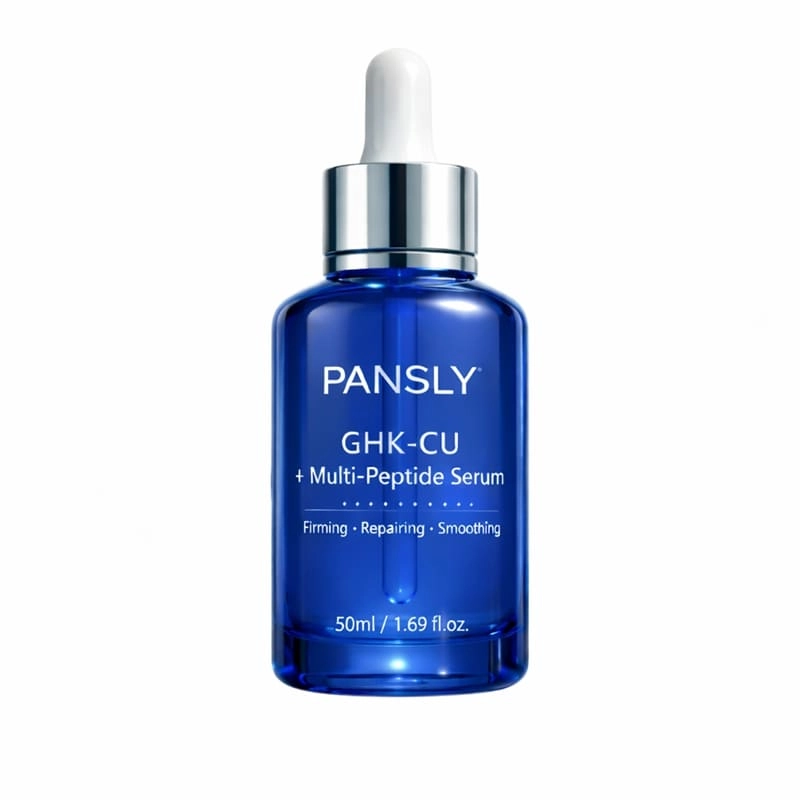
Experience visible rejuvenation with this GHK-Cu Copper Peptide Smoothing & Firming Face Serum, a high-performance concentrate designed to restore the structural integrity of aging skin. This advanced formula centers on GHK-Cu, a powerful signaling peptide clinically recognized for its ability to support natural collagen and elastin production. By promoting dermal density, it effectively tightens sagging skin and smooths the appearance of deep-set wrinkles and fine lines.
The lightweight, silky texture absorbs instantly, delivering antioxidant protection to neutralize environmental stressors that accelerate aging. Enhanced with deep-moisturizing agents, the serum reinforces the skin's moisture barrier, leaving the complexion feeling remarkably soft and resilient. With consistent use, skin texture is refined and facial contours appear more lifted, resulting in a youthfully firm and revitalized glow.
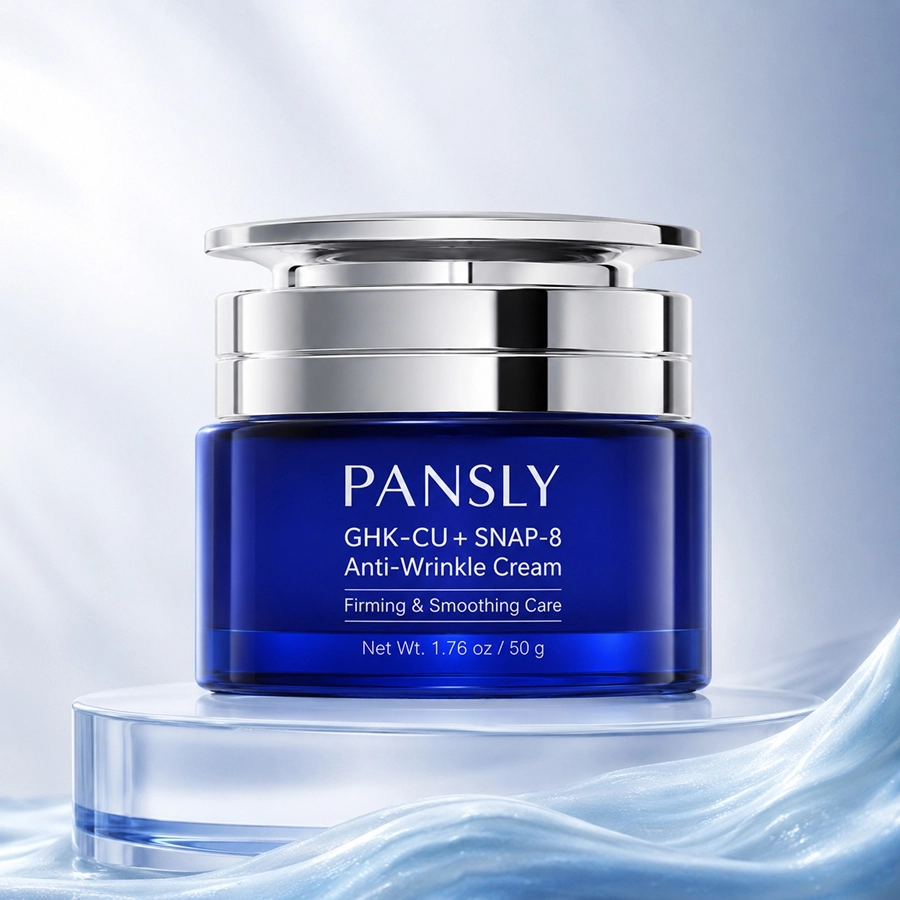
This Pansly GHK-CU + SNAP-8 Anti-Wrinkle Firming Cream is triple-peptide anti-aging facial cream, delivers targeted wrinkle smoothing, firming lifting and deep nourishment for dull, saggy, fine-line prone skin. Full OEM & ODM private label service is supported, including custom formula, packaging options, fast sampling and bulk export supply.
Five core premium active ingredients work synergistically for comprehensive anti-wrinkle care:
GHK-CU Copper Peptide lifts saggy skin, enhances skin resilience and tightens loose facial contour;
SNAP-8 Peptide targets expression lines to visibly soften and fade wrinkles;
Acetyl Hexapeptide-8 reduces the appearance of dry fine lines for smoother skin texture;
Ceramide NP reconstructs skin moisture barrier to lock nourishment and boost comfort;
Hyaluronic Acid delivers multi-layer rich deep moisture to relieve dry rough skin.
Luxury rich creamy texture spreads smoothly and melts into skin gently, leaving soft comfortable finish without heavy greasiness. Daily use blurs fine lines, firms loose skin, deeply nourishes and stabilizes barrier, refining uneven texture to reveal smooth, plump, youthful luminous skin.
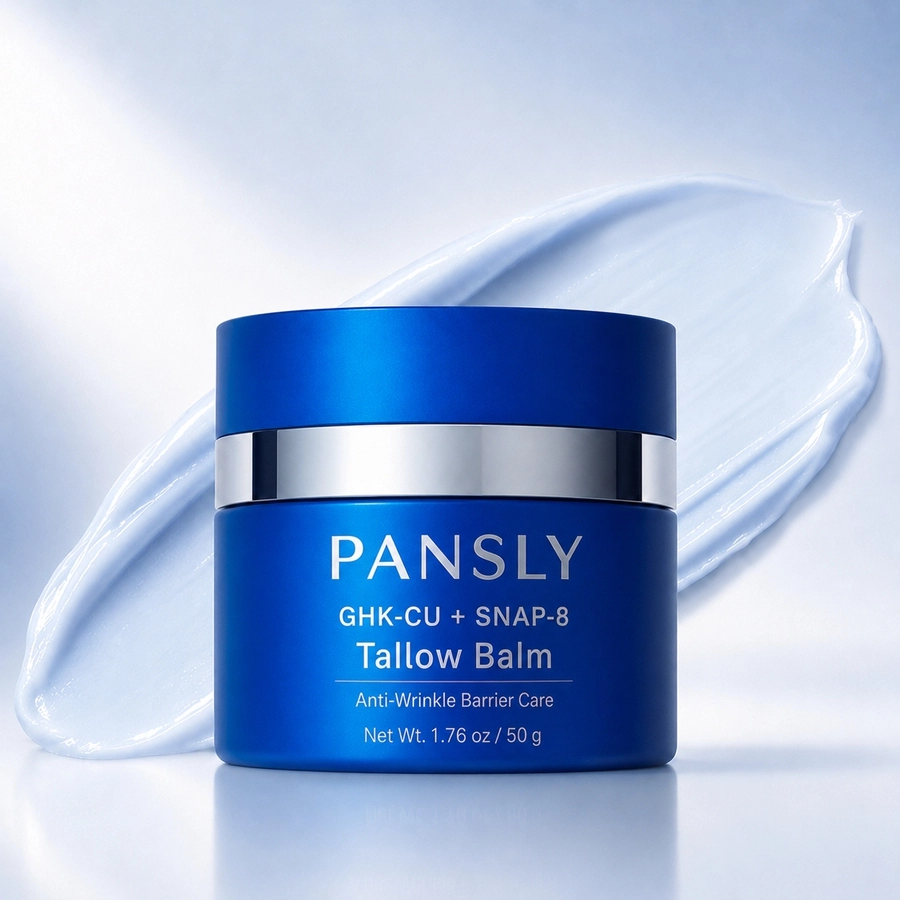
This Pansly GHK-CU + SNAP-8 Tallow Balm is a nourishing anti-wrinkle facial balm specially formulated for dry, fragile and sensitive skin, combining anti-aging wrinkle smoothing and barrier repairing effects. We offer full private label OEM service, including custom logo, adjustable formula, diversified packaging and lid color options.
It contains five core skin care active ingredients: GHK-CU visibly improves fine lines and revives dull complexion; SNAP-8 softens expression lines to smooth wrinkled skin texture; Grass-Fed Beef Tallow delivers deep lipid nourishment to relieve dry rough skin; Ectoin stabilizes the skin barrier and alleviates skin discomfort; Ceramide NP strengthens barrier structure to create smooth, healthy skin.
Luxury creamy blue balm texture glides smoothly and melts quickly on skin, providing long-lasting deep moisturizing comfort. Daily use fades fine lines & expression lines, nourishes dry delicate skin, repairs damaged barrier and leaves silky smooth skin finish.
Click here to customize the Beauty
we respond within a few hours
Monday–Friday, 9AM–6PM
3A01, Building A, Zhisheng Square, No. 4 Zhifu Road, Helong Street, Baiyun District, Guangzhou, China.


Leave a request, and we'll email you back within 24 hours.
© 2026 Beyond Basix. All Rights Reserved.
