
Regulatory & Safety Checklist for PDRN Anti-Wrinkle Serum OEMs
- Regulatory pathway and mandatory documentation for polynucleotide topical formulations
- Classification, jurisdictional routes, and dossier expectations
- Essential dossier components and safety reports
- Labeling, claims, and advertising compliance
- Safety assessment and production controls for nucleic-acid skin concentrates
- Toxicology, biocompatibility, and human patch testing
- Microbiological controls and endotoxin management
- Cleanroom classification, equipment validation, and change control
- Analytical testing, stability protocols, and batch release criteria
- Assay methodology and impurity profiling
- Stability study design and shelf-life determination
- Release testing, certificates of analysis, and lot traceability
- Supply-chain governance, post-market vigilance, and manufacturer responsibilities
- Raw-material qualification and supplier audits
- Adverse event reporting, complaint handling, and corrective actions
- Logistics, serialization, and cold‑chain considerations
- Why select a full-service OEM/ODM partner for biological topical launches
- Operational and commercial advantages of integrated manufacturing
- Key contractual protections buyers should demand
- Document checklist for supplier qualification
- Beyond Basix — manufacturing competence, certifications, and product scope
- Facility capabilities and process controls
- Regulatory credentials and formulation expertise
- Product portfolio and customized development
- Quality assurance, transparency, and partnership model
- Frequently Asked Questions
High-priority enterprise summary: This compliance-focused operational brief condenses regulatory requirements, safety evaluation protocols, quality-control checkpoints, and supply-chain governance needed for commercializing topical polynucleotide-based wrinkle treatments through one-stop contract manufacturing; it maps dossier elements for market authorizations, lists mandatory biocompatibility and microbiological tests, prescribes stability and analytical release criteria, and outlines post-market surveillance and labeling constraints to help brand owners and OEM/ODM partners mitigate regulatory risk and accelerate product launch.
Regulatory pathway and mandatory documentation for polynucleotide topical formulations
Classification, jurisdictional routes, and dossier expectations
Determining whether a regenerative nucleic-acid topical is regulated as a cosmetic, cosmeceutical, or medicinal product is the first procurement decision. Jurisdictions vary: the EU applies EU Cosmetics Regulation for non‑medicinal claims, while the US enforces product safety under FDA cosmetic statutes. For markets where an active biological component triggers additional scrutiny, expect medicinal-product dossiers or local biologicals pathways. Buyers must request a regulatory strategy memo from the manufacturer that maps intended claims to registration route, required clinical evidence, and labeling constraints.
Essential dossier components and safety reports
Regulatory filings should include a complete product information file: ingredient provenance and certificates of analysis, manufacturing flow chart, Good Manufacturing Practice evidence, stability data, preservative efficacy test results, microbiological controls, toxicology summaries, and a safety assessment compliant with local frameworks. For EU market entry, a Product Information File (PIF) must be maintained per Regulation (EC) No 1223/2009; provide this during supplier qualification and keep it updated for audits.
Labeling, claims, and advertising compliance
Label text must match the dossier and avoid therapeutic claims unless supported by a medicinal registration. Claims such as skin regeneration or cellular repair require substantiation. Packaging artwork approval workflows should be part of the OEM contract and include multilingual regulatory checks and required contact information for responsible person or local distributor.
Safety assessment and production controls for nucleic-acid skin concentrates
Toxicology, biocompatibility, and human patch testing
Polynucleotide-containing preparations require a tailored safety assessment. Required studies often include in vitro cytotoxicity, irritation and sensitization panels, and human repeat insult patch tests (HRIPT) when applicable. For formulations crossing into medical device or medicinal territory, ISO 10993-style biocompatibility testing and GLP toxicology data may be necessary. Buyers should require a manufacturer-provided safety summary and raw-data access for third-party review.
Microbiological controls and endotoxin management
Topical biologicals need stringent microbiological specifications: total aerobic microbial count (TAMC), total yeast and mold count (TYMC), absence testing for specified pathogens (e.g., S. aureus, P. aeruginosa, C. albicans), and endotoxin monitoring when water-based or injectable-grade ingredients are involved. Manufactures must document environmental monitoring results for the production zones and demonstrate validated preservative efficacy (challenge test) aligned with ISO 11930 expectations for cosmetic products.
Cleanroom classification, equipment validation, and change control
Manufacturing critical steps for regenerative concentrates should occur in controlled environments. Buyers should verify cleanroom classification, validation of critical utilities (WFI or purified water systems), and equipment calibration logs. A formal change-control process must be in place to manage raw-material switches, process updates, or equipment relocation to prevent unexpected quality drift.
Analytical testing, stability protocols, and batch release criteria
Assay methodology and impurity profiling
Analytical characterization should include identity testing of the active polynucleotide fraction (e.g., size-distribution profiles via electrophoresis or HPLC), potency assay where applicable, and impurity/contaminant profiling (residual protein, host-cell DNA, solvent residues). Methods must be validated per ICH Q2(R1) principles for accuracy, precision, specificity, and robustness. Procurement teams must request method validation reports and limits of detection/quantitation.
Stability study design and shelf-life determination
Stability programs should combine real-time and accelerated protocols that reflect intended commercial packaging and storage conditions. Data must support declared shelf-life and demonstrate preservation of physicochemical properties, microbiological integrity, and functional activity over time. Include stress tests (thermal, freeze–thaw, photostability) to identify failure modes and necessary label storage instructions.
Release testing, certificates of analysis, and lot traceability
Each lot should be released only after passing a predefined panel: identity, assay/potency, pH/viscosity (if applicable), microbiological limits, preservative efficacy, and appearance. Certificates of Analysis (CoA) must be provided with manufacturing date, expiry, batch number, and test results. Buyers should require unique batch traceability and retention samples for at least the declared shelf-life.
| Aspect | Traditional QC | Advanced/AI-assisted QC |
|---|---|---|
| Identity & assay | Gel electrophoresis, manual HPLC runs | High-resolution HPLC/LC-MS with ML-based peak deconvolution |
| Stability prediction | Real-time + accelerated empirical testing | Predictive models combining accelerated data and AI for shelf-life forecasting |
| Microbial surveillance | Periodic environmental culture sampling | Continuous monitoring + rapid PCR pathogen screening |
| Batch release speed | Dependent on manual lab throughput | Automated analytics + digital CoA generation reduces lead time |
Supply-chain governance, post-market vigilance, and manufacturer responsibilities
Raw-material qualification and supplier audits
Polynucleotide raw materials require complete traceability from donor/source to final API. Buyers should insist on supplier qualification programs, incoming material testing, and certificates such as MSDS and origin declarations. A qualified vendor list (QVL) and periodic supplier audits reduce contamination and authenticity risks.
Adverse event reporting, complaint handling, and corrective actions
Post-market surveillance must be defined contractually: timelines for event notification, sample retention for investigation, root-cause analysis, and corrective/preventive actions (CAPA). For markets with mandatory reporting requirements, manufacturers must provide documented processes aligned with local vigilance systems and maintain an adverse event log accessible to brand owners.
Logistics, serialization, and cold‑chain considerations
Depending on formulation stability, cold-chain logistics or controlled-temperature shipping may be necessary. Batch serialization and tamper-evident packaging help prevent counterfeits. Contract terms should include lead time commitments, minimum order quantities, and contingency plans for supply interruptions.
Why select a full-service OEM/ODM partner for biological topical launches
Operational and commercial advantages of integrated manufacturing
Partnering with an experienced contract manufacturer reduces time-to-market by consolidating R&D, clinical support, analytical development, GMP production, and regulatory submission support. Integrated partners provide scalable production lines, validated processes, and a single point of accountability for quality and logistics, lowering procurement complexity for brand owners.
Key contractual protections buyers should demand
Service agreements must define quality specifications, change-control thresholds, IP ownership for formulations and analytics, confidentiality clauses, regulatory responsibilities for market registrations, and clearly spelled-out warranty and recall procedures to protect commercial interests.
Document checklist for supplier qualification
Minimal documentation required during supplier diligence: company GMP certificate, ISO certifications, facility tour records or videos, environmental monitoring logs, recent CoAs, method validation reports, stability summaries, and sample CoAs for representative lots. Request references for similar polynucleotide or biologically active projects.
Beyond Basix — manufacturing competence, certifications, and product scope
Facility capabilities and process controls
We operate a 12,000-square-meter facility with a 100,000-level GMPC pharmaceutical-grade dust-free workshop and 12 production lines, equipped with advanced machinery imported from Germany, the US, and other regions. Our facilities are structured to support controlled-environment manufacturing, validated utilities, and process flow segregation for high-risk biological formulations.
Regulatory credentials and formulation expertise
Guangzhou Beyond Basix Cosmetics Ltd. is a leading comprehensive cosmetics care manufacturer with over 23 years of experience in research, production, and sales. Focusing on the development of skincare products with effective ingredients for 12 years, we operate four major brands: LANTHOME, PANSLY, FIRSTSUN, and SAUVASINE. We are certified with ISO 9001, CE, MSDS, GMP, HALAL, and more. These credentials support regulatory submissions and provide buyers with documented quality assurance across manufacturing stages.
Product portfolio and customized development
Our one-stop OEM/ODM for skincare services cover a broad range of formulations across Skincare Products, Hair Care Products, Eye Care Products, and Body Care Products. We provide end-to-end support—from formula optimization and stability programs to small-batch clinical tolerability trials and full-scale production—enabling brand owners to commercialize advanced topical technologies with confidence.
Quality assurance, transparency, and partnership model
We prioritize transparent documentation: validated analytical methods, batch CoAs, stability data sets, and regulatory support materials are supplied to clients as part of our partnership model. For buyers seeking to develop regenerative topical treatments based on polynucleotides or other active biochemistries, our engineering and quality teams offer program-level oversight to reduce regulatory risk and improve launch predictability.
Authoritative references and regulatory frameworks referenced in this brief include the Polydeoxyribonucleotide overview, FDA cosmetics guidance, the EU Cosmetics Regulation, ISO standards for quality systems and GMP best practices, and public health considerations outlined by the World Health Organization. Buyers should align supplier documentation with these references during technical due diligence.
Frequently Asked Questions
What regulatory pathway applies to polynucleotide-containing topical products?
Classification depends on intended claims and jurisdiction; products marketed with only cosmetic claims typically follow cosmetic regulations (e.g., EU Cosmetics Regulation), while products asserting therapeutic or regenerative claims may require medicinal or biological product dossiers and additional clinical data. Manufacturers should map claims to registration routes and document requirements early in development.
Which safety tests are essential before commercial release of a nucleic-acid topical formulation?
Essential tests include in vitro cytotoxicity, irritation and sensitization assessments, preservative efficacy/challenge tests, microbial limits testing (TAMC/TYMC and absence of specific pathogens), and human patch testing where applicable; for higher regulatory classes, GLP toxicology or ISO 10993-style biocompatibility data may be necessary.
What analytical and stability evidence should buyers request from an OEM?
Buyers should request validated identity and potency assays (e.g., HPLC, electrophoresis), impurity profiling, method validation reports per ICH Q2(R1), plus real-time and accelerated stability data that support declared shelf-life, packaging compatibility, and storage conditions; CoAs for representative lots and retention samples are also required.
How should supply-chain traceability and supplier qualification be managed for sensitive active ingredients?
Insist on full raw-material traceability, supplier qualification programs, and audit records; require certificates of analysis, origin documentation, MSDS, and periodic requalification. Contracts should include contingency plans, lead-time guarantees, and minimum quality thresholds to mitigate sourcing interruptions and authenticity risks.
What contractual protections should brand owners require from a contract manufacturer for biologically active topicals?
Contracts should define quality specifications, change-control protocols, IP ownership and confidentiality, responsibilities for regulatory submissions and post-market obligations, CAPA timelines, recall procedures, minimum order quantities, lead times, and sample retention policies to protect commercial and regulatory interests.

Elevate your professional skincare offerings with this Private Label Copper Peptide Anti-Wrinkle Firming Serum, a powerhouse concentrate designed for superior age-defying results. This sophisticated formula leverages the synergistic effects of GHK-Cu and SNAP-8 to address multiple layers of skin aging. The GHK-Cu copper peptides act as a vital signaling mechanism to enhance skin density and firmness, while the advanced SNAP-8 octapeptide specifically targets expression lines, helping to relax the appearance of deep-seated wrinkles for a smoother, more refined surface.
This lightweight, rapid-absorption serum provides a professional-grade solution for clients seeking a non-invasive lift. It effectively restores elasticity, improves skin texture, and provides essential antioxidant protection. Perfect for high-end beauty brands, this serum leaves the complexion looking visibly contoured, hydrated, and youthfully revitalized.
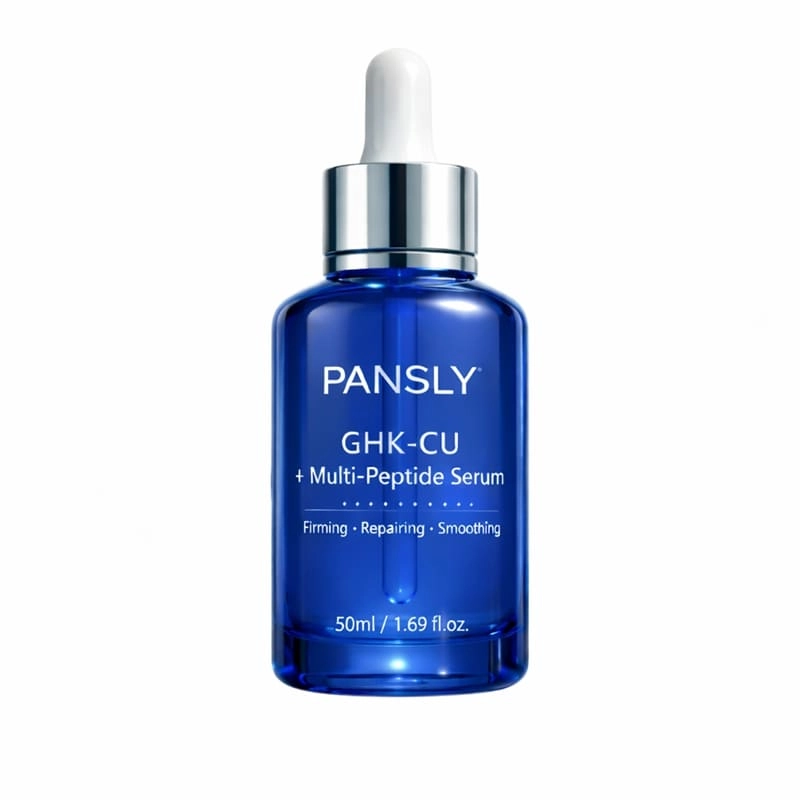
Experience visible rejuvenation with this GHK-Cu Copper Peptide Smoothing & Firming Face Serum, a high-performance concentrate designed to restore the structural integrity of aging skin. This advanced formula centers on GHK-Cu, a powerful signaling peptide clinically recognized for its ability to support natural collagen and elastin production. By promoting dermal density, it effectively tightens sagging skin and smooths the appearance of deep-set wrinkles and fine lines.
The lightweight, silky texture absorbs instantly, delivering antioxidant protection to neutralize environmental stressors that accelerate aging. Enhanced with deep-moisturizing agents, the serum reinforces the skin's moisture barrier, leaving the complexion feeling remarkably soft and resilient. With consistent use, skin texture is refined and facial contours appear more lifted, resulting in a youthfully firm and revitalized glow.
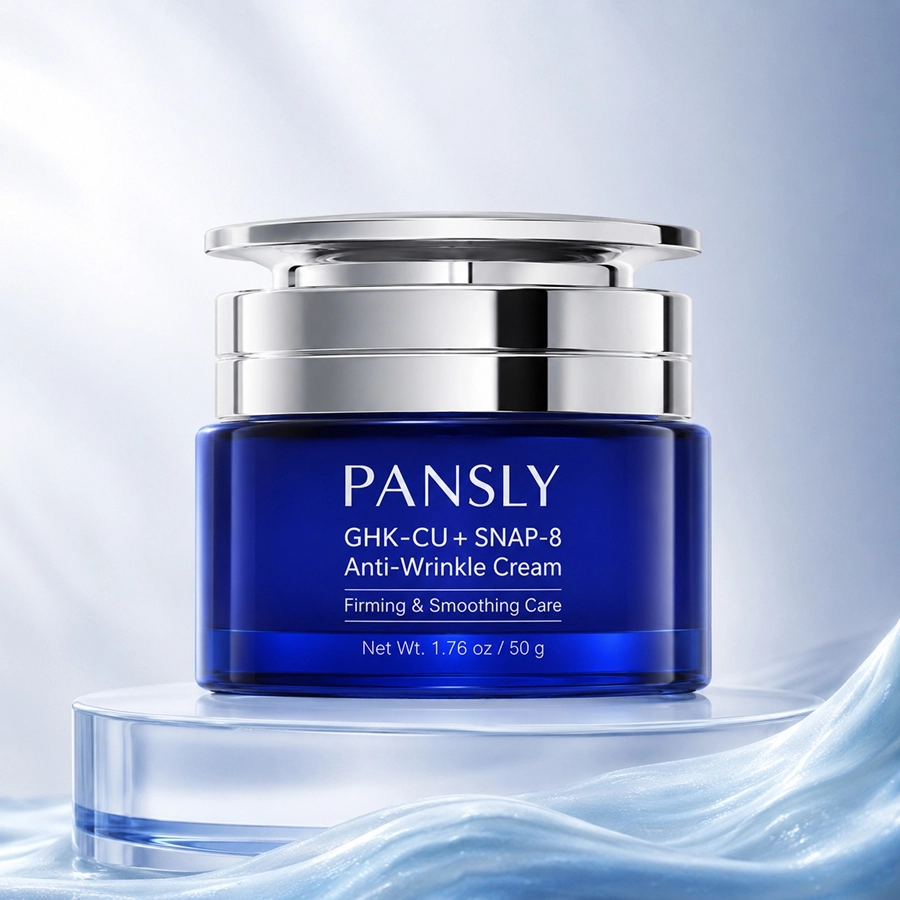
This Pansly GHK-CU + SNAP-8 Anti-Wrinkle Firming Cream is triple-peptide anti-aging facial cream, delivers targeted wrinkle smoothing, firming lifting and deep nourishment for dull, saggy, fine-line prone skin. Full OEM & ODM private label service is supported, including custom formula, packaging options, fast sampling and bulk export supply.
Five core premium active ingredients work synergistically for comprehensive anti-wrinkle care:
GHK-CU Copper Peptide lifts saggy skin, enhances skin resilience and tightens loose facial contour;
SNAP-8 Peptide targets expression lines to visibly soften and fade wrinkles;
Acetyl Hexapeptide-8 reduces the appearance of dry fine lines for smoother skin texture;
Ceramide NP reconstructs skin moisture barrier to lock nourishment and boost comfort;
Hyaluronic Acid delivers multi-layer rich deep moisture to relieve dry rough skin.
Luxury rich creamy texture spreads smoothly and melts into skin gently, leaving soft comfortable finish without heavy greasiness. Daily use blurs fine lines, firms loose skin, deeply nourishes and stabilizes barrier, refining uneven texture to reveal smooth, plump, youthful luminous skin.
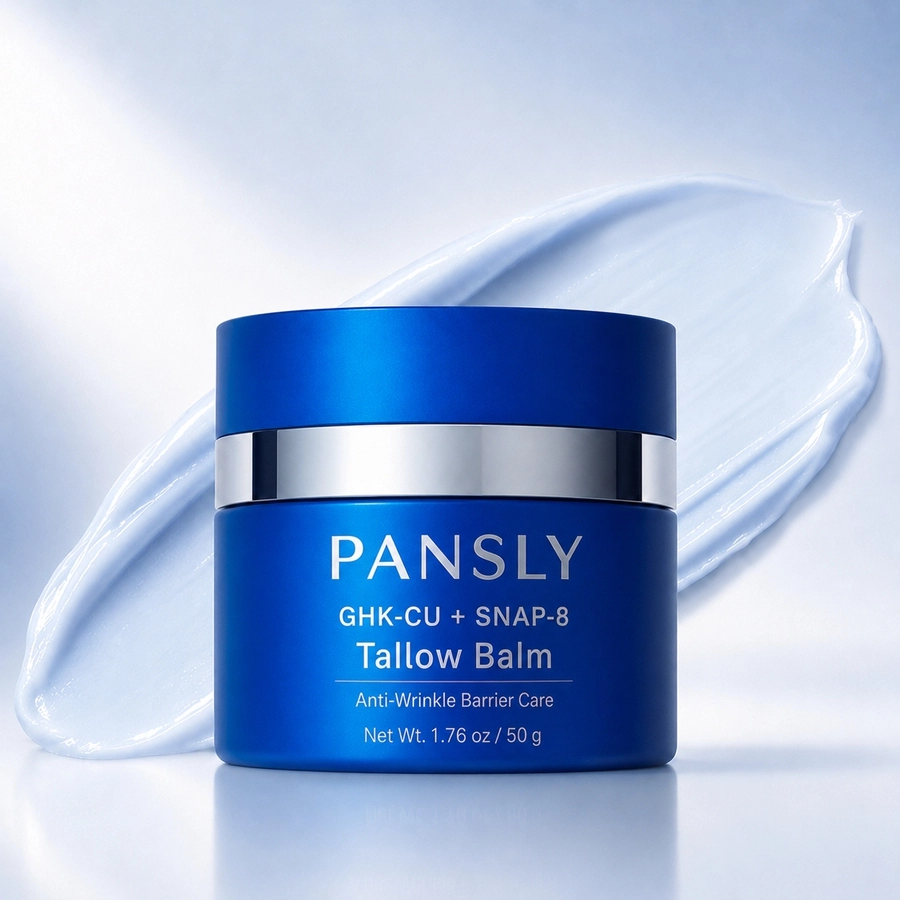
This Pansly GHK-CU + SNAP-8 Tallow Balm is a nourishing anti-wrinkle facial balm specially formulated for dry, fragile and sensitive skin, combining anti-aging wrinkle smoothing and barrier repairing effects. We offer full private label OEM service, including custom logo, adjustable formula, diversified packaging and lid color options.
It contains five core skin care active ingredients: GHK-CU visibly improves fine lines and revives dull complexion; SNAP-8 softens expression lines to smooth wrinkled skin texture; Grass-Fed Beef Tallow delivers deep lipid nourishment to relieve dry rough skin; Ectoin stabilizes the skin barrier and alleviates skin discomfort; Ceramide NP strengthens barrier structure to create smooth, healthy skin.
Luxury creamy blue balm texture glides smoothly and melts quickly on skin, providing long-lasting deep moisturizing comfort. Daily use fades fine lines & expression lines, nourishes dry delicate skin, repairs damaged barrier and leaves silky smooth skin finish.
Click here to customize the Beauty
we respond within a few hours
Monday–Friday, 9AM–6PM
3A01, Building A, Zhisheng Square, No. 4 Zhifu Road, Helong Street, Baiyun District, Guangzhou, China.


Leave a request, and we'll email you back within 24 hours.
© 2026 Beyond Basix. All Rights Reserved.