Regulatory & Safety Checklist for Peptide Skincare Suppliers
- Regulatory landscape and classification of peptide actives
- Regional frameworks and obligations
- Active ingredient vs. cosmetic claim: impact on regulatory pathway
- Key documentation to request from suppliers
- Safety testing, quality control, and analytical expectations
- Identity, purity, and potency analytics
- Stability, preservative efficacy, and shelf-life protocols
- Microbiology and contamination control
- Manufacturing compliance, facility standards, and audit priorities
- Good manufacturing practices and facility requirements
- Packaging, labeling, and claim control
- Supply chain traceability and recall readiness
- Procurement due diligence and contractual protections for brand owners
- Supplier qualification checklist
- Audit strategy and sample verification
- Contractual terms and IP/data protection
- Why assess one-stop OEM/ODM partners carefully — and how Beyond Basix meets buyer requirements
- Operational scale, cleanroom capability, and equipment
- Certifications, testing infrastructure, and formulation expertise
- One-stop service model for scalable launches
- Buyer-centric risk mitigation and partnership approach
- Frequently Asked Questions
High-density executive summary: Suppliers of bioactive peptide formulations must meet multi-jurisdictional requirements spanning safety dossiers, GMP production, analytical identity/purity testing, preservative and stability verification, microbiological control, labeling and claims substantiation, and robust supplier traceability; this checklist consolidates regulatory references (including U.S. FDA Cosmetics Guidance, EU Cosmetics Regulation, and ISO 22716 GMP), practical QA/QC checkpoints, sample contract language for procurement teams, and a manufacturer capability profile to evaluate one-stop OEM/ODM partners.
Regulatory landscape and classification of peptide actives
Regional frameworks and obligations
Different markets classify peptide-containing preparations through distinct regulatory lenses: the United States regulates cosmetics under the Federal Food, Drug, and Cosmetic Act where finished products do not require pre-market approval but must be safe and correctly labeled; the European Union mandates a safety assessment and product notification process before placing cosmetics on the market; and many APAC jurisdictions use a combination of registration and notification depending on intended claims. Buyers should verify the target market classification for each SKU before procurement to determine dossier and labeling obligations; useful starting points include regulatory summaries from the U.S. FDA Cosmetics Guidance and the EU Cosmetics Regulation.
Active ingredient vs. cosmetic claim: impact on regulatory pathway
When peptide-containing formulations imply therapeutic or pharmacological effects (e.g., “treats” or “repairs beyond cosmetic action”), regulatory treatment can shift from cosmetic oversight to medicinal product rules. Procurement teams must lock claim language early and request labeling mock-ups to prevent later reclassification that would trigger additional clinical or regulatory burdens.
Key documentation to request from suppliers
Minimum dossier: certificate of analysis (COA) for peptide batches, material safety data sheet (MSDS), GMP certificates, stability protocol/outcomes, microbial test results, heavy metals screen, and a list of raw material suppliers for traceability. For traceable synthesis of short-chain peptides, request supporting analytical data such as HPLC chromatograms and LC-MS identity confirmation; for broader context on peptide chemistry, see Peptide (Wikipedia).
Safety testing, quality control, and analytical expectations
Identity, purity, and potency analytics
Analytical verification must include identity testing (LC-MS or equivalent), purity (% area by HPLC), and peptide sequence confirmation where applicable. Buyers should require batch-specific COAs and raw chromatogram PDFs to validate that synthetic or biotechnological manufacture meets specification limits (typically >95% purity for active peptides used in topical formulations, unless justified otherwise).
Stability, preservative efficacy, and shelf-life protocols
Suppliers must supply accelerated and real-time stability data demonstrating potency retention, physical stability (no phase separation, color/odor changes), and preservative efficacy test (Challenge Test/Preservative Efficacy Test per recognized pharmacopoeial or industry protocols). For paraben-free or preservative-optimized systems containing peptides, verify that preservative function is adequate across expected microbial burdens.
Microbiology and contamination control
Because peptide actives can be sensitive to enzymatic degradation and microbial contamination, require certificate of microbiological analysis for each finished batch (total aerobic count, total yeast & mold, absence of pathogens). When suppliers use aqueous formulations, a documented environmental monitoring program and cleanroom control data should be included.
Manufacturing compliance, facility standards, and audit priorities
Good manufacturing practices and facility requirements
Confirm the manufacturer operates under cosmetic GMP consistent with ISO 22716 or equivalent pharmaceutical-grade dust-free processes for high-risk lines. Buyers should request facility certification, recent audit reports, and a description of segregation practices for peptide synthesis, blending, and filling. A 100,000-level GMPC (class 10^5) dust-free workshop is a strong indicator for low-particulate environments in formulation and filling.
Packaging, labeling, and claim control
Packaging must protect physicochemical integrity of peptides (airless pumps, UV-protective containers, nitrogen headspace where necessary). Label content must match allowed cosmetic claims in target jurisdictions and include INCI names, batch numbers, recommended storage conditions, and shelf-life. For EU market entry, ensure a Responsible Person and cosmetic product safety report (CPSR) are in place before notification.
Supply chain traceability and recall readiness
Require end-to-end traceability: raw material lot sourcing, in-process batch records, finished goods COAs, and retention sample policy. Contractual obligations should specify lead times, minimum order quantities, and recall communication protocols. A supplier should be capable of supporting post-market surveillance and adverse event reporting as required by regulators.
| Regulatory Authority / Standard | Pre-market Approval | Key Requirement(s) | Typical Buyer Action |
|---|---|---|---|
| U.S. FDA | No general pre-approval for cosmetics | Products must be safe and properly labeled; color additives and certain claims regulated | Retain COA/MSDS; ensure labeling compliance and adverse event reporting |
| European Union (EU) | No pre-approval but CPSR and notification to CPNP required | Safety assessment, Responsible Person, Product Information File | Require CPSR and proof of CPNP notification |
| ISO 22716 (GMP) | Guidance/standard for manufacturing | GMP for cosmetics: quality management, personnel, equipment, and documentation | Request ISO 22716 conformity evidence and audit reports |
| China (NMPA - filing/registration) | Varies by product type; special cosmetics require registration | Ingredient restrictions, safety data, and local testing where applicable | Confirm registration status and local testing requirements before launch |
Procurement due diligence and contractual protections for brand owners
Supplier qualification checklist
Brands should build a supplier scorecard that covers: 1) legal business licenses and export permissions; 2) current GMP/quality certifications; 3) batch-level analytical evidence; 4) environmental and occupational safety controls; 5) lead time and capacity data; and 6) insurance and indemnity limits. Request site photos, equipment lists, and third-party audit summaries to validate capability claims.
Audit strategy and sample verification
Plan a two-tier testing approach: a pre-production qualification test on a pilot batch, followed by release testing on production batches. Include independent third-party laboratory confirmation for critical attributes (identity, potency, purity, microbial limits). Schedule on-site audits for higher-risk launches and maintain a rotating sample program to catch lot-to-lot variability.
Contractual terms and IP/data protection
Contracts should specify warranties for compliance, batch acceptance criteria, out-of-specification (OOS) procedures, confidentiality clauses for formula/IP, change control requirements, and recall handling. For custom peptide sequences, nail down ownership of synthesis methods and any improvements during scale-up to avoid disputes.
Why assess one-stop OEM/ODM partners carefully — and how Beyond Basix meets buyer requirements
Operational scale, cleanroom capability, and equipment
We operate a 12,000-square-meter production facility that includes a 100,000-level GMPC pharmaceutical-grade dust-free workshop and 12 production lines. The presence of dedicated, segregated lines for high-potency actives and advanced machinery imported from Germany and the United States reduces cross-contamination risk and supports complex formulation workflows.
Certifications, testing infrastructure, and formulation expertise
Our company maintains ISO 9001-based quality systems, GMP-compliant production, MSDS documentation for all materials, CE marking where applicable, and HALAL certification for targeted markets. With focused R&D on effective actives for 12 years, our engineering and analytical teams deliver stability protocols, HPLC/LC-MS identity reports, preservative efficacy testing, and microbial controls aligned with buyer expectations.
One-stop service model for scalable launches
Beyond Basix provides end-to-end services across Skincare Products, Hair Care Products, Eye Care Products, and Body Care Products: from ingredient sourcing and formula development to pilot production, full-scale manufacturing, and packaging. Our multi-brand experience (LANTHOME, PANSLY, FIRSTSUN, SAUVASINE) demonstrates capability to manage differentiated market positioning and multi-channel distribution needs.
Buyer-centric risk mitigation and partnership approach
We commit to transparent documentation (COAs, batch records, stability files), responsive sample programs, and clear contractual terms for change control and recalls. Buyers benefit from reduced qualification cycles, consolidated supply chains, and an experienced OEM/ODM partner capable of supporting regulatory submissions, labeling strategies, and post-market surveillance.
Authoritative references and further reading: U.S. FDA Cosmetics Guidance, EU Cosmetics Regulation, ISO 22716 GMP, and technical background on peptides at Peptide (Wikipedia).
To request a supplier qualification pack, pilot pricing, or a virtual facility tour, procurement teams should prepare a short RFQ including target markets, expected annual volume, required claim language, and target launch timeline.
Contact Beyond Basix to review compliant formulations, bulk peptide sourcing options, and turnkey OEM/ODM manufacturing plans.
Frequently Asked Questions
What regulatory approvals are required to sell peptide-containing cosmetics in the EU?
For the European Union, a cosmetic product must have a completed Cosmetic Product Safety Report (CPSR), a Responsible Person identified, and the product must be notified to the Cosmetic Product Notification Portal (CPNP) prior to market placement; labeling and claim compliance must also meet EU rules as summarized in the EU Cosmetics Regulation.
Does the U.S. FDA pre-approve peptide-based topical products?
In the United States, most cosmetics do not require pre-market approval by the FDA; however, finished products must be safe and properly labeled, and ingredients or claims that imply therapeutic effects may trigger drug regulation and require additional approvals.
Which laboratory tests should buyers require for peptide actives and finished formulas?
Buyers should request identity testing (LC-MS or equivalent), purity results (HPLC percent area), batch COAs, stability data (accelerated and real-time), preservative efficacy challenge tests, heavy metals screening, and microbial limits testing (total aerobic count, yeast and mold, absence of key pathogens).
What GMP and facility evidence should procurement teams verify from an OEM/ODM?
Procurement teams should verify GMP conformity (ISO 22716 or equivalent), cleanroom class and environmental monitoring data for critical lines, equipment validation records, personnel training records, and recent third-party audit reports or certificates to ensure manufacturing controls meet product risk profiles.
How should contracts manage out-of-specification (OOS) results and recalls?
Contracts should include defined OOS investigation procedures, acceptance/rejection criteria, supplier obligations for remediation, traceability and notification timelines, cost allocation for recalls, and indemnity clauses; require the supplier to maintain insurance limits adequate to cover product liability events.

Elevate your professional skincare offerings with this Private Label Copper Peptide Anti-Wrinkle Firming Serum, a powerhouse concentrate designed for superior age-defying results. This sophisticated formula leverages the synergistic effects of GHK-Cu and SNAP-8 to address multiple layers of skin aging. The GHK-Cu copper peptides act as a vital signaling mechanism to enhance skin density and firmness, while the advanced SNAP-8 octapeptide specifically targets expression lines, helping to relax the appearance of deep-seated wrinkles for a smoother, more refined surface.
This lightweight, rapid-absorption serum provides a professional-grade solution for clients seeking a non-invasive lift. It effectively restores elasticity, improves skin texture, and provides essential antioxidant protection. Perfect for high-end beauty brands, this serum leaves the complexion looking visibly contoured, hydrated, and youthfully revitalized.
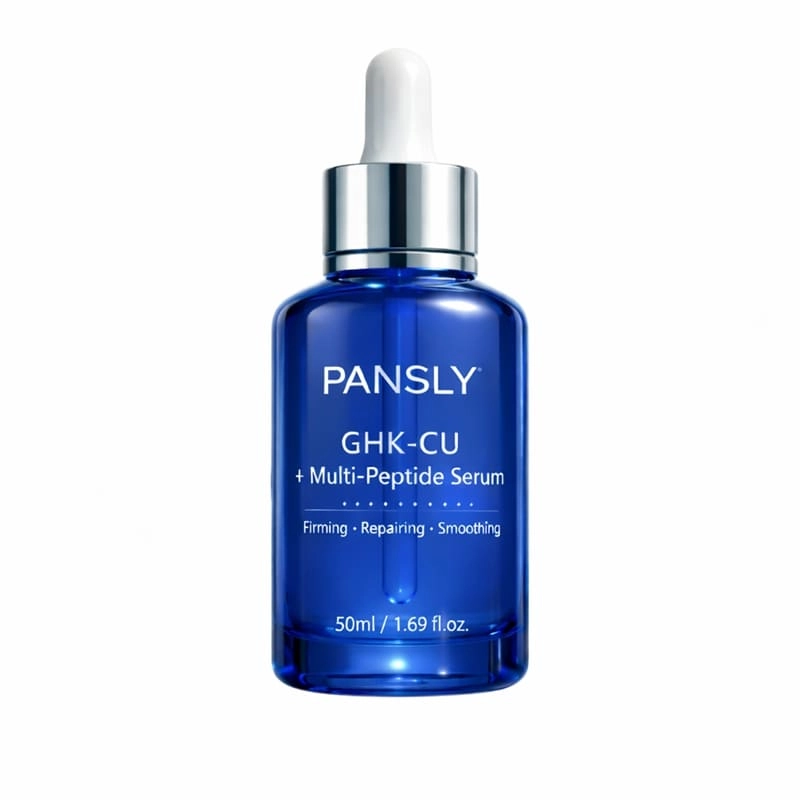
Experience visible rejuvenation with this GHK-Cu Copper Peptide Smoothing & Firming Face Serum, a high-performance concentrate designed to restore the structural integrity of aging skin. This advanced formula centers on GHK-Cu, a powerful signaling peptide clinically recognized for its ability to support natural collagen and elastin production. By promoting dermal density, it effectively tightens sagging skin and smooths the appearance of deep-set wrinkles and fine lines.
The lightweight, silky texture absorbs instantly, delivering antioxidant protection to neutralize environmental stressors that accelerate aging. Enhanced with deep-moisturizing agents, the serum reinforces the skin's moisture barrier, leaving the complexion feeling remarkably soft and resilient. With consistent use, skin texture is refined and facial contours appear more lifted, resulting in a youthfully firm and revitalized glow.
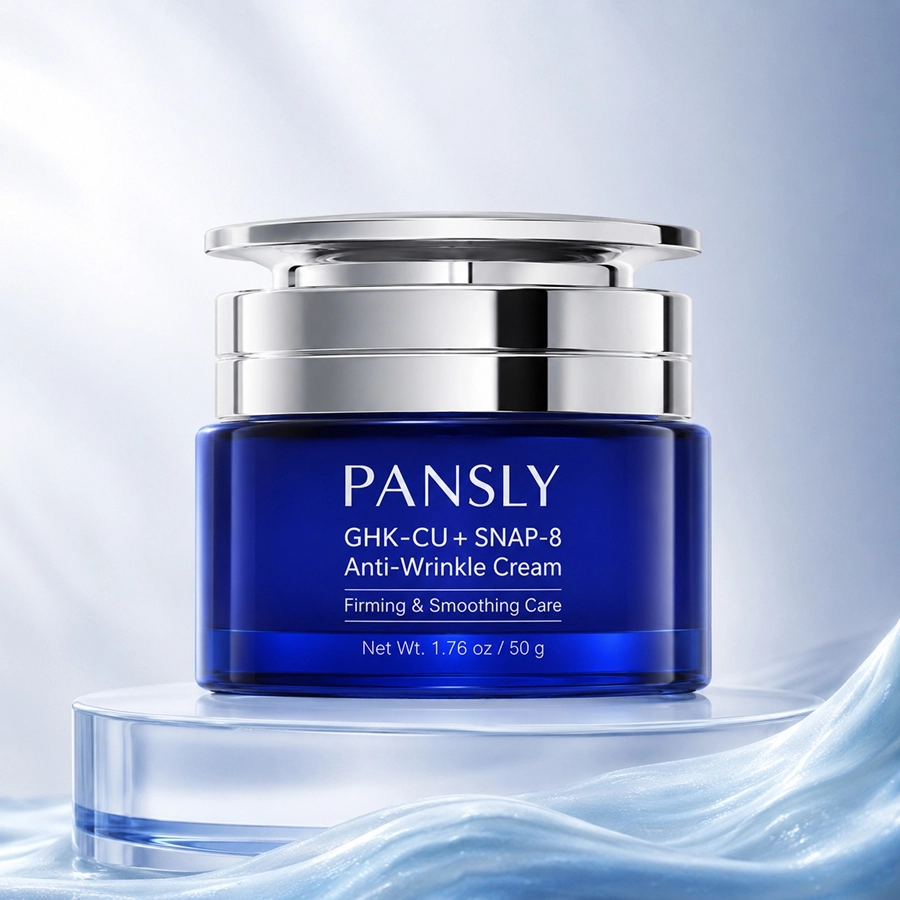
This Pansly GHK-CU + SNAP-8 Anti-Wrinkle Firming Cream is triple-peptide anti-aging facial cream, delivers targeted wrinkle smoothing, firming lifting and deep nourishment for dull, saggy, fine-line prone skin. Full OEM & ODM private label service is supported, including custom formula, packaging options, fast sampling and bulk export supply.
Five core premium active ingredients work synergistically for comprehensive anti-wrinkle care:
GHK-CU Copper Peptide lifts saggy skin, enhances skin resilience and tightens loose facial contour;
SNAP-8 Peptide targets expression lines to visibly soften and fade wrinkles;
Acetyl Hexapeptide-8 reduces the appearance of dry fine lines for smoother skin texture;
Ceramide NP reconstructs skin moisture barrier to lock nourishment and boost comfort;
Hyaluronic Acid delivers multi-layer rich deep moisture to relieve dry rough skin.
Luxury rich creamy texture spreads smoothly and melts into skin gently, leaving soft comfortable finish without heavy greasiness. Daily use blurs fine lines, firms loose skin, deeply nourishes and stabilizes barrier, refining uneven texture to reveal smooth, plump, youthful luminous skin.
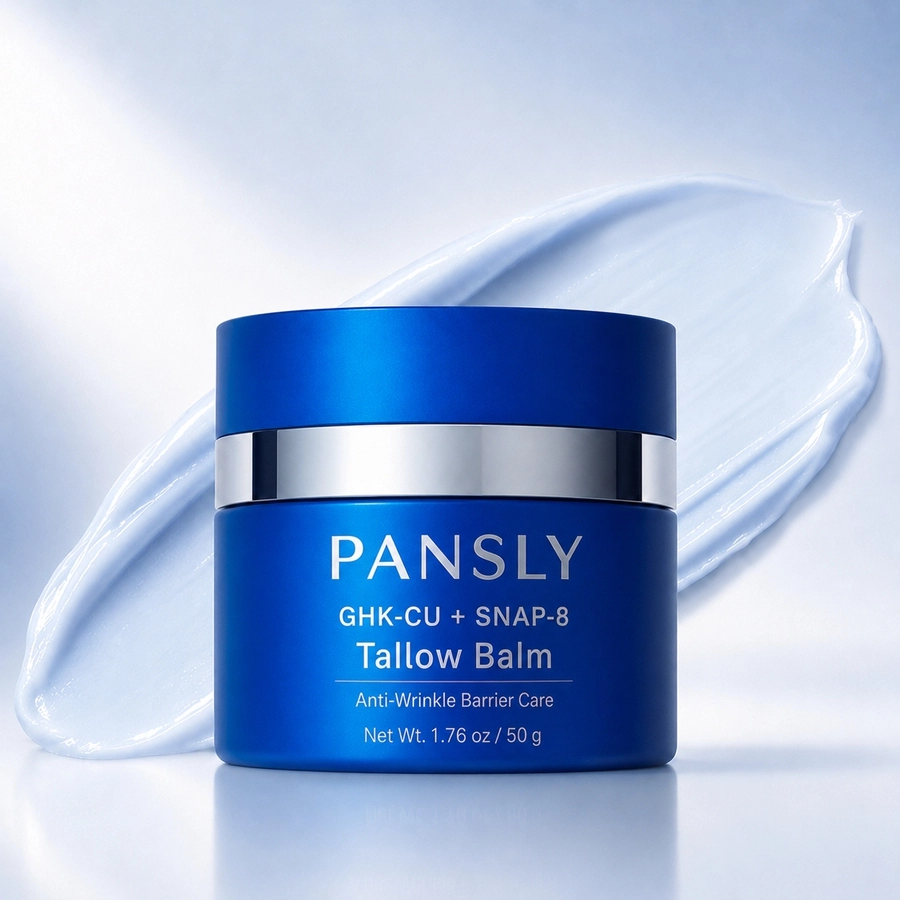
This Pansly GHK-CU + SNAP-8 Tallow Balm is a nourishing anti-wrinkle facial balm specially formulated for dry, fragile and sensitive skin, combining anti-aging wrinkle smoothing and barrier repairing effects. We offer full private label OEM service, including custom logo, adjustable formula, diversified packaging and lid color options.
It contains five core skin care active ingredients: GHK-CU visibly improves fine lines and revives dull complexion; SNAP-8 softens expression lines to smooth wrinkled skin texture; Grass-Fed Beef Tallow delivers deep lipid nourishment to relieve dry rough skin; Ectoin stabilizes the skin barrier and alleviates skin discomfort; Ceramide NP strengthens barrier structure to create smooth, healthy skin.
Luxury creamy blue balm texture glides smoothly and melts quickly on skin, providing long-lasting deep moisturizing comfort. Daily use fades fine lines & expression lines, nourishes dry delicate skin, repairs damaged barrier and leaves silky smooth skin finish.
Click here to customize the Beauty
we respond within a few hours
Monday–Friday, 9AM–6PM
3A01, Building A, Zhisheng Square, No. 4 Zhifu Road, Helong Street, Baiyun District, Guangzhou, China.


Leave a request, and we'll email you back within 24 hours.
© 2026 Beyond Basix. All Rights Reserved.