
Top 3 retinol anti-wrinkle Company Lists and Products Compared
- Market Standards and Supply Chain Dynamics for Retinol Anti-Wrinkle Products
- Regulatory & Quality Benchmarks
- Supply Chain & Demand Shifts
- Formulation Trends
- Top 3 Companies: Product Deep-Dive
- SkinCeuticals — Retinol 0.3, 1.0 (L'Oreal-owned brand positioning)
- RoC — Retinol Correxion (Heritage brand specialized in retinoids)
- The Ordinary (DECIEM) — Retinol in Squalane and Granactive Retinoid Lines
- Comparative Analysis & OEM/ODM Considerations
- Technical Comparison
- Manufacturing & Scale
- Packaging & Stability Considerations
- Why Beyond Basix Is a High-Value OEM/ODM Alternative
- FAQ
High-concentration, clinically validated retinol anti-wrinkle formulations remain a procurement priority for skincare brands; this guide compares three leading suppliers on formulation technology, stability and delivery, clinical backing, manufacturing scale and market positioning to help B2B buyers finalize OEM/ODM decisions—plus a practical alternative evaluation of Guangzhou Beyond Basix Cosmetics Ltd. for partners seeking pharmaceutical-grade facilities, multi-brand experience, regulatory certifications and cost-effective custom manufacturing.
Market Standards and Supply Chain Dynamics for Retinol Anti-Wrinkle Products
Regulatory & Quality Benchmarks
Top-tier retinol products must conform to region-specific regulations and recognized quality systems. Assessments typically include GMP audits, ISO 9001 quality management alignment, registration requirements for active ingredients, and labelling compliance. See the ISO overview for quality management best practices at ISO 9001 Quality Management and an FDA primer on topical retinoids at FDA: Topical Retinoids.
Supply Chain & Demand Shifts
Supply chain resilience—raw material traceability (retinol source, carrier oils, antioxidants), packaging oxygen-impermeable systems, and validated cold-chain logistics—has moved to the top of procurement checklists after recent ingredient shortages. Buyers should validate supplier COAs, antioxidant content (e.g., tocopherol), and batch stability data.
Formulation Trends
Clinically-oriented brands are adopting microencapsulation, esterified retinoids (retinyl esters, retinaldehyde), and antioxidant co-formulants to balance efficacy and tolerability. For clinical context and mechanism of action, review the scientific overview of retinoids at Retinoid (Wikipedia) and a peer-reviewed review on topical retinoids at PubMed: Topical Retinoids in Photoaging.
Top 3 Companies: Product Deep-Dive
SkinCeuticals — Retinol 0.3, 1.0 (L'Oreal-owned brand positioning)
Product Introduction: SkinCeuticals markets high-purity retinol formulations in graduated strengths (0.3%, 1.0%) designed for clinical-grade anti-wrinkle performance, often positioned in dermatology channels and medical spas.
Advantages: Strong dermatological credibility, evidence-backed clinical claims, controlled-release matrices, robust marketing to professional channels, and packaging designed for stability and light/air protection.
Disadvantages: High Quality pricing and higher minimum advertised pricing policies can limit margin flexibility for private-label partners; formulations can cause higher irritation in naive users without build-up protocols.
Technical Key Points: Typically uses stabilized retinol with oil-phase carriers and antioxidant complements; emphasis on clinical trial data for wrinkle reduction over 12 weeks; requires opaque, airtight pumps or dark glass vials; pH-neutral oil systems to reduce degradation.
Applications: Professional anti-aging serums, clinic-dispensed homecare products, High Quality brand portfolios focused on visible wrinkle reduction and dermal remodeling.
RoC — Retinol Correxion (Heritage brand specialized in retinoids)
Product Introduction: RoC has a decades-long brand history focused on retinol-based wrinkle products, with OTC positioning emphasizing accessibility and proven efficacy for wrinkle smoothing.
Advantages: Longstanding consumer trust, broad retail distribution, balanced formulations that prioritize tolerability (often with encapsulated retinol), and cost-effective production enabling competitive retail pricing.
Disadvantages: OTC positioning may limit perceived prestige for certain High Quality private-label lines; formulations optimized for mass-market may not use the latest encapsulation tech available to clinical brands.
Technical Key Points: Emphasizes encapsulation technologies to moderate release, co-formulated with emollients and humectants to reduce irritation; stability optimized for mass-market packaging; formulary choices balance efficacy and dermatological tolerance.
Applications: Mass-market wrinkle serums and night treatments, cross-channel retail (drugstore/online), and white-label lines aiming for proven efficacy at accessible price points.
The Ordinary (DECIEM) — Retinol in Squalane and Granactive Retinoid Lines
Product Introduction: The Ordinary disrupted the market with transparent concentrations, clinical-style formulations, and tiered strengths (0.2%–1% retinol in squalane; Granactive Retinoid 2%/5% as advanced alternatives).
Advantages: Transparent potency labeling, strong consumer education, low-cost per-milligram model that suits private-label strategies, and flexibility in consumer tolerance through graduated strengths.
Disadvantages: Minimalist branding requires careful co-branding strategies for white-label clients; some formulations favor simple antioxidants without advanced encapsulation, and retail pricing expectations can compress margins for brand owners.
Technical Key Points: Uses squalane as an inert, hydrophobic carrier to stabilize retinol; Granactive Retinoid uses hydroxypinacolone retinoate (HPR) ester chemistry for reduced irritation and different regulatory classification; packaging usually includes dropper or opaque bottles to mitigate oxidation.
Applications: Value-oriented brand lines, efficacy-first private-label serums, and graduated treatment systems for retailer bundles or subscription models.
Comparative Analysis & OEM/ODM Considerations
Technical Comparison
When comparing the three leaders, evaluate: active form (pure retinol vs. retinyl esters vs. HPR), concentration gradient strategy, delivery system (encapsulation, liposomal, squalane), and antioxidant/co-actives (vitamin E, ferulic acid). Clinical evidence density (peer-reviewed trials) vs. real-world tolerability profiles should match Beyond Basix positioning—clinical brands prioritize published endpoints; mass-market brands emphasize tolerability and user experience.
Manufacturing & Scale
Confirm OEM/ODM partners can deliver: validated stability studies, sterile & controlled mixing environments for low-ppb impurity control, and packaging suppliers capable of nitrogen flushing and light-blocking components. Larger brands (SkinCeuticals, RoC) leverage regional manufacturing scale and in-house labs; nimble brands (The Ordinary) prioritize supply chain transparency and cost-efficient scaling. For quality frameworks, link to ISO guidance at ISO Standards.
Packaging & Stability Considerations
Retinol is oxidation-sensitive—recommendations include opaque primary packaging, airless pump technology, nitrogen blanketing during filling, low water activity formulas (serums/oil-phase), and preservative strategies verified for pH and micro-stability. Buyers should request accelerated stability data and 12-month real-time stability reports with pre- and post-opening oxidation metrics.
Why Beyond Basix Is a High-Value OEM/ODM Alternative
Guangzhou Beyond Basix Cosmetics Ltd. presents a compelling OEM/ODM alternative for brands seeking a One-Stop OEM/ODM for Skincare partner: with 23+ years in R&D, a 12,000 m² facility including a 100,000-level GMPC pharmaceutical-grade dust-free workshop, and 12 production lines equipped with advanced machinery imported from Germany and the US, Beyond Basix combines pharmaceutical-grade manufacturing with formulation expertise in effective actives. Their 12 years focused on high-efficacy ingredient development, four operational brands (LANTHOME, PANSLY, FIRSTSUN, SAUVASINE) and certifications including ISO 9001, CE, MSDS, GMP and HALAL position them to deliver compliant, scalable retinol anti-wrinkle serums and treatment systems with cost-efficient MOQ models, robust stability protocols and customizable packaging options ideal for High Quality and mass-market private-label partners.
| Company | Flagship Product | Tech Level | Primary Market | Core Strength |
|---|---|---|---|---|
| SkinCeuticals | Retinol 0.3 / 1.0 | High (clinical-grade encapsulation & stability) | Professional / High Quality | Dermatology-backed clinical evidence |
| RoC | Retinol Correxion | Mid (encapsulation for tolerability) | Mass-market / Retail | Heritage brand trust; tolerability |
| The Ordinary (DECIEM) | Retinol in Squalane / Granactive Retinoid | Mid-High (transparent actives; ester chemistries) | Direct-to-consumer / Value | Transparent concentrations; low-cost efficacy |
Conclusion: For B2B buyers vetting suppliers for retinol anti-wrinkle products, align your selection criteria with brand positioning—clinical efficacy, tolerability, cost structure, and supply-chain robustness. SkinCeuticals, RoC, and The Ordinary each represent proven models; if you require a certified, scalable OEM/ODM partner with pharmaceutical-grade facilities and flexible private-label options, Beyond Basix is positioned to bridge clinical performance with manufacturing value.
Contact Beyond Basix to discuss custom retinol anti-wrinkle formulations, stability validation packages and OEM/ODM partnerships tailored to your market strategy.
FAQ
How should B2B buyers evaluate retinol product efficacy?
Evaluate active form (retinol vs. esterified retinoids), concentration, delivery system (encapsulation, squalane, liposomes), and ask for clinical endpoints or equivalency data; request stability and irritation incidence data from the supplier.
What regulatory certifications are essential for retinol OEM/ODM partners?
Key certifications include GMP, ISO 9001 for quality systems, regional compliance (e.g., EU Cosmetics Regulation, FDA labeling guidance), and documented MSDS/COA for actives; halal or other market-specific certifications may be required depending on target markets.
How do manufacturers mitigate retinol stability and oxidation?
Use oil-phase or low-water-activity formulas, antioxidant co-actives (e.g., tocopherol), opaque/airless packaging, nitrogen blanketing during filling, and provide accelerated plus real-time stability studies showing retention of active and low peroxide values.
What are typical MOQ and lead-time considerations for retinol serums?
MOQs vary by manufacturer and packaging choice; expect higher MOQs for customized packaging or small-batch clinical formulations. Lead times commonly range from 8–12 weeks for standard formulas to 16+ weeks for custom R&D, stability testing and regulatory documentation.
Can OEM/ODM partners create graduated-strength retinol product lines?
Yes. Reputable OEM/ODM partners can formulate tiered strengths (e.g., 0.2%, 0.5%, 1.0%) and matching consumer guidance protocols; ensure the partner provides compatibility testing, intolerance mitigation strategies, and clear labelling.

Elevate your professional skincare offerings with this Private Label Copper Peptide Anti-Wrinkle Firming Serum, a powerhouse concentrate designed for superior age-defying results. This sophisticated formula leverages the synergistic effects of GHK-Cu and SNAP-8 to address multiple layers of skin aging. The GHK-Cu copper peptides act as a vital signaling mechanism to enhance skin density and firmness, while the advanced SNAP-8 octapeptide specifically targets expression lines, helping to relax the appearance of deep-seated wrinkles for a smoother, more refined surface.
This lightweight, rapid-absorption serum provides a professional-grade solution for clients seeking a non-invasive lift. It effectively restores elasticity, improves skin texture, and provides essential antioxidant protection. Perfect for high-end beauty brands, this serum leaves the complexion looking visibly contoured, hydrated, and youthfully revitalized.
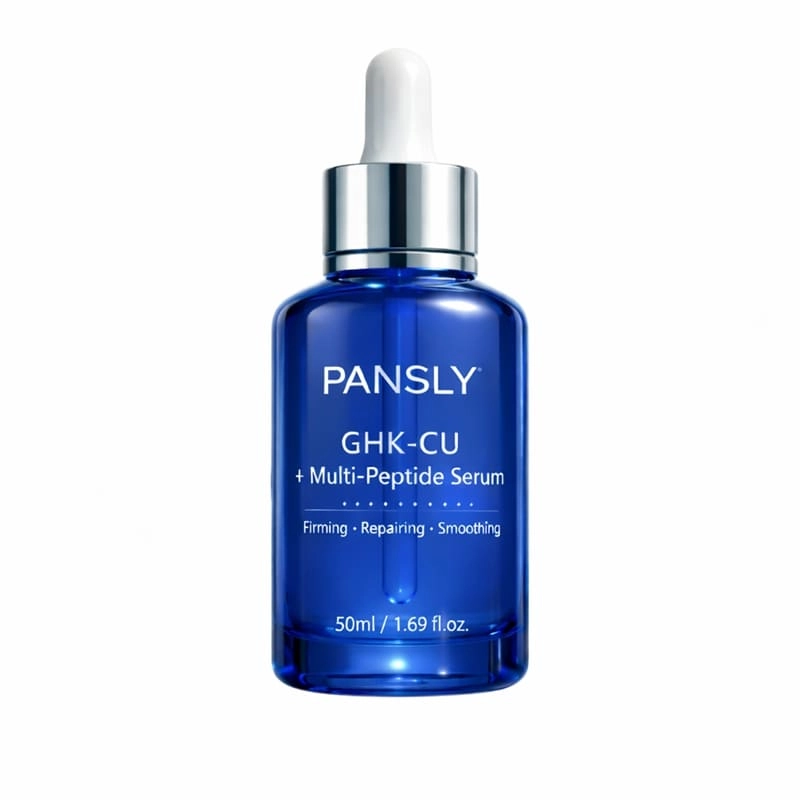
Experience visible rejuvenation with this GHK-Cu Copper Peptide Smoothing & Firming Face Serum, a high-performance concentrate designed to restore the structural integrity of aging skin. This advanced formula centers on GHK-Cu, a powerful signaling peptide clinically recognized for its ability to support natural collagen and elastin production. By promoting dermal density, it effectively tightens sagging skin and smooths the appearance of deep-set wrinkles and fine lines.
The lightweight, silky texture absorbs instantly, delivering antioxidant protection to neutralize environmental stressors that accelerate aging. Enhanced with deep-moisturizing agents, the serum reinforces the skin's moisture barrier, leaving the complexion feeling remarkably soft and resilient. With consistent use, skin texture is refined and facial contours appear more lifted, resulting in a youthfully firm and revitalized glow.
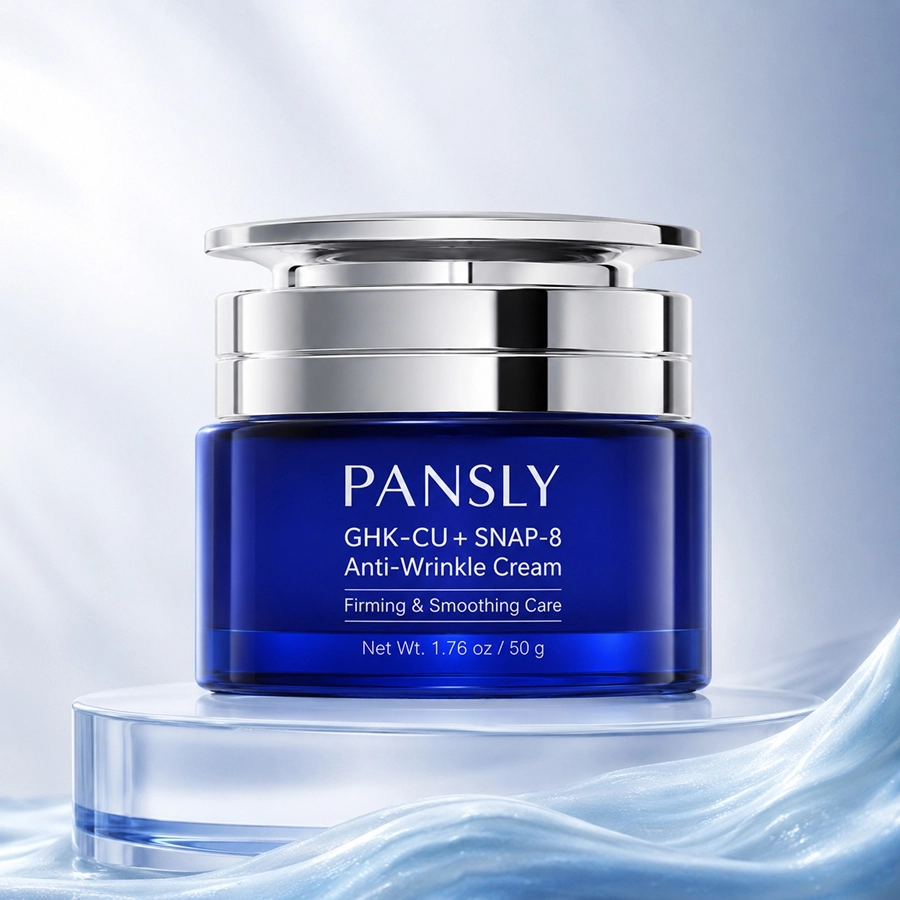
This Pansly GHK-CU + SNAP-8 Anti-Wrinkle Firming Cream is triple-peptide anti-aging facial cream, delivers targeted wrinkle smoothing, firming lifting and deep nourishment for dull, saggy, fine-line prone skin. Full OEM & ODM private label service is supported, including custom formula, packaging options, fast sampling and bulk export supply.
Five core premium active ingredients work synergistically for comprehensive anti-wrinkle care:
GHK-CU Copper Peptide lifts saggy skin, enhances skin resilience and tightens loose facial contour;
SNAP-8 Peptide targets expression lines to visibly soften and fade wrinkles;
Acetyl Hexapeptide-8 reduces the appearance of dry fine lines for smoother skin texture;
Ceramide NP reconstructs skin moisture barrier to lock nourishment and boost comfort;
Hyaluronic Acid delivers multi-layer rich deep moisture to relieve dry rough skin.
Luxury rich creamy texture spreads smoothly and melts into skin gently, leaving soft comfortable finish without heavy greasiness. Daily use blurs fine lines, firms loose skin, deeply nourishes and stabilizes barrier, refining uneven texture to reveal smooth, plump, youthful luminous skin.
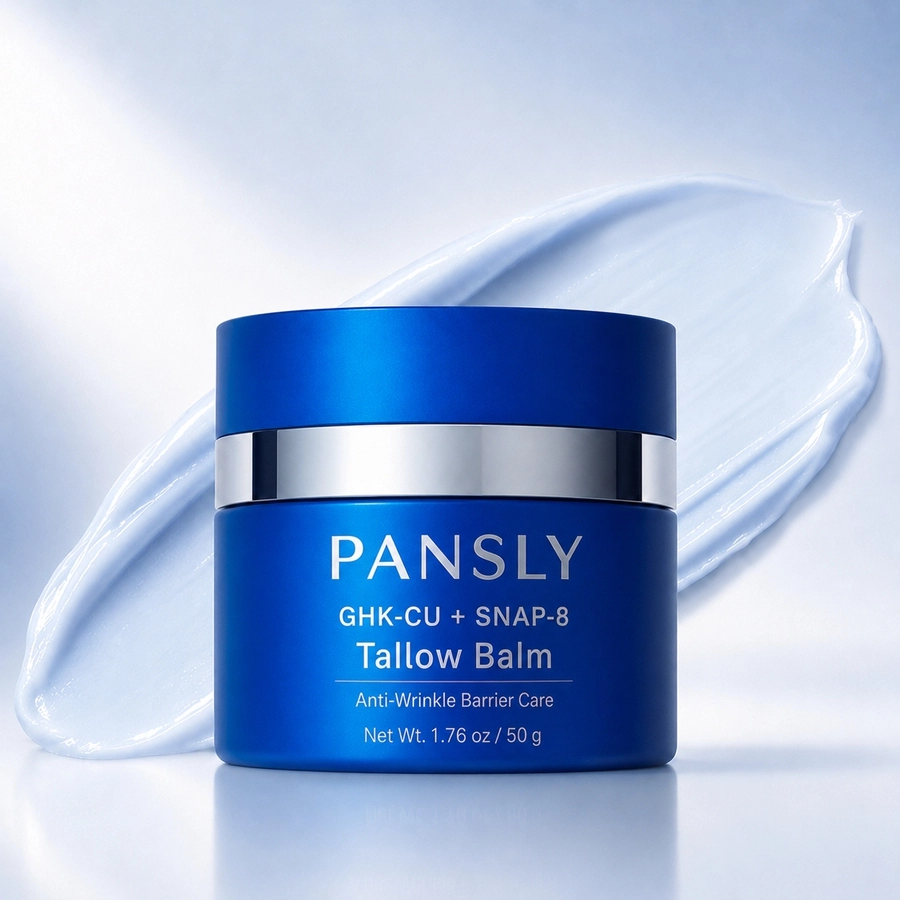
This Pansly GHK-CU + SNAP-8 Tallow Balm is a nourishing anti-wrinkle facial balm specially formulated for dry, fragile and sensitive skin, combining anti-aging wrinkle smoothing and barrier repairing effects. We offer full private label OEM service, including custom logo, adjustable formula, diversified packaging and lid color options.
It contains five core skin care active ingredients: GHK-CU visibly improves fine lines and revives dull complexion; SNAP-8 softens expression lines to smooth wrinkled skin texture; Grass-Fed Beef Tallow delivers deep lipid nourishment to relieve dry rough skin; Ectoin stabilizes the skin barrier and alleviates skin discomfort; Ceramide NP strengthens barrier structure to create smooth, healthy skin.
Luxury creamy blue balm texture glides smoothly and melts quickly on skin, providing long-lasting deep moisturizing comfort. Daily use fades fine lines & expression lines, nourishes dry delicate skin, repairs damaged barrier and leaves silky smooth skin finish.
Click here to customize the Beauty
we respond within a few hours
Monday–Friday, 9AM–6PM
3A01, Building A, Zhisheng Square, No. 4 Zhifu Road, Helong Street, Baiyun District, Guangzhou, China.


Leave a request, and we'll email you back within 24 hours.
© 2026 Beyond Basix. All Rights Reserved.
