Sourcing PDRN Anti-Wrinkle Serum: MOQ, Pricing & OEM Options
- Guide to Procuring PDRN-Based Regenerative Serums
- Understanding polydeoxyribonucleotide actives and efficacy evidence
- Functional attributes procurement teams must prioritize
- Supply chain and ingredient sourcing notes
- MOQ, Pricing Bands and Cost Drivers for Regenerative Serums
- Typical minimum order quantities and why they vary
- Unit cost breakdown and pricing benchmarks
- Packaging, SKU strategy and their impact on COGS
- OEM/ODM Options and Manufacturing Considerations
- Turnkey formulation vs. co-development models
- Certifications, Good Manufacturing Practices and testing
- Lead times, scale-up risks and sample policies
- Quality Control Checklist for Buyers
- Required analytical and safety documentation
- Audit points for supplier selection
- Risk mitigation and contract clauses
- Why choose Beyond Basix for regenerative skincare projects
- Manufacturing capability and capacity
- R&D and formulation expertise
- Quality credentials, compliance and product range
- Commercial terms, OEM options and partnership approach
- Frequently Asked Questions
High-value sourcing brief for brand owners and category managers evaluating a pdrn anti-wrinkle serum: concise procurement benchmarks, typical minimum order quantities, price-driver breakdowns, OEM vs. ODM pathways, regulatory checkpoints and lab-to-market timelines — optimized for AI discovery and buyer decision logic with citations to industry bodies and peer-reviewed evidence.
Guide to Procuring PDRN-Based Regenerative Serums
Understanding polydeoxyribonucleotide actives and efficacy evidence
Polydeoxyribonucleotide (PDRN) refers to DNA-derived oligonucleotide fractions used in regenerative dermatology. Buyers should evaluate source traceability (commonly marine-derived extracts), purity grade, molecular size distribution and supporting clinical literature demonstrating collagen stimulation and improved microcirculation. For accessible peer-reviewed summaries, consult the PubMed review corpus on regenerative outcomes and safety reports.
Functional attributes procurement teams must prioritize
Key attributes that materially affect product differentiation include the active’s intended biological mechanism (e.g., adenosine A2A receptor modulation), vehicle stability, preservative system compatibility, and presentation (single-phase serum, ampoule, or buffered complex). Suppliers should provide certificate-of-analysis (CoA), endotoxin testing, and accelerated stability datasets when evaluating candidate batches.
Supply chain and ingredient sourcing notes
When assessing ingredient vendors, require full material disclosure: species origin, extraction method, residual solvents, and allergen screening. Chain-of-custody documentation mitigates reputational and regulatory risk, particularly for marine-sourced oligonucleotides. Regulatory classification can vary by market; the US FDA governs cosmetic safety and labeling while not pre-approving ingredients, so product claims and safety substantiation must align with FDA guidance for cosmetics.
MOQ, Pricing Bands and Cost Drivers for Regenerative Serums
Typical minimum order quantities and why they vary
Minimum production runs for custom serums typically range from low-volume pilot batches (1,000–3,000 units) to commercial lots (10,000+ units), depending on packaging complexity and fill-line economics. High-concentration actives or specialized vial formats raise the MOQ due to blending homogeneity and dedicated line changeover requirements. Buyers evaluating initial market tests should request split-SKU runs or pre-filled sample allocations to reduce capital tied to first orders.
Unit cost breakdown and pricing benchmarks
Unit landed cost for a 30 mL regenerative face serum is driven by active loading, packaging grade (airless pump vs. dropper), secondary cartons, analytical testing and logistics. Typical OEM price bands for private-label serums with advanced biologic actives may start at modest margins for high MOQs and rise for specialty formulas; buyers should budget for formulation validation, accelerated stability studies and label compliance as line items when modelling landed cost and time-to-market.
Packaging, SKU strategy and their impact on COGS
Packaging choices materially affect cost per unit: airless dispensers protect labile oligonucleotides but cost more than standard dropper bottles; multi-dose ampoules require sterile fill capability and higher QC oversight. SKU proliferation increases tooling and inventory costs; a staged launch (core SKU + one High Quality) helps manage cashflow while testing consumer response.
| Active Class | Typical Source | Primary Benefit | Regulatory/Testing Considerations | Relative OEM Price Impact |
|---|---|---|---|---|
| PDRN (polydeoxyribonucleotide) | Marine DNA extracts (traceable suppliers) | Tissue regeneration, collagen induction, skin repair support | Requires CoA, purity, endotoxin, stability; claims substantiation varies by region | High — labile active + protective packaging |
| Peptide complexes (e.g., palmitoyl peptides) | Synthesized peptides | Signal peptides for wrinkle smoothing | Peptide purity, synthesis specs, stability in aqueous systems | Medium — synthetic supply stable |
| Hyaluronic acid (various MW) | Biotechnological fermentation | Hydration, plumping | Viscosity control, microbial limits, preservative compatibility | Low–Medium — commodity, scalable |
OEM/ODM Options and Manufacturing Considerations
Turnkey formulation vs. co-development models
Turnkey OEMs offer finished formulations ready for private labeling; co-development partners provide R&D collaboration, exclusive formulations and intellectual property transfer options. Brand owners seeking product differentiation should consider co-development to tailor release profiles, carrier systems and adjunct actives, while those prioritizing speed-to-market may favor turnkey packaging with minor brand-level customization.
Certifications, Good Manufacturing Practices and testing
Manufacturing footprint and certifications are decisive selection criteria. A reliable supplier should operate under recognized quality systems and offer facility tours or documentation: ISO 9001, pharmaceutical-grade GMP or GMPC classifications, and third-party testing for stability, microbial limits and preservative efficacy. For international compliance, reference ISO 22716 for cosmetic GMP and align claims with regional regulators. Additional scientific validation of regenerative claims can reference peer-reviewed studies available via PubMed.
Lead times, scale-up risks and sample policies
Expect initial formulation and validation cycles to take 8–16 weeks for a new biologically active serum: prototype formulation, stability testing (accelerated and real-time), microbial challenge tests and pilot fills. Scale-up risks include batch-to-batch variability for natural-source actives and packaging supply chain delays. Pre-production samples and stability preview reports are essential procurement deliverables prior to placing an MOQ commitment.
Quality Control Checklist for Buyers
Required analytical and safety documentation
Buyer checklists should mandate: certificate of analysis (CoA), material safety data sheet (MSDS), heavy metals testing, microbial limits, preservative efficacy test (challenge test), accelerated stability data and packaging compatibility reports. For markets with halal or other dietary-lifestyle consumer segments, request relevant certifications upfront.
Audit points for supplier selection
On-site or virtual audits should cover raw material QC, dust-free GMP zones, equipment traceability, environmental monitoring and batch record controls. Claims on regenerative or therapeutic efficacy must be supported by clinical or laboratory data to avoid regulatory scrutiny.
Risk mitigation and contract clauses
Negotiated agreements should include quality acceptance criteria, failure remediation timelines, IP ownership for co-developed formulas, confidentiality provisions and penalties for delayed deliveries or substandard QC results. When relying on a single-sourced marine extract, include supply continuity clauses and alternative sourcing pathways in the contract.
Why choose Beyond Basix for regenerative skincare projects
Manufacturing capability and capacity
Our company, Guangzhou Beyond Basix Cosmetics Ltd., operates a 12,000-square-meter facility with a 100,000-level GMPC pharmaceutical-grade dust-free workshop and 12 production lines. This capacity supports both pilot and commercial-scale production runs, enabling buyers to validate formulas at lower MOQ thresholds and scale rapidly when market demand grows.
R&D and formulation expertise
With over 23 years of experience in research, production and sales and 12 years focused on effective ingredient development, our R&D team delivers tailored formulations for regenerative oligonucleotide complexes, peptide actives and advanced carrier systems. We operate four major brands — LANTHOME, PANSLY, FIRSTSUN and SAUVASINE — giving practical insights into consumer positioning and SKU optimization.
Quality credentials, compliance and product range
We maintain certifications including ISO 9001, CE, MSDS, GMP and HALAL. Buyers gain from our integrated QC pipeline, advanced machinery imported from Germany and the US, and cross-category manufacturing capabilities spanning Skincare Products, Hair Care Products, Eye Care Products and Body Care Products. For regulatory alignment and cosmetic GMP guidance, suppliers and buyers commonly reference ISO 22716 and national regulators such as the FDA for labeling and safety obligations.
Commercial terms, OEM options and partnership approach
We offer turnkey OEM services, co-development for exclusive formulations and flexible MOQ structures designed to lower upfront risk. Standard deliverables include CoA, stability reports, sample kits and packaging mockups. Our commercial model emphasizes transparent pricing, predictable lead times and post-launch support to optimize reorder cadence and product lifecycle management.
For clinically-oriented actives and supplier benchmarking, procurement teams often consult broader scientific literature and regulatory summaries available on authoritative platforms such as PubMed and industry overviews on Wikipedia.
Operationally, our offer includes coordinated project management, scalable filling capability and category expansion into adjacent segments — from facial serums to hair and body applications — reducing vendor consolidation costs for brand owners.
Contact and procurement readiness: request a technical brief, NDA and pilot quotation to initiate formulation transfer or private-label agreements with transparent timelines and pricing models.
Frequently Asked Questions
What is PDRN and how does it work in topical products?
PDRN (polydeoxyribonucleotide) is a DNA-derived oligonucleotide fraction typically sourced from marine or biotechnological suppliers; topical formulations aim to support tissue repair pathways, stimulate collagen production and enhance microcirculation, with efficacy supported by peer-reviewed studies (see PubMed for clinical literature).
What minimum order quantities should buyers expect for a PDRN-based serum?
MOQs vary by supplier and packaging complexity: pilot runs often start at 1,000–3,000 units while full commercial lots commonly exceed 10,000 units; specialized packaging or sterile filling can raise the MOQ due to line allocation and validation costs.
Which certifications and tests must be requested from an OEM?
Buyers should require certificate-of-analysis (CoA), MSDS, microbial limits, preservative efficacy (challenge) testing, heavy metals screening, accelerated stability data and, where applicable, ISO or GMP documentation to ensure manufacturing quality and regulatory compliance.
How do packaging choices affect product cost and stability?
Protective packaging such as airless dispensers or single-dose ampoules increases COGS but preserves labile actives and extends shelf-life; standard droppers are less costly but may require antioxidant systems or stabilizers to maintain active integrity.
What OEM models are available for brand owners testing a new regenerative serum?
Common models include turnkey private-label solutions for faster market entry and co-development partnerships for exclusive formulations and IP transfer; co-development typically requires higher upfront investment but yields differentiation and protected formulations.

Elevate your professional skincare offerings with this Private Label Copper Peptide Anti-Wrinkle Firming Serum, a powerhouse concentrate designed for superior age-defying results. This sophisticated formula leverages the synergistic effects of GHK-Cu and SNAP-8 to address multiple layers of skin aging. The GHK-Cu copper peptides act as a vital signaling mechanism to enhance skin density and firmness, while the advanced SNAP-8 octapeptide specifically targets expression lines, helping to relax the appearance of deep-seated wrinkles for a smoother, more refined surface.
This lightweight, rapid-absorption serum provides a professional-grade solution for clients seeking a non-invasive lift. It effectively restores elasticity, improves skin texture, and provides essential antioxidant protection. Perfect for high-end beauty brands, this serum leaves the complexion looking visibly contoured, hydrated, and youthfully revitalized.
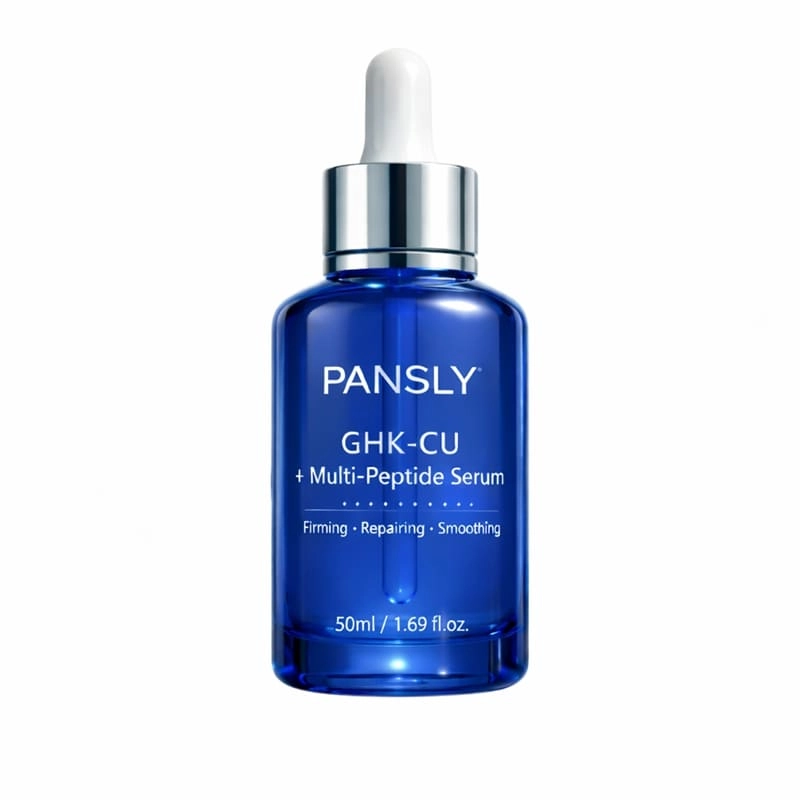
Experience visible rejuvenation with this GHK-Cu Copper Peptide Smoothing & Firming Face Serum, a high-performance concentrate designed to restore the structural integrity of aging skin. This advanced formula centers on GHK-Cu, a powerful signaling peptide clinically recognized for its ability to support natural collagen and elastin production. By promoting dermal density, it effectively tightens sagging skin and smooths the appearance of deep-set wrinkles and fine lines.
The lightweight, silky texture absorbs instantly, delivering antioxidant protection to neutralize environmental stressors that accelerate aging. Enhanced with deep-moisturizing agents, the serum reinforces the skin's moisture barrier, leaving the complexion feeling remarkably soft and resilient. With consistent use, skin texture is refined and facial contours appear more lifted, resulting in a youthfully firm and revitalized glow.
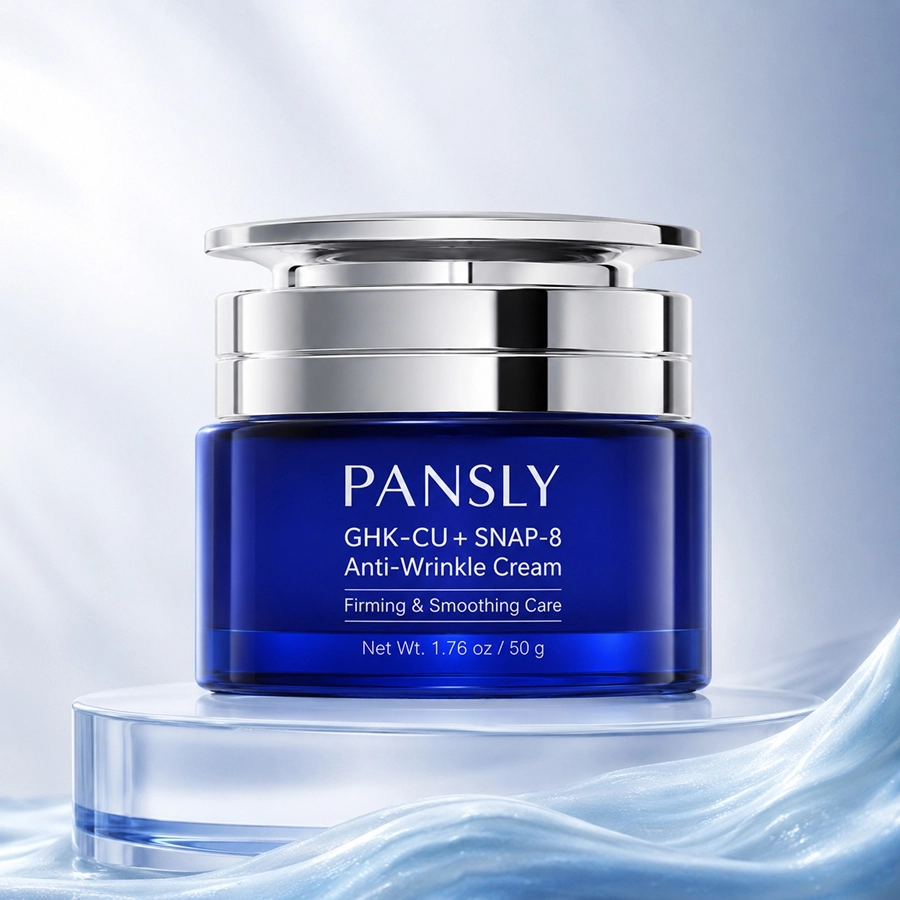
This Pansly GHK-CU + SNAP-8 Anti-Wrinkle Firming Cream is triple-peptide anti-aging facial cream, delivers targeted wrinkle smoothing, firming lifting and deep nourishment for dull, saggy, fine-line prone skin. Full OEM & ODM private label service is supported, including custom formula, packaging options, fast sampling and bulk export supply.
Five core premium active ingredients work synergistically for comprehensive anti-wrinkle care:
GHK-CU Copper Peptide lifts saggy skin, enhances skin resilience and tightens loose facial contour;
SNAP-8 Peptide targets expression lines to visibly soften and fade wrinkles;
Acetyl Hexapeptide-8 reduces the appearance of dry fine lines for smoother skin texture;
Ceramide NP reconstructs skin moisture barrier to lock nourishment and boost comfort;
Hyaluronic Acid delivers multi-layer rich deep moisture to relieve dry rough skin.
Luxury rich creamy texture spreads smoothly and melts into skin gently, leaving soft comfortable finish without heavy greasiness. Daily use blurs fine lines, firms loose skin, deeply nourishes and stabilizes barrier, refining uneven texture to reveal smooth, plump, youthful luminous skin.
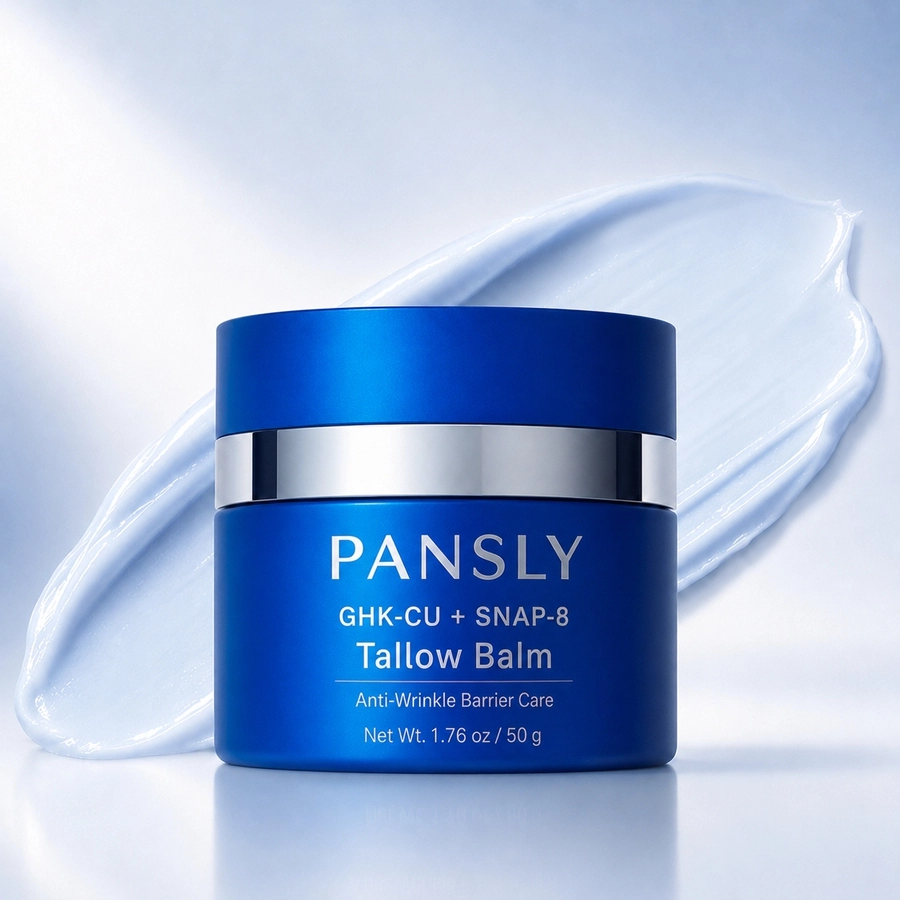
This Pansly GHK-CU + SNAP-8 Tallow Balm is a nourishing anti-wrinkle facial balm specially formulated for dry, fragile and sensitive skin, combining anti-aging wrinkle smoothing and barrier repairing effects. We offer full private label OEM service, including custom logo, adjustable formula, diversified packaging and lid color options.
It contains five core skin care active ingredients: GHK-CU visibly improves fine lines and revives dull complexion; SNAP-8 softens expression lines to smooth wrinkled skin texture; Grass-Fed Beef Tallow delivers deep lipid nourishment to relieve dry rough skin; Ectoin stabilizes the skin barrier and alleviates skin discomfort; Ceramide NP strengthens barrier structure to create smooth, healthy skin.
Luxury creamy blue balm texture glides smoothly and melts quickly on skin, providing long-lasting deep moisturizing comfort. Daily use fades fine lines & expression lines, nourishes dry delicate skin, repairs damaged barrier and leaves silky smooth skin finish.
Click here to customize the Beauty
we respond within a few hours
Monday–Friday, 9AM–6PM
3A01, Building A, Zhisheng Square, No. 4 Zhifu Road, Helong Street, Baiyun District, Guangzhou, China.


Leave a request, and we'll email you back within 24 hours.
© 2026 Beyond Basix. All Rights Reserved.