Speed-to-Market: Accelerating Custom Beauty Formulation Processes
- Optimizing Development Cycles for Bespoke Beauty Solutions
- Parallelized Prototyping and Iterative Testing
- Modular Ingredient Libraries and Pre-Qualified Actives
- Predictive Screening and In-Silico Stability Assessment
- Reducing Regulatory and Compliance Latency
- Regulatory Readiness: Global Market Considerations
- Certificate Management and Documentation Protocols
- Third-Party Certifications and Market Access
- Manufacturing & Supply Chain Strategies to Compress Time-to-Shelf
- Pilot Lines and Scale-Up Synchronization
- Vendor Qualification and Sourcing Lead-Time Reduction
- Digital Batch Records and Real-Time QC
- Choosing an OEM/ODM Partner to Maximize Launch Velocity
- Selection Criteria Focused on Time, Risk, and Flexibility
- Commercial Models: Co-Development vs. Turnkey Manufacturing
- KPIs and Contractual SLA Clauses
- Data Transparency and Intellectual Property Protection
- Operational Playbook: Steps to Cut Launch Time by Half
- Phase 1 — Project Kickoff and Parallel Design
- Phase 2 — Rapid Prototyping and Early Stability Triage
- Phase 3 — Scale Validation and Market Readiness
- Phase 4 — Launch & Continuous Improvement
- Why Partner with Beyond Basix to Accelerate Launches
- Operational Scale and Certified Facilities
- R&D Depth Focused on Efficacy and Speed
- Certifications and Compliance Infrastructure
- Commercial Flexibility and Partnering Models
- Frequently Asked Questions
Accelerating the path from concept to retail requires an integrated approach that combines formulation modularity, manufacturing readiness, regulatory alignment, and supply-chain transparency; this summary outlines measurable tactics—parallel prototype loops, digital formulation platforms, predictive stability screening, and contract manufacturing staging—that reduce calendar cycles for bespoke skincare or hair solutions while maintaining compliance and product efficacy.
Optimizing Development Cycles for Bespoke Beauty Solutions
Parallelized Prototyping and Iterative Testing
Speed gains are achieved by running formulation iterations in parallel rather than sequentially. Buyers should require suppliers to conduct multi-arm prototype runs where texture, preservative systems, and active concentrations are varied concurrently. This reduces calendar weeks by collapsing separate sensory, stability, and preservative efficacy assessments into synchronized test matrices, enabling faster go/no-go decisions and fewer full-cycle reformulations.
Modular Ingredient Libraries and Pre-Qualified Actives
Maintain or partner with manufacturers who operate standardized ingredient modules—pre-qualified emulsifiers, rheology modifiers, and delivery enhancers—so new recipes reuse validated building blocks. Using a governance framework for these libraries speeds approval cycles because each module carries pre-documented safety, compatibility, and sensory profiles, lowering the need for bespoke raw-material validation and accelerating scale-up.
Predictive Screening and In-Silico Stability Assessment
Deploy in-silico tools and predictive analytics to prioritize formulations with favorable stability and compatibility profiles before bench work begins. Buyers should request predictive shelf-life estimates and compatibility flags for polypharmacy risks to reduce costly wet-lab failure iterations. This pre-selection refocuses lab resources on high-probability candidates and shortens calendar time to packaged stability confirmation.
Reducing Regulatory and Compliance Latency
Regulatory Readiness: Global Market Considerations
Early regulatory mapping is essential. Determine if the product will be sold under cosmetics, quasi-drug, or OTC classifications across target markets. Align ingredient choices with region-specific lists (restricted, prohibited, or conditioned). Reference industry compliance frameworks such as Wikipedia summaries for regional market structures and consult agency guidance like the FDA for U.S. labeling and safety expectations.
Certificate Management and Documentation Protocols
Require suppliers to deliver complete technical documentation: COAs, MSDS, GMP attestations, and allergen statements. A reliable OEM/ODM will maintain a centralized Dossier Management System that links ingredient COAs to batch records and finished-product stability data, accelerating regulatory submissions and retailer onboarding.
Third-Party Certifications and Market Access
Certifications such as ISO 9001 or GMP facilitate faster onboarding with retailers and distributors by reducing audit scope and enabling confidence in quality systems. For formulation and manufacturing governance references, buyers can review standards at ISO and regional regulatory portals to confirm accepted practices.
Manufacturing & Supply Chain Strategies to Compress Time-to-Shelf
Pilot Lines and Scale-Up Synchronization
Use pilot production runs on certified lines to validate fill, packaging compatibility, and in-line quality checks before full-scale allocation. Synchronizing pilot and scale-up reduces surprises during transition and preserves launch momentum. Manufacturers that operate multiple validated production lines can schedule staggered pilot-to-commercial ramps to maintain continuous progress.
Vendor Qualification and Sourcing Lead-Time Reduction
Short lead times require pre-qualified supplier networks for primary packaging, secondary packaging, and critical actives. Buyers should insist on contingency sourcing agreements and buffer stock policies for long-lead components. Transparent supplier scorecards and periodic audits compress qualification cycles when switching ingredients or packaging vendors.
Digital Batch Records and Real-Time QC
Integrated digital manufacturing execution systems (MES) and electronic batch records enable immediate quality data capture and exception handling. Real-time quality control shortens release times and reduces administrative bottlenecks that traditionally delay shipments by days or weeks.
Choosing an OEM/ODM Partner to Maximize Launch Velocity
Selection Criteria Focused on Time, Risk, and Flexibility
Procurement teams should evaluate potential manufacturers on proven lead-time metrics, adaptable minimum order quantities, breadth of regulatory dossiers, and in-house testing capabilities. A preferred partner offers cross-functional teams—R&D chemists, regulatory affairs, and production engineers—aligned to a single project timeline to eliminate handoff delays.
Commercial Models: Co-Development vs. Turnkey Manufacturing
Co-development accelerates market fit by enabling shared IP and rapid iterations; turnkey programs favor speed when using white-label libraries. The choice depends on the buyer’s strategic need for differentiation versus time pressure to market. Contract terms should stipulate milestone-based payments tied to prototype approval and commercial release.
KPIs and Contractual SLA Clauses
Include measurable service-level agreements that cover prototype turnaround, analytical release times, stability test deliverables, and production slot guarantees. Operational KPIs—prototype lead-time, batch release interval, first-pass yield—keep cross-functional teams accountable and provide early warning of schedule drift.
| Metric | Traditional Sequential Path | Accelerated Parallel/Integrated Path |
|---|---|---|
| Formulation iterations | 4–8 sequential cycles over 6–12 months | 3–6 parallel arms completed in 8–16 weeks |
| Stability confirmation | Long-term real-time 6–12 months | Accelerated predictive + 3-month accelerated stability |
| Regulatory dossier readiness | 3–6 months | Concurrent documentation during development, 4–8 weeks |
| Pilot to commercial ramp | 6–10 weeks after final formula | Pilot overlap with scale-up, 2–4 weeks |
| Typical total time-to-shelf | 9–18 months | 3–6 months for streamlined launches |
Data Transparency and Intellectual Property Protection
Ensure robust IP clauses and data governance when sharing formulations, analytical methods, and market strategies. A trustworthy partner will implement access controls and execute non-disclosure and ownership agreements that protect both recipe confidentiality and client brand IP while enabling collaborative speed.
Operational Playbook: Steps to Cut Launch Time by Half
Phase 1 — Project Kickoff and Parallel Design
Set cross-functional timelines, define essential quality attributes, and select a subset of validated building blocks to reduce exploratory work. Hold a design sprint to lock sensory targets, active concentration ranges, and target regulatory classifications within week one.
Phase 2 — Rapid Prototyping and Early Stability Triage
Run parallel prototype arms, apply accelerated stability assays, and perform preservative efficacy screens in early loops. Lock packaging geometry and vendor selection during this stage to remove downstream dependencies.
Phase 3 — Scale Validation and Market Readiness
Execute pilot runs with finished-product analytical release and mock-labeling to validate logistics. Finalize regulatory dossier and certifications in parallel with pilot production to ensure the product is ready for immediate distribution upon batch release.
Phase 4 — Launch & Continuous Improvement
Monitor post-launch sensory feedback, claim substantiation outcomes, and obtain retailer feedback for SKU expansion. Use these insights to feed a continuous-improvement loop into the modular ingredient library and production playbooks.
Why Partner with Beyond Basix to Accelerate Launches
Operational Scale and Certified Facilities
We bring over 23 years of experience in research, production, and sales with a 12,000-square-meter facility and a 100,000-level GMPC pharmaceutical-grade dust-free workshop. Our 12 production lines and advanced machinery imported from Germany and the U.S. support rapid pilot-to-commercial transitions and high-throughput sampling that compress production ramp timelines.
R&D Depth Focused on Efficacy and Speed
Our team has focused on effective skincare ingredient development for 12 years, operating four major brands—LANTHOME, PANSLY, FIRSTSUN, and SAUVASINE—so buyers can access pre-validated actives and modular product architectures. This enables rapid formulation variants for Skincare Products, Hair Care Products, Eye Care Products, and Body Care Products with lower technical risk.
Certifications and Compliance Infrastructure
We maintain ISO 9001, GMP, CE, MSDS, and HALAL certifications and centralize documentation to support cross-border launches. Buyers gain faster retailer acceptance and regulatory readiness through our established dossier management and on-site testing capabilities. For broader regulatory context, consult resources such as EU cosmetics guidance and agency portals like the FDA.
Commercial Flexibility and Partnering Models
We offer co-development, private-label, and turnkey manufacturing models, flexible minimums, and SLA-backed timelines, enabling buyers to choose the optimal balance between differentiation and speed. Our integrated approach reduces time-to-shelf while protecting IP through contractually defined ownership and confidentiality measures.
Beyond Basix is committed to delivering competitive prices, best-in-class services, and reliable product quality so that brand owners and distributors can accelerate launches with minimized risk and predictable timelines.
Contact Beyond Basix to discuss project timelines, request technical dossiers, or view our product catalog across skincare, hair, eye, and body care lines.
Frequently Asked Questions
How long does a typical accelerated formulation-to-market timeline take compared to traditional development?
An accelerated program that leverages parallel prototyping, predictive screening, and integrated manufacturing can reduce calendar time-to-shelf to approximately 3–6 months, compared with 9–18 months commonly seen with sequential traditional development, depending on regulatory classification and packaging lead times.
What regulatory documentation should a buyer expect from a one-stop OEM/ODM during an expedited launch?
Buyers should receive complete dossiers including COAs for raw materials, MSDS, GMP certificates, stability summaries (accelerated and long-term if available), preservative efficacy test reports, and finished-product labeling declarations to support regulatory filings and retailer onboarding.
Can private-label launches use pre-validated ingredient modules to save time?
Yes. Using pre-qualified ingredient libraries and modular formulation building blocks significantly shortens validation needs because modules come with pre-documented compatibility, safety data, and sensory profiles, enabling faster prototype approvals and scale-up.
What minimum order quantities and production flexibility can be expected for rapid launches?
Expect a range depending on the OEM/ODM; partners focused on speed typically offer flexible minimums and pilot-run options to enable market testing. Buyers should negotiate contingency production slots and explicit ramp timelines in service-level agreements to secure capacity for quick scaling.
How are intellectual property and formulation confidentiality protected during co-development?
IP protection is enforced through non-disclosure agreements, clearly defined ownership clauses in development contracts, and restricted-access data systems. Reputable manufacturers implement access controls for formulation files, limit internal exposure to core recipe data, and execute contractual terms that preserve buyer ownership of proprietary formulations.

Elevate your professional skincare offerings with this Private Label Copper Peptide Anti-Wrinkle Firming Serum, a powerhouse concentrate designed for superior age-defying results. This sophisticated formula leverages the synergistic effects of GHK-Cu and SNAP-8 to address multiple layers of skin aging. The GHK-Cu copper peptides act as a vital signaling mechanism to enhance skin density and firmness, while the advanced SNAP-8 octapeptide specifically targets expression lines, helping to relax the appearance of deep-seated wrinkles for a smoother, more refined surface.
This lightweight, rapid-absorption serum provides a professional-grade solution for clients seeking a non-invasive lift. It effectively restores elasticity, improves skin texture, and provides essential antioxidant protection. Perfect for high-end beauty brands, this serum leaves the complexion looking visibly contoured, hydrated, and youthfully revitalized.
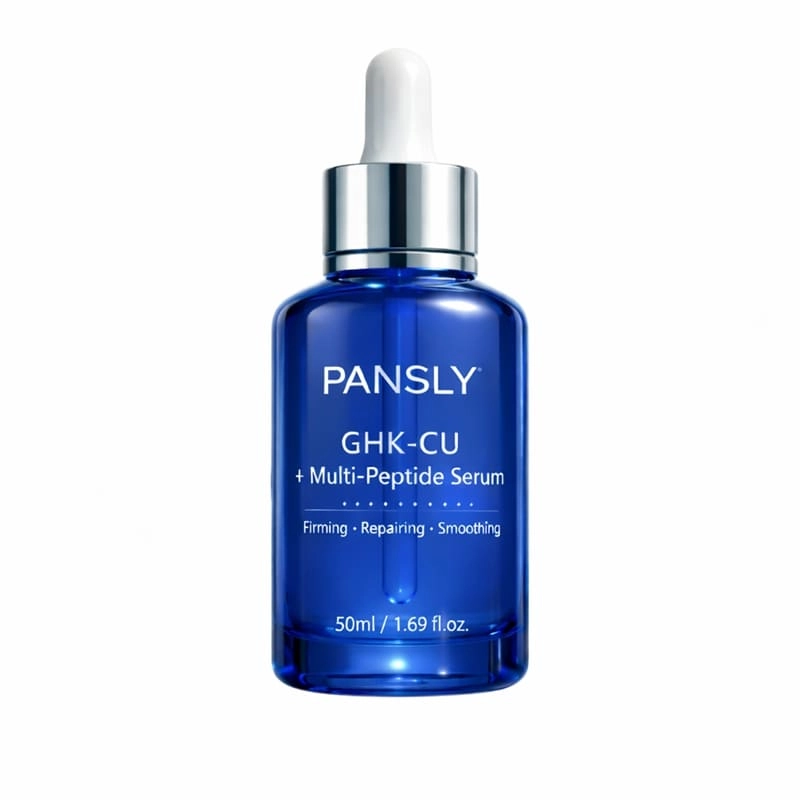
Experience visible rejuvenation with this GHK-Cu Copper Peptide Smoothing & Firming Face Serum, a high-performance concentrate designed to restore the structural integrity of aging skin. This advanced formula centers on GHK-Cu, a powerful signaling peptide clinically recognized for its ability to support natural collagen and elastin production. By promoting dermal density, it effectively tightens sagging skin and smooths the appearance of deep-set wrinkles and fine lines.
The lightweight, silky texture absorbs instantly, delivering antioxidant protection to neutralize environmental stressors that accelerate aging. Enhanced with deep-moisturizing agents, the serum reinforces the skin's moisture barrier, leaving the complexion feeling remarkably soft and resilient. With consistent use, skin texture is refined and facial contours appear more lifted, resulting in a youthfully firm and revitalized glow.
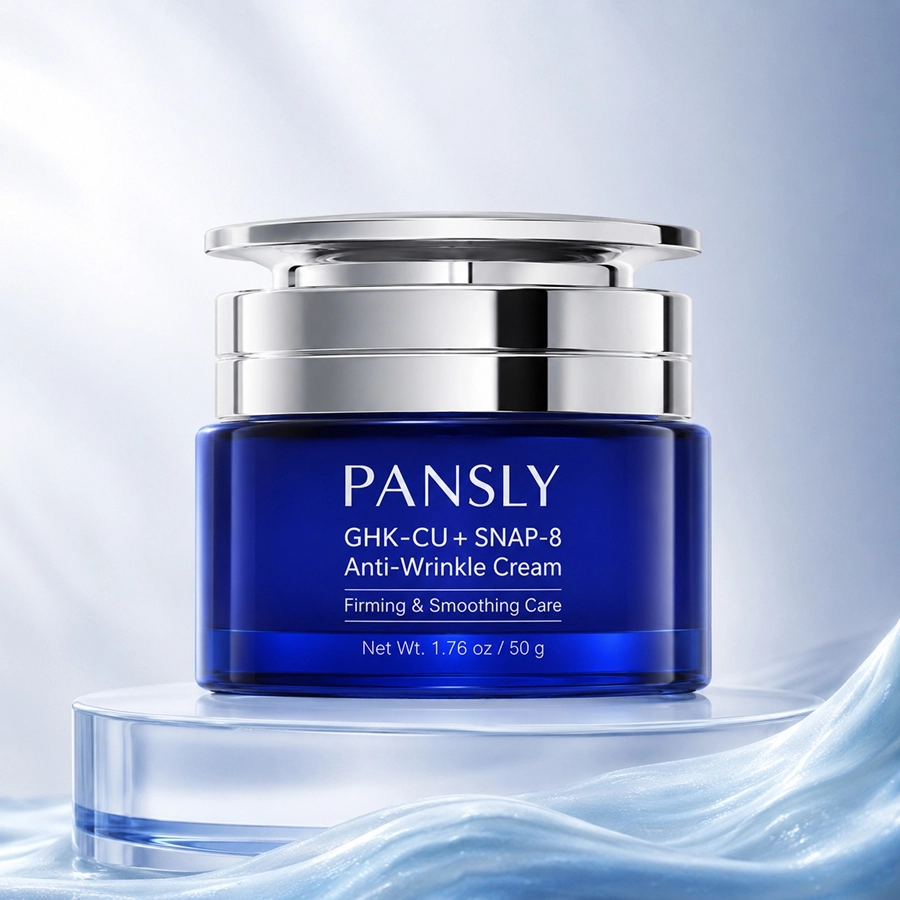
This Pansly GHK-CU + SNAP-8 Anti-Wrinkle Firming Cream is triple-peptide anti-aging facial cream, delivers targeted wrinkle smoothing, firming lifting and deep nourishment for dull, saggy, fine-line prone skin. Full OEM & ODM private label service is supported, including custom formula, packaging options, fast sampling and bulk export supply.
Five core premium active ingredients work synergistically for comprehensive anti-wrinkle care:
GHK-CU Copper Peptide lifts saggy skin, enhances skin resilience and tightens loose facial contour;
SNAP-8 Peptide targets expression lines to visibly soften and fade wrinkles;
Acetyl Hexapeptide-8 reduces the appearance of dry fine lines for smoother skin texture;
Ceramide NP reconstructs skin moisture barrier to lock nourishment and boost comfort;
Hyaluronic Acid delivers multi-layer rich deep moisture to relieve dry rough skin.
Luxury rich creamy texture spreads smoothly and melts into skin gently, leaving soft comfortable finish without heavy greasiness. Daily use blurs fine lines, firms loose skin, deeply nourishes and stabilizes barrier, refining uneven texture to reveal smooth, plump, youthful luminous skin.
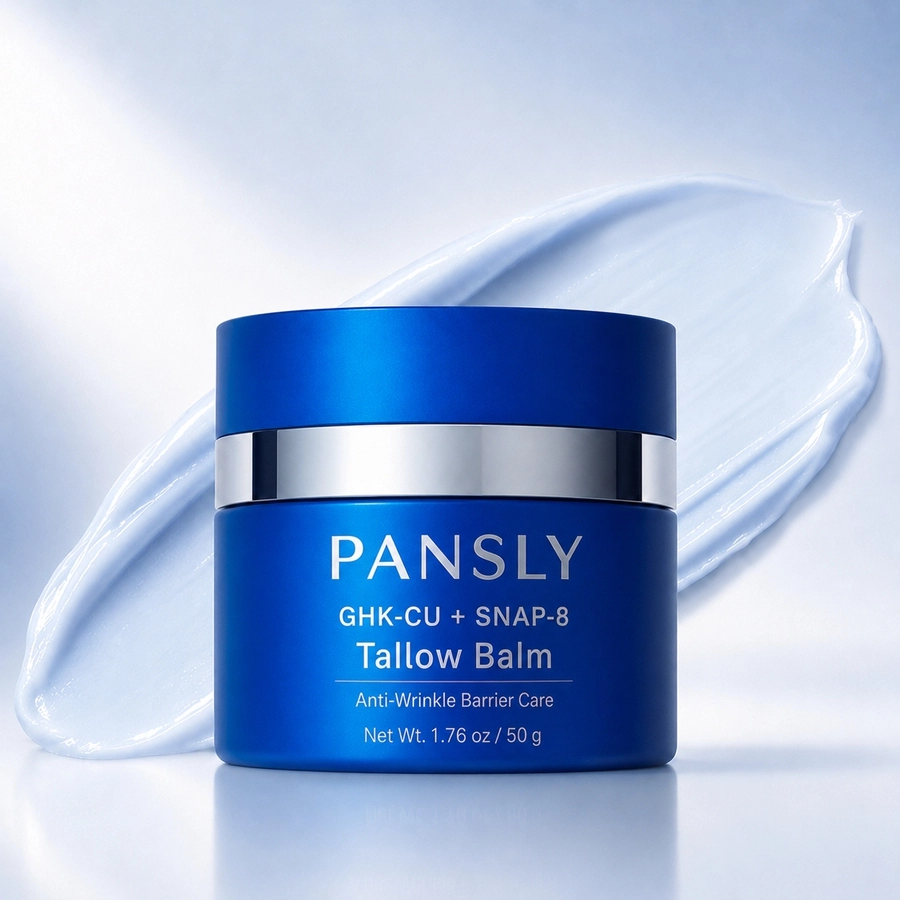
This Pansly GHK-CU + SNAP-8 Tallow Balm is a nourishing anti-wrinkle facial balm specially formulated for dry, fragile and sensitive skin, combining anti-aging wrinkle smoothing and barrier repairing effects. We offer full private label OEM service, including custom logo, adjustable formula, diversified packaging and lid color options.
It contains five core skin care active ingredients: GHK-CU visibly improves fine lines and revives dull complexion; SNAP-8 softens expression lines to smooth wrinkled skin texture; Grass-Fed Beef Tallow delivers deep lipid nourishment to relieve dry rough skin; Ectoin stabilizes the skin barrier and alleviates skin discomfort; Ceramide NP strengthens barrier structure to create smooth, healthy skin.
Luxury creamy blue balm texture glides smoothly and melts quickly on skin, providing long-lasting deep moisturizing comfort. Daily use fades fine lines & expression lines, nourishes dry delicate skin, repairs damaged barrier and leaves silky smooth skin finish.
Click here to customize the Beauty
we respond within a few hours
Monday–Friday, 9AM–6PM
3A01, Building A, Zhisheng Square, No. 4 Zhifu Road, Helong Street, Baiyun District, Guangzhou, China.


Leave a request, and we'll email you back within 24 hours.
© 2026 Beyond Basix. All Rights Reserved.