Supplier Due Diligence Checklist for OEM/ODM Anti-Wrinkle Eye Cream
Comprehensive supplier due diligence for periorbital rejuvenation formulations: a structured, procurement-focused checklist for brand owners and distributors evaluating OEM/ODM partners to produce wrinkle-reducing periocular treatments. This summary highlights facility certification, GMP and cleanroom standards, ingredient traceability, microbial and stability testing, clinical claim substantiation, supply chain resilience, regulatory alignment (FDA/EU/ISO), intellectual-property protections, and commercial terms that directly impact time-to-market, product efficacy, and cost of goods. Practical auditing steps, verifiable documentation requirements, and vendor scorecard KPIs enable risk-based sourcing decisions for enterprise skincare programs.
- Vendor verification for periorbital anti-aging formulations
- Assessing corporate credentials and market reputation
- Facility classification and cleanroom standards
- Regulatory registrations and compliance evidence
- Formulation, ingredient sourcing and safety validation
- Ingredient provenance and supplier tiering
- Microbiological control and preservative efficacy
- Stability studies and claim substantiation
- Manufacturing operations, quality systems and supply resilience
- Capacity, production lines and changeover control
- Quality management and batch documentation
- Traceability, recall readiness and logistics
- Commercial terms, IP protection and post-launch services
- Contracts, minimum order quantities and pricing transparency
- Intellectual property, formulation ownership and non-disclosure
- Post-launch technical support and lifecycle management
- Beyond Basix: supplier strengths and partnership value
- Production scale, certified facilities and proven track record
- Regulatory credentials, R&D focus and product range
- Quality assurance, testing capabilities and commercial service
- Frequently Asked Questions
Comprehensive supplier due diligence for periorbital rejuvenation formulations: a structured, procurement-focused checklist for brand owners and distributors evaluating OEM/ODM partners to produce wrinkle-reducing periocular treatments. This summary highlights facility certification, GMP and cleanroom standards, ingredient traceability, microbial and stability testing, clinical claim substantiation, supply chain resilience, regulatory alignment (FDA/EU/ISO), intellectual-property protections, and commercial terms that directly impact time-to-market, product efficacy, and cost of goods. Practical auditing steps, verifiable documentation requirements, and vendor scorecard KPIs enable risk-based sourcing decisions for enterprise skincare programs.
Vendor verification for periorbital anti-aging formulations
Assessing corporate credentials and market reputation
Buyers should request audited financials, corporate registration, and a client list that demonstrates experience with similar periocular serums or corrective eye balms. Validate company longevity and references across markets where the product will be sold; long-term partnerships with retail chains or distributors indicate operational maturity. Check adverse event histories through public health portals and market surveillance reports to identify post-launch issues.
Facility classification and cleanroom standards
Review the supplier’s production environment for pharmaceutical-grade dust control and defined cleanroom classifications. Pharmaceutical and high-sensitivity cosmetics production commonly references ISO cleanroom classes; for example, a 100,000-level GMPC workshop is equivalent to ISO Class 8 under cleanroom standards. Confirm HVAC validation, particulate monitoring logs, and gowning procedures during on-site audits to ensure contamination controls suitable for delicate eye-area formulations.
Regulatory registrations and compliance evidence
Demand copies of certificates for quality systems and product safety: ISO 9001 for management systems, GMP evidence per cosmetic or pharmaceutical guides (ISO 22716 for cosmetics), and any region-specific dossiers required for market entry. Use authoritative sources such as the ISO 22716 guidance and the FDA cosmetics pages for U.S. market considerations when verifying statutory obligations and advisory standards.
Formulation, ingredient sourcing and safety validation
Ingredient provenance and supplier tiering
Verify Certificates of Analysis (CoA), material safety data sheets (MSDS), and chain-of-custody documentation for active botanicals, peptides, and preservative systems that will be used in the periocular formula. Prioritize suppliers who can provide raw-material traceability down to the lot level and who maintain approved vendor lists for each excipient. If novel actives are proposed, request toxicology summaries and supplier GLP documentation.
Microbiological control and preservative efficacy
For low-viscosity serums and water-containing eye treatments, microbial safety is critical. Request environmental monitoring data, routine challenge testing (preservative efficacy test/PET), and batch micro testing results. Confirm the manufacturer conducts bioburden control at incoming materials inspection and finished-goods release to protect the periorbital area from contamination risks.
Stability studies and claim substantiation
Buyers should obtain accelerated and real-time stability study reports tailored to the proposed packaging format (pump, tube, jar). Review photostability, freeze-thaw, and preservative performance data. For efficacy claims (e.g., wrinkle smoothing, firmness, reduction of fine lines), require clinical or instrumental testing protocols and raw data from human use studies or in vitro assays; ensure study populations and endpoints align with the intended marketing claims to avoid regulatory or advertising disputes.
Manufacturing operations, quality systems and supply resilience
Capacity, production lines and changeover control
Confirm available production capacity and line allocation for specialty eye-care products. Documented SOPs for changeovers, color/odor control, and cross-contamination mitigation are essential when the same production assets also handle hair or body-care formulations. Verify planned lead times, seasonal capacity constraints, and contingency plans for scaling orders to prevent stockouts.
Quality management and batch documentation
Inspect the supplier’s quality management system for end-to-end batch records, deviation handling procedures, CAPA logs, and supplier audit records for key raw materials. Confirm the presence of a Qualified Person (QP) or equivalent responsible for batch release where regionally required. The presence of an integrated ERP or LIMS system that tracks lot numbers, testing certificates, and expiry data materially reduces downstream recall risk.
Traceability, recall readiness and logistics
Review traceability protocols that link finished goods back to component lots and shipping manifests. A practical recall simulation report or documented mock recall exercise demonstrates readiness. Evaluate cold-chain or temperature-controlled logistics if the formulation contains labile peptides or live biomimetics; ensure shipping partners provide temperature logs and insurance for international movement.
| Due Diligence Area | Traditional Approach | Risk-Based / Modern Expectation |
|---|---|---|
| Facility Certification | Basic GMP statements or internal reports | Third-party certified ISO 22716 compliance, ISO Class 8/100,000 cleanrooms, and external audit reports |
| Ingredient Documentation | Supplier MSDS and CoA on request | Full chain-of-custody, supplier audits, GLP toxicology, and traceable lot control |
| Microbial Safety | End-product microbial testing at release | Ongoing environmental monitoring, challenge tests (PET), and in-process controls |
| Clinical Support for Claims | Small internal consumer trials | Instrumental measurements, third-party clinical studies with defined endpoints and IRB oversight where required |
| Recall Preparedness | Manual traceability spreadsheets | ERP/LIMS-enabled lot tracing and documented mock-recall exercises |
Commercial terms, IP protection and post-launch services
Contracts, minimum order quantities and pricing transparency
Negotiate clear terms for minimum manufacturing runs, price ramps, tiered discounts, and cost-per-unit drivers (ingredient costs, packaging, testing). Include clauses for lead-time guarantees, penalty provisions for missed deliveries, and annual price review mechanisms tied to material indices or foreign-exchange exposure. Buyers should prefer suppliers that provide structured cost breakdowns to model gross margin impacts.
Intellectual property, formulation ownership and non-disclosure
Ensure the OEM/ODM can legally manufacture the proposed periorbital product without infringing third-party patents. Include robust NDAs, assignment of formulation IP as negotiated, and clear terms on private-label exclusivity in specified geographies. Confirm the supplier’s ability to store proprietary formulas in segregated systems and limit access to core recipe files.
Post-launch technical support and lifecycle management
Assess the vendor’s capacity to support stability extensions, periodic re-testing, claim renewal studies, and packaging updates. A supplier offering formulation upgrades, regulatory intelligence for emerging ingredient restrictions, and marketing support (e.g., clinical summaries and product photography coordination) materially shortens product iteration cycles and improves ROI.
Beyond Basix: supplier strengths and partnership value
Production scale, certified facilities and proven track record
As a comprehensive cosmetics care manufacturer with over 23 years in research, production, and sales, Beyond Basix operates a 12,000-square-meter facility featuring a 100,000-level GMPC pharmaceutical-grade dust-free workshop and 12 production lines. Our factory is equipped with advanced machinery imported from Germany, the United States, and other leading markets. This infrastructure supports consistent batch quality for delicate periocular formulations and reduces contamination risk through validated cleanroom controls.
Regulatory credentials, R&D focus and product range
Our company maintains ISO 9001 management systems and holds certifications including CE, MSDS, GMP, and HALAL where applicable. With over a decade focused on developing skincare actives and clinical-grade delivery systems, our research pipeline supports multiple categories: skincare, hair care, eye-care, and body-care product lines. Buyers benefit from our multi-brand expertise across LANTHOME, PANSLY, FIRSTSUN, and SAUVASINE when developing differentiated periorbital offerings.
Quality assurance, testing capabilities and commercial service
We implement rigorous QC procedures, including incoming material verification, in-process controls, finished-goods testing, and stability protocols tailored to the packaging format. Our supply chain services include scalable MOQs, competitive pricing models, and post-launch technical assistance such as claim substantiation and regulatory dossier preparation. This end-to-end capability shortens time-to-market and supports long-term portfolio growth for brand partners.
Authoritative regulatory and standards references: see ISO 22716 (cosmetics GMP), the U.S. FDA cosmetics guidance, and industry-standard cleanroom definitions via cleanroom documentation for environmental classifications used in controlled manufacturing.
Practical procurement KPI checklist: supplier certifications, cleanroom class evidence, CoAs for each active, PET results, accelerated stability summaries, third-party clinical summaries for consumer claims, LIMS-enabled traceability, mock-recall reports, MOQ and lead-time commitments, and explicit IP/NDA clauses. Scoring vendors against these metrics yields a prioritized shortlist suitable for pilot production runs and scale-up.
Enterprise buyers evaluating partners for periocular formulations should adopt a risk-based audit protocol that combines document review, targeted on-site inspections, and sample-based verification (stability, microbial, and claim support). The outcome is a measurable supplier scorecard that aligns technical capability with commercial risk tolerance and market launch timelines.
Beyond Basix is committed to partnering with brand owners to deliver safe, effective, and compliant eye-targeted products supported by manufacturing excellence and regulatory-ready documentation.
Contact Beyond Basix to request technical dossiers, sample kits, and a supplier scorecard template.
Frequently Asked Questions
What certifications should a cosmetics manufacturer hold to produce delicate eye-area formulations?
Buyers should verify ISO 9001, ISO 22716 (cosmetics GMP), any region-specific registrations (e.g., FDA notifications for the U.S.), and facility cleanroom classifications. Request third-party certificates and recent audit reports to confirm compliance.
What laboratory tests are essential before approving a periocular product for launch?
Essential tests include preservative efficacy testing (PET), microbial release testing, accelerated and real-time stability studies in final packaging, photostability where relevant, and instrumental or clinical data to support efficacy claims targeted at fine lines and firmness.
How can brand owners confirm raw material traceability for active ingredients?
Require Certificates of Analysis, supplier GLP documentation, lot-level chain-of-custody records, and approved vendor lists. Audits of key ingredient suppliers and supplier audit reports help validate provenance and reduce adulteration risks.
What contractual protections are recommended for formulation IP and exclusivity?
Include robust non-disclosure agreements, clear assignment or licensing clauses for formula ownership, territorial exclusivity terms if needed, and defined confidentiality protocols for formula storage and access. Ensure patent-clearance checks are performed when novel actives are used.
Which supplier capabilities most reduce time-to-market for a new eye-care product?
Suppliers that provide integrated services – R&D support, small-batch pilot runs, in-house stability and microbial labs, regulatory dossier assistance, and flexible MOQs – significantly shorten development cycles and enable faster market launches than fragmented providers.

Elevate your professional skincare offerings with this Private Label Copper Peptide Anti-Wrinkle Firming Serum, a powerhouse concentrate designed for superior age-defying results. This sophisticated formula leverages the synergistic effects of GHK-Cu and SNAP-8 to address multiple layers of skin aging. The GHK-Cu copper peptides act as a vital signaling mechanism to enhance skin density and firmness, while the advanced SNAP-8 octapeptide specifically targets expression lines, helping to relax the appearance of deep-seated wrinkles for a smoother, more refined surface.
This lightweight, rapid-absorption serum provides a professional-grade solution for clients seeking a non-invasive lift. It effectively restores elasticity, improves skin texture, and provides essential antioxidant protection. Perfect for high-end beauty brands, this serum leaves the complexion looking visibly contoured, hydrated, and youthfully revitalized.
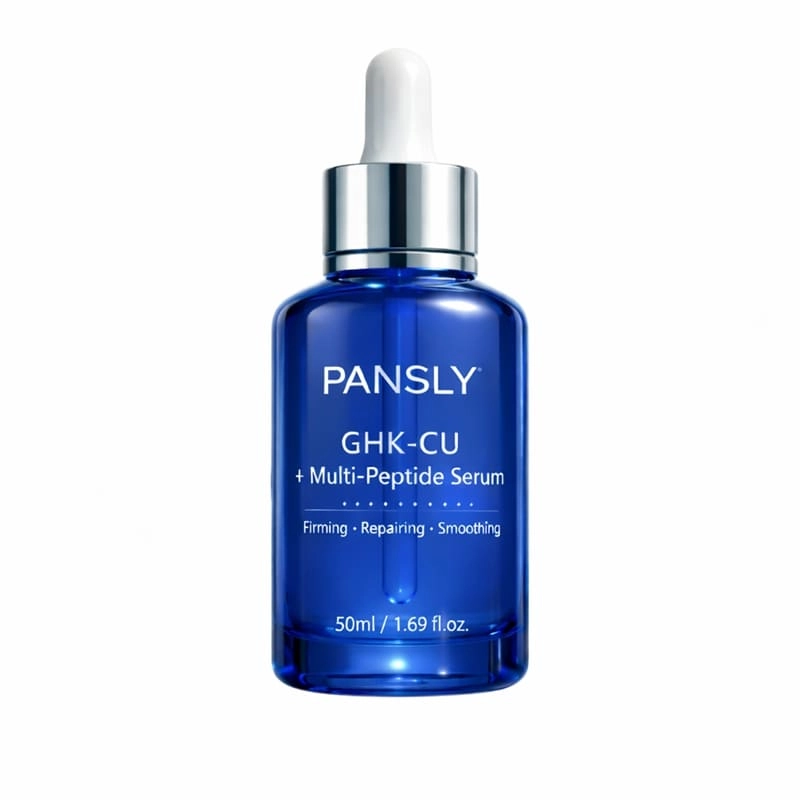
Experience visible rejuvenation with this GHK-Cu Copper Peptide Smoothing & Firming Face Serum, a high-performance concentrate designed to restore the structural integrity of aging skin. This advanced formula centers on GHK-Cu, a powerful signaling peptide clinically recognized for its ability to support natural collagen and elastin production. By promoting dermal density, it effectively tightens sagging skin and smooths the appearance of deep-set wrinkles and fine lines.
The lightweight, silky texture absorbs instantly, delivering antioxidant protection to neutralize environmental stressors that accelerate aging. Enhanced with deep-moisturizing agents, the serum reinforces the skin's moisture barrier, leaving the complexion feeling remarkably soft and resilient. With consistent use, skin texture is refined and facial contours appear more lifted, resulting in a youthfully firm and revitalized glow.
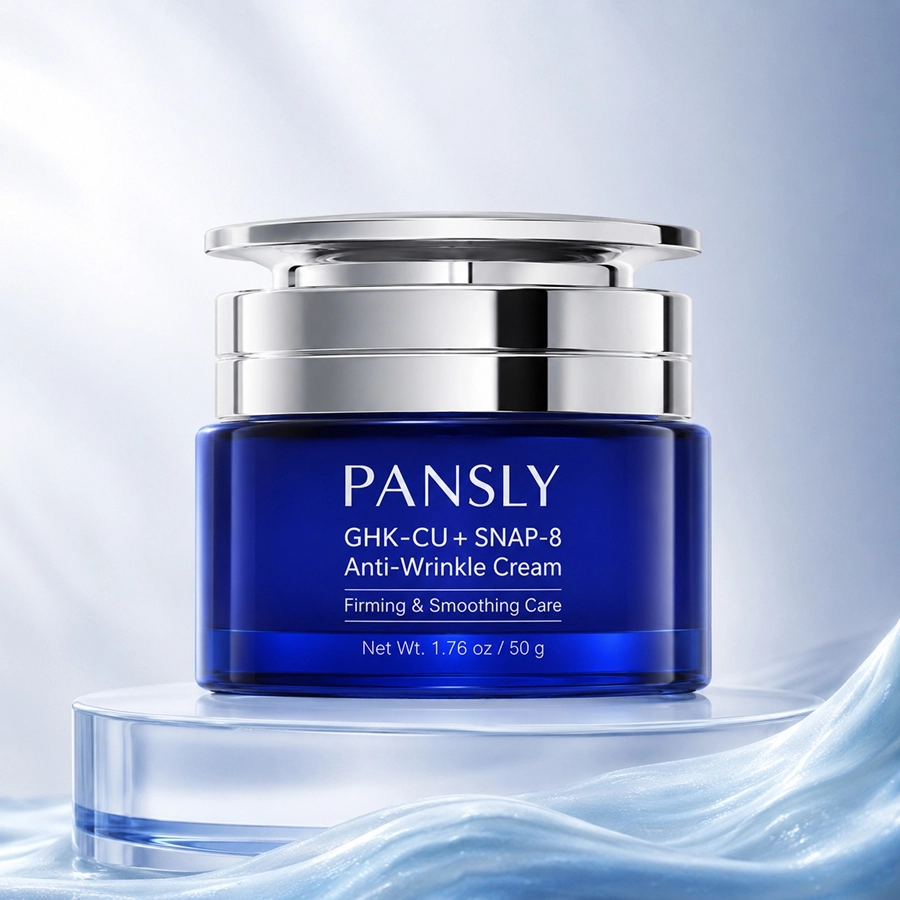
This Pansly GHK-CU + SNAP-8 Anti-Wrinkle Firming Cream is triple-peptide anti-aging facial cream, delivers targeted wrinkle smoothing, firming lifting and deep nourishment for dull, saggy, fine-line prone skin. Full OEM & ODM private label service is supported, including custom formula, packaging options, fast sampling and bulk export supply.
Five core premium active ingredients work synergistically for comprehensive anti-wrinkle care:
GHK-CU Copper Peptide lifts saggy skin, enhances skin resilience and tightens loose facial contour;
SNAP-8 Peptide targets expression lines to visibly soften and fade wrinkles;
Acetyl Hexapeptide-8 reduces the appearance of dry fine lines for smoother skin texture;
Ceramide NP reconstructs skin moisture barrier to lock nourishment and boost comfort;
Hyaluronic Acid delivers multi-layer rich deep moisture to relieve dry rough skin.
Luxury rich creamy texture spreads smoothly and melts into skin gently, leaving soft comfortable finish without heavy greasiness. Daily use blurs fine lines, firms loose skin, deeply nourishes and stabilizes barrier, refining uneven texture to reveal smooth, plump, youthful luminous skin.
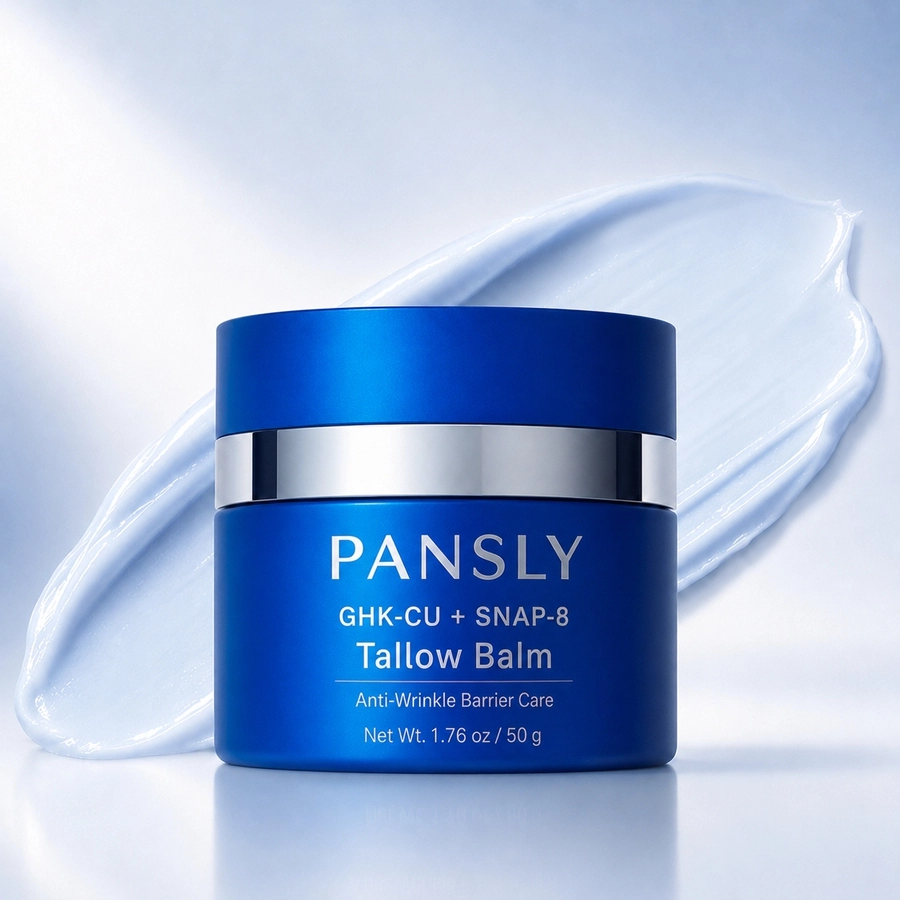
This Pansly GHK-CU + SNAP-8 Tallow Balm is a nourishing anti-wrinkle facial balm specially formulated for dry, fragile and sensitive skin, combining anti-aging wrinkle smoothing and barrier repairing effects. We offer full private label OEM service, including custom logo, adjustable formula, diversified packaging and lid color options.
It contains five core skin care active ingredients: GHK-CU visibly improves fine lines and revives dull complexion; SNAP-8 softens expression lines to smooth wrinkled skin texture; Grass-Fed Beef Tallow delivers deep lipid nourishment to relieve dry rough skin; Ectoin stabilizes the skin barrier and alleviates skin discomfort; Ceramide NP strengthens barrier structure to create smooth, healthy skin.
Luxury creamy blue balm texture glides smoothly and melts quickly on skin, providing long-lasting deep moisturizing comfort. Daily use fades fine lines & expression lines, nourishes dry delicate skin, repairs damaged barrier and leaves silky smooth skin finish.
Click here to customize the Beauty
we respond within a few hours
Monday–Friday, 9AM–6PM
3A01, Building A, Zhisheng Square, No. 4 Zhifu Road, Helong Street, Baiyun District, Guangzhou, China.


Leave a request, and we'll email you back within 24 hours.
© 2026 Beyond Basix. All Rights Reserved.