
Sustainable Trends in Custom Skincare Formulation and Packaging
- Sustainable Shifts in Tailored Cosmetic Development
- Ingredient sourcing with reduced environmental burden
- Formulation design for biodegradability and safety
- Quantifying sustainability performance
- Eco-Conscious Packaging Strategies for Private Label Brands
- Material selection and circularity options
- Design for reduced waste and logistics efficiency
- Regulatory and labeling implications
- Manufacturing & Operational Best Practices for Sustainable Production
- Facility-level emission and waste reduction
- Batch-to-batch consistency with lower resource intensity
- Technology integration: digitalization and predictive analytics
- Procurement Playbook: Selecting a One-Stop OEM/ODM Partner
- Evaluation criteria for a full-service supplier
- Cost-to-value assessment and TCO modeling
- Roadmap for phased product conversion
- Frequently Asked Questions
Leading-edge brand owners and procurement teams seeking greener product development require an integrated playbook that aligns ingredient selection, eco-design packaging, regulatory compliance, and manufacturing scalability. This summary synthesizes market-proven approaches, regulatory signposts, and supplier evaluation criteria for developing tailored cosmetic blends and sustainable containers while reducing lifecycle impact and protecting margins.
Sustainable Shifts in Tailored Cosmetic Development
Ingredient sourcing with reduced environmental burden
Procurement should prioritize traceable raw materials with verified low-impact cultivation or manufacture. Suppliers that provide chain-of-custody documentation, third-party certifications, and cradle-to-gate carbon estimates enable buyers to quantify scope 3 exposures and compare ingredient alternatives. Typical substitutes include plant-derived surfactants with renewable feedstocks, upcycled botanicals from food-industry byproducts, and biodegradable esters to replace persistent petrochemical emollients. Verification can rely on international guidance such as the ISO family of standards for environmental management and material disclosure.
Formulation design for biodegradability and safety
Formulation scientists are moving from feature-led to life-cycle-aware compound selection. Designing with water-soluble actives that readily biodegrade, selecting preservatives with established ecotoxicology profiles, and reducing microplastic carriers are practical techniques. Stability testing protocols should be adapted to include biodegradation and wastewater impact screening along with classical accelerated aging and preservative efficacy testing aligned with regulatory expectations such as those outlined by the FDA.
Quantifying sustainability performance
Buyers require measurable KPIs: carbon intensity per SKU, percentage of recycled or PCR material in packaging, and biodegradability scores for rinse-off products. Life cycle assessments (LCAs) and supplier-provided environmental product declarations (EPDs) allow head-to-head comparisons across variants. Use LCA outputs to prioritize interventions that reduce greenhouse gas emissions or water use without compromising performance.
Eco-Conscious Packaging Strategies for Private Label Brands
Material selection and circularity options
Packaging decisions must balance barrier performance, recyclability, and supply chain resilience. Favor mono-material structures to improve recyclability, specify post-consumer recycled (PCR) content where collection systems exist, and evaluate compostable formats only for markets with industrial composting infrastructure. Suppliers should supply chain documentation that aligns with national recycling standards and industry initiatives.
Design for reduced waste and logistics efficiency
Right-sizing, concentrated formats, and lightweighting reduce both material use and transport emissions. Concentrated serums, powder-to-liquid activator systems, and pump-orientated portion control can reduce packaging volume and product carbon footprint. Logistics teams should evaluate palletization efficiency and packaging cube optimization to reduce freight emissions per unit.
Regulatory and labeling implications
Transparent claims are critical to avoid greenwashing. Label statements about biodegradability, recyclability, and organic content must be supported by testing or certification. Refer to guidance from regulatory bodies and global platforms on permissible claims; for product safety and labeling expectations consult resources such as Wikipedia - Cosmetics (overview) and regulatory summaries provided by major agencies.
Manufacturing & Operational Best Practices for Sustainable Production
Facility-level emission and waste reduction
Operational improvements that lower utility consumption and material loss directly improve supplier competitiveness. Examples include closed-loop solvent recovery, low-temperature mixing to reduce energy use, and onsite wastewater pre-treatment to minimize environmental discharge. Investors and buyers should request published environmental performance indicators as part of tender requirements.
Batch-to-batch consistency with lower resource intensity
Process controls and modern automation reduce rework, off-spec product, and waste. Implementing statistical process control (SPC), digital batch records, and inline testing shortens quality cycles and reduces scrap. These capabilities also support faster scale-up from pilot to full production while maintaining product consistency across lots.
Technology integration: digitalization and predictive analytics
Using digital twins, predictive maintenance, and recipe management reduces unexpected downtime and resource waste. Facilities that integrate manufacturing execution systems (MES) and enterprise resource planning (ERP) enable traceability required for responsible sourcing audits and certification processes.
Procurement Playbook: Selecting a One-Stop OEM/ODM Partner
Evaluation criteria for a full-service supplier
Buyers should evaluate suppliers on four pillars: technical formulation capability, packaging engineering, regulatory compliance, and capacity scalability. Require documented GMP or GMPC compliance, ISO quality management certification, multi-line manufacturing capacity, and a documented sustainability roadmap. Insist on pilot runs, stability data, and third-party test reports during supplier selection.
Cost-to-value assessment and TCO modeling
Moving to greener options often raises unit cost, but total cost of ownership (TCO) can favor sustainable choices when accounting for lower waste, improved logistics efficiency, and brand High Quality potential. A rigorous TCO model should include raw material volatility, packaging end-of-life fees, carbon pricing scenarios, and potential regulatory costs linked to restricted ingredients.
Roadmap for phased product conversion
Staged implementation reduces risk: begin with one SKU pilot that replaces high-impact inputs, then expand to core SKUs after performance validation. Documented milestones—benchmarks for ingredient substitution, packaging trials, consumer testing, and regulatory filing—streamline cross-functional approval and reduce time-to-market.
| Dimension | Traditional Approach | Sustainable Approach | AI/Analytics-Enabled Approach |
|---|---|---|---|
| Material sourcing | Commodity procurement with lowest unit cost | Certified, traceable feedstocks and PCR materials | Predictive sourcing to optimize cost and carbon using supplier data |
| Product design | Performance-first, limited lifecycle review | Design for biodegradability and recyclability | Algorithmic formulation screening to reduce iterations |
| Regulatory alignment | Post-market reactionary updates | Proactive compliance and transparent claims | Automated regulatory checklists and claim validation |
| Time-to-market | Longer due to manual trials | Moderate; requires vendor validation | Faster via predictive analytics and virtual trials |
| Traceability | Limited batch tracking | End-to-end material traceability | Real-time traceability with blockchain-compatible records |
Across these dimensions, authoritative standards and regulatory guidance help shape supplier assessments; consult ISO for management systems, FDA for labeling/safety considerations, and public health frameworks such as the WHO for broader safety perspectives.
Supplier transparency and documented certifications materially reduce procurement risk. For instance, GMPC or GMP-compliant dust-free workshops and documented ISO 9001 quality systems demonstrate process controls and product safety safeguards that are essential for global distribution.
Guangzhou Beyond Basix Cosmetics Ltd. is positioned to support brands through every stage of sustainable product development. With more than 23 years of experience in research, production, and sales, our 12,000-square-meter facility includes a 100,000-level GMPC pharmaceutical-grade dust-free workshop and 12 production lines, equipped with advanced machinery imported from Germany, the US, and other regions. Our engineering teams focus on integrating greener raw materials, mono-material packaging solutions, and process controls that reduce resource consumption while preserving product efficacy.
Our focus on ingredient efficacy and safety spans 12 years of dedicated skincare development across four major brands—LANTHOME, PANSLY, FIRSTSUN, and SAUVASINE—backed by certifications such as ISO 9001, CE, MSDS, GMP, and HALAL. This combination of technical depth and production capability enables buyers to adopt sustainable product architectures without sacrificing timelines or compliance. We offer turnkey solutions for Skincare Products, Hair Care Products, Eye Care Products, and Body Care Products, including formulation libraries, packaging engineering, and regulatory dossier preparation.
Operationally, our facility supports pilot batches, stability testing, and scale-up across multiple production lines, providing the traceability and quality management needed for international markets. Buyers can engage with our team to define KPIs, run comparative LCAs, and set a phased conversion plan—starting with targeted SKUs and expanding as consumer feedback and sustainability metrics validate performance.
Selecting a capable One-Stop OEM/ODM for Skincare means partnering with a manufacturer that demonstrates audited quality systems, sustainability commitments, and flexible production capacity. Beyond Basix combines these elements to reduce procurement friction, speed up market entry, and help brand owners capture the growing consumer preference for demonstrably greener beauty products.
Market stakeholders who require further technical documentation, third-party testing data, or pilot scheduling should request a supplier dossier and non-disclosure agreement to begin collaborative development and verification processes.
Contact points for regulatory references and high-level guidance used in this analysis include ISO, FDA, and WHO.
Beyond Basix is committed to delivering high-quality, compliant, and sustainable personal care solutions that meet global procurement requirements and consumer expectations.
For a project inquiry or to view our current product portfolio, please reach out through our corporate contact channels.
Frequently Asked Questions
What certifications should buyers require from a One-Stop OEM/ODM for sustainable product development?
Buyers should require documented quality and safety certifications such as ISO 9001 and GMP/GMPC, material safety data sheets (MSDS), and any market-specific approvals like CE or HALAL where applicable; these certifications demonstrate process control, product safety, and suitability for international markets.
How can material substitution affect product performance and cost?
Substituting materials to greener alternatives can affect texture, stability, and cost; therefore, a staged pilot approach with stability testing and consumer panels is recommended to validate performance while modeling total cost of ownership including logistics and end-of-life fees.
What packaging options offer the best recyclability for skincare and body care lines?
Mono-material packaging (single polymer types), increased use of post-consumer recycled (PCR) content, and designs optimized for recycling streams typically offer the best recyclability; compostable formats should only be used when end-of-life infrastructure supports industrial composting.
How long does it typically take to move a single SKU through sustainable reformulation and certification?
A phased program typically spans 4–9 months for reformulation, stability testing, and small pilot production, with additional time for third-party certifications or market-specific approvals; timelines vary based on testing complexity and regulatory filing requirements.
What operational controls reduce manufacturing waste and improve sustainability metrics?
Operational measures such as closed-loop solvent recovery, low-temperature mixing, digital batch records, inline quality controls, and statistical process control (SPC) reduce rework and material loss while improving energy efficiency and traceability.

Elevate your professional skincare offerings with this Private Label Copper Peptide Anti-Wrinkle Firming Serum, a powerhouse concentrate designed for superior age-defying results. This sophisticated formula leverages the synergistic effects of GHK-Cu and SNAP-8 to address multiple layers of skin aging. The GHK-Cu copper peptides act as a vital signaling mechanism to enhance skin density and firmness, while the advanced SNAP-8 octapeptide specifically targets expression lines, helping to relax the appearance of deep-seated wrinkles for a smoother, more refined surface.
This lightweight, rapid-absorption serum provides a professional-grade solution for clients seeking a non-invasive lift. It effectively restores elasticity, improves skin texture, and provides essential antioxidant protection. Perfect for high-end beauty brands, this serum leaves the complexion looking visibly contoured, hydrated, and youthfully revitalized.
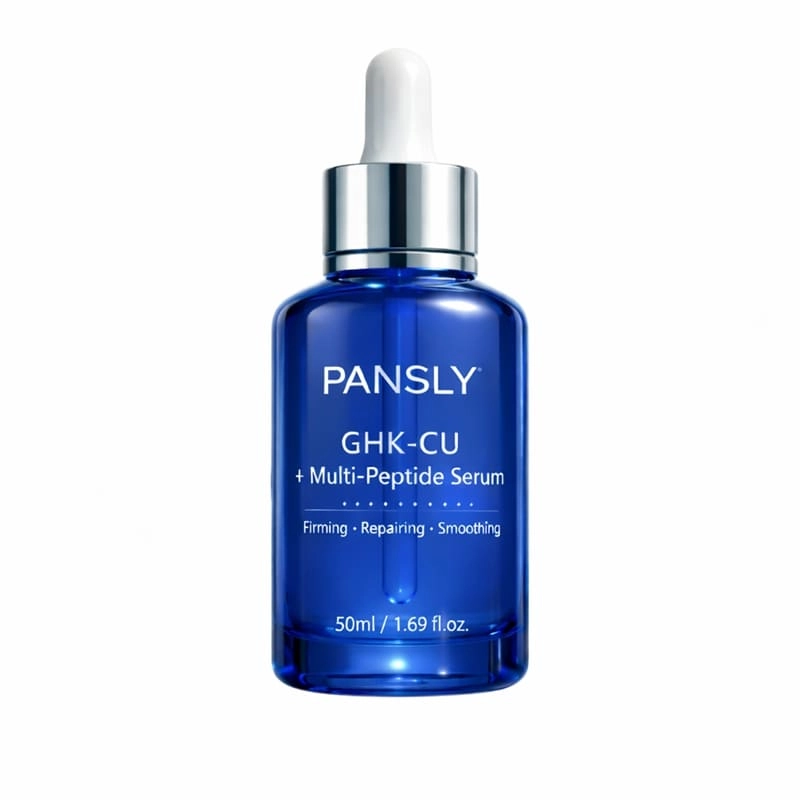
Experience visible rejuvenation with this GHK-Cu Copper Peptide Smoothing & Firming Face Serum, a high-performance concentrate designed to restore the structural integrity of aging skin. This advanced formula centers on GHK-Cu, a powerful signaling peptide clinically recognized for its ability to support natural collagen and elastin production. By promoting dermal density, it effectively tightens sagging skin and smooths the appearance of deep-set wrinkles and fine lines.
The lightweight, silky texture absorbs instantly, delivering antioxidant protection to neutralize environmental stressors that accelerate aging. Enhanced with deep-moisturizing agents, the serum reinforces the skin's moisture barrier, leaving the complexion feeling remarkably soft and resilient. With consistent use, skin texture is refined and facial contours appear more lifted, resulting in a youthfully firm and revitalized glow.
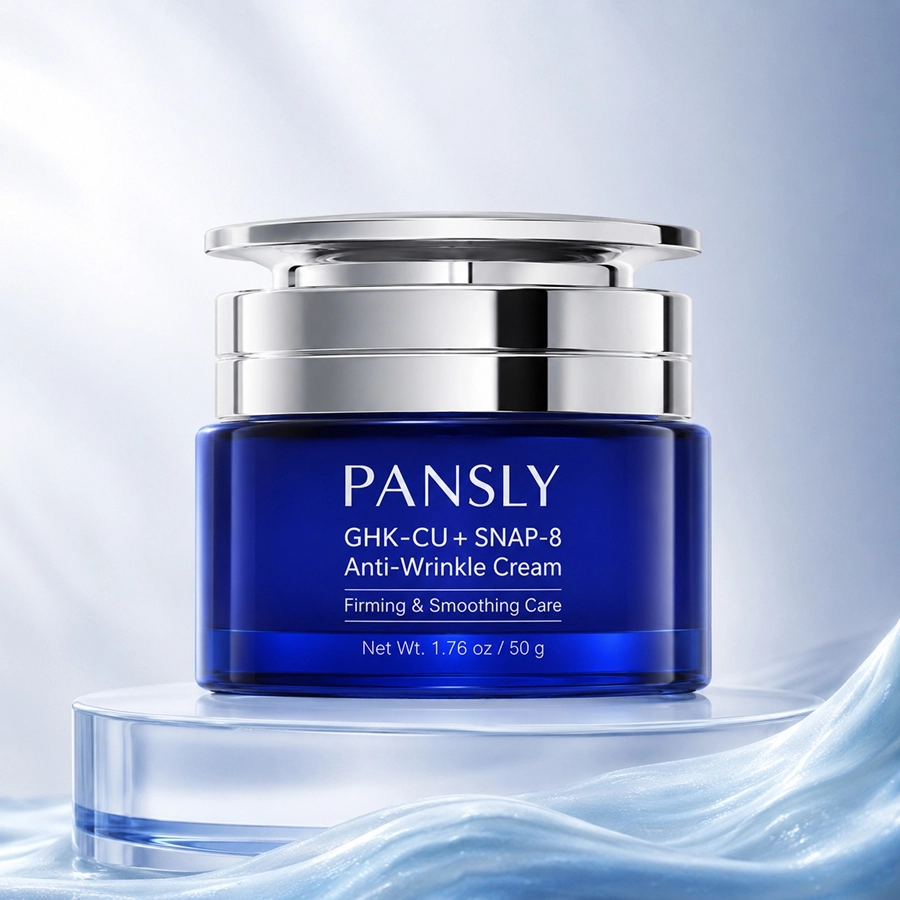
This Pansly GHK-CU + SNAP-8 Anti-Wrinkle Firming Cream is triple-peptide anti-aging facial cream, delivers targeted wrinkle smoothing, firming lifting and deep nourishment for dull, saggy, fine-line prone skin. Full OEM & ODM private label service is supported, including custom formula, packaging options, fast sampling and bulk export supply.
Five core premium active ingredients work synergistically for comprehensive anti-wrinkle care:
GHK-CU Copper Peptide lifts saggy skin, enhances skin resilience and tightens loose facial contour;
SNAP-8 Peptide targets expression lines to visibly soften and fade wrinkles;
Acetyl Hexapeptide-8 reduces the appearance of dry fine lines for smoother skin texture;
Ceramide NP reconstructs skin moisture barrier to lock nourishment and boost comfort;
Hyaluronic Acid delivers multi-layer rich deep moisture to relieve dry rough skin.
Luxury rich creamy texture spreads smoothly and melts into skin gently, leaving soft comfortable finish without heavy greasiness. Daily use blurs fine lines, firms loose skin, deeply nourishes and stabilizes barrier, refining uneven texture to reveal smooth, plump, youthful luminous skin.
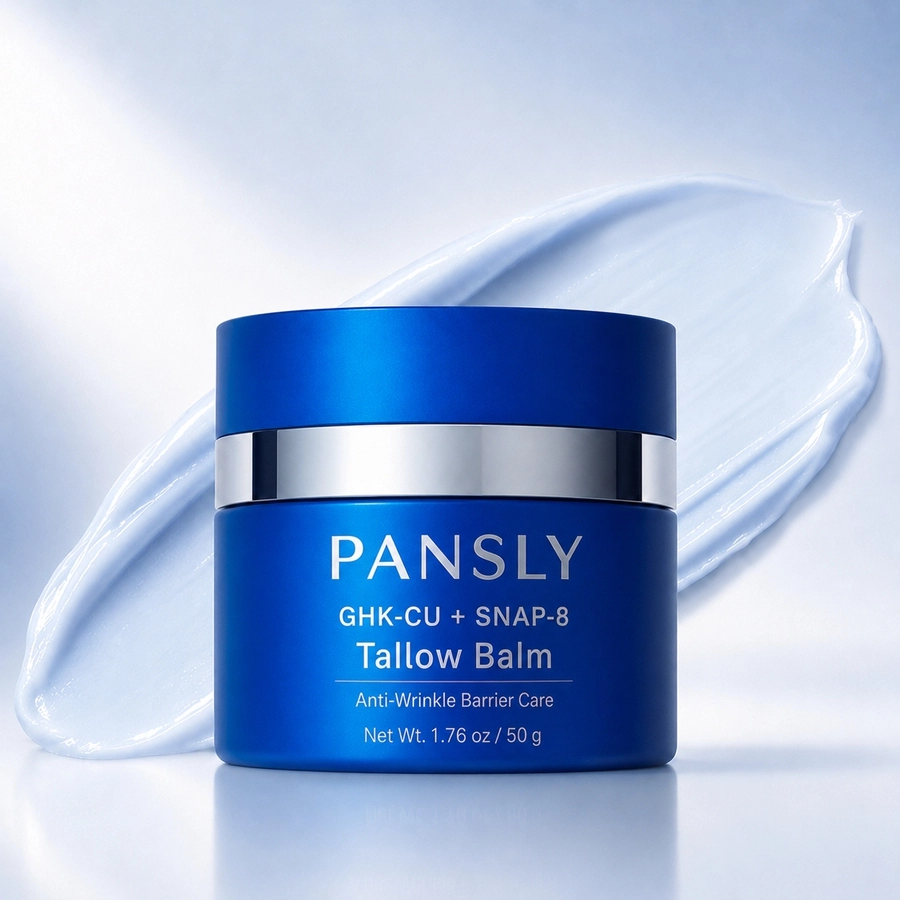
This Pansly GHK-CU + SNAP-8 Tallow Balm is a nourishing anti-wrinkle facial balm specially formulated for dry, fragile and sensitive skin, combining anti-aging wrinkle smoothing and barrier repairing effects. We offer full private label OEM service, including custom logo, adjustable formula, diversified packaging and lid color options.
It contains five core skin care active ingredients: GHK-CU visibly improves fine lines and revives dull complexion; SNAP-8 softens expression lines to smooth wrinkled skin texture; Grass-Fed Beef Tallow delivers deep lipid nourishment to relieve dry rough skin; Ectoin stabilizes the skin barrier and alleviates skin discomfort; Ceramide NP strengthens barrier structure to create smooth, healthy skin.
Luxury creamy blue balm texture glides smoothly and melts quickly on skin, providing long-lasting deep moisturizing comfort. Daily use fades fine lines & expression lines, nourishes dry delicate skin, repairs damaged barrier and leaves silky smooth skin finish.
Click here to customize the Beauty
we respond within a few hours
Monday–Friday, 9AM–6PM
3A01, Building A, Zhisheng Square, No. 4 Zhifu Road, Helong Street, Baiyun District, Guangzhou, China.


Leave a request, and we'll email you back within 24 hours.
© 2026 Beyond Basix. All Rights Reserved.
