How to Choose a Sunscreen Cream Manufacturer: 10 OEM/ODM Criteria

- Quick Answer
- Key Takeaways
- What Makes a Sunscreen Cream Manufacturer Suitable for OEM/ODM?
- 10 Criteria for Evaluating Sunscreen Cream Manufacturers
- 1. Start With the Target Market
- 2. Match the UV-Filter System to the Product Brief
- 3. Review SPF and UVA Evidence Carefully
- 4. Define Every Marketing Claim Before Development
- 5. Evaluate Stability Before You Approve the Formula
- 6. Test Formula and Packaging as One System
- 7. Inspect Quality-Control and Traceability Practices
- 8. Build a Documentation Matrix
- 9. Compare MOQ, Pilot Options, and Scale-Up Conditions
- 10. Require a Clear Change-Control Process
- Consumer Brand vs OEM/ODM Manufacturer: Do Not Confuse the Two
- OEM vs ODM vs Private Label Sunscreen
- Documents to Request Before Selecting a Sunscreen Supplier
- How to Build a Sunscreen Cream RFQ
- RFQ Checklist
- Beyond Basix as a Sunscreen OEM/ODM Option
- Prepare Your Sunscreen Project for Supplier Review
- Buyer FAQs
Quick Answer
A suitable sunscreen cream manufacturer should be evaluated on more than a formula sample or a quoted SPF value. For OEM/ODM projects, buyers should confirm the target market, UV-filter system, SPF and UVA test evidence, stability and packaging compatibility, quality controls, documentation, scale-up capability, customization scope, and change-control process. The right supplier is the one that can match the intended product positioning while providing evidence and records appropriate to the markets where the sunscreen will be sold.
Key Takeaways
- Define the target market and claim package before selecting filters, SPF targets, packaging, or test plans.
- Treat SPF, UVA, water-resistance, and other performance claims as evidence-based requirements rather than marketing language.
- Evaluate the formula and the manufacturing system together: stability, packaging, batch consistency, documentation, and change control can be as important as the first sample.
- Separate consumer-brand reputation from OEM/ODM manufacturing capability. A well-known retail sunscreen brand is not automatically a contract manufacturer for third-party projects.
- Use a detailed RFQ so suppliers quote against the same formula, packaging, test, quantity, market, and documentation assumptions.
What Makes a Sunscreen Cream Manufacturer Suitable for OEM/ODM?
Sunscreen projects combine cosmetic formulation decisions with performance claims, packaging interactions, quality controls, and market-specific requirements. That makes supplier selection different from sourcing a simple moisturizer. A strong OEM/ODM partner should be able to explain what is already validated, what still requires testing, which variables may change performance, and which documents the buyer must prepare for the intended market.
Before comparing suppliers, define the product brief. At minimum, specify the intended market, product format, target SPF or protection positioning, preferred UV-filter approach, skin feel, finish, packaging type, target quantity, required claims, desired launch timing, and whether the project is private label, formula customization, or full ODM development.
For an overview of Beyond Basix sun-care formats, buyers can review the Sun Care category and the dedicated Sunscreen Cream page before preparing an RFQ.
10 Criteria for Evaluating Sunscreen Cream Manufacturers
| Criterion | What to Evaluate | What to Request |
|---|---|---|
| 1. Target-market fit | Whether the supplier understands the intended market, product classification, permitted ingredients, labeling, and evidence expectations. | Market-specific documentation checklist and responsibility matrix. |
| 2. UV-filter system | Mineral, organic, or combined filter strategy; compatibility with sensory, tint, finish, and positioning goals. | Full INCI, filter rationale, sample specification, and any relevant limitations. |
| 3. SPF/UVA evidence | Whether protection claims are supported by appropriate testing for the intended market and final formula. | Available test reports, test method, lab information, sample identity, and test date. |
| 4. Claim substantiation | Evidence for water resistance, skin-feel, moisturizing, sensitive-skin, antioxidant, or other proposed claims. | Claim list with supporting evidence and conditions of use. |
| 5. Stability | Formula stability under expected storage, transport, temperature, and light conditions. | Stability protocol, available results, acceptance criteria, and retest plan after material changes. |
| 6. Packaging compatibility | Interaction between formula and tube, pump, bottle, airless system, coating, gasket, or decoration. | Compatibility testing plan using the final or representative pack. |
| 7. Quality control | Incoming controls, in-process controls, finished-product specifications, microbiological controls, traceability, and release process. | Sample specification, COA format, batch records, and QC checkpoints. |
| 8. Documentation | Availability of ingredient, safety, manufacturing, test, and market-support documents relevant to the project. | Document index showing what is available, pending, market-specific, or buyer-supplied. |
| 9. MOQ and scale-up | Prototype, pilot, first-order, and repeat-order quantities; production-line fit; lead-time assumptions; scale-up controls. | MOQ by packaging/formula, pilot options, capacity assumptions, and production timeline. |
| 10. Change control | How changes to raw materials, packaging, process, supplier, or formula are reviewed before implementation. | Change-notification process and rules for retesting or reapproval. |
1. Start With the Target Market
Do not choose a sunscreen formula first and ask about market fit later. Sunscreen requirements can differ by country or region, including product classification, allowed filters, labeling, claim wording, test evidence, and registration responsibilities. The supplier should be able to identify which parts it can support and which decisions remain with the brand owner, responsible person, importer, or local regulatory specialist.
2. Match the UV-Filter System to the Product Brief
The filter system affects more than protection. It can influence viscosity, whiteness, transparency, spreadability, film formation, skin feel, pilling, compatibility with pigments or actives, and packaging. If your brief calls for a mineral concept, compare zinc oxide-only and zinc oxide/titanium dioxide approaches in the context of the complete formula rather than judging filters in isolation. The guide Zinc Oxide vs Titanium Dioxide for Mineral Sunscreen Brands provides a more focused comparison.
3. Review SPF and UVA Evidence Carefully
A test report is useful only when it can be connected to the formula, sample, packaging assumptions, test method, and claim being made. Ask whether the report applies to the exact proposed formula or only to a base formula. If your project changes filters, concentrations, film-forming ingredients, pigments, emollients, or other performance-sensitive components, confirm whether new testing is required before using the original protection claim.
4. Define Every Marketing Claim Before Development
Terms such as water resistant, moisturizing, barrier-focused, sensitive-skin, antioxidant, tinted, matte, invisible, or lightweight can affect formulation and evidence needs. Put the intended claims in the development brief and ask the manufacturer to classify them as already supported, test-dependent, market-dependent, or not yet supported. This avoids creating packaging and sales copy around claims that the final product cannot substantiate.
5. Evaluate Stability Before You Approve the Formula
Sunscreen cream stability should be assessed using defined acceptance criteria rather than visual inspection alone. Buyers should discuss appearance, odor, viscosity, pH where relevant, phase separation, filter dispersion, microbiological expectations, and any other project-specific specification. The test plan should also consider the intended pack and expected storage or transport conditions.
6. Test Formula and Packaging as One System
A stable bulk formula may still create problems in the final pack. Pumps can clog, seals can swell, tubes can delaminate, decoration can change, or the product can dispense differently over time. Packaging compatibility should therefore be discussed early, especially when the brand is supplying custom packaging or changing the pack after formula validation.
7. Inspect Quality-Control and Traceability Practices
Request an example finished-product specification and ask how raw materials, bulk batches, filling, coding, retention samples, deviations, and finished-product release are controlled. For B2B buyers, consistent batch documentation is often as important as a strong first sample because it supports repeat orders, complaint investigation, and change management.
8. Build a Documentation Matrix
Instead of asking whether a supplier is “compliant,” create a document matrix. List each document required for your market and project, who provides it, whether it applies to the exact formula, and whether it expires or must be renewed. This can include ingredient documents, safety information, test reports, manufacturing records, product specifications, and market-specific materials. Certification scope and current validity should be verified rather than assumed from a logo or marketing statement.
9. Compare MOQ, Pilot Options, and Scale-Up Conditions
MOQ is rarely a single number. Formula batch size, packaging supplier requirements, decoration, components, carton quantities, and special raw materials can each create a different minimum. Ask suppliers to separate prototype, pilot, first-order, and repeat-order assumptions. Also ask what changes between lab and production scale and how scale-up is approved.
10. Require a Clear Change-Control Process
Sunscreen performance can be sensitive to changes in raw materials, suppliers, processing, or packaging. Your quality agreement or project documents should define which changes require notification, buyer approval, renewed stability work, compatibility checks, or protection testing. This protects the commercial formula after launch and makes repeat-order risk easier to manage.
Consumer Brand vs OEM/ODM Manufacturer: Do Not Confuse the Two
A retail sunscreen brand can be useful for market benchmarking, but it should not automatically be described as an OEM/ODM manufacturer or supplier for third-party brands. Brand owners, contract manufacturers, private-label suppliers, and component or raw-material suppliers play different roles.
| Business Type | Typical Role | Buyer Question |
|---|---|---|
| Consumer brand | Develops and markets products under its own brand. | Is this a market benchmark or an actual contract-manufacturing option? |
| OEM manufacturer | Produces to an agreed specification, formula, or manufacturing brief. | What parts of the formula, testing, packaging, and documentation are buyer-controlled? |
| ODM manufacturer | Provides development support and a broader turnkey path from concept to production. | Which development steps, tests, and documents are included in the project scope? |
| Private-label supplier | Offers an existing base or ready-developed product for branding and packaging customization. | What can be changed without triggering new testing or a new development cycle? |
OEM vs ODM vs Private Label Sunscreen
The right model depends on how differentiated the product must be, how much development work the buyer can manage, and how quickly the project needs to move. Private label can be appropriate when an existing formula and limited customization meet the brief. OEM is useful when specifications are already defined. ODM is more suitable when the brand needs broader support with formulation, samples, testing coordination, packaging, documentation, and production planning.
For buyers comparing a mineral concept with a more conventional SPF cream structure, the article Tallow Mineral Sunscreen vs Standard SPF Cream Explained highlights formulation, testing, sensory, and sourcing questions that can be included in supplier discussions.
Documents to Request Before Selecting a Sunscreen Supplier
The exact document set depends on the market, formula, claims, and buyer responsibilities. A practical supplier-review package can include:
- Proposed formula or full INCI list and product specification.
- Available SPF, UVA, water-resistance, or other performance evidence relevant to the proposed claims.
- Stability data or the planned stability protocol for the final formula and pack.
- Packaging compatibility plan where applicable.
- Finished-product COA format and key release specifications.
- Ingredient and safety documentation required for the target market.
- Manufacturing, quality, and certification records that are relevant to the project, with scope and validity available for verification.
- Batch traceability, retention-sample, deviation, complaint, and change-control procedures.
How to Build a Sunscreen Cream RFQ
A detailed RFQ makes supplier quotes easier to compare and reduces hidden assumptions. Send the same brief to every shortlisted manufacturer and require suppliers to identify exclusions or unconfirmed items.
RFQ Checklist
- Target market: country or region where the product will be sold.
- Product type: cream, lotion, stick, spray, tinted product, or another format.
- Protection target: desired SPF/UVA positioning and any water-resistance requirement.
- Filter preference: mineral, organic, combined, or open to supplier recommendation subject to market fit.
- Sensory target: finish, spreadability, whiteness, tint, fragrance, skin feel, and pilling expectations.
- Claims: all proposed marketing and skin-benefit claims.
- Packaging: pack type, size, component source, decoration, and whether the buyer or manufacturer supplies it.
- Quantity: sample quantity, pilot quantity, first commercial order, and forecast range.
- Documentation: tests, specifications, safety files, quality records, and market-support documents required.
- Timeline: target dates for samples, approval, testing, packaging, production, and launch.
Beyond Basix as a Sunscreen OEM/ODM Option
Beyond Basix is positioned as a one-stop OEM/ODM skincare manufacturer. Current company information states more than 23 years of experience in research, production, and sales, a 12,000-square-meter facility, and 12 production lines. Buyers should still evaluate every sunscreen project against the specific formula, target market, claims, test plan, packaging, quantity, and documentation requirements described above rather than relying on company scale alone.
For buyers considering mineral sun-care concepts, Beyond Basix currently publishes product pages for Pansly GHK-CU Beef Tallow Mineral Sunscreen SPF50 PA++++ and Pansly GHK-CU Copper Peptide Tallow Mineral Sunscreen SPF30. These pages can be used as product references when discussing texture, positioning, packaging, or customization goals; project-specific claims and testing should be confirmed for the exact formula being sourced.
A supplier discussion is most productive when the buyer sends a complete brief rather than asking only for a price. Use the RFQ checklist above, then share your sunscreen project requirements for a configuration and feasibility review.
Prepare Your Sunscreen Project for Supplier Review
The most reliable sourcing process starts with a precise brief and a documented comparison. Define the market, formula direction, protection claims, packaging, evidence, quantity, and timeline first; then evaluate each manufacturer against the same criteria.
Buyer FAQs
How do I choose a sunscreen cream manufacturer?
Choose a supplier by matching its capabilities to your target market, UV-filter system, protection claims, test evidence, stability plan, packaging, quality controls, documentation, MOQ, scale-up needs, and change-control requirements. Compare suppliers against the same written RFQ rather than relying on samples or price alone.
What should I ask for before approving a sunscreen OEM/ODM formula?
Ask for the proposed INCI list, product specification, available SPF/UVA or other claim evidence, stability status, packaging compatibility plan, quality-control specification, document index, MOQ, production assumptions, and a clear list of items that still require testing or market-specific review.
Can a manufacturer customize mineral and non-mineral sunscreen formulas?
Many OEM/ODM manufacturers can work with different UV-filter approaches, but actual customization depends on the target market, available ingredients, desired claims, sensory target, packaging, and test plan. Confirm the supplier's capability for the exact brief rather than assuming every filter system can be used in every market.
Does changing a sunscreen formula require new testing?
It can. Changes to UV filters, concentrations, film formers, pigments, emollients, process conditions, packaging, or other performance-sensitive variables may affect protection, stability, or compatibility. The manufacturer and the buyer's regulatory or quality team should determine what must be repeated for the intended market and claims.
What is the difference between OEM, ODM, and private-label sunscreen?
OEM generally means manufacturing to an agreed specification, ODM includes broader product-development support, and private label typically starts from an existing product or base that is branded and customized within defined limits. Exact service scopes differ by supplier, so responsibilities should be written into the project brief.
What information should I include in a sunscreen RFQ?
Include the target market, product format, desired protection positioning, UV-filter preference, sensory target, claims, packaging, quantities, documentation requirements, test expectations, and launch timeline. Ask suppliers to state all assumptions, exclusions, and items that still need confirmation.

Elevate your professional skincare offerings with this Private Label Copper Peptide Anti-Wrinkle Firming Serum, a powerhouse concentrate designed for superior age-defying results. This sophisticated formula leverages the synergistic effects of GHK-Cu and SNAP-8 to address multiple layers of skin aging. The GHK-Cu copper peptides act as a vital signaling mechanism to enhance skin density and firmness, while the advanced SNAP-8 octapeptide specifically targets expression lines, helping to relax the appearance of deep-seated wrinkles for a smoother, more refined surface.
This lightweight, rapid-absorption serum provides a professional-grade solution for clients seeking a non-invasive lift. It effectively restores elasticity, improves skin texture, and provides essential antioxidant protection. Perfect for high-end beauty brands, this serum leaves the complexion looking visibly contoured, hydrated, and youthfully revitalized.
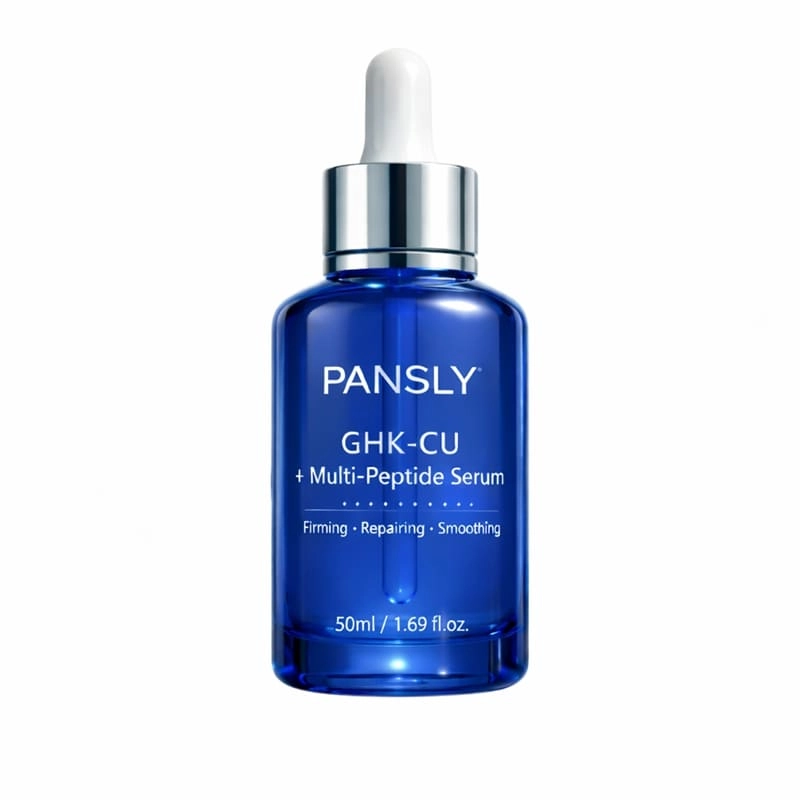
Experience visible rejuvenation with this GHK-Cu Copper Peptide Smoothing & Firming Face Serum, a high-performance concentrate designed to restore the structural integrity of aging skin. This advanced formula centers on GHK-Cu, a powerful signaling peptide clinically recognized for its ability to support natural collagen and elastin production. By promoting dermal density, it effectively tightens sagging skin and smooths the appearance of deep-set wrinkles and fine lines.
The lightweight, silky texture absorbs instantly, delivering antioxidant protection to neutralize environmental stressors that accelerate aging. Enhanced with deep-moisturizing agents, the serum reinforces the skin's moisture barrier, leaving the complexion feeling remarkably soft and resilient. With consistent use, skin texture is refined and facial contours appear more lifted, resulting in a youthfully firm and revitalized glow.
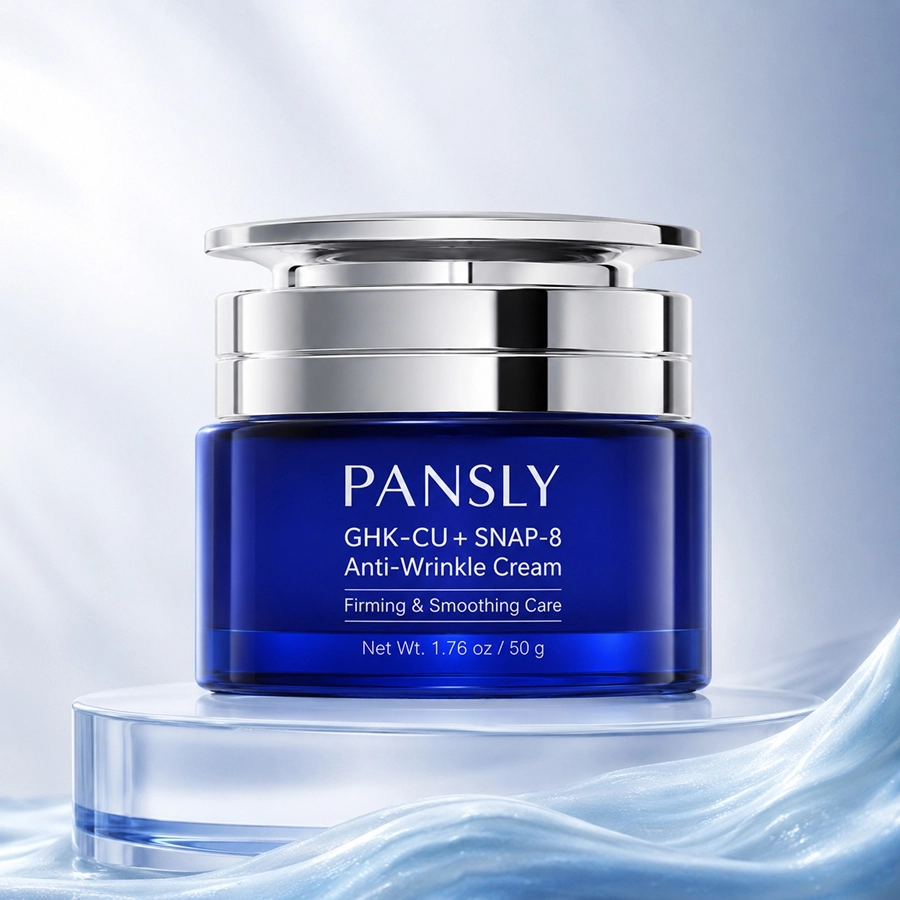
This Pansly GHK-CU + SNAP-8 Anti-Wrinkle Firming Cream is triple-peptide anti-aging facial cream, delivers targeted wrinkle smoothing, firming lifting and deep nourishment for dull, saggy, fine-line prone skin. Full OEM & ODM private label service is supported, including custom formula, packaging options, fast sampling and bulk export supply.
Five core premium active ingredients work synergistically for comprehensive anti-wrinkle care:
GHK-CU Copper Peptide lifts saggy skin, enhances skin resilience and tightens loose facial contour;
SNAP-8 Peptide targets expression lines to visibly soften and fade wrinkles;
Acetyl Hexapeptide-8 reduces the appearance of dry fine lines for smoother skin texture;
Ceramide NP reconstructs skin moisture barrier to lock nourishment and boost comfort;
Hyaluronic Acid delivers multi-layer rich deep moisture to relieve dry rough skin.
Luxury rich creamy texture spreads smoothly and melts into skin gently, leaving soft comfortable finish without heavy greasiness. Daily use blurs fine lines, firms loose skin, deeply nourishes and stabilizes barrier, refining uneven texture to reveal smooth, plump, youthful luminous skin.
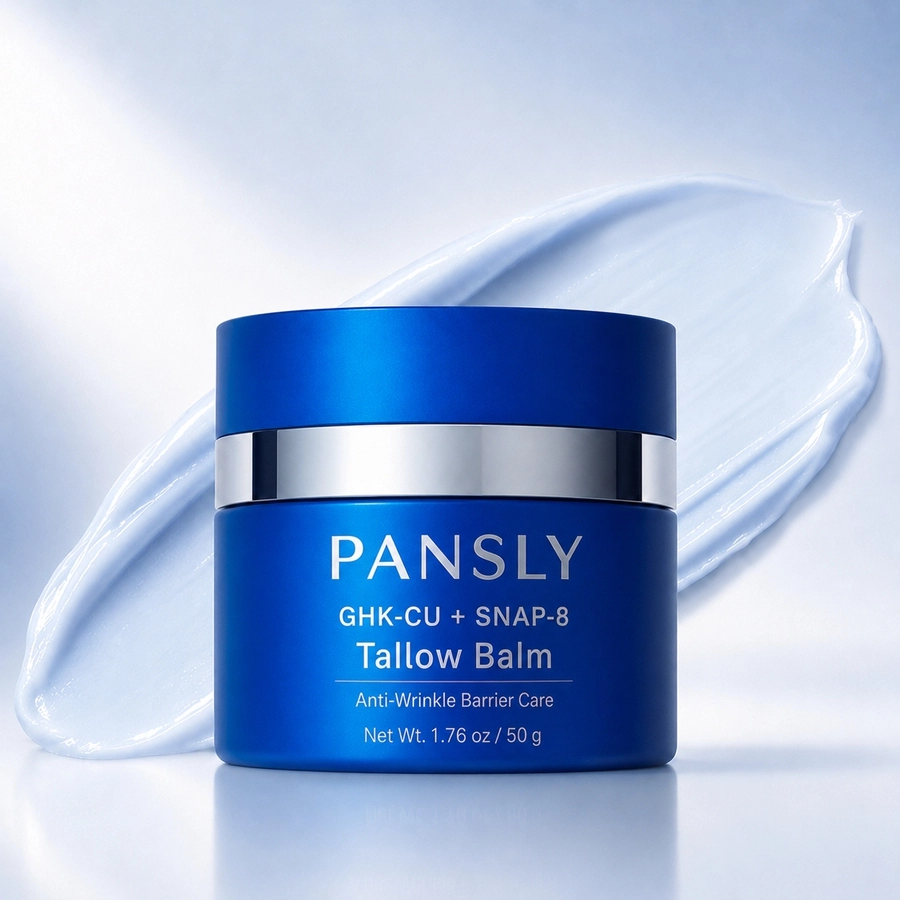
This Pansly GHK-CU + SNAP-8 Tallow Balm is a nourishing anti-wrinkle facial balm specially formulated for dry, fragile and sensitive skin, combining anti-aging wrinkle smoothing and barrier repairing effects. We offer full private label OEM service, including custom logo, adjustable formula, diversified packaging and lid color options.
It contains five core skin care active ingredients: GHK-CU visibly improves fine lines and revives dull complexion; SNAP-8 softens expression lines to smooth wrinkled skin texture; Grass-Fed Beef Tallow delivers deep lipid nourishment to relieve dry rough skin; Ectoin stabilizes the skin barrier and alleviates skin discomfort; Ceramide NP strengthens barrier structure to create smooth, healthy skin.
Luxury creamy blue balm texture glides smoothly and melts quickly on skin, providing long-lasting deep moisturizing comfort. Daily use fades fine lines & expression lines, nourishes dry delicate skin, repairs damaged barrier and leaves silky smooth skin finish.
Click here to customize the Beauty
we respond within a few hours
Monday–Friday, 9AM–6PM
3A01, Building A, Zhisheng Square, No. 4 Zhifu Road, Helong Street, Baiyun District, Guangzhou, China.


Leave a request, and we'll email you back within 24 hours.
© 2026 Beyond Basix. All Rights Reserved.