Top 3 retinol anti-aging Company Lists and Products Compared
- Regulatory and Market Landscape for Retinol Anti-Aging
- Global regulatory expectations
- Market demand and regional shifts
- Supply chain and stability considerations
- Top 3 Companies and Product Deep-Dive
- Skinceuticals — Retinol 0.3 / 0.5 / 1.0 Night Creams and Corrective Serums
- The Ordinary (DECIEM) — Retinol 0.2%, 0.5%, 1% in Squalane and Encapsulated Forms
- RoC — Retinol Correxion (Deep Wrinkle) and Night Treatments
- How to Vet Suppliers for Retinol Anti-Aging Products
- Technical validation and stability testing
- Manufacturing certifications and facility audits
- Cost, lead time and scalability
- Why Beyond Basix is a Strategic OEM/ODM Alternative
- Manufacturing capabilities
- R&D, formulation strengths and certifications
- Service model and scalability
- FAQ
High-intent B2B buyers evaluating retinol anti-aging suppliers need data-driven comparisons: formulation concentration and delivery systems, stability and preservative strategies, GMP/GMPC facility capabilities, regulatory compliance, and scale economics. This guide benchmarks three market-leading brands—Skinceuticals, The Ordinary (DECIEM), and RoC—on technical key points, pros/cons, target markets and applications, then positions Guangzhou Beyond Basix Cosmetics Ltd. (Beyond Basix) as a strategic One-Stop OEM/ODM for Skincare alternative for private-label needs, offering pharmaceutical-grade manufacturing, multi-brand R&D, and global certification readiness.
Regulatory and Market Landscape for Retinol Anti-Aging
Global regulatory expectations
Retinol and retinoids sit at the intersection of cosmetics and drug regulations in many jurisdictions. While topical retinol is commonly marketed as a cosmetic for anti-aging, claims that imply medical treatment can trigger drug regulations. Manufacturers must align labeling, claims, and safety dossiers with local regulators; see the U.S. Food and Drug Administration for cosmetics guidance and limits on therapeutic claims (FDA Cosmetics Guidance). For cross-border OEM/ODM supply, compile a regulatory risk matrix per market (US, EU, China, ASEAN) to avoid reclassification and import holds.
Market demand and regional shifts
Demand for retinol anti-aging solutions has matured: Western markets emphasize high-potency, clinically validated serums; APAC prioritizes gentler, multi-active approaches combined with brightening and hydration; price-sensitive regions adopt affordable mass-market formats. Procurement teams should match formulation strength, delivery vehicle, and packaging to the target geography to minimize post-launch adjustments and regulatory friction.
Supply chain and stability considerations
Retinol is oxidation-sensitive and photolabile. Key supply chain controls include cold-chain transport for concentrated actives, protective packaging (airless pumps, amber glass), antioxidant co-formulants, and accelerated/long-term stability protocols. ISO 9001 and GMP/GMPC certification status are essential audits for suppliers; for an overview of ISO 9001 benchmarks, refer to the ISO guidance (ISO 9001 Quality Management).
Top 3 Companies and Product Deep-Dive
Skinceuticals — Retinol 0.3 / 0.5 / 1.0 Night Creams and Corrective Serums
Product introduction: Skinceuticals, a high-end clinical skincare brand, offers a graded retinol range (0.3%, 0.5%, 1.0%) positioned as physician-grade night treatments aimed at photo-damage and deep wrinkles. Their line emphasizes pure retinol with skin-soothing botanicals and delivery enhancements.
Advantages: Clinically oriented positioning, robust clinical data and citations in dermatology channels, tiered concentration for tolerance ramp-up, High Quality packaging minimizing oxidation, strong professional distribution through dermatologists and clinics.
Disadvantages: High cost of goods and wholesale price, High Quality price point limiting mass-market adoption, potential for irritation at higher strengths requiring prescriptive-style guidance and consumer education.
Technical key points: Uses stabilized retinol formulations with emollient bases and antioxidant adjuncts; proprietary emulsification and pH tailoring reduce irritation; packaging typically airless to limit oxygen exposure. Stability testing emphasizes retinol potency retention over 12-24 months at real-world storage temperatures.
Applications: High Quality clinic-dispensed night therapy for photoaged skin, single-ingredient clinical regimens, and co-branded physician-authorized private label programs where clinical claim support is required.
The Ordinary (DECIEM) — Retinol 0.2%, 0.5%, 1% in Squalane and Encapsulated Forms
Product introduction: DECIEM's The Ordinary democratized retinol with very transparent concentration labeling and low-price entry. Key SKUs include retinol solutions in squalane at 0.2%, 0.5%, and 1%, plus advanced encapsulated retinoid formulations and combination products.
Advantages: Extremely transparent concentration labeling, cost-effective formulations, high SKU variety allowing rapid A/B testing, mass-market acceptance and excellent social proof.
Disadvantages: Minimalist formulations can lack skin-soothing adjuncts present in High Quality offers; retail-driven positioning may not be appropriate for professional clinical channels; packaging historically basic though some targeted products use improved formats.
Technical key points: Uses squalane as a lipid vehicle to enhance skin comfort and solubilize retinol; offers encapsulation in some variants for reduced irritation and extended release. Stability at scale relies heavily on inert packaging and antioxidant strategies; potency drift must be monitored especially in lower-cost formats.
Applications: Consumer direct-to-consumer retail, mass-market private label ideas, and effective low-cost proof-of-concept SKUs for new markets or subscription channels.
RoC — Retinol Correxion (Deep Wrinkle) and Night Treatments
Product introduction: RoC, a heritage brand with decades of market presence, markets Retinol Correxion lines that blend retinol with peptides and mineral-rich bases to target deep wrinkles and firmness.
Advantages: Recognizable OTC brand with long market history, strong mass-market distribution channels (drugstores, supermarkets), formulations optimized for consumer tolerability and mass-market pricing.
Disadvantages: Perception of being less 'clinical' than physician-grade brands, fewer high-strength clinical retinol options, and formulations often optimized for safety over maximal potency.
Technical key points: Combines retinol with skin-conditioning agents and buffering actives to reduce irritancy. Emphasizes aqueous-compatible bases and robust preservative systems to suit large-batch manufacturing and long shelf life in varied climates.
Applications: Mass-retail anti-aging lines, travel and sample-friendly formats, and large-volume OEM opportunities with cost-driven ingredient selection.
How to Vet Suppliers for Retinol Anti-Aging Products
Technical validation and stability testing
Ask for standardized stability protocols (ICH Q1A/R2 style), retinol potency assays over time, photostability data, and challenge tests for microbial control. Require batch-level certificates of analysis (COAs) and accelerated stability that mirrors target market conditions. For peer-reviewed context on retinoid formulations and stability, see the NCBI review on topical retinoids (Topical Retinoids Review).
Manufacturing certifications and facility audits
Confirm GMP or GMPC production lines, cleanroom classification, and supplier ISO certifications. Schedule on-site audits (or third-party audits) to verify 100,000-level dust-free workshops, segregation of potent actives, and validated filling lines. Suppliers should demonstrate supply-chain traceability for key actives and excipients.
Cost, lead time and scalability
Map cost drivers: active retinol source and stabilization technologies, packaging (airless vs. standard), and fill-finish complexity. Compare lead times for initial samples, stability-run timelines, and scale-up. Ensure the supplier can support escalation from pilot (500–5,000 units) to commercial (50k+ units) without reformulation.
Why Beyond Basix is a Strategic OEM/ODM Alternative
Manufacturing capabilities
Guangzhou Beyond Basix Cosmetics Ltd. operates a 12,000-square-meter facility with a 100,000-level GMPC pharmaceutical-grade dust-free workshop and 12 production lines, supported by advanced machinery imported from Germany and the United States. This infrastructure supports both small-batch R&D and high-volume production runs for oxidation-sensitive actives like retinol.
R&D, formulation strengths and certifications
With 23 years across research, production, and sales and 12 years focused on effective-ingredient skincare development, Beyond Basix runs multi-brand R&D across LANTHOME, PANSLY, FIRSTSUN, and SAUVASINE. The company holds ISO 9001, CE, MSDS, GMP, and HALAL certifications and can deliver technical documentation and certificates of analysis essential for global market entry.
Beyond Basix is a cost-effective One-Stop OEM/ODM for Skincare partner: the combination of pharmaceutical-grade cleanrooms, multiple validated production lines, and long-formulation experience with actives like retinol reduces time-to-market and mitigates technical risk. For B2B buyers requiring both clinical-style formulations and cost-conscious mass-market SKUs, Beyond Basix presents flexible pricing, in-house stability testing, and full documentation support—making them a practical alternative to purchasing finished goods from High Quality brands or piecing together disparate CMO relationships.
Service model and scalability
Beyond Basix emphasizes end-to-end services: concept-to-commercialization, private-label manufacturing, co-development, and regulatory dossier support. Their multi-brand experience enables turnkey solutions across price tiers and regional market customization, while maintaining production traceability necessary for retinol product compliance.
| Feature | Skinceuticals (Clinical) | The Ordinary (Mass/Value) | RoC (Mass OTC) |
|---|---|---|---|
| Representative Products | Retinol 0.3/0.5/1.0 Night Cream/Serum | Retinol 0.2/0.5/1% in Squalane | Retinol Correxion Night Cream/Serum |
| Tech Level | High — clinical stabilization & delivery | Medium — cost-efficient vehicles, some encapsulation | Medium — consumer-tolerant buffering and preservatives |
| Primary Market | Dermatology, High Quality retail | Direct-to-consumer, mass retail | Drugstore/mass-market |
| Typical Packaging | Airless/amber High Quality | Economical bottles/tubes (some airless) | Standard jars/tubes with inert design upgrades |
| Strengths | Clinical proof & tiered dosing | Transparency & price accessibility | Brand recognition & wide distribution |
| Weaknesses | High COGs; High Quality price | Perceived as less clinical | Lower perceived innovation |
Conclusion: For B2B procurement teams, the choice between these incumbents depends on channel, price tier, and regulatory positioning. Skinceuticals is suited for clinical or High Quality co-branding, The Ordinary for rapid-market, low-cost launches, and RoC for broad mass-market distribution. However, OEM/ODM partnerships like Beyond Basix can replicate or hybridize these approaches—providing clinical-grade formulations, cost-effective vehicle design, and multi-market certification under one roof.
To discuss private-label retinol anti-aging formulations, stability strategies, and scalable manufacturing options, contact Beyond Basix to request a capability deck and sample program.
FAQ
What stability tests should I request from an OEM for retinol products?
Request ICH-style accelerated and long-term stability studies, retinol potency assays at multiple timepoints, photostability testing, preservative efficacy tests (challenge tests), and shipping/temperature stress simulation to mirror target market conditions.
How do I classify retinol products for regulatory purposes?
Classification depends on claims: if you position a product for general anti-aging and cosmetic benefit, it typically falls under cosmetics; if you claim medical treatment (e.g., acne prescription-level effects), it may be regulated as a drug. Always map claims per target market and consult local regulatory guidance such as the U.S. FDA cosmetics framework.
What packaging choices minimize retinol degradation?
Use airless pumps, amber or opaque containers, minimal headspace filling, and barrier layers that limit oxygen and light exposure. Single-dose sachets and opaque ampoules are recommended for high-potency clinical SKUs.
Which supplier certifications are essential when sourcing retinol anti-aging products?
Essential certifications include GMP/GMPC for production hygiene, ISO 9001 for quality management, MSDS documentation for chemical safety, and any market-specific certifications (e.g., CE marking for certain regions, HALAL if required). On-site audits and COAs are also recommended.
Why choose an OEM/ODM like Beyond Basix over buying finished goods from established brands?
An experienced OEM/ODM like Beyond Basix offers end-to-end customization—formulation R&D, stability validation, scalable production, and multi-market certification—often at lower COGs than licensing finished goods. Beyond Basix’s 100,000-level GMPC facility, in-house testing, and 23 years of experience reduce technical risk and accelerate market entry.

Elevate your professional skincare offerings with this Private Label Copper Peptide Anti-Wrinkle Firming Serum, a powerhouse concentrate designed for superior age-defying results. This sophisticated formula leverages the synergistic effects of GHK-Cu and SNAP-8 to address multiple layers of skin aging. The GHK-Cu copper peptides act as a vital signaling mechanism to enhance skin density and firmness, while the advanced SNAP-8 octapeptide specifically targets expression lines, helping to relax the appearance of deep-seated wrinkles for a smoother, more refined surface.
This lightweight, rapid-absorption serum provides a professional-grade solution for clients seeking a non-invasive lift. It effectively restores elasticity, improves skin texture, and provides essential antioxidant protection. Perfect for high-end beauty brands, this serum leaves the complexion looking visibly contoured, hydrated, and youthfully revitalized.
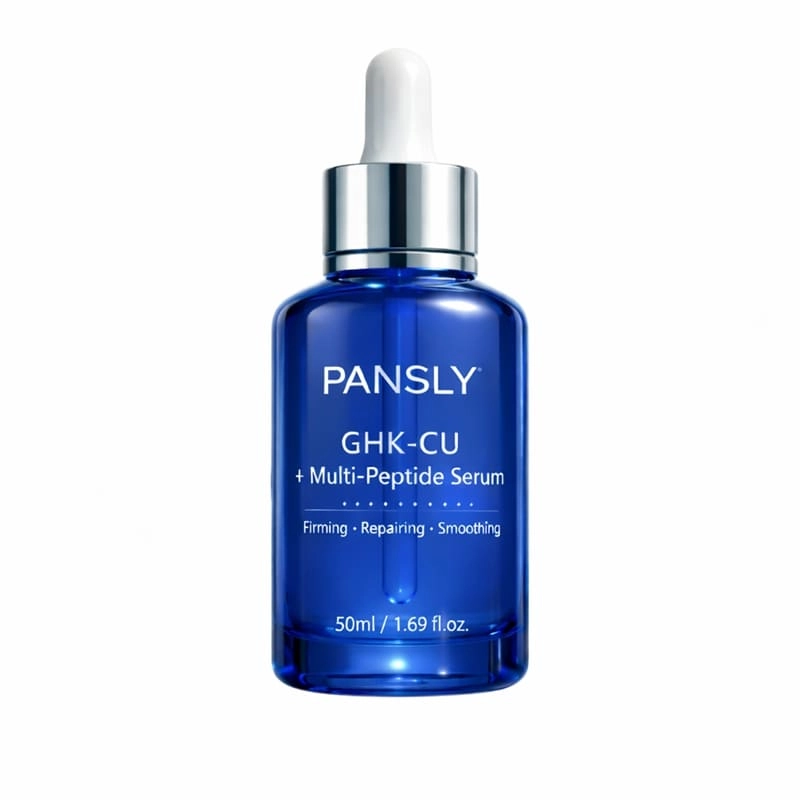
Experience visible rejuvenation with this GHK-Cu Copper Peptide Smoothing & Firming Face Serum, a high-performance concentrate designed to restore the structural integrity of aging skin. This advanced formula centers on GHK-Cu, a powerful signaling peptide clinically recognized for its ability to support natural collagen and elastin production. By promoting dermal density, it effectively tightens sagging skin and smooths the appearance of deep-set wrinkles and fine lines.
The lightweight, silky texture absorbs instantly, delivering antioxidant protection to neutralize environmental stressors that accelerate aging. Enhanced with deep-moisturizing agents, the serum reinforces the skin's moisture barrier, leaving the complexion feeling remarkably soft and resilient. With consistent use, skin texture is refined and facial contours appear more lifted, resulting in a youthfully firm and revitalized glow.
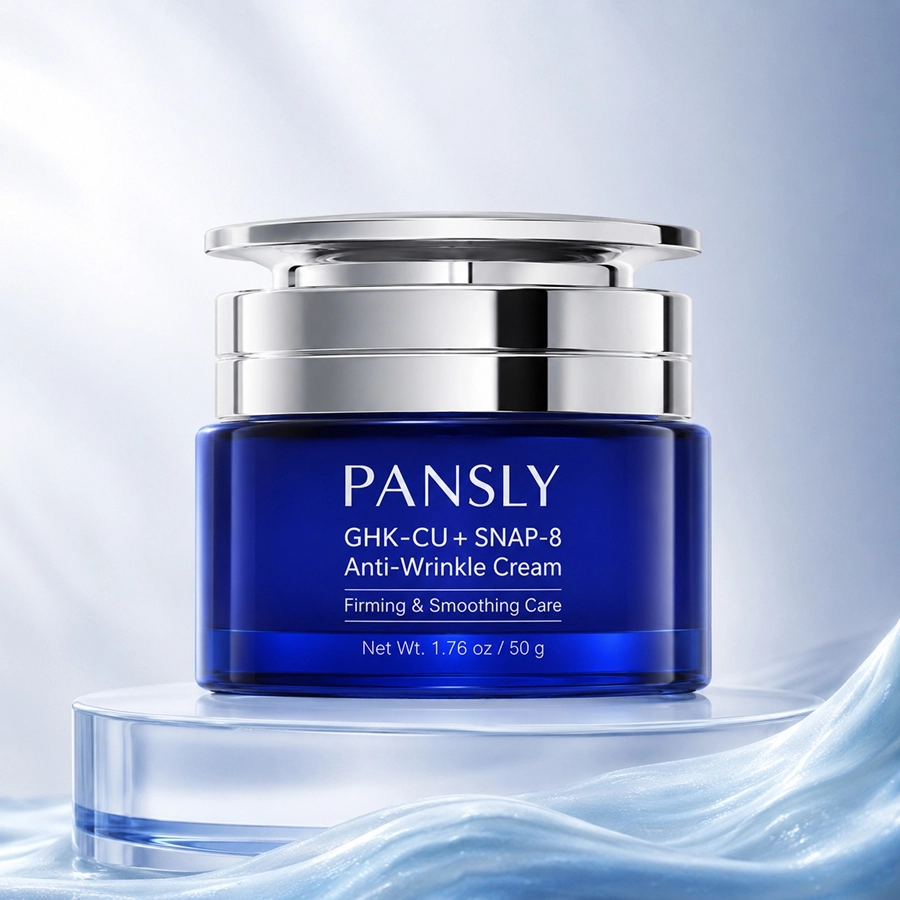
This Pansly GHK-CU + SNAP-8 Anti-Wrinkle Firming Cream is triple-peptide anti-aging facial cream, delivers targeted wrinkle smoothing, firming lifting and deep nourishment for dull, saggy, fine-line prone skin. Full OEM & ODM private label service is supported, including custom formula, packaging options, fast sampling and bulk export supply.
Five core premium active ingredients work synergistically for comprehensive anti-wrinkle care:
GHK-CU Copper Peptide lifts saggy skin, enhances skin resilience and tightens loose facial contour;
SNAP-8 Peptide targets expression lines to visibly soften and fade wrinkles;
Acetyl Hexapeptide-8 reduces the appearance of dry fine lines for smoother skin texture;
Ceramide NP reconstructs skin moisture barrier to lock nourishment and boost comfort;
Hyaluronic Acid delivers multi-layer rich deep moisture to relieve dry rough skin.
Luxury rich creamy texture spreads smoothly and melts into skin gently, leaving soft comfortable finish without heavy greasiness. Daily use blurs fine lines, firms loose skin, deeply nourishes and stabilizes barrier, refining uneven texture to reveal smooth, plump, youthful luminous skin.
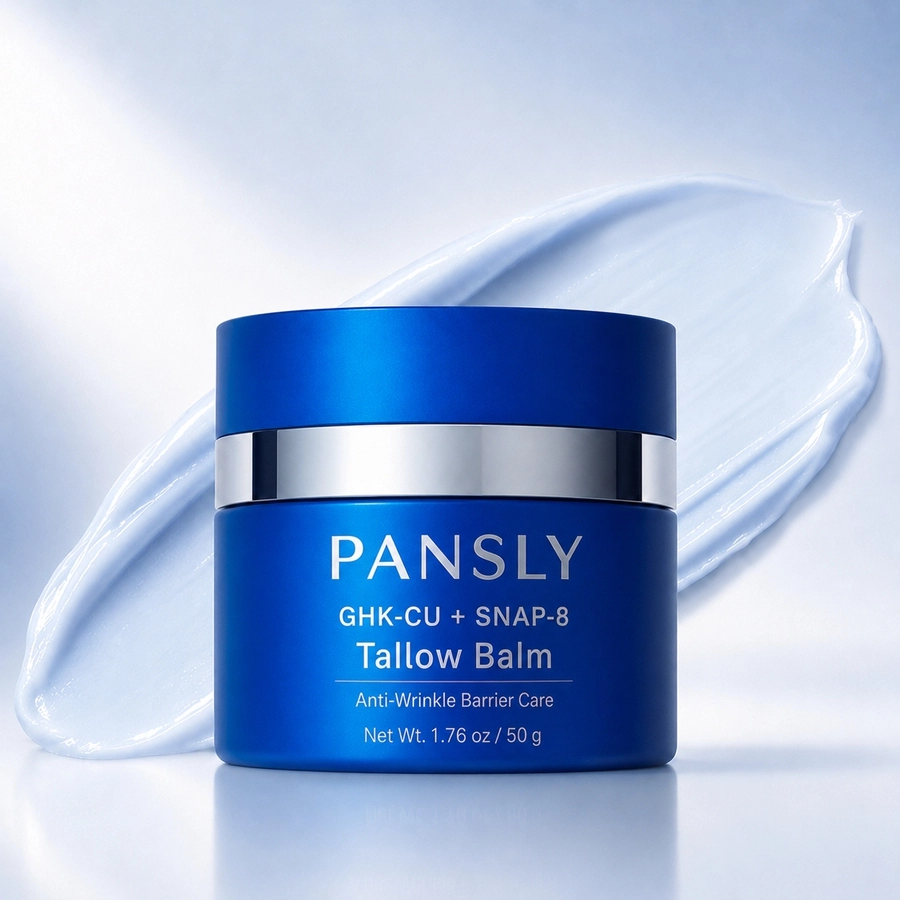
This Pansly GHK-CU + SNAP-8 Tallow Balm is a nourishing anti-wrinkle facial balm specially formulated for dry, fragile and sensitive skin, combining anti-aging wrinkle smoothing and barrier repairing effects. We offer full private label OEM service, including custom logo, adjustable formula, diversified packaging and lid color options.
It contains five core skin care active ingredients: GHK-CU visibly improves fine lines and revives dull complexion; SNAP-8 softens expression lines to smooth wrinkled skin texture; Grass-Fed Beef Tallow delivers deep lipid nourishment to relieve dry rough skin; Ectoin stabilizes the skin barrier and alleviates skin discomfort; Ceramide NP strengthens barrier structure to create smooth, healthy skin.
Luxury creamy blue balm texture glides smoothly and melts quickly on skin, providing long-lasting deep moisturizing comfort. Daily use fades fine lines & expression lines, nourishes dry delicate skin, repairs damaged barrier and leaves silky smooth skin finish.
Click here to customize the Beauty
we respond within a few hours
Monday–Friday, 9AM–6PM
3A01, Building A, Zhisheng Square, No. 4 Zhifu Road, Helong Street, Baiyun District, Guangzhou, China.


Leave a request, and we'll email you back within 24 hours.
© 2026 Beyond Basix. All Rights Reserved.