
10 Retinol Anti-Aging Serum OEM/ODM Manufacturers to Evaluate
- Quick Answer
- Key Takeaways
- How to Evaluate Retinol Anti-Aging Manufacturers
- 10 Retinol Anti-Aging Manufacturers and OEM/ODM Suppliers to Evaluate
- 1. Beyond Basix
- Questions to confirm with Beyond Basix
- 2. COSMAX
- 3. Kolmar Korea
- 4. Intercos Group
- 5. kdc/one
- 6. Fareva
- 7. Nox Bellcow Cosmetics
- 8. Cosmetic Solutions
- 9. Vitelle Labs
- 10. Dynamic Blending
- What Should You Compare Before Shortlisting a Retinol Manufacturer?
- Formulation Stability and Packaging Should Be Evaluated Together
- How Retinol Fits Into a Broader Anti-Aging Product Strategy
- Retinol Manufacturer vs. Consumer Skincare Brand
- Supplier Due Diligence: When Should a Candidate Be Removed From the Shortlist?
- Possible disqualification triggers
- Choose Supporting Actives by Product Strategy, Not Ingredient Trends
- Regulatory and Claims Review Should Be Market-Specific
- How to Build a Comparable Retinol OEM/ODM RFQ
- Retinol Manufacturer Shortlist Scorecard
- Final Supplier Selection
- Preparing a Retinol OEM/ODM Project?
- FAQ
- Is Beyond Basix a retinol anti-aging manufacturer?
- How should I compare retinol anti-aging manufacturers?
- Are all skincare OEM/ODM factories suitable for retinol products?
- What documents should I request from a retinol manufacturer?
- Should I choose a large ODM group or a more specialized manufacturer?
- What information should I send for a retinol OEM/ODM quotation?
- Common Questions About Retional OEM
Quick Answer
Choosing a retinol anti-aging manufacturer is less about finding the largest supplier and more about finding a manufacturing partner that can execute the exact product brief. Buyers should compare the proposed retinol or vitamin A system, formulation route, finished-product stability, packaging compatibility, testing plan, regulatory documentation, MOQ, production scale, and development timeline using the same RFQ criteria.
The 10 manufacturers below are presented as suppliers to evaluate for OEM, ODM, contract manufacturing, or private-label skincare projects. They are not ranked from best to worst. Final qualification should be based on project-specific technical evidence, commercial fit, and target-market requirements.
Key Takeaways
- Use one standardized RFQ so every retinol manufacturer is evaluated against the same requirements.
- Compare the proposed vitamin A system and finished formula, not only general skincare manufacturing capabilities.
- Evaluate formulation stability and packaging compatibility together because they are part of the same finished-product system.
- Clarify what testing, documentation, packaging work, samples, and development services are included in each quotation.
- Do not assume a consumer skincare brand is available for third-party OEM or ODM manufacturing.
- Use a consistent retinol supplier screening framework before approving samples, pilot production, or commercial orders.
How to Evaluate Retinol Anti-Aging Manufacturers
A useful manufacturer shortlist starts with a defined product brief. Instead of asking whether a factory can manufacture retinol skincare in general, define the intended product format, destination market, target positioning, packaging, order volume, customization level, and expected validation requirements.
The technical discussion should also establish the intended retinol formulation and skin-renewal active strategy. This gives product development and procurement teams a more useful basis for discussing vitamin A systems, formula constraints, packaging choices, stability expectations, and claims direction.
A manufacturer should move to the next stage only when its proposal clearly explains how the specific SKU will be developed, tested, packaged, documented, scaled, and produced.
10 Retinol Anti-Aging Manufacturers and OEM/ODM Suppliers to Evaluate
| Company | Why Evaluate | Potential Project Fit | RFQ Priorities |
|---|---|---|---|
| Beyond Basix | Skincare OEM/ODM manufacturer with verified general manufacturing infrastructure listed in the current site profile. | Private-label and customized skincare development. | Retinol system, formula route, testing, packaging, MOQ, timeline, and market documentation. |
| COSMAX | Included in the current article as a global cosmetics ODM/OBM manufacturing option. | Larger or multi-market skincare programs. | Vitamin A system, testing, packaging, minimums, and destination-market scope. |
| Kolmar Korea | Included in the current article as an integrated cosmetics ODM development and manufacturing option. | Projects requiring broader development support. | Formula development, testing, packaging, scale-up, and documentation. |
| Intercos Group | Included in the current article as an international cosmetics R&D and manufacturing group. | Innovation-led or premium skincare concepts. | Retinol experience, stability strategy, scale-up, testing, and project minimums. |
| kdc/one | Included in the current article as a beauty development and manufacturing option. | Turnkey formulation, packaging, and manufacturing projects. | Formula options, claims review, testing, regulatory scope, and production volume. |
| Fareva | Included in the current article as a beauty and personal-care contract manufacturing option. | Larger skincare programs or multi-format portfolios. | Validation plan, packaging compatibility, manufacturing scope, and commercial scale. |
| Nox Bellcow Cosmetics | Included in the current article as a Guangdong-based cosmetics ODM option. | China- or Asia-oriented skincare sourcing. | Formula availability, testing, MOQ, packaging, and export documentation. |
| Cosmetic Solutions | Included in the current article as a U.S.-based private-label and custom skincare manufacturing option. | U.S.-focused stock or customized skincare programs. | Stock versus custom route, stability, packaging, MOQ, and labeling support. |
| Vitelle Labs | Included in the current article as a professional skincare private-label and contract manufacturing option. | Professional, spa, esthetic, or specialist skincare. | Vitamin A systems, customization, minimums, packaging, testing, and shelf-life validation. |
| Dynamic Blending | Included in the current article as a turnkey formulation and contract manufacturing option. | Custom development for emerging or growing skincare brands. | Retinol sourcing, formulation, stability, packaging, pilot process, and minimums. |
1. Beyond Basix
Beyond Basix can be evaluated as a skincare OEM/ODM manufacturing partner for private-label and customized retinol anti-aging projects. The current site profile lists more than 23 years of cosmetics-industry experience, a 12,000-square-meter facility, a 100,000-level GMPC dust-free workshop, and 12 production lines. Skincare is also listed among the site's core manufacturing categories.
These general manufacturing facts should still be separated from project-specific retinol capability. Before commercial development, buyers should confirm the proposed retinol or vitamin A system, formulation route, testing plan, packaging compatibility, destination-market requirements, MOQ, and development timeline for the exact SKU.
Brands preparing a product brief can first review Beyond Basix's retinol anti-aging OEM/ODM solutions to understand how the product concept fits within its skincare development offering.
Questions to confirm with Beyond Basix
- What retinol or vitamin A system is proposed for the project?
- Is the development route stock, semi-custom, or fully customized?
- How will finished-product stability and packaging compatibility be evaluated?
- Which microbiological, physical, chemical, and other relevant tests are included?
- What are the sample, pilot, MOQ, scale-up, and production assumptions?
- Which documents and regulatory-review responsibilities apply to the intended market?
2. COSMAX
The current article identifies COSMAX as a global cosmetics ODM/OBM option with formulation and manufacturing capabilities. It may be relevant when a skincare project requires larger-scale development or coordination across multiple markets.
For a retinol project, buyers should request a project-specific proposal covering the vitamin A system, formulation approach, stability and packaging plan, testing scope, manufacturing minimums, and destination-market documentation rather than relying only on general corporate capabilities.
3. Kolmar Korea
The current article identifies Kolmar Korea as an integrated cosmetics ODM option covering product development and manufacturing. That type of operating model may be relevant to brands seeking manufacturer involvement earlier in the development process.
Retinol supplier evaluation should still focus on the exact active system, formulation process, stability protocol, packaging evaluation, testing responsibilities, scale-up requirements, commercial terms, and documents provided with the finished SKU.
4. Intercos Group
The current article identifies Intercos Group as an international cosmetics R&D and manufacturing option with skincare capabilities. It may therefore be relevant to innovation-focused or premium product-development briefs.
Premium positioning should not replace technical qualification. Ask how the supplier will translate the brief into a defined vitamin A system, stable finished formula, compatible packaging format, validation plan, scale-up process, and commercial manufacturing route.
5. kdc/one
The current article identifies kdc/one as a beauty development and manufacturing option covering formulation, manufacturing, packaging, and related support. This can be relevant when a brand wants several stages of development coordinated through one manufacturing relationship.
For retinol anti-aging development, compare the formula route, vitamin A system, testing scope, packaging solution, claims-review responsibilities, regulatory scope, production volume, and which services are included or excluded from the quotation.
6. Fareva
The current article identifies Fareva as a contract manufacturing option across beauty and personal-care categories, including skincare. It may be relevant to buyers evaluating larger programs or portfolios involving multiple skincare formats.
Before including a supplier in the final shortlist, confirm the proposed retinol system, manufacturing location for the project, stability and compatibility plan, packaging requirements, commercial production scale, testing responsibilities, and documentation package.
7. Nox Bellcow Cosmetics
The current article identifies Nox Bellcow as a Guangdong-based cosmetics ODM option with skincare manufacturing and development capabilities. Buyers evaluating China- or Asia-oriented sourcing routes may include the company in an initial comparison.
To make quotations comparable, use the same specification sheet across suppliers and ask for project-specific information on formulation, testing, packaging, MOQ, batch requirements, development stages, and target-market documentation.
8. Cosmetic Solutions
The current article identifies Cosmetic Solutions as a U.S.-based private-label, custom-formulation, and contract skincare manufacturing option. It may be relevant to brands evaluating a U.S.-based production route or comparing stock formulations with custom product development.
Stock and custom programs should be evaluated separately. The vitamin A system, formula ownership, differentiation, development timing, testing requirements, packaging, MOQ, and documentation scope may differ materially between the two routes.
9. Vitelle Labs
The current article identifies Vitelle Labs as a professional skincare private-label and contract manufacturing option. This may make it relevant to brands serving spa, esthetic, specialist, or professional skincare channels.
Retinol qualification should confirm the available vitamin A systems, degree of customization, minimum-order requirements, testing scope, packaging selection process, and how the supplier proposes to support the finished-product shelf-life plan.
10. Dynamic Blending
The current article identifies Dynamic Blending as a turnkey formulation and contract manufacturing option for skincare and personal-care products. A custom-development model may be relevant to emerging brands or projects requiring greater formulation flexibility.
The RFQ should define the target product format, formulation direction, destination market, packaging preference, expected production quantities, validation needs, and desired level of customization so the proposal can be compared with other suppliers on the same basis.
What Should You Compare Before Shortlisting a Retinol Manufacturer?
A supplier list only becomes useful when every candidate is evaluated against the same technical and commercial requirements.
| Evaluation Area | What to Ask | Why It Matters |
|---|---|---|
| Retinol system | Which vitamin A ingredient and formulation approach are proposed? | The active system can influence stability, formulation, packaging, claims, and market review. |
| Development route | Is the SKU stock, semi-custom, or fully customized? | Development time, differentiation, testing, ownership, and minimums may differ. |
| Finished-product stability | What studies are planned for the final formula and package? | Raw-material information alone does not establish finished-product shelf life. |
| Packaging compatibility | How will the package be evaluated with the formulation? | Light, air exposure, dispensing, closure performance, and material interaction can matter. |
| Testing | Which microbiological, physical, chemical, compatibility, or other tests are included? | Testing should match the exact SKU, packaging, claims direction, and destination market. |
| Commercial scope | What is included in formulation, samples, testing, packaging, documentation, and production pricing? | Different quotation scopes can make unit-price comparisons misleading. |
| Market readiness | What documentation and review steps apply to the destination market? | Requirements can vary by formula, claims, market, and launch timing. |
Formulation Stability and Packaging Should Be Evaluated Together
Retinol product development is not simply an ingredient-selection exercise. The active system, base formula, supporting ingredients, process conditions, packaging, filling process, storage assumptions, and testing strategy operate as one finished-product system.
A manufacturer should therefore explain how the final formula will be validated in the intended or representative package rather than relying only on raw-material specifications. Brands developing wrinkle- or fine-line-focused products can also use a fine-line retinol product-development framework to connect formulation, packaging, positioning, and use-case decisions.
Before commercial production, buyers should understand what will be tested, what the acceptance criteria are, who is responsible for each step, and when the final packaging specification becomes fixed.
How Retinol Fits Into a Broader Anti-Aging Product Strategy
Retinol does not need to be evaluated in isolation. During development, a brand may need to balance renewal positioning with skin feel, barrier-support concepts, peptide storytelling, product differentiation, or a broader anti-aging portfolio strategy.
For example, a product team can compare a retinol and peptide anti-aging formulation with a simpler single-active positioning route. The objective is not to assume that more actives are automatically better, but to determine whether the combination supports the intended formula, sensory experience, claims direction, testing plan, and product architecture.
At launch-planning level, brands may also need to compare retinol cream versus peptide serum positioning. The selected route can affect formulation, packaging, supplier capabilities, merchandising, and launch strategy.
For a multi-SKU anti-aging range, evaluating retinol versus copper peptide positioning can also help reduce overlap between products intended to play different roles within the same portfolio.
Retinol Manufacturer vs. Consumer Skincare Brand
A consumer brand with a successful retinol product is not automatically an OEM, ODM, private-label, or contract manufacturing supplier.
For B2B sourcing, the relevant supplier pool consists of companies that offer a manufacturing or development model suitable for third-party projects. Depending on the brief, that may include OEM manufacturing, ODM development, custom formulation, contract manufacturing, or private-label production.
Keeping this distinction clear prevents procurement teams from spending time evaluating retail brands that do not provide the required B2B manufacturing service.
Supplier Due Diligence: When Should a Candidate Be Removed From the Shortlist?
Predefined disqualification criteria make supplier selection more consistent. A low quoted price should not compensate for unresolved gaps in formulation, testing, packaging, documentation, or communication.
A broader OEM anti-wrinkle manufacturer evaluation process can also be used to structure supplier discussions around technical capability, quality expectations, documentation, scale-up, and commercial responsibilities.
Possible disqualification triggers
- The supplier cannot clearly define the proposed retinol or vitamin A system.
- Important testing or packaging work is excluded from the quotation without being clearly identified.
- There is no clear finished-formula and packaging compatibility plan.
- MOQ, pilot quantity, development stages, or lead-time assumptions repeatedly change without explanation.
- Responsibilities for target-market documentation remain unclear.
- The supplier cannot connect formulation, claims, packaging, validation, and manufacturing into one coherent development plan.
Choose Supporting Actives by Product Strategy, Not Ingredient Trends
A manufacturer may recommend peptides, humectants, antioxidants, soothing ingredients, barrier-support ingredients, or other supporting components around a retinol concept. Each ingredient should have a clear role in the formulation and product positioning.
Brands comparing different concepts can use an active-ingredient strategy for OEM anti-wrinkle serums as a framework for supplier discussions rather than requesting popular ingredients without defining their intended formulation role.
The supplier should be able to explain how each addition affects product function, sensory profile, stability, compatibility, claims direction, testing, and commercial scope.
Regulatory and Claims Review Should Be Market-Specific
Retinol and vitamin A requirements can vary according to the destination market, product category, formulation, claims, and launch timing. Buyers should therefore define the intended market early in the RFQ process.
Avoid relying on broad statements such as “globally compliant.” Instead, document the target market, proposed vitamin A ingredient, intended product format, claims direction, labeling responsibilities, required documentation, and the party responsible for final regulatory review.
The same principle applies to anti-aging claims. Manufacturing capability alone does not establish whether every proposed claim is appropriate. Formula, evidence, packaging copy, and market requirements should be reviewed together before launch.
How to Build a Comparable Retinol OEM/ODM RFQ
Send the same core development brief to every shortlisted manufacturer so technical and commercial differences can be compared on the same basis.
- Target market: Specify the countries or regions where the finished product is intended to be sold.
- Product format: Define serum, cream, moisturizer, eye product, lotion, or another format.
- Retinol direction: Explain the desired vitamin A or formulation concept without assuming unverified supplier capabilities.
- Target customer: Define the intended user, use case, sensory direction, and positioning.
- Customization level: State whether stock, semi-custom, or fully customized development is acceptable.
- Packaging: Provide the preferred pack type, size, dispensing format, material, and decoration needs if known.
- Order volume: Provide expected sample, pilot, launch, and repeat-order quantities.
- Testing: Define expected stability, microbiological, compatibility, performance, or market-specific testing.
- Documentation: Specify the raw-material, finished-product, quality, packaging, and market documents required.
- Claims direction: Explain the intended cosmetic positioning so the proposed formula and claims can be evaluated together.
- Commercial scope: Ask each supplier to identify what is included and excluded from development, testing, packaging, artwork, documentation, and production pricing.
Retinol Manufacturer Shortlist Scorecard
| Scorecard Area | Evidence to Request | Decision Question |
|---|---|---|
| Formulation fit | Formula proposal, ingredient strategy, development route. | Does the manufacturer understand the exact product brief? |
| Validation fit | Stability, compatibility, microbiological, and other agreed testing plans. | Can the supplier explain how the finished SKU will be validated? |
| Packaging fit | Packaging recommendation and compatibility plan. | Is packaging being treated as part of the finished formulation system? |
| Quality fit | Project-specific quality documentation and testing responsibilities. | Are quality requirements clear before production? |
| Commercial fit | MOQ, pilot quantities, quotation scope, payment terms, and timeline assumptions. | Does the manufacturer's commercial model fit the launch plan? |
| Market fit | Destination-market documentation and responsibility matrix. | Can the project proceed without unresolved market-readiness gaps? |
| Communication fit | Written RFQ responses, approvals, and change-control process. | Are assumptions and responsibilities documented consistently? |
Final Supplier Selection
There is no universal best retinol anti-aging manufacturer for every skincare brand. The appropriate manufacturing partner depends on the required formulation route, destination market, production scale, testing plan, packaging format, commercial scope, launch timing, and level of development support.
Large global ODM groups may suit some high-volume or multi-market programs, while specialist or regional manufacturers may offer a different balance of customization, communication, production scale, and commercial flexibility. The relevant question is which supplier best matches the defined project requirements.
Beyond Basix can be evaluated using the same scorecard. Its current site profile provides verified general manufacturing information, while retinol-specific formula details, testing, packaging, MOQ, timelines, and destination-market requirements should still be confirmed for the individual SKU.
Preparing a Retinol OEM/ODM Project?
If you are developing a private-label or customized retinol serum, cream, moisturizer, eye product, or related anti-aging skincare SKU, prepare the target market, product format, formulation direction, packaging preference, estimated order volume, testing requirements, and documentation needs before requesting a manufacturing proposal.
Share your product requirements for an OEM/ODM project review
FAQ
Is Beyond Basix a retinol anti-aging manufacturer?
Beyond Basix is confirmed by the current site profile as a skincare OEM/ODM manufacturer. For an individual retinol project, buyers should confirm the proposed vitamin A system, formula route, testing, packaging, MOQ, timeline, and destination-market documentation before commercial production.
How should I compare retinol anti-aging manufacturers?
Send the same RFQ to each shortlisted supplier and compare formulation approach, retinol system, finished-product stability, packaging compatibility, testing, production scale, MOQ, timeline, documentation, and responsibility boundaries on the same scope.
Are all skincare OEM/ODM factories suitable for retinol products?
No. General skincare manufacturing capability does not establish that a supplier offers the retinol system, formulation route, testing plan, packaging solution, or target-market documentation required for a specific SKU. Project-specific capability should be confirmed during qualification.
What documents should I request from a retinol manufacturer?
The required document package depends on the formula, product type, claims, packaging, and destination market. Buyers should agree on project-specific raw-material, finished-product, quality, testing, packaging, and market documentation before commercial production.
Should I choose a large ODM group or a more specialized manufacturer?
It depends on the project. Larger ODM groups may suit some high-volume or multi-market programs, while other manufacturers may offer different levels of customization, communication, production flexibility, or commercial fit. Compare every candidate against the same product brief and acceptance criteria.
What information should I send for a retinol OEM/ODM quotation?
Provide the target market, product format, formulation direction, intended positioning, customization level, packaging preference, estimated sample and commercial quantities, testing expectations, documentation requirements, and desired launch timing.
Common Questions About Retional OEM
Is Beyond Basix a retinol anti-aging manufacturer?
Beyond Basix is confirmed by the current site profile as a skincare OEM/ODM manufacturer. For a specific retinol project, buyers should confirm the proposed vitamin A system, formula route, testing, packaging, MOQ, timeline, and target-market documentation before commercial production.
How should I compare retinol anti-aging manufacturers?
Send the same RFQ to every shortlisted supplier and compare formulation approach, retinol system, finished-product stability, packaging compatibility, quality testing, production scale, MOQ, timeline, documentation, and regulatory responsibilities on the same scope.
Are all skincare OEM/ODM factories suitable for retinol products?
No. General skincare manufacturing capability does not establish that a factory offers the exact retinol system, formulation route, testing plan, packaging solution, or market documentation required for a specific project. Retinol-specific capability should be confirmed during supplier qualification.
What documents should I request from a retinol manufacturer?
The exact document list depends on the formula, product type, claims, and destination market. Buyers commonly request project-specific raw-material, finished-product, quality, testing, packaging, and market documentation, with responsibilities agreed before commercial production.
Should I choose a large ODM group or a more specialized manufacturer?
It depends on the project. Larger ODM groups may fit high-volume or multi-market programs, while other manufacturers may offer different levels of customization, communication, production scale, or commercial flexibility. Compare each candidate against the same product brief and acceptance criteria.
What information should I send for a retinol OEM/ODM quotation?
Provide the target market, product format, formulation direction, intended positioning, customization level, packaging preference, estimated sample and production quantities, required testing, documentation needs, and desired launch timing so suppliers can quote against comparable requirements.

Elevate your professional skincare offerings with this Private Label Copper Peptide Anti-Wrinkle Firming Serum, a powerhouse concentrate designed for superior age-defying results. This sophisticated formula leverages the synergistic effects of GHK-Cu and SNAP-8 to address multiple layers of skin aging. The GHK-Cu copper peptides act as a vital signaling mechanism to enhance skin density and firmness, while the advanced SNAP-8 octapeptide specifically targets expression lines, helping to relax the appearance of deep-seated wrinkles for a smoother, more refined surface.
This lightweight, rapid-absorption serum provides a professional-grade solution for clients seeking a non-invasive lift. It effectively restores elasticity, improves skin texture, and provides essential antioxidant protection. Perfect for high-end beauty brands, this serum leaves the complexion looking visibly contoured, hydrated, and youthfully revitalized.
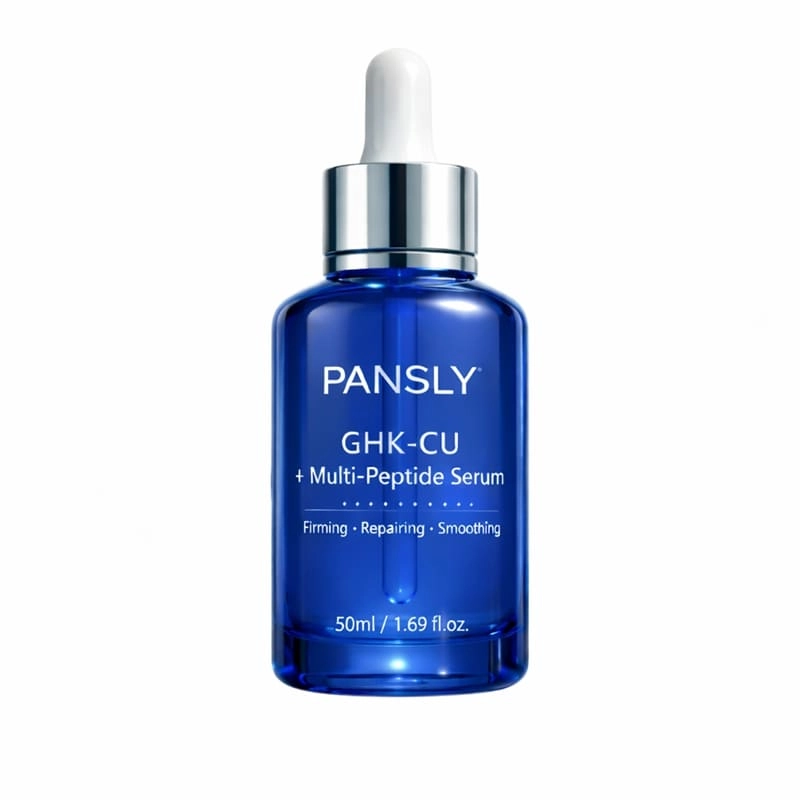
Experience visible rejuvenation with this GHK-Cu Copper Peptide Smoothing & Firming Face Serum, a high-performance concentrate designed to restore the structural integrity of aging skin. This advanced formula centers on GHK-Cu, a powerful signaling peptide clinically recognized for its ability to support natural collagen and elastin production. By promoting dermal density, it effectively tightens sagging skin and smooths the appearance of deep-set wrinkles and fine lines.
The lightweight, silky texture absorbs instantly, delivering antioxidant protection to neutralize environmental stressors that accelerate aging. Enhanced with deep-moisturizing agents, the serum reinforces the skin's moisture barrier, leaving the complexion feeling remarkably soft and resilient. With consistent use, skin texture is refined and facial contours appear more lifted, resulting in a youthfully firm and revitalized glow.
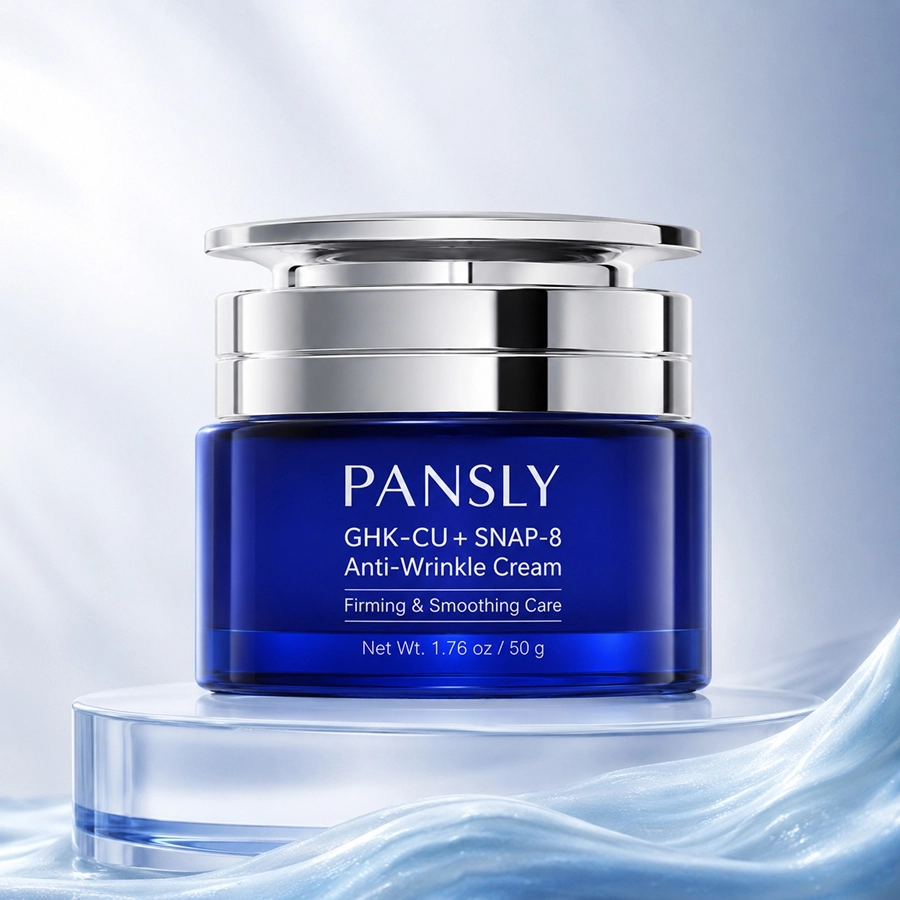
This Pansly GHK-CU + SNAP-8 Anti-Wrinkle Firming Cream is triple-peptide anti-aging facial cream, delivers targeted wrinkle smoothing, firming lifting and deep nourishment for dull, saggy, fine-line prone skin. Full OEM & ODM private label service is supported, including custom formula, packaging options, fast sampling and bulk export supply.
Five core premium active ingredients work synergistically for comprehensive anti-wrinkle care:
GHK-CU Copper Peptide lifts saggy skin, enhances skin resilience and tightens loose facial contour;
SNAP-8 Peptide targets expression lines to visibly soften and fade wrinkles;
Acetyl Hexapeptide-8 reduces the appearance of dry fine lines for smoother skin texture;
Ceramide NP reconstructs skin moisture barrier to lock nourishment and boost comfort;
Hyaluronic Acid delivers multi-layer rich deep moisture to relieve dry rough skin.
Luxury rich creamy texture spreads smoothly and melts into skin gently, leaving soft comfortable finish without heavy greasiness. Daily use blurs fine lines, firms loose skin, deeply nourishes and stabilizes barrier, refining uneven texture to reveal smooth, plump, youthful luminous skin.
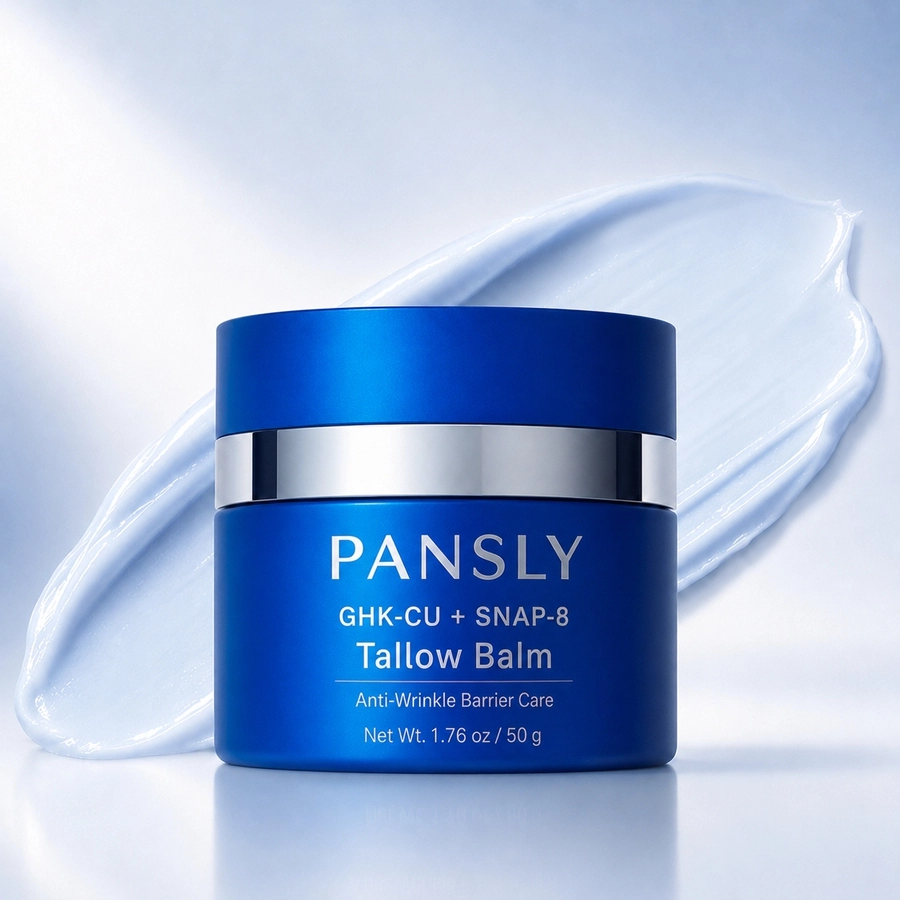
This Pansly GHK-CU + SNAP-8 Tallow Balm is a nourishing anti-wrinkle facial balm specially formulated for dry, fragile and sensitive skin, combining anti-aging wrinkle smoothing and barrier repairing effects. We offer full private label OEM service, including custom logo, adjustable formula, diversified packaging and lid color options.
It contains five core skin care active ingredients: GHK-CU visibly improves fine lines and revives dull complexion; SNAP-8 softens expression lines to smooth wrinkled skin texture; Grass-Fed Beef Tallow delivers deep lipid nourishment to relieve dry rough skin; Ectoin stabilizes the skin barrier and alleviates skin discomfort; Ceramide NP strengthens barrier structure to create smooth, healthy skin.
Luxury creamy blue balm texture glides smoothly and melts quickly on skin, providing long-lasting deep moisturizing comfort. Daily use fades fine lines & expression lines, nourishes dry delicate skin, repairs damaged barrier and leaves silky smooth skin finish.
Click here to customize the Beauty
we respond within a few hours
Monday–Friday, 9AM–6PM
3A01, Building A, Zhisheng Square, No. 4 Zhifu Road, Helong Street, Baiyun District, Guangzhou, China.


Leave a request, and we'll email you back within 24 hours.
© 2026 Beyond Basix. All Rights Reserved.
